

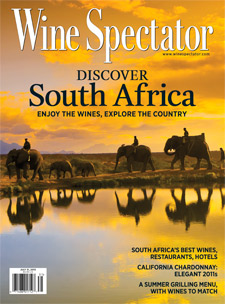

Two new publications ask us to remember what’s old about South African wine even as we embrace the new. I’m talking about James Molesworth’s cover feature in the current issue of Wine Spectator and Tim James’s just-published book Wines of the New South Africa: Tradition and Revolution (University of California Press, 2013).
Wine Spectator Showcase
The Wine Spectator report gives South Africa the full glossy wine magazine treatment (over 30 pages of text and photos), starting with James Molesworth’s “At a Crossroads” essay then continuing with a tasting report including ratings for more than 500 wines, a short list of wine recommendations, selected producer profiles, and brief travel recommendations for Cape Town, Stellenbosch, and Franschhoek, Paarl and Swartland.
Molesworth does a great job capturing a sense of South Africa’s dynamism — this s a country that is moving quickly into the future. It was interesting to compare his ratings with my own experience when I was in Cape Town last year. I am not an expert taster and I always defer to those who are, but I was pleased to see some similarities in our reactions, particularly regarding the many fine Syrah and Rhone blend wines as well as the Bordeaux-style reds. And we seem to agree that many of the white wines are both extremely delicious and present extremely good value.
If there is one place where we differ just a bit it is Pinotage. I went to South Africa a Pinotage skeptic based on my early experiences with the grape variety back in the 1990s, but I have become a convert. Molesworth correctly notes that many of South Africa’s early post-Apartheid exports were not up to snuff and that’s when U.S. consumers like me got their first tastes of South African wine and their first (and sometimes last) experience of Pinotage.
Pinotage has certainly changed along with the wines more generally as the industry has caught up with international standards and I found many favorites among wines made from old bush Pinotage vines and with careful use of oak, so I might put Pinotage a bit higher on the scale than Molesworth, but I wouldn’t want to press too hard to make it a “signature varietal.” South African wine is diverse and can’t be captured in any single wine, region or style.
I guess Molesworth just didn’t find the quality he was seeking in Pinotage. Or maybe the South Africa story is easier to tell Americans (at least for now) with Pinotage in the background. Either way, this useful survey of the territory is recommended Wine 101 reading for anyone who wants to discover (or re-discover) South Africa’s wines.
Wines of the New South Africa


But of course Wine Spectator only scratches the surface — it is impossible to do more than that in a few dozen pages. So if Molesworth’s fine feature makes you want to learn more, head straight for Tim James’s new book, Wines of the New South Africa: Tradition and Revolution.
James digs down a good deal deeper into South Africa’s wine story in his 300+ pages of text and simple maps. The heart of the book is a collection of chapters on ten key wine producing areas with both general regional information and detailed profiles of the major wine producers. The profiles are very much up-to-date and capture effectively the dynamic nature of South African wine today.
The regional discussions are preceded by exceptionally informative overview chapters on history, grape varieties and wine styles and South Africa’s Wines of Origin system. The chapter on grape varieties and styles surprised me — I didn’t think an analysis of the grapes and so forth would be so interesting and teach me so much about South Africa and its wine industry.
This is a fine book — well-written, detailed and interesting — that deserves your attention. What could make it better? Perhaps James (or another author) will publish a colorful wine atlas of South Africa to supplement this volume. South Africa’s terroir is so complex and interesting — it would be great to see it explored (and illustrated) in equal depth.
Follow the Wine to South Africa
South Africa is one of the world’s top ten wine producing countries, so it more than fills the 300 pages available here. Want do learn even more? I guess the next step is to take a trip, which is what Sue and I are doing early next year.
I was hoping that the Wine Spectator’s travel section would be useful in making plans, but perhaps I was expecting to much. The collection of brief restaurant and hotel profiles whets the appetite, that’s for sure, but the luxury lodging choices are pretty much outside my budget range.
Wine Spectator publisher Marvin Shanken says that Johann Rupert nagged him for years to visit South Africa and now that he finally has done it he urges us all to follow his lead. Molesworth and James give us a road map. Start packing you bags. And don’t forget your corkscrew.
>>><<<
About that Wine Spectator cover photo. Elephants? Really? With all the beautiful Cape winelands vineyard and winery scenery, I wonder why they fell back on a cliché like African elephants? Oh well, if elephants are good enough for Wine Spectator …
