Wine & Value: Push, Pull, Squeeze

A cynic, according to Oscar Wilde, knows the price of everything and the value of nothing. For some reason, this characterization is often associated with “dismal science” economists like me. Today’s Wine Economist column hopes to make an exception to Wilde’s rule by focusing on wine’s value problem and how understanding it can help explain recent market trends.

Price versus Value

Inflation is on everyone’s mind these days (both as an election issue and in more general terms), so it is not surprising that there is concern about the high cost of wine. But when I look at other consumer categories (as I did on The Wine Economist several weeks ago), I find that price isn’t as important to consumers today as value.

Consumers seem to recognize that sometimes when you pay less you get less. They are willing to pay more when they believe they get better value. A focus on value and not just price is not new, of course. Although it is easy to imagine that the Two Buck Chuck boom of a few years ago was driven by low price, it was true that there were even cheaper options. Many of the wine drinkers who embraced TBC cited value as the appeal. TBC is a two dollar wine, they’d say, that tastes like a five dollar wine.

Push versus Pull

Many wine consumers have shifted up a shelf or two on the wine wall in recent years in a process called Premiumization. Why have they done this? Did they wake up one morning and think that they just weren’t spending enough on wine? Probably not. Maybe they were pulled up by the higher quality of more expensive wines. I am sure that is the case for many.

But it is also possible that they were pushed up by falling quality and poorer value of the wines they had been drinking before. Did the value proposition of those mainstream wines deteriorate?

The Big Squeeze

Both wine producers and winegrape growers have been squeezed in recent years as costs have risen faster than price. One way that winegrowers have reacted is by increasing vineyard yields. This can be often be done without affecting grape quality, but only up to a point, as I understand it. When growers are squeezed so hard, quality can suffer and this can affect the perceived value of the resulting wine.

I know some growers who believe the value problem comes from a different source. They see wineries, caught in a cost squeeze themselves, substituting cheaper imported bulk wine (there is a lot of it on the market these days) for higher-cost domestic wine. California growers might argue that this dilutes quality.

Whatever the reason, the demand for wines below $10 (and now above $10, too) has been falling for many years. There are certainly many reasons for this phenomenon, but I think the value hypothesis is part of the problem. Value-seeking consumers have reacted to changing circumstances by shifting their wine-buying behavior, pushed by lower value here, pulled by high perceived value there, and squeezed by general economic conditions.

Some Implications

If budget-constrained consumers find themselves forced to move to higher price points in order to find the value that you used to get at lower cost, then it is not surprising that they have reduced the volume of wine they purchase.

If consumers believe that white wines give them the value they seek at lower cost than red wines, this might explain some of the red-to-white wine shift that we are seeing.

If correct, my speculations about value explain some but surely not all of the changes we have seen in the wine industry and raise an interesting question. Are the wine industry’s reactions to the current crisis addressing the cause of the problem or only the symptoms?

Global Market Trends: Is White Wine the New Red?

The global wine market is in flux these days and much of the attention is focused on falling consumption in the post-pandemic era. Global wine consumption actually peaked a few years ago, as the graph above shows, but the trend was disguised for a while by Covid pantry-stocking and other factors.

The falling sales volume is a stark fact that concentrates the mind, but it isn’t the only wine market change to consider. The strong trend of premiumization seems to have lost momentum, too, which may be related to a growing affordability crisis affecting many products including wine. (It is noteworthy that both Burberry’s luxury stores and Dollar Tree budget stores are experiencing sales declines associated with strained consumer budgets.) Do consumers think wine is good value for money?

Bottle of White? Bottle of Red?

Another trend that bears watching is the shift (in both production and consumption) from red to white wine (increased rosé sales are also part of this pattern). The change is so dramatic that last year the  OIV produced a special report on the topic. The OIV data for wine production shows a dramatic shift from red to white (see below). Like the decline in global wine consumption, this trend started a few years ago but has picked up steam (and attracted attention) recently.

The figure below provides a demand-side picture of the situation. Global white wine sales (by volume) held up better in the current climate than did red wine sales, so white’s share of the pie has grown. Changing production is a response to shifts in demand. Good news for white wine producers like New Zealand. Not-so-good for red wine producers like Argentina and Spain.

The changing color of wine shows up in both the data and on the store shelves. We have encountered more examples of white wines made from red grapes, for example, as producers look to align production with demand within the constraints of existing vineyard varieties. White Malbec from Argentina? It was the surprise hit of one of our tastings. White Pinot Noir from Oregon? Yes, that’s a thing now, too, and it can be very nice.

The China Syndrome

Part of the global decline in red wine production and consumption is no doubt due to the collapse of the Chinese wine market in the last ten years (wine production and sales in China are disproportionately red) as shown in the graph below.

French Paradox?

The pattern of changing red-white consumption differs considerably among the largest consuming countries. In France, for example, the volume of red wine sales has trended down for many years, with white and pink wines holding their own.

Do you remember the “French Paradox”? That was the title of the 60 Minutes program segment about how the French stay healthy in part by drinking red wine. It helped power a red wine boom in the U.S. Well, it looks like we have another paradox on our hands now as French red wine consumption slip slides away at the same time, we are told, that consumer interest in health has increased.

American Exceptionalism?

In the United States, on the other hand, red wine sales by volume have been stagnant (premiumization has pushed value up, however). White wine sales (and pink too, to a lesser extent) have risen modestly as measured by volume (see below) The red shift in U.S. wine consumption is less pronounced than in China or France … so far.

(Note that the OIV data shown here end in 2021, before U.S. wine consumption began to sharply decline.)

The NIQ sales data for the U.S. (found in the most recent issue of Wine Business Monthly) suggest that this red-to-white trend may be accelerating.  Total sales value for the most recent 52 weeks, for example, was $9,172 million for red wine and $7,857 for white wine (red still leads by dollar value). But this pattern changes when you look at the most recent four survey weeks, where white wine’s $619 million outpaces red wine’s $583 million. Seasonal factors surely account for some of white wine’s lead, of course, but it still comes as a surprise.

The shift is more dramatic when measured by volume of sales. For the most recent 52 weeks the numbers are 72.9 million cases of red wine versus 79.9 million cases of white wine. White’s lead lengthens for the most recent four weeks. Measured white wine sales were 6.2 million cases compared with 4.7 million cases of red wine.

The patterns of red-to-white sales shift differ by country, but the fact of the global trend seems pretty clear. What’s behind this surprising change in consumption patterns? Every time I come up with a simple answer to this question I quickly find a reason to dismiss it, so I won’t bore you with my theories. I note that the OIV report is long on factors but shorter on analysis, too.

The Curse of Corporate Wine-Think Déjà Vu?

The global wine industry continues to adjust to the “new normal” market environment, with recent news stories focusing on strategies to support demand (Come Over October), grubbing-up programs to reduce grape supply, and restructuring wine winemaking businesses (Vintage Wine Estates bankruptcy, Duckhorn Vineyards acquisition, etc.) after a surge of consolidation fueled by cheap money came to a sudden end.

The restructuring has sometimes returned wineries to the people and families that founded them. In other cases (here I am thinking specifically about Stags Leap Wine Cellars and Col Solare in Washington State) a family-winery partner (the Antinori family) has acquired control from its unintended private-equity co-owner. I hesitate to generalize, but the situation suggests that the advantages of family ownership and control in the wine business are becoming clear again.

I wrote a series of columns about family versus corporate wine regimes back in 2015 and I thought it might be useful to re-publish excerpts from two of them now because the issues they addressed seem relevant again today. Hope you find them interesting.

The Curious Dominance of Family-Owned Wine Businesses in the U.S.

May 5, 2015

Last week’s column about the rise and fall of the Taylor Wine Company of New York raises a number of interesting issues and one of them is the singular importance of family-owned and privately-held businesses in the U.S. wine industry and the very mixed record of publicly-listed wine corporations. In retrospect, a case can be made that Taylor’s downfall began when they made the initial move from family ownership to public corporation.big10
The conventional wisdom holds that family-owned and privately held firms can be very successful, but their scale and scope are necessarily limited. Corporations, it is said, can have better access to capital and may be able to negotiate risk more successfully because of limited liability structure. You might expect the largest firms in any given industry to be corporations and this is true in some industries, but not in others.

Wine Exceptionalism

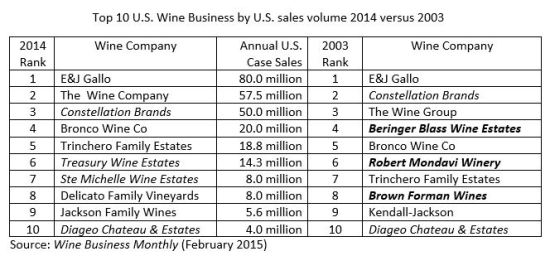
Wine is one exception to the dominant corporation rule. Here (above) is a table of the ten largest wine businesses in the U.S. market (measured by estimated or reported volume not value of sales) for 2014 and 2003. The data are from Wine Business Monthly, which publishes an analysis of the 30 biggest U.S. wine firms each February.  I’m looking at just the top ten to keep the analysis simple, although I should note that these ten firms collectively account for about three-quarters of all wine sold in the U.S.

Looking at the 2014 data, you will note that only four of the top ten firms (those in italics) are public corporations or subsidiaries of public corporations. The other six are family-owned or, like The Wine Group, privately-held and together they produce more than half of all the wine sold in America. [editors note: There was a typo in te graph, which should list The Wine Group not The Wine Company.] The bias towards private- and family-ownership is even stronger if we look at the next 20 wineries where only a few corporate names like Pernod Ricard make the list.

Looking closely at the 2014 numbers it is hard not to be impressed by the growth of family firms Delicato and Jackson Family Estates and also the success of Ste Michelle Wine Estates, which seems to behave like a privately-held firm even though it is a subsidiary of a public one, albeit in a different line of business (Altria specializes in tobacco products, not drinks).

All in the Family

Family- and private-owned wine companies are if anything more important today than they were before the Great Recession. Why are family-owned wineries so vibrant despite their structural economic limitations?

The conventional answer to this question — and there is in fact a substantial academic literature dealing with family businesses and even family wine businesses — stresses the ways that family businesses take a multi-generational approach and are able to negotiate the trade-off between short run returns and long run value. Corporations, it is said, are sometimes driven too much by quarterly returns and end up sacrificing the long term to achieve immediate financial goals.

When business requires a long run vision, it is said, families gain an advantage. Wine is certainly a business where it is necessary to look into the future if only because vines are perennials not annuals like corn or soybeans and successful brands are perennials, too.

Another school of thought examines issues of trust and transactions costs within the firm and the ways that family ties can reduce internal barriers and make interactions more effective.  It is commonplace to say that wine is a relationship business and family firms may have advantages in this regard. I have knows some family wine businesses that even go out of their way to work with family-owned distributors and so forth.  I think one author saw family-to-family links (the Casella family and the Deutsch family) as keys to the success of Yellow Tail brand wine.

Maybe the Real Question Is …

There are good explanations for the success of family-owned wine businesses, but sometimes they feel a bit ad hoc, tailored to explain a particular case and less capable of generalization.  And they often fail to fully account for the fact that many family businesses (and family-owned wine businesses) either fail or, like the Taylor family, end going over to the dark corporate side. Family relationships can be good, bad or ugly — you cannot think of the Mondavi family story without channeling an episode of Family Feud) and not every new generation wants to stay in the business. So there must be something more here than simple families think long-term. But maybe we are actually asking the wrong question.

Maybe the question isn’t why family-owned wine businesses are so strong and instead why corporate owned wine businesses are sometimes so ineffective. Is there something about wine that turns smart corporate brains to mush (not all of them, of course, but maybe some of them)? Come back next week for some thoughts on this provocative question.

The Curse of Corporate Wine-Think?

 May 12, 2015

Protecting Assets versus Leveraging Them

One difference that I have noticed about family wine businesses versus some of the corporations regards the role of key assets such as brand and reputation.  Many family wineries that come to mind seems to see their role as protecting brand and reputation so that they will continue to provide benefits well into the future. Some corporations that come to mind, on the other hand, seem to focus on leveraging brand and reputation in order to increase short run returns.

What’s the problem with leveraging a brand? Leverage has the potential to increase returns in any business, but it also increases risk. And one risk is that the integrity of key assets can be undermined by the leverage process itself.

An example? Well, I hate to pick on Treasury Wine Estates because they have seen enough bad news in the last few years, but one of my readers emailed me in dismay when a news story appeared about Treasury’s latest market strategy. I’ll use this as an example, but Treasury isn’t the only wine corporation that I could pick on and maybe not even the best example

One element of Treasury’s plan is to develop brands for the “masstige” market segment, which means taking a prestige brand and levergaing it by introducing a cheaper mass market product that rides on the iconic brand’s reputation. 
Masstige? Sounds like something from a Dilbert cartoon, which means of course that it is a totally authentic contemporary business term. Prestige fashion house Versace, for example, seems to have developed a masstige product line for mass market retailer H&M. The line was launched in 2011 and I’m not sure where it stands today. Maybe it was a big success? If  masstige  worked for shoes and dresses, how could it be a bad idea for wine?

I’m sure a prestige association helps sell the cheaper mass market products, but I can think of some examples in the wine business (Paul Masson? Beringer?  Mondavi?) where it might have undermined the iconic brand itself a little or a lot, which seems self-defeating. I know that has happened in the fashion field (think about how the Pierre Cardin brand was diluted by cheap logo products) so I imagine it could be a factor in wine, too.

Think Global, Source Global

Here’s another example. Regional identity is more important in wine than in some other industries and Treasury owns some famous “wine of origin” brands — wines associated with particular regions, which are valuable assets.  But my worried reader was concerned about Treasury’s plan to source globally to expand the scale of some of these regional brands.

“Building scale via sourcing breadth is one of the most critical platforms necessary for the globalization of wine brands,” according to the report. Gosh, that even sounds like corp-speak, doesn’t it? Logical, I suppose, but maybe locally-defined brands need to be locally sourced to maintain authenticity? Maybe consumers would be suspicious of a Stags Leap wine, to make up an example, that is sourced from Australia or some other distant place as a way of leveraging its brand power? I wonder just how flexible these terroir-based brand concepts are in the real world where consumers are the ones who decide what is authentic and what is bogus.

Global Market Moral Hazard

Some big wine corporations that have had troubles in recent years seem to have made the mistake of thinking that big global markets will soak up all that they (and the other big firms) can produce. It’s a matter of global-think. The global markets are huge. There’s always a market for another dozen containers somewhere in the big world of wine, or so it might seem, and so the risk of failure is misunderestimated, to use a GW Bushism.

In finance we would say that the false sense that the global market is always there to bail you out leads to moral hazard and this is probably true in wine, too.  Moral hazard encourages excessive investment and promotes booms and the busts that often follow. What seems to be true for an individual company is not necessarily true for an industry and misunderstanding this sort of risk is downright dangerous in an industry like wine, which is by its nature subject to cycles and booms and busts.

If private- and family-firms avoid the tendency to think global when their markets are local and thus avoid misunderestimating risk and if they really do work to preserve rather than leverage key assets it might help explain their lasting power and influence. Lots of “ifs” there, but its a theory. What do you think?

Alcohol and the Idea of Wine

A brief rumination inspired by the Come Over October movement.

I was very fortunate to be appointed to an endowed university chair about 20 years ago, which afforded me great freedom in what I could teach, so long as the classes contributed to the college education goals. My first new class was called “The Idea of Wine” and it quickly became the school’s most popular course, with a waiting list longer than the class list itself, even though the students knew it wasn’t a wine-tasting course and certainly not a wine-drinking course.

That’s the Idea!

Why did I call the course “The Idea of Wine”? Because ideas are important and how we think about things affects how we act. Many people seem to think about wine in terms of its alcoholic content and it is true that alcohol is critical to wine production. Wine isn’t just grape juice with alcohol added. The process of fermentation transforms the grape juice into a very different product. That’s why non-alcoholic wines must first be fermented and then the alcohol removed. You can’t avoid that alcohol step if you want to have wine.

So alcohol is part of wine, but if your idea of wine is alcohol, then it distorts the situation. I noticed this when I wrote a column a few weeks ago questioning whether wine is a good value in today’s marketplace. A couple of readers wrote to me suggesting that I had missed the obvious point. If you think of wine as alcohol, then it can be an excellent value, with a cost per unit of alcohol lower than beer or spirits for inexpensive commercial wines. OK, that’s probably true. Many people probably think of wine as just cheap alcohol, and they are entitled to their opinion, but that’s not the way I see it.

Prohibition’s Long Shadow

You can see where thinking about wine as just an alcohol delivery system can lead if you look at the U.S. experience with Prohibition. Beverage alcohol in general was prohibited during the Great Experiment in sobriety (although illegal booze was available, of course). But one loophole in the law allowed for home production of up to 200 gallons of wine per year for “non-alcoholic” family use.

Home-made wine, therefore, became a ready source of alcohol and, it must be said, alcoholic content was often all it had in common with quality pre-Prohibition wine since it was produced by amateur vintners in make-shift facilities with grapes that often traveled long distances in trucks and rail cars before processing. The idea of wine for most people was pretty sorry indeed.

Wine changed when Prohibition was repealed, but the idea of wine as alcohol didn’t suddenly disappear. Alcoholic content was still very important (sales of cheap fortified wines soared). State-controlled and sometimes state-operated distribution systems treated wine as a dangerous substance. It has taken almost 100 years to change the idea of wine in America and now we confront the possibility that the pendulum has started swinging back again.

The Hunt for Grape October

The idea of wine as alcohol has gained primacy in recent years. It may be a bad idea whose time has come, as they say, but it behooves those of us who love wine to put forward altertnative visions.

And so I am glad that we are celebrating Come Over October (COO) this year because it is built on a bigger idea of wine. The idea of COO isn’t about what wine is or what it’s made of or what ten aromas and flavors you should try to pick out. The idea of COO is to focus on what wine does (bring us together) and how wine makes us feel when we share it with old friends and new ones, too.

Ideas are important. John Maynard Keynes wrote that ideas are powerful for good or evil. If alcohol is a dangerously bad idea of wine then COO is a dangerously good idea, don’t you think?

Is October the Month You Finally Try Non-Alcoholic Wine?

Is October 2024 the month you finally try non-alcoholic (NA) wine? Maybe you’ve never sampled NA wine before or perhaps you have and were disappointed. In either case, this might be a good time to see what’s going on.

The Case for NA Wine

The NA wine market in the U.S. is growing, which is worth noting since the overall wine market continues to struggle. NA wine sales have grown by more than 25 percent over the last year, albeit from a relatively small base.  On an anecdotal level, we have watched as the NA part of the wine wall at our local upscale supermarket has grown from one lonely bottom shelf to two shelves and now three. Given the competition for shelf space, that says a lot.

Sue and I got interested in non-alcoholic wine a few years ago when a good friend of ours was in a severe cycling accident. Recovery from the concussion she suffered was slow and the doctors said no alcohol, not even wine. But a glass of wine in the evening lifts the spirits, so the search was on for an alternative with the taste and feel of wine, but without the alcoholic kick.

Our initial research was a bit disappointing because NA wines were not always easy to find and the selection was generally limited. This was especially true in on-premise situations. There was almost always NA beer available, but NA wine? Not so much.

Since then the NA category has exploded, especially for NA beer and NA spirits. At one point, for example, U.S.-made Athletic NA beer was the best-selling brand of beer at Whole Foods stores. NA brews from Europe are popular, which makes sense because the combination of active anti-alcohol movements in Europe and strict drink-driving laws pushed up the demand for these products early on.

A recent shopping trip revealed three or four varieties of a single inexpensive California NA wine brand at the local Safeway store. But the Metropolitan Market across the street offered nearly 20 different NA wine SKUs ranging from about $10 to nearly $30. The wines came from the U.S. (Washington and California), Germany, New Zealand, and South Africa.

The Second Glass Test

Writing in The Wine Economist in December 2023, I proposed “The Second Glass” test for NA products.  NA beer and wine ought to remind you of the regular product and not be, like the sparkling apple cider we used to serve non-drinkers at our parties, a liquid placeholder for wine. And it should be tasty enough that you’d want a second glass and not just nurse the first one until it is time to go home.

Good NA beers satisfy the Second Glass test, but so far we have not found many wines that do. Either they don’t remind us of the equivalent wine (a NA New Zealand Sauvignon Blanc, for example, ought to remind you of a NZ Sauvignon Blanc) or they just don’t make you ask for that second glass. The growing interest in NA wines is such that the Second Glass test article is by far the most-read single article on Wine Economist so far this year!

The NA wine section at your local upscale supermarket probably isn’t as large as the equivalent NA beer space, but at least it exists (I still haven’t seen NA wine on a by-the-glass on-trade list), so maybe it is time you checked it out. October is just around the corner. Maybe that’s the time.

Why October?

October has sort of evolved into a month to think about how wine fits into your lifestyle. It started, I think, with the advent of something called Sober October, which is sort of an echo of Dry January. Why October? Because it rhymes with Sober, I suppose. Sober October provoked the creation of a movement called Come Over October (which only rhymes if you have a pretty bad head cold), which stresses the sort  of social gatherings that are wine’s natural environment.

Water keeps us apart, I like to say, but wine brings us together. That’s the spirit of Come Over October to me and the program is receiving lots of support from wineries and retailers that are happy to remind consumers that wine is about people and sharing, not alcoholic content.

Since Come Over October is about bringing people together, alcohol is neither necessary nor sufficient to participate and it seems to me that this is your opportunity to give NA wine a test run if you haven’t tried it or a second chance if you have. I know some readers will object to bringing NA wine into the conversation, but if consumers are interested in NA products and if wineries can profitably make good ones, then it seems like we should embrace the opportunity. Imagine if cola makers rejected the idea of sugar-free colas or if coffee producers turned their backs on caffeine-free coffee. You’d think they were nuts.

Meet ZERONIMO and Dr. LO

Our most recent NA wine experiments have involved brands from ZERONIMO and Dr. LO. The ZERONIMO wines are imported from Austria. Although they are produced in relatively small quantities, they have found markets in both Europe and America. Production has expanded from 3000 bottles to 60,000 bottles of four different wines.

White wines and sparkling wines are the types of NA wines we most often see on store shelves, so we were interested to try the ZERONIMO Sparkling Select ($39.30), a blend of Pinot Blanc, Chardonnay, and Sauvignon Blanc. It was very dry and refreshing. It passed the second glass test for me, but Sue said it was on the edge for her because of the acidity.

We have not seen or tried many red NA wines. The highly-rated (98 points!) ZERONIMO Leonis Red Blend ($69.40) is a blend of Blaufränkisch, Zweigelt, and Cabernet Sauvignon that spends two years in oak.  It is light-bodied, as you might expect from an Austrian red, and showed oak influence without tasting woody. It is the first red NA wine we’ve tried to pass the second glass test, but I wish I had been more successful in teasing out the fruit.

Dr. LO is a line of NA wines from Loosen Bros., the well-known producer of Mosel wines. There is both an alcohol-removed Riesling and an NA carbonated Riesling in the portfolio. Sue and I are predisposed to like Mosel Riesling wines in general and we admire Loosen wines in particular. And it seems like they might be a particularly good base for NA treatment since the regular wines start out with relatively low alcohol levels. The alcohol is removed using the vacuum distillation method which, Loosen argues, creates a more balanced NA wine, when combined with the low initial alcohol level.

We really wanted to like still Dr. L Riesling (and we did) but it didn’t fully pass our second glass test. It was tasty and refreshing, giving us the fruit we missed in the earlier tastings, so we’d happily have another glass, but to be honest it didn’t remind us of Riesling wine. That’s a subjective assessment, of course, but that’s our finding. Your mileage may vary.

Come on Over

If October is the month when we make a point to invite friends and family over to share wine, food, and fun, then it is not a bad time to try out some of these non-alcoholic wine products. There will be some folks who want to avoid or limit alcohol consumption for health or religious reasons or who have volunteered for the role of designated driver.

They are going to be looking for something tasty to drink while avoiding alcohol. Why shouldn’t it be wine?