How Will We Know (When the Wine Market Finally Turns Around)?

If only wine were as simple as love.

How Can You Tell?

How can you tell if someone really loves you? The answer is simple, according to Betty Everett’s 1964 hit tune “The Shoop Shoop Song.”

Does he love me, I want to know
How can I tell if he loves me so
Is it in his eyes, oh no you’ll be deceived
Is it in his eyes, oh no you’ll make believe
If you want to know, if he loves you so
It’s in his kiss
That’s where it is, oh yeah

The truth about love is not reliably revealed by objective observable indicators such as hugs, smiles, or longing looks. It is too easy to fool yourself into thinking these mean more than they do. No, it is the subjective emotional response that matters. I’s in his kiss.

The message must resonate with a lot of people because the song has been covered by many artists, including Cher, Aretha Franklin, and Linda Ronstadt and the Muppets.

Love and Wine: Both Mysterious

The Shoop Shoop Song comes to mind because a friend writes that he is trying to figure out how he will know when the U.S. wine market finally turns up. Turning points, where momentum shifts decisively from one direction to another, are devilishly difficult to call in the economy in general and financial markets in particular. Making even a single correct turning point call can be enough to make a fortune or a career.

Everyone is hoping for a turning point in the wine business. Bad news has dominated the industry landscape for the last several years to such an extent that we’ve had to invent a few creative new categories of “good news” to justify hope. For a while the good news was that wine sales weren’t falling in all categories (hey, Sauvignon Blanc is still selling OK). But now even Sauvignon Blanc is struggling a bit, so that kind of good news is harder to swallow.

This is Good News?

Last year at this time the good news was that the bad news was getting worse at a slower rate. (You might want to read that again slowly.) Wine sales were falling but at just, say, five percent instead of seven percent. Slower decline isn’t the same as an increase, but maybe it’s a step in that direction. That was the hope.

Now the focus for many is on hitting the bottom in the hope that what follows will be a bounce (because markets often overshoot and then rebound when they change direction), a turning point. It will be difficult to know when that happens because of the complicated nature of the wine business.

The turning point, when it comes, is likely to be different for wines at different price points and from different countries. And it will be different depending upon where we take the market’s pulse: retail sales, wholesale inventories, producer shipments, bulk wine balance, winegrape demand and  prices, or international trade flows. All of these indicators might never show a green light all at once. How will we know? And how can we avoid fooling ourselves as the Shoop Shoop Song warns?

Another Missed Turn!

Chances are that most of us will  zoom right past the turning point without realizing what we’ve done. The only thing harder than spotting a turning point in real time is realizing when it has already happened. Here are a couple of charts from the OIV’s April 2025 global wine market report that show what I mean.

When did global wine consumption make the turn toward fewer bottles sold? Not many of us realized that’s what was happening during the global financial crisis, but here (above) are the OIV data. Since then we have had ups and downs (and regional variations, of course) that disguised a worldwide downward trend that only became obvious in the wake of the COVID pandemic. I didn’t call it at the time. Did you?

The global wine production graph above shows a situation that is even harder to forecast just because the dips are often followed by peaks, so it is always dangerous to forecast further decline. The current dip looks bigger than most of the others. Will the peak be bigger, too? If so, when will it show up?

That’s Where It Is!

Which brings us back to The Shoop Shoop Song because it applies a version of the Sherlock Holmes method to the question of love. Holmes advised to systematically eliminate all the logical possibilities and whatever is left, no matter how unlikely, must be the answer.  It must be his kiss, the song explains, because nothing else is a sure-fire answer.

When it comes to calling the wine industry’s eventual turn, data won’t necessarily be the best guide (although I will sure be watching it closely). It may be that subjective, emotional factors (it’s in his kiss) will be the best we can do.  Will we know when our feelings for wine are reciprocated? Fingers crossed we don’t have to wait too much longer to find out.

Existential Threat? Anatomy of Italy’s Wine Crisis

It is cold comfort for U.S. winegrowers, producers, distributors, and retailers, but they are not alone in suffering a cascade of wine market woes. Recent reports from Italy, for example, paint an increasingly clear picture of a major wine-producing country in crisis.

UIV Analysis Focuses on Exports

The Unione Italiana Vini, which has more than 800 members and accounts for 85% of Italian wine exports, has been “the voice of Italian wine” since 1895. Recently that voice has sounded an alarm. A June 2025 press release focused on falling export demand for Italian wine. Italy’s domestic market for wine is large, of course, but production is very much larger, so many regions depend critically on export sales. Exports account for 63% of total sales in Piedmont, for example, 59.5% in  Tuscany, and 58.7% in  Abruzzo.

The U.S. is Italy’s biggest export market, so you can imagine that President Trump’s “Liberation Day” tariff announcements were not welcome news in Italy. As the UIV chart above shows, there was a surge of shipments to the U.S. in the first two months of 2025 as exports were accelerated in an attempt to build inventories before the tariffs went into force (Italy was not the only wine country to use this strategy). Then exports to the U.S. fell sharply in terms of both volume and value.

With substantial stocks in U.S. warehouses and unfavorable tariff and exchange rate conditions, the prospect of improved exports to the U.S. market for the rest of the year is not bright. And all this was driven by uncertainty about U.S. policy as the final tariff rate was not yet determined.

Trouble Beyond the U.S. Market

A second recent press release presented even more disturbing news.

The imbalance between potential output and market demand was highlighted in a report presented today by UIV’s Observatory, led by Carlo Flamini. Data from the first five months of 2025 show volume declines across Italy’s top four export markets: Italy (-1.8%), U.S. (-4.7%), UK (-3%), and Germany (-9.6%). These countries collectively account for 73% of Italian wine revenues. Overall retail sales are down 3.4%, with still and sparkling wines falling 5.3%. Only spumante bucked the trend, growing 4.9%. Despite the downturn, Italy remains the only major wine-producing country expanding its vineyard area – a growth that risks worsening oversupply.

Italy has been fortunate to experience several short harvests in recent years, which have masked the large structural wine surplus that is now impossible to ignore. What is to be done?

Internal and External Adjustment

One strategy is to focus on export markets by negotiating lower tariffs and reduced trade barriers generally. But, as the press release suggests, it would be all but impossible to replace lost U.S. sales by shifting focus to other markets. Some attractive non-EU export markets (think Brazil) have tariff barriers (27%) even higher than the 10% or 20% rates often discussed for the U.S.  Border adjustments won’t solve Italy’s problems. Internal reforms are needed.

Here is the UIV’s agenda.

  • UIV is urging immediate structural changes to balance supply and demand. Key proposals include:
    • Lowering grape yields per hectare, including ending exemptions for generic wines.
    • Aligning DOC (controlled designation of origin) production limits with actual 5-year averages.
    • Reducing or eliminating the 20% overproduction allowance for DOC wines.
    • Revising reclassification mechanisms and accelerating production management tools.
    • Freezing new planting authorizations for one year.
  • UIV is also calling for a major reorganization of Italy’s appellation system. Although 529 DOC/IGT labels are officially recognized, just 20 account for 80% of national production.

There are two things to note on this reform agenda. The first is that it sensibly addresses the market surplus from both supply and demand perspectives. Fewer grapes and less wine should be produced on the supply side. And changes should be made to make the wine easier to understand and more consumer-friendly on the demand side.

Too Many Cheeses?

I especially support the movement to reduce the kaleidoscopic blur of regional designations. Charles de Gaulle famously said that it is impossible to govern a nation with 246 different kinds of cheese. Strong local identity isn’t always easily aligned with national purpose.

Italy is learning that having 529 regional wine identities can be a problem, too. (A lesson that might apply here in the U.S. as well.)

The second thing I would like you to note is that the reform agenda focuses on regulation, which is the way that Old World wine sectors tend to view things.  Sometimes I think that the most important difference between Old World and New World is whether responsibility for change is located in the public or the private sector. (In this way of thinking many New World wine countries belong in the Old World.)

In any case, I agree that Italy’s current problems are due in part to the regulatory structure, which has sometimes aimed to protect producers from market forces rather than channeling those forces productively. So the UIV’s proposals for reform are appropriate. The question is, will they be implemented and then will they succeed?

Existential Threat?

The situation worsened last week when U.S. President Donald Trump threatened 30% tariffs on EU products including wine, an increase from the 20%, then 10%, then maybe 17% rates suggested earlier this year. The fact thast the dollar has fallen in value substantially against the euro this year magnifies the dilemma by increasing the cost of European wines to U.S. buyers regardless of the tariff rate.

The term “existential threat” is thrown around too casualy these days but it may perhaps apply to the Italian wine industry today. Here is the UIV response to the 30% tariff threat.

Rome, July 12, 2025 – “It took just one letter to write the darkest page in the history of relations between two long-standing Western allies. A 30% tariff on wine, if confirmed, would amount to a near-embargo on 80% of Italian wine exports. At this point, the fate of our industry – and hundreds of thousands of jobs – hangs on what could be considered extra time, which will prove crucial. It’s unrealistic to think such volumes can be redirected elsewhere in the short term. At the same time, an extraordinary intervention from the EU will be absolutely necessary.” This was the stark warning issued by Lamberto Frescobaldi, President of Unione Italiana Vini (UIV), following the Trump administration’s announcement – delivered in a formal letter – of additional 30% tariffs on European Union wine imports, set to take effect on August 1.

Italian Prime Minister Georgia Meloni is sometimes said to be a “Trump whisperer,” able to talk sense to the U.S. President. I am sure Italy’s wine sector is hoping she will succeed in her efforts so that they can move ahead with their necessary reforms.

The Trouble with Tribbles, Tariffs, & Wine

The Trouble with Tribbles, if you remember your Star Trek history, is that they are adorable. People fall in love with the fuzzy little creatures. But Tribbles multiply like crazy, and pretty soon the place is overrun with them.

Tariffs are not very much like Tribbles, to be honest, but they do have a few things in common right now. First, some people are really in love with tariffs to the point where just saying the word seems to make them feel good.

But, a bit like Tribbles, tariffs tend to multiply both because one tariff often calls for another (did you see the Liberation Day list of tariffs that included some countries that barely exist?) and because of tit-for-tat responses. Tariffs beget tariffs,  and pretty soon things can get out of control.

Get Specific!

Tariffs are also like Tribbles in that they really gum up the works and make the economic system less efficient in both creating jobs and meeting consumer needs. To see this, suppose that the government has a specific goal, such as to create jobs in the auto industry. It may or may not be a good idea for government to step in here because anything it does will introduce a distortion. But assume there is a good case for intervention. What’s the best approach?

As an economist, I favor something I call the “specificity rule,” which holds that the best policy is the one that most specifically targets the problem and so introduces the fewest distortions into the system. In the auto worker case, training programs to develop skills and specific investment incentives would make sense. Stimulus to purchase new autos would help, but would be less efficient because they would subsidize existing jobs as well as any new ones created. A tariff on imported cars would create additional unnecessary inefficiencies as well as shrink the car market overall by raising prices. That’s bad. A tariff on all imported products would depress overall demand and do little for the auto workers.

I hope the specificity rule makes sense. Specific solutions are often slower to implement and often require targeted expenditures, but are better in terms of losses in efficiency, growth, and consumer benefits. All policies have a cost that’s either paid through taxes to fund programs or higher costs and prices (or sometimes both) on producers and consumers. Keeping the total cost low and distortions minimized while achieving results is the goal.

Uneven Field

What does this have to do with wine? Well, the global wine industry is in a slump right now, and winegrowers around the world are suffering with low prices, reduced demand, and acres and acres of surplus fruit. Because wine is an important industry in many countries, governments are supplying aid in order to stabilize agricultural incomes, facilitate adjustment to different land uses, and promote wine sales, especially in export markets.

You can argue whether this aid is a good idea or not, but much of it (especially the adjustment assistance) more or less adheres to the specificity rule. The policies are focused on the intended results.

Wine is an important industry here in the United States, too, but government policies to stabilize, adjust, and promote are much less forthcoming here, which creates, as many have noted, an uneven playing field for U.S. wine and winegrape growing. To a certain extent, U.S. growers bear a part of the burden of foreign adjustment. They would be justified in seeking similar specific assistance to better balance competitive forces.

Darn Tribbles!

Enter the Tariff Tribble. The chances of securing the targeted aid that American winegrape growers need seem very low in the current environment. (Indeed, this applies to agriculture generally, much of which has already been harmed by foreign reaction to American tariffs.) If more effective, specific assistance is not available, then it is understandable that some in the wine industry would turn to embrace tariffs.

But tariffs are the wrong solution to the problem because they cause collateral damage, invite retaliation, and, by raising prices, act to shrink the wine market and squeeze distribution generally.

Darn Tribbles. So lovable. But they can love you to death if you are not careful.

>>><<<

Can’t resist including a scene from the original Star Trek episolde. Reminds me of how much tariffs and Tribbles have in common!

Don Melchor & Chile’s Good Value Curse

Sue and I have been looking for the right excuse to open a bottle of Don Melchor, the famous Chilean Cabernet Sauvignon that was named 2024 Wine of the Year by Wine Spectator magazine. Finally, we decided that the act of pulling the cork was excuse enough, and we enjoyed the wine with a nice steak.

Don Melchor is the flagship winery of Concha y Toro, one of the world’s most respected wine producers. The wine was world class, balanced and elegant, and paired perfectly with a dry-aged steak. I admit that I don’t really know what it means to be “wine of the year,” but this wine (and everyone who helped make it) deserves whatever recognition they receive. Bravo!

Message in a Bottle?

You would think that the year’s top wine could be the wine with the highest score, but if you pay attention to these things, you have already noticed that, while all the highlighted wines have high scores, the final rankings are not simply by the numbers.

Sometimes, it seems to me, the people who put together Top 10 or Top 100 lists (and not just Wine Spectator) want to send a message. Sometimes it is to highlight particular regions or to balance Old World and New World recognition. In 2009, in the aftermath of the global financial crisis, for example, a Reserve Cabernet Sauvignon from Columbia Crest was Wine Spectator’s top wine. It was an excellent wine (a friend opened a bottle for us last year), but I think it was chosen in part to send a message that excellent wines didn’t have to cost a fortune (the release price of the Columbia Crest was just $27) or come from Bordeaux or Napa, either.

In the same way, I suspect that the Don Melchor was chosen at least in part to draw attention to Chile’s excellent wines and the fact that they can command high prices. (The Don Melchor we enjoyed was an editorial sample, but the local Total Wine has it in stock for $140.)  Chilean wines have long been filed under “good value,” which is much better than a “bad value” label that some other regions have earned. But I think many producers see good value as a barrier to their quest for higher status. The Wine Spectator award helped in this regard, and the Don Melchor wine has the quality to make the label stick, if you know what I mean.

The Good Value Curse

You can see the good value curse in the numbers. U.S. wine market data in the most recent issue of Wine Business Monthly put the average bottle-equivalent price for Chilean wine at $5.04 for the previous 12 months, lower than the import average of $9.66 and even lower than Australia’s $5.49.

Not surprisingly, measured U.S. sales of Chilean wine are down with the rest of the market, falling 3.6% by volume and 0.3% by value. (These declines are actually less than the overall market’s decline.)

Chile is more dependent on export markets than most other major producing countries, so wine market contractions in the U.S., U.K., and perhaps especially China have been a major blow. Factor in the uncertainty caused by the Trump tariffs and the list of Chilean wine’s challenges grows.

It is, therefore shocking, but perhaps not surprising to see this graph from the OIV database, which shows that the vineyard area in Chile has quite suddenly declined back to levels last seen at the turn of the century. Wine grapes are unprofitable, especially in the O’Higgins region, according to a Department of Agriculture report. Growers are shifting to cherries, citrus, and other crops with better prospects and margins.

Quality and Diversity

Sue and I have sampled many Chilean wines and we have been impressed by both the surprising diversity of wine types and styles and the steady rise in quality. The challenge, or perhaps one of the challenges, is to bring the best of Chile’s wine into sharper focus for consumers who confront a dazzling array of wine choices. Not an easy task, especially in this market environment.

Don Melchor has a role to play here as a sort of beacon to draw consumers closer to the world of quality Chilean wines.

Wine & the Trump Tariffs: A Cloudy Crystal Ball

I’ve received emails asking me to write about the Trump tariff regime (and other policies) and how they will affect the wine industry. I have resisted so far because there is not enough information on which to base an argument or opinion. There is lots of speculation, but not yet much solid fact.

Beyond Speculation?

“Wine and the Age of Uncertainty” was the title of my remarks at the State of the Industry session at this year’s Unified Wine & Grape Symposium (which I previewed on The Wine Economist a few weeks before the event). Uncertainty is a constant factor in agriculture in general and wine in particular, I argued, but 2025 is different because there are so many unknowns to consider.

I illustrated this point with the slide above. Looking narrowly at the trade situation, there are lots of questions that need answers in order to get beyond speculation. I highlighted a few of the most important ones in red. None of the questions had firm answers back in January and they still don’t today.

So uncertainty prevails in the realm of “known unknowns,” which are the things that you know you don’t know. And that doesn’t even consider the bigger domain of  “unknown unknowns,” which are the things you don’t know you don’t know (but should).

They say that what you don’t know can’t hurt you, but what you don’t know you don’t know can bite you in the butt.

The View from Abroad

How are foreign producers reacting to this unstable trade environment? No surprise, considering all the unknowns, there is no single dominant strategy. A common tactic, both in wine and more generally, has been to get as many products into the country as possible before full tariffs kick in. This will keep the distribution pipeline going at least for a while. It is not a permanent solution, but no one knows what the next step in trade policy might be. Maybe the tariffs will disappear as quickly as they appeared? An import surge buys time even if it comes at a cost.

Sue and I were in Spain last month and we encountered two very different reactions from producers there. Some accepted the fact of tariffs, but were relieved that they would be 10% instead of the 120% rates previously threatened. We can live with 10%, they said, and they are working out the appropriate business model for these circumstances.  The wine industry has lots of problems (see below) and a 10% U.S. tariff is not the most serious of them. Ten percent is the new zero, as some have said, and many accept that so long as they can be sure that that’s what will prevail.

But not everyone agrees with this sentiment. We talked to one producer who said his firm was walking away from the U.S. market. Ten percent, 100 percent, 20 percent, what next? The uncertainty is simply too great to justify long-term investment. There are other markets where the risk-reward equation has a better balance.

Zero-Sum Solution?

Several European producers asked if the tariffs were benefiting U.S. wine producers. That’s a natural question if you think about tariffs and trade as a zero-sum game, where my loss is your gain. But in fact wine seems to be a negative-sum game at the moment as the global industry adjusts to a new normal. Demographic shifts do not favor alcoholic beverages generally. Neither do health concerns.

Economic uncertainty is undermining demand for many categories of luxury goods (and wine, for most people, is more affordable luxury than basic necessity). The threat of tariffs only serves to make the situation worse by raising costs and shrinking the already narrow distribution channel.

One way to think about the situation is in terms of what I call “pie economics.” What’s happening to the market pie? Is it growing or shrinking? What’s happening to your share of the pie? Is it getting bigger or smaller?

When markets are growing, distribution issues are often less important. The growing pie can make up for any small cut in your share. But when the pie is shrinking, the dominant strategy is to focus on share. That’s when zero-sum thinking kicks in. But in the case of tariffs, it is really a negative-sum game because higher import costs can sometimes shrink the pie so much that no one is better off.

The wine market pie was already shrinking, of course, so tariffs just make things worse. How it will turn out, and if anyone will be a winner, is still not clear.

So, wine and tariffs? My crystal ball’s all steamed up. Can’t see a thing. How about yours?

>>><<<

Some say that economics is the “science of unintended consequences” and a recent Financial Times article bears this out in the case of the Trump tariffs. One of the potential winners of the current trade war, according to the article, might be Vinarchy, which was created when Australia’s Accolade Wines merged with Pernod Ricard’s wine operations to create te world’s second largest specialist wine producer.

Vinarchy’s brands will be subject to tariffs on U.S. sales like everyone else, which is not good news. But the anti-American wine sentiment that the Trump tariffs have stirred up might create opportunities, too. They see openings for Jacob’s Creek in Canada, for example, and Campo Viejo in Mexico and the rest of Latin America, for example,  as consumers look for alternatives to California wine.

The Three Faces of the American Wine Dilemma

We live in a time when problems we face are complicated but many of the answers proposed to address them are very simple.  I am suspicious of simple answers to complicated questions, both in general (this was the theme of my 2005 book Globaloney) and when it comes to the American wine industry.

Draining America’s Wine Lake

Wine Economist readers already know about the American wine industry’s general over-supply problem.  Despite several short harvests in a row in California, wine inventories remain very high and prices are falling. As Jeff Bitter pointed out at the Unified Wine & Grape Symposium last month, many thousands of acres of wine grape vines have been removed and more grubbing up is necessary before supply has been downsized to balance with demand. Similar adjustments are taking place throughout the world of wine.

I was interested to learn from Jeff that California’s Central Valley is perhaps closer to equilibrium than, say, the Central Coast. This is in part because growers in the valley can more effectively switch to alternative crops, which cushions the blow of vine removal. Indeed, many large growers already farm multiple types of crops, so the switch is a change of ratio and proportion, not a move into a new line of business.

Some growers would like to “furlough” their vineyards, to pause production until the market has stabilized. But, at least in some areas, this is made difficult because of water use regulations. Water rights can be withdrawn if the land is not actively farmed for several years. So in some areas, where alternative crops are not feasible and water rights are tightly controlled, vineyard removals or furloughs are hard to manage. No wonder there are reports of some vineyards simply abandoned! (I have also heard of one vineyard that was offered at a zero-dollar lease to anyone who would keep production going and, therefore, keep water rights safe.)

Unemployment: Cyclical, Structural, Frictional

The wine market situation is complicated in other ways, too. Both Glenn Proctor and Danny Brager talked about the problem at the Unified in terms of structural versus cyclical adjustments and this got me to thinking about the way economists explain unemployment as the interaction of three forces. I will explain briefly since I think these concepts apply to wine, too.

Cyclical unemployment is caused by cycles in the economy. Workers lose their jobs as firms scale back during a recession, for example, and gain them back (or get other jobs) when economic growth returns. Macroeconomic stimulus (tax cuts, interest rate reductions) are tools of choice to address cyclical unemployment.

Structural unemployment is joblessness due to changes in the essential structure of the economy. Changing patterns of trade, environmental shifts, and technological change are some of the causes of structural unemployment. Some newspaper employees, for example, suffer structural unemployment as demand shifts from physical to digital platforms for information, entertainment, and advertising. One of the concerns about artificial intelligence technology is that it might contribute to structural unemployment.

It is significant that policies designed to address cyclical unemployment such as interest rate cuts will do little to correct (and could even accelerate) structural unemployment problems.

Finally there is frictional unemployment, which is joblessness caused by inefficiencies in the labor market, as happens when there are jobs available in one city and jobless workers in another city, but information inefficiencies, high transaction costs, and other barriers prevent them from productive connection. The current housing market, with higher mortgage interest rates and historically high prices, is one source of frictional unemployment, for example. Job market policies tailored to either address cyclical or structural unemployment problems may have little impact on frictional unemployment. There aren’t many easy answers to complicated questions.

The American Wine Dilemma

These concepts apply to the wine industry in America and other countries today. The wine market has long been subject to medium-term (7- to 10-year) cycles, for example, although “wild card” events such as the COVID pandemic have distorted the pattern. Some wine industry folks have never seen the bottom of the wine cycle before. The fact that the previous “boom” part of the cycle was characterized by a ratchet-up of wine prices (premiumization) makes the down cycle more difficult to predict.

There are also structural changes at work. Demographic transition (baby boomer rise and fall) is part of the situation, but so is the structural shift in attitudes and behavior towards beverage alcohol generally.  There also seems to be a structural shift in consumer preferences away from red wines toward white wines. It is hard to predict how and when these structural forces might run their course and when or whether they might reverse.

Finally, there are frictional concerns that take many forms around the world, but here in the United States are perhaps most apparent in wine distribution and retailing. Wine distribution pipelines have narrowed in recent years. I have written that every industry organizes itself around its most important inefficiency (or “bottleneck,” if you know what I mean). Distribution is wine’s bottleneck, not growing grapes or making wine. The fact that this bottleneck has narrowed is significant and could well reshape the industry broadly.

The Age of Uncertainty

If you are looking for a simple answer to the dilemma of American wine, you are not going to find it here. The point, as stated above, is that complicated questions seldom have simple answers. Complexity leads to uncertainty because each of the cyclical, structural, and frictional forces is difficult to predict and their dynamic interaction is sometimes best modeled by chaos theory

So, as I wrote here a few weeks ago, we have entered the Age of Uncertainty. In economics, uncertainty equals risk and risk discourages investment, innovation, and growth. Not what the wine industry needs at this moment. But understanding uncertainty and risk is better than charging ahead in ignorance.

2025: Wine & the Age of Uncertainty

The Unified Wine & Grape Symposium, North America’s largest wine industry meeting and trade show, is only a few weeks away. I will be in Sacramento to moderate the State of the Industry session, which features an impressive lineup of wine industry experts:

  • Jeff Bitter, Allied Grape Growers
  • Glenn Proctor, The Ciatti Company
  • Stephen Rannekleiv, Rabobank
  • Danny Brager, Brager Beverage Alcohol Consulting

The panelists have decades of experience in the wine industry, which informs their analysis of current problems and future prospects. It is a tremendous opportunity to hear what the experts are thinking now and to talk about it with the other attendees.

There are many other sessions at the Unified covering all sorts of topics in winegrowing, winemaking, marketing, and business operations. I am particularly interested in the Thursday general session on Crafting a Positive Narrative: Promoting Wine in the Face of Challenges, which will be moderated by New York Times wine critic Eric Asimov. One of the biggest challenges, of course, is the rising anti-alcohol movement. Telling wine’s positive story is as difficult as it is important in the current environment.

There is something for everyone at the Unified (click here to view the complete program and click here to read the speaker bios). Sue especially appreciates the big trade show where more than 900 exhibitors will highlight what’s new in the wine industry from the biggest machines, smartest technology, and best products and services from vineyard to cellar to bottling line all the way to market.

Always the Age of Uncertainty?

I always start the State of the Industry session with a few remarks to set the stage and this year I have chosen a theme, the Age of Uncertainty. This is a time of great change in the wine industry and change makes people nervous.

Age of Uncertainty? I know what you are thinking. It is always the Age of Uncertainty in the wine business. Growing grapes is risky, making wine is risky, and selling wine is risky. There is no part of the wine business that does not have an uncertain component. Wine is a global business, too, and while global markets create opportunities they also introduce additional layers of risk.

I specialize in international and global wine markets, so I am especially concerned with how international economic policies add more layers of uncertainty to wine business today. We have been told to expect high tariffs (on wine and just about everything else) in 2025. Depending upon how they are structured, and how our trading partners react to them, tariffs can have a number of direct and indirect effects.  There’s a lot at stake and the final outcome is difficult to predict.

Indeed, the International Monetary Fund recently identified the threat of tariffs as a major global economic concern. The possibility of tariffs has driven up long-term borrowing costs around the world, according to the IMF, which will release its new report on the global economy later this week.

And this week’s Economist newspaper highlights uncertainty about tariffs and other policies as a main cause of global instability.

It is easy to see why uncertainty has spread. Will Donald Trump deport millions of people? Nobody knows. But if he succeeds inflation could jump as employers lose workers. The story is similar for tariffs, which would also increase prices. At the same time, potential Chinese counter-measures in a trade war, such as a devaluation of the yuan, could prompt a global deflationary shock.

The rising perceived risk, according to the Economist, helps explain falling bond prices, rising mortgage interest rates, and many other current trends. They say that what you don’t know won’t hurt you, but uncertainty clearly has a cost.

Not by Wine Alone

I know many people who think a tariff on imported wine would benefit American growers and producers and others who strongly oppose the idea. But it is important to remember that we aren’t talking about tariffs just on wine. Although it is hard to know right now (that uncertainty thing), it looks like the new administration will impose tariffs on most imported products from many or most of our trading partners, with the highest tax rates on China, Mexico, and Canada, the countries with whom we trade the most.

Border taxes on such a long list of imports have different effects than a tax on a specific product category like wine. That’s part of the uncertainty problem. U.S. producers may gain from protection from imports but lose from higher costs for imported supplies, equipment, and technology. Labor costs, interest costs, and insurance costs would all likely be pushed higher by rising inflation.

And U.S. tariffs aren’t the end of the story. How will other countries react? Will European nations retaliate with tariffs on U.S. wine? Probably not. I think they’d focus on spirits, not wine. Would Canada target U.S. wine? Yes, I think they might and that’s a problem because Canada is a good market for U.S. wine exports.

The  Dollar Also Rises

President Trump favors a falling dollar value on foreign exchange markets because that would reinforce his trade policy by discouraging imports and promoting exports. But tariffs tend to push the dollar higher as we have seen since the election results were announced. The dollar’s value rises when it sounds like tariffs will be used as a blunt weapon to keep out imports. The dollar falls, however, when the rhetoric suggests tariffs as targeted strategic tools to gain specific concessions. Which way will tariff policy lean in 2025? I don’t know, do you?

How are tariffs and the dollar related? Here’s one way. Tariffs tend to increase inflation, which forces the Federal Reserve to keep interest rates higher than they otherwise would be. This attracts foreign capital that boosts the dollar’s value, making imports cheaper in dollar terms and U.S. exports less competitive abroad.

Immigrant policies are the third element of the Age of Uncertainty for wine in my analysis. It is too soon to know how border controls and deportations might affect labor both generally and in industries such as agriculture and construction that are most exposed. So wine’s Age of Uncertainty is a complicated matter.What’s the bottom line? I’m saving that for the State of the Industry session.

Galbraith’s Uncertainty Principle

Why did I choose this theme for my remarks? The idea was inspired by an old book that strikes me as still relevant today. The Age of Uncertainty is the title of a 1977 BBC/KCTS television series and an accompanying book by the distinguished Harvard economist John Kenneth Galbraith. The book and videos, which survey two hundred years of economic history and the history of economics, were timed to coincide with the 200th anniversary of Adam Smith’s Wealth of Nations.

People tend to remember Galbraith as the sophisticated author, public intellectual, and Harvard professor that he became, but his personal story is more complicated. He grew up on his family’s small Ontario farm and seemed set for a farming career, graduating from Ontario Agricultural College in 1931. But the 1930s were not the best of times for farming and Galbraith soon found himself doing PhD studies in agricultural economics at the University of California and then working for the U.S. federal government’s Agricultural Adjustment Agency (AAA) trying to prop up farm prices.

I don’t think that wine is mentioned even once in Galbraith’s book, but his agricultural background and experiences are easy to trace. The world has changed a lot in the almost 50 years since The Age of Uncertainty first appeared (and nearly 250 years since Wealth of Nations), but American winegrowers and agriculture generally can certainly relate to Galbraith’s story and the concerns he expressed in this book.

The Curse of Corporate Wine-Think Déjà Vu?

The global wine industry continues to adjust to the “new normal” market environment, with recent news stories focusing on strategies to support demand (Come Over October), grubbing-up programs to reduce grape supply, and restructuring wine winemaking businesses (Vintage Wine Estates bankruptcy, Duckhorn Vineyards acquisition, etc.) after a surge of consolidation fueled by cheap money came to a sudden end.

The restructuring has sometimes returned wineries to the people and families that founded them. In other cases (here I am thinking specifically about Stags Leap Wine Cellars and Col Solare in Washington State) a family-winery partner (the Antinori family) has acquired control from its unintended private-equity co-owner. I hesitate to generalize, but the situation suggests that the advantages of family ownership and control in the wine business are becoming clear again.

I wrote a series of columns about family versus corporate wine regimes back in 2015 and I thought it might be useful to re-publish excerpts from two of them now because the issues they addressed seem relevant again today. Hope you find them interesting.

The Curious Dominance of Family-Owned Wine Businesses in the U.S.

May 5, 2015

Last week’s column about the rise and fall of the Taylor Wine Company of New York raises a number of interesting issues and one of them is the singular importance of family-owned and privately-held businesses in the U.S. wine industry and the very mixed record of publicly-listed wine corporations. In retrospect, a case can be made that Taylor’s downfall began when they made the initial move from family ownership to public corporation.big10
The conventional wisdom holds that family-owned and privately held firms can be very successful, but their scale and scope are necessarily limited. Corporations, it is said, can have better access to capital and may be able to negotiate risk more successfully because of limited liability structure. You might expect the largest firms in any given industry to be corporations and this is true in some industries, but not in others.

Wine Exceptionalism

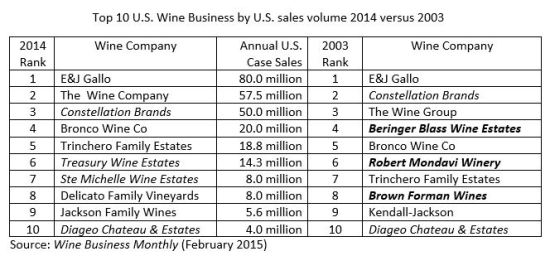
Wine is one exception to the dominant corporation rule. Here (above) is a table of the ten largest wine businesses in the U.S. market (measured by estimated or reported volume not value of sales) for 2014 and 2003. The data are from Wine Business Monthly, which publishes an analysis of the 30 biggest U.S. wine firms each February.  I’m looking at just the top ten to keep the analysis simple, although I should note that these ten firms collectively account for about three-quarters of all wine sold in the U.S.

Looking at the 2014 data, you will note that only four of the top ten firms (those in italics) are public corporations or subsidiaries of public corporations. The other six are family-owned or, like The Wine Group, privately-held and together they produce more than half of all the wine sold in America. [editors note: There was a typo in te graph, which should list The Wine Group not The Wine Company.] The bias towards private- and family-ownership is even stronger if we look at the next 20 wineries where only a few corporate names like Pernod Ricard make the list.

Looking closely at the 2014 numbers it is hard not to be impressed by the growth of family firms Delicato and Jackson Family Estates and also the success of Ste Michelle Wine Estates, which seems to behave like a privately-held firm even though it is a subsidiary of a public one, albeit in a different line of business (Altria specializes in tobacco products, not drinks).

All in the Family

Family- and private-owned wine companies are if anything more important today than they were before the Great Recession. Why are family-owned wineries so vibrant despite their structural economic limitations?

The conventional answer to this question — and there is in fact a substantial academic literature dealing with family businesses and even family wine businesses — stresses the ways that family businesses take a multi-generational approach and are able to negotiate the trade-off between short run returns and long run value. Corporations, it is said, are sometimes driven too much by quarterly returns and end up sacrificing the long term to achieve immediate financial goals.

When business requires a long run vision, it is said, families gain an advantage. Wine is certainly a business where it is necessary to look into the future if only because vines are perennials not annuals like corn or soybeans and successful brands are perennials, too.

Another school of thought examines issues of trust and transactions costs within the firm and the ways that family ties can reduce internal barriers and make interactions more effective.  It is commonplace to say that wine is a relationship business and family firms may have advantages in this regard. I have knows some family wine businesses that even go out of their way to work with family-owned distributors and so forth.  I think one author saw family-to-family links (the Casella family and the Deutsch family) as keys to the success of Yellow Tail brand wine.

Maybe the Real Question Is …

There are good explanations for the success of family-owned wine businesses, but sometimes they feel a bit ad hoc, tailored to explain a particular case and less capable of generalization.  And they often fail to fully account for the fact that many family businesses (and family-owned wine businesses) either fail or, like the Taylor family, end going over to the dark corporate side. Family relationships can be good, bad or ugly — you cannot think of the Mondavi family story without channeling an episode of Family Feud) and not every new generation wants to stay in the business. So there must be something more here than simple families think long-term. But maybe we are actually asking the wrong question.

Maybe the question isn’t why family-owned wine businesses are so strong and instead why corporate owned wine businesses are sometimes so ineffective. Is there something about wine that turns smart corporate brains to mush (not all of them, of course, but maybe some of them)? Come back next week for some thoughts on this provocative question.

The Curse of Corporate Wine-Think?

 May 12, 2015

Protecting Assets versus Leveraging Them

One difference that I have noticed about family wine businesses versus some of the corporations regards the role of key assets such as brand and reputation.  Many family wineries that come to mind seems to see their role as protecting brand and reputation so that they will continue to provide benefits well into the future. Some corporations that come to mind, on the other hand, seem to focus on leveraging brand and reputation in order to increase short run returns.

What’s the problem with leveraging a brand? Leverage has the potential to increase returns in any business, but it also increases risk. And one risk is that the integrity of key assets can be undermined by the leverage process itself.

An example? Well, I hate to pick on Treasury Wine Estates because they have seen enough bad news in the last few years, but one of my readers emailed me in dismay when a news story appeared about Treasury’s latest market strategy. I’ll use this as an example, but Treasury isn’t the only wine corporation that I could pick on and maybe not even the best example

One element of Treasury’s plan is to develop brands for the “masstige” market segment, which means taking a prestige brand and levergaing it by introducing a cheaper mass market product that rides on the iconic brand’s reputation. 
Masstige? Sounds like something from a Dilbert cartoon, which means of course that it is a totally authentic contemporary business term. Prestige fashion house Versace, for example, seems to have developed a masstige product line for mass market retailer H&M. The line was launched in 2011 and I’m not sure where it stands today. Maybe it was a big success? If  masstige  worked for shoes and dresses, how could it be a bad idea for wine?

I’m sure a prestige association helps sell the cheaper mass market products, but I can think of some examples in the wine business (Paul Masson? Beringer?  Mondavi?) where it might have undermined the iconic brand itself a little or a lot, which seems self-defeating. I know that has happened in the fashion field (think about how the Pierre Cardin brand was diluted by cheap logo products) so I imagine it could be a factor in wine, too.

Think Global, Source Global

Here’s another example. Regional identity is more important in wine than in some other industries and Treasury owns some famous “wine of origin” brands — wines associated with particular regions, which are valuable assets.  But my worried reader was concerned about Treasury’s plan to source globally to expand the scale of some of these regional brands.

“Building scale via sourcing breadth is one of the most critical platforms necessary for the globalization of wine brands,” according to the report. Gosh, that even sounds like corp-speak, doesn’t it? Logical, I suppose, but maybe locally-defined brands need to be locally sourced to maintain authenticity? Maybe consumers would be suspicious of a Stags Leap wine, to make up an example, that is sourced from Australia or some other distant place as a way of leveraging its brand power? I wonder just how flexible these terroir-based brand concepts are in the real world where consumers are the ones who decide what is authentic and what is bogus.

Global Market Moral Hazard

Some big wine corporations that have had troubles in recent years seem to have made the mistake of thinking that big global markets will soak up all that they (and the other big firms) can produce. It’s a matter of global-think. The global markets are huge. There’s always a market for another dozen containers somewhere in the big world of wine, or so it might seem, and so the risk of failure is misunderestimated, to use a GW Bushism.

In finance we would say that the false sense that the global market is always there to bail you out leads to moral hazard and this is probably true in wine, too.  Moral hazard encourages excessive investment and promotes booms and the busts that often follow. What seems to be true for an individual company is not necessarily true for an industry and misunderstanding this sort of risk is downright dangerous in an industry like wine, which is by its nature subject to cycles and booms and busts.

If private- and family-firms avoid the tendency to think global when their markets are local and thus avoid misunderestimating risk and if they really do work to preserve rather than leverage key assets it might help explain their lasting power and influence. Lots of “ifs” there, but its a theory. What do you think?

Bordeaux Bloodbath? Grubbing Up Deja Vu

You’ve probably seen the news from Europe. The headline on Politico read, “Bordeaux bloodbath! France pays winemakers to dig up vines.”  The French government has allocated €120  million to subsidize the removal of as many as 30,000 hectares of grape vines in the Bordeaux region due to unfavorable market conditions, according to EuroNews. That’s about €4,000 per hectare. The Bordeaux program is part of a bigger plan to take as many as 100,000 hectares (out of a total of 800,000) out of production.

It seems to me that the numbers are both big (100,000 hectares removed?) and small (€4,000 per hectare). American growers will rue the fact that they generally don’t receive subsidies from anyone when they are forced to grub up vines. The French are both lucky and not.

Grubbing up is a hardy perennial. France isn’t the only country that has to pull out surplus vines today and this isn’t the first time, either. I looked back in The Wine Economist archives to see when the topic of grubbing up first appeared on these pages. Here is what I found. You’ll note that I was skeptical about the EU program when I wrote this back in 2008. New Zealand’s earlier vine-pull scheme turned out well, I noted, but ripping out vines is only a temporary fix unless there are associated policy and structural changes to alter the market balance. I expect the same holds true today.

>>><<<

Grubbing Up / The Wine Economist / May 6, 2008

Grubbing up is one of my favorite wine economics terms. It means to pull the vines up by the roots and replace them with other agricultural crops. It is a harsh term, just as it sounds, because it is the opposite of wine — it is anti-wine. Grubbing up isn’t something that a wine lover contemplates with ease, but sometimes it is necessary. The European Union’s Council of Ministers has recently finalized a grubbing up scheme for the EU and it is probably a good idea, even if it may not work.

Watering Down the Wine Lake

The problem is that EU wine production vastly exceeds demand with the result that thousands of liters of wine must be bought up by the EU each year and distilled into alcohol to prevent prices from dropping through the floor. The distillation price support only encourages continued production, waste and expense. It is a mess — a wine lake, as people say — and it has to stop.

A fairly radical plan was introduced a few years ago, one that would have paid farmers to grub up thousands of hectare of vines and introduced market reforms to allow (by deregulating) and to encourage (through supporting programs) European winegrowers to compete more effectively with New World winemakers who are taking their markets.

The package that the Council of Ministers agreed last week is significant even if it is less radical than the original initiative (Decanter magazine called it “watered-down” — never a good thing when you are talking about wine). The program called for subsidies to encourage winegrowers to eliminate up to 175,000 hectares of vines (versus 400,000 hectares in the original proposal), limit chaptalisation (the addition of sugar in the wine-making process) rather than eliminating it, and market-based reforms that encourage and enable winegrowers to compete on world markets (through varietal labeling of wines) rather than hide behind protective barriers.

I’ve been reading up on the details of the final EU plan and it is pretty interesting.  The program includes money for grubbing up, of course, and deregulation of wine labels, removal of some vine planting restrictions (so marketable grape varieties can replace uneconomic grubbed up varietals), funds for wine promotion abroad, and so forth. Like any EU program, it is a complicated balance of economic reality, fiscal feasibility and political necessity.

The idea is to help the European wine industry transition to a new market environment, where export markets are growing, domestic markets shrinking and competition is fierce. It is not unreasonable to think that policies like this could work. They worked in New Zealand in the 1980s, for example.

Lessons from Kiwi Wine History

New Zealand today is famous as one of the great success stories in the world wine market. A small nation in an unlikely location, it punches above its weight in the global wine market, holding the title as champion exporter. Not in quantity, obviously, but in price. New Zealand has the highest average export price of any wine producing country.

But such was not the case 25 years ago. New Zealand suffered from a surplus of mediocre wine that could only be sold domestically behind high protective barriers. The industry collapsed with many failed firms from a combination of bad wine and surplus production. The government paid to grub up vines and then opened the market to international competition. Cheap but better wines from Australia flooded in to fill the domestic bulk wine market, leaving New Zealand producers only one choice — make better wine for export. They have done so brilliantly. Their success inspires the EU reforms.

It would be a mistake to think that what worked so well in New Zealand in the 1980s will work equally well in Europe today. It is unlikely that the EU would be willing to let its wine sector reach the sort of crisis that New Zealand experienced and that motivated the dramatic reforms implemented there. If big change comes from big crisis, as I believe (I wrote a book on this theme), then Europe is unlikely to see big change. The social cost of crisis is just too great. The guiding principle of EU policy is to prevent crisis, which makes change that much harder to effect.

Comparing New Zealand to Europe is problematic in other ways, too. New Zealand’s wine production is tiny — a drop in the bucket, really — whereas European producers account for well more than half of all the wine in the world. New Zealand’s grubbing up program may have been difficult, but only 1500 hectares were uprooted rather than the “watered-down” 175,000 set for the EU.

Changing the Rules of the Game

The principle of the EU wine reform scheme is sound, yet many reports that I have read are pessimistic. I think this is mainly because the final reforms are so much more timid that the initial proposal. But there are other reasons for concern.

One thing that economists have learned over the past 25 years is that institutions matter. This is another way of saying that economic forces do not always produce the same results. If the “rules of the game” are different the laws of economics will produce different results. Institutions are the rules of the game in life. Dani Rodrik, my favorite development economist, makes this point in his recent book One Economics, Many Recipes. The nature of local institutions, public and private, formal and informal, shapes the economic landscape in important ways.

This idea applies to the EU reforms in particular. Take the grubbing up scheme, for example. An incentive to repurpose large but unprofitable vineyards in Australia, for example, might well meet with an enthusiastic response because the institutions of wine growing there are different, with large vineyards and a consolidated industry. But European vineyards are much different and represent a completely different model.

Many vineyards (where much of the inferior surplus wine originates) are tiny inherited plots of a hectare or so, frequently on sites with few viable alternative uses. The rules of the game here are much different. A hectare might produce 20-30 tons if badly overcropped and, at perhaps $500 per ton at the local cooperative, gross revenues are too small for a family to live on but too great (compared to alternative uses) to give up. It’s an institutional trap that might be solved by consolidation, but making large vineyards out of these scattered small plots is necessarily costly and difficult.

Under these circumstances growers are likely to hang on to their vines for years rather than accept a modest one-time payment. Grubbing up might need to be forced, not voluntary, to have much effect.

New regulations to allow wines to be labeled according to grape variety (rather than the traditional local geographic designation) might be attractive to a large and distinctly commercial wine producer, but much wine in Europe is still produced by cooperatives that have little to distinguish their wines from others apart form the local designation. What advantage would they have as simple varietals in a world awash with good varietal wine?

A Certain Vision of Wine

It is possible to envision a future where the reforms can work, where the marginal vineyards have gone out of production, where consolidation has increased efficiency and where branded varietals can compete with the world market. (I have even seen some early attempts at EU branded varietals in the discount bins of a local store — more about this in a future posting.) I think it is possible that this vision may be realized — eventually.

But oh, it is such a big jump. The institutions of the small family vineyard and the local wine cooperative seem to me to make these reforms much more difficult. New Zealand’s success will be difficult to repeat.

Wine Economics 101: the Three Vs of Wine

We often talk about trends and problems in the wine industry, but I think we all know that wine isn’t a single business about which it is easy to generalize. Different countries or regions have different business characteristics, for example, and making and selling multi-million case brands like Gallo’s Barefoot differs greatly from much smaller and more local operations.

The wine industry doesn’t come in one size or shape that fits all and doesn’t run at a single speed. Significantly, while all or most parts of the “wine patch” face challenges from climate change and declining consumption of beverage alcohol, the specific conditions vary and can change quickly.

So when a journalist asks me about what’s happening in the wine industry, as happens frequently, I have to stop, pause, and think. Which wine industry are we talking about?

Wine and the Three Vs

The Financial Times recently published an interview with Stephen Cronk, co-founder of the Provençal Rosé producer Maison Mirabeau, about the perils and rewards of starting a wine business more or less from scratch.  Mirabeau has achieved great success in just a few years. How did it happen? Here’s an excerpt of the Q&A.

Was there a seminal moment in your business? Probably when I met a British Master of Wine in the Languedoc in 2008. He told me about the three Vs: viticulture, vinification and vendre, farming vines, winemaking and selling. Up until then I thought I would focus on buying a vineyard. He said don’t buy a vineyard yet: build a brand. Looking back, it was absolutely the right advice.

The idea of the Three Vs is important. There is a romantic image of winemaking that looks like this. Lovingly hand-tended grapevines surrounding a modest winery, with a cozy tasting room next door where most of the wine is sold (often by the winemaker herself) to loyal customers.  This is the idea of wine that defines the industry for many people. But, from an economic standpoint, it is a bit misleading because it suggests that wine is a single business when it is really, as the Financial Times story points out, it is really more like three.

Growing grapes is agriculture. It is a risky capital-intensive business that requires specialized equipment and knowledge. Growing wine grapes successfully and profitably is a considerable achievement. Making wine is also a risky capital-intensive business. It requires specialized equipment, some of which is only used once a year.

Finally selling wine is a risky capital-intensive business, too. It is risky because selling wine like selling anything else is affected by market forces beyond individual control. It is capital intensive because building a brand or establishing networks of personal or professional relationships to facilitate sales can consume a good deal of time and money. Many winery owners have told me that, going into the business, they thought that growing grapes or making wine would be their biggest challenge, but selling wine and tending to customers sometimes is the hardest part.

Specialization and Exchange

Because all three businesses are capital heavy and all three are risky, there is a strong incentive for specialization at the firm level and for the industry to take advantage of Adam Smith’s principle of the division of labor. Smith said that the division of labor was determined by the extent of the market and so it is not surprising that it is most fully realized in the wine business by very large wine companies that specialize in one or two but seldom all three wine industry segments.

Some of the largest winemaking facilities here in Washington, for example, are mainly engaged in contract wine production for other firms, which market the wines under their own brand names. And some large wine firms sell big volumes of wine with few direct employees, relying upon purchased grapes, contract production, and bulk wine purchases to feed their efficient marketing and distribution pipelines.

Specialization and exchange is Adam Smith’s recipe for efficient production, but the situation is never as simple as that (and nothing is ever very simple in the wine industry). Remember that each of the V-factors is risky and the risks are very different. Engaging in just one V-function means you only have to account for one set of risks, not all three, but from an industry viewpoint the risks are always there. And in some cases division of labor can magnify them.

Risky Business

All three wine industry functions are risky in part because they involve lags. The final market for wine is constantly evolving, for example, but firms that specialize in marketing have to make plans many months or even years in advance, so there is always the risk that the last quarter’s market plan is no longer relevant. That’s a problem.

Wine production involves lags, too, and they can be much longer. The wine that a producer can sell today is based on decisions made one, two, three, or more years in the past. Time lags mean that costly shortages and surpluses are more likely, creating instability. The viticulture V is also subject to lags and they are much longer than the previous ones just because of the time it takes to bring grape vines into production or to alter the product mix on existing vines.

One implication of this situation is that, while sometimes the Three Vs are in synch and tell the same story, sometimes they are not and you get a different reading on the health of the industry depending upon which V you consult. Arguably this is the case today, when the disruptions of the pandemic era and rapid inflation are working their way through the system at different speeds.

Market Dynamics

There is a certain degree of instability baked into each wine industry segment’s cake. What happens when we fit them all together? Under some circumstances, the result can be benign or even beneficial as cycles offset one another the way that the sound waves your noise-canceling headphones emit silence the racket around you. But it is also possible for cyclical factors to compound, making the overall wine industry riskier than its individual segments.

Is this one of those times when risks are compounded because instability in each segment feeds the others? Risky business(es).

>>><<<

I recently discussed some of these wine economics themes and more with “Wine Behind the Scenes” podcast host Laurel Simmons. Click on this link to listen to our 30-minute conversation.