Back to the Future of Armenian Wine

The mission of Boston-based Storica Armenian Wines is to introduce U.S. consumers to the pleasures of Armenian wine and they seem to be off to a good start.

Just last week, for example, Wine Bible author Karen MacNeil‘s Instagram #TasteWithKaren webinar featured Vahe Keushguerian, founder of Keush wines, for a tasting of three of his Armenian traditional method sparkling wines. One of them, the Keush Origins, was our Open That Bottle Night 2021 wine. A delightful wine from an unexpected source, made from indigenous grapes that we’d never before experienced. A great introduction to Armenian wine.

Armenia’s Deep Roots

We are only now getting to know Armenian wine a little but, but already I can see that this is a topic full of fascinating puzzles and paradoxes. Wine in Armenia is both very old and very new.  Landlocked Armenia’s latitude is a bit too low, but its high elevation compensates and creates a sort of grape vine Eden. It is impossible to prove, of course, but Armenia just might be the place where Vine Zero was born, the ultimate source of the vitis vinifera grapes that fill most modern wine bottles today. The oldest known evidence of a working winery was found here.

Armenia’s neighbor Georgia shares some of this history and sometimes calls itself “the cradle of wine” (Armenians like to say they are the “birthplace of wine”) and I rather naively assumed that, because we have visited Georgia and tasted many of their wines, that this might give me a head start in understanding Armenia and its wines. But that’s not how it worked out at all.

No Escaping It

Wine is inescapable in Georgia. It is integral to the national identity. Home-production is so important that it has taken a while for commercially produced wine, most of it aimed for export markets in the former Soviet state markets, to attract a critical mass of local consumers.  Georgia is now investing to develop new markets in China, Europe, and North America in order to reduce their dependence on former-Soviet state exports.

Wine grapes are inescapable in Armenia, as near as I can tell from my research, but wine maybe not so much until quite recently. The World Atlas of Wine estimates at more than 80% of wine grape production goes to make brandy, the national drink.

The wine sector is relatively small, according to this source, with about 50 wineries in 2018, 30 of which only appeared in the last ten years, driven in part by investment from members of the vast international Armenian diaspora and technical “flying winemaker” expertise.

Armenia’s wine past is a mixed bag, as I’ll explain below, but its future is simply irresistible according to winemaking superstar Alberto Antonini. He rates his Zorah project in Armenia (along with his Otrona project in Argentine Patagonia) as the most interesting opportunities in today’s wine world.

Stalin Did It

Why was there so little attention to wine in its birthplace? It is complicated, of course, but one line of reasoning traces the situation back to Stalin’s Soviet Union. The Soviet system was all about exploiting the efficiencies of division of labor to generate maximum output with scarce resources. Thus was Georgia (Stalin’s birthplace and source of his favorite wine) selected to supply wine for the Soviet bloc while Armenia was assigned to specialize brandy production despite the fact that good wine was made in both countries.

That Armenian brandy is excellent and has been compared favorably to Cognac might make Stalin’s policy credible, but the impact on Armenia’s wine sector remains. The production and market structures established in the Soviet era have been slow to change, but change they have and the wines that Storica is introducing to the U.S. market is part of the story.

Terroirist’s Territory

Sue and I enjoyed our OTBN selection of Keush Origins sparkling wine, a traditional method blend of indigenous grape varieties: Voskehat, the most-planted white grape, and Khatoun Kharji, a grape variety that is rare even in Armenia. Sourced from 60-100 year old vines planted at 1800 meters above sea level. An extreme wine with character and finesse. It was an impressive start our Armenia research.

Next in line was Zulal Voskehat 2019, a dry white wine with medium body, good balance, and a very interesting finish, which evolved as we enjoyed the wine with pasta primavera. Vineyards planted on volcanic soils at 1400 meters in the Vayots Dzor region near the Azerbaijani border supplied the grapes for this wine.

Zulal, which means “pure” in Armenian, is a project founded in 2017 by Vahe Keushguerian’s daughter, Aimee Keushguerian. The focus is on indigenous grape varieties and own-rooted vines so old that they pre-date the Soviet era. They are, I suppose, a pure expression of Armenia’s wine past but made using modern cellar practices. It is part of a movement to bring wine back to the center of Armenian culture.

Areni, named for its home village in Vayots Dzor where evidence of the world’s oldest known winery facility was discovered, is said to be Armenia’s signature grape variety and, based on our sample bottle of Zulal Areni 2018, it is a sound choice. Grapes from vines at 1400-1750 meters elevation (wow!) were vinified in stainless steel to produce a fresh, medium-bodied red wine that one tasting note placed somewhere between Pinot Noir and Sangiovese, although I think it is something all its own. We enjoyed the spice and plummy flavors, which went especially well with our dinner of chicken and sautéed spinach with peanut sauce. A keeper for sure.

There is a Zulal Areni Reserve, which is aged for a year in used Caucasian and French oak, that we are setting aside to share with our Armenian-American friends Z and G. It will be a great pleasure, when the pandemic clouds have finally passed, to share with them this is wine as well as a Keush Blanc de Blanc traditional method sparkler. I am confident it will be worth the wait.

Armenian wine has a lot to offer and these first tastes are just the beginning. The Keush and Zulal wines are a fascinating introduction to the Armenian wine renaissance.

>>><<<

WorldWineRegions.com has created a fascinating website with interactive maps of the world’s wine regions. Here is a link to the map of Areni in Vayots Dzor. Zoom in and out to see both the vineyard areas and the overall terrain.
Climate Change Risks: Reading Between the Wines

Climate change is a threat to the global wine industry — there is not much disagreement about this fact. But what are the specific risks to the wine product chain and what are wine businesses doing about them?

Climate Change Risk: Timely Idea?

This is a complicated question if only because the wine product chain has so many links that are vulnerable to climate change’s direct and indirect effects. One way to begin to answer the question, I proposed in last week’s Wine Economist column, is to focus on the concept of material risk. Climate change is not just an abstract threat to wine, it poses a threat to the material operations of wine firms, which are required, therefore, to disclose and analyze them for the benefit of current and potential investors.

I didn’t come up with this idea myself. As I noted last week, I was inspired by Robert Swaak’s comments at the Porto Climate Change and Wine summit. And I was interested to see climate change and material risk featured in articles in both the Wall Street Journal and the Economist newspaper reporting on Biden administration investment disclosure policy.

And now the Financial Times reports that the European Central Bank is undertaking a climate change stress test to determine the risks that European banks need to take into account in their operations. Climate change risk (and the use of risk disclosure to stimulate action) is an idea that is in the air just now. Let’s see what we can learn from it.

I’ve chosen four quite different firms in different parts of the wine business to discuss here.  This analysis is not especially deep or sophisticated, but hopefully it tells us something about how these businesses think about climate change and perhaps how wine businesses in general see these risks.

Constellation Brands

I start with Constellation Brands because it is a very large publicly-traded company, which therefore has many investors who will look closely at its analysis of risk. Constellation is an important wine and spirits producer, but it derives much of its income from Mexican beer imports and has cannabis interests, too, and each business is subject to a number of significant risks. Constellation identifies four categories of risk: operational risk, strategic risk, financial risk, and “other risks,” which includes risk stemming from the fact that the company has a dual share class structure and is effectively controlled by the Sands family.

Seven pages of the report are devoted to the operational risks (pandemics are risk #1 in the 2020 report) and each risk receives relatively detailed analysis. Climate change is next to last on the list, with discussion focusing on risks to wine supply (through the impact of climate change on vineyard production, for example), and the potential costs of environmental regulatory compliance.

My key take-away form the Constellation annual report is perspective. Climate change is a business risk and environmental advocates would like it to be the top priority. But, in practice, there are a great many risks and, although climate change is taken seriously, it must necessarily compete with other risks for attention and resources.

Treasury Wine Estates

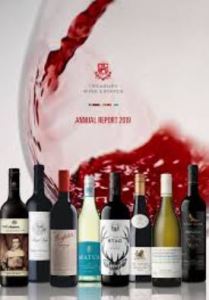
Treasury Wine Estates is a large multinational wine business with substantial assets in Australia and the United States and key markets in China, the UK, the US and around the world. Its Penfolds brand is iconic. It published both a summary Annual Report in 2020 and a supplementary Sustainability Report,  so clearly the importance of environmental issues isrecognized. I focused on the main annual report for this summary.

TWE’s annual report identifies 12 categories of material risk. Changing geopolitical risks is #7 on the list, but I suspect that it is close to the top of the minds of the company’s leaders right now. Political friction between China and TWE’s home country Australia resulted in high Chinese “anti-dumping” tariffs on Aussie wine imports and the collapse of TWE’s #1 export market. Treasury is working on a re-structuring plan and shifting focus, at least for now, to other export markets. That, my friends, is an example of how a seemingly low-probability material risk can strike suddenly and with major impact.

Climate is listed as the #1 material risk, which is described as

The impacts of climate change may lead to adverse effects on business operations and performance.
Restrictions on access to and/or an increase in the cost of water and energy, and the inability of
third-party suppliers to adapt to and mitigate against climate change, could impact on TWE’s ability to effectively source grapes and wine for production.

In addition, governmental actions to reduce the impacts of climate change, for example packaging
waste and emission reduction targets may also impact  TWE’s cost base.

The report lists a number of mitigation strategies.  Treasury’s report suggests that its management recognizes both the direct and indirect impacts of climate on their business and, like Constellation, also anticipate changing regulatory environments as governments address climate change issues. Much more detail is provided in the Sustainability Report.

Tesco

Tesco, the big British supermarket chain, is an incredibly important link in the global wine product chain. Indeed, in my book Wine Wars I list its headquarters on Delamare Road in Cheshunt, Hertfordshire as the center of the wine universe if we think in terms of retail sales. But wine is just one of many products and services that Tesco sells.

The annual report presents what it describes as “a robust approach to risk, ” with a long list of risks, each assessed according to movement (increasing, decreasing risk) and key controls and mitigating factors. Going through the list, I began to worry when I didn’t see a category for climate change. Then I turned to page 20 and discovered that climate is so important to Tesco that it has its own special risk task force.

In addition to general climate risks, Tesco seems to be undertaking specific studies of key product categories and risk areas, which makes sense. Wine is not one of the focus areas in the current report, but it is interesting to look closely at what’s there. Some UK stores and distribution centers, for example, are at risk from flooding due to climate change. And supplies of produce from outside the UK are threatened by climate effects in the countries of origin. South Africa, Egypt, Spain, and Peru are noted as particular concerns.

The supply chains for protein (beef, chicken, etc.) are concerns, too. But there are also demand-side impacts. Tesco expects that climate concerns will shift consumers to plant-based proteins that have less environmental impact than animal-based foods, so building those supply chains and anticipating demand is on the agenda. Very interesting.

Amorim

My final case study is Amorim, the world’s largest producer of cork closures. Amorim is well known for its commitment to sustainability, so I was sure that climate change would factor into its business plan.

Amorim categorizes its business risks as short-term and long-term potential threats. In the short time frame, anything that can affect its two main markets — the world wine industry and the construction sector — will have major impact on the business. The list of things that Amorim must worry about is thus nearly endless.

Long run risks include foreign exchange shifts, competition from alternative closures, and of course the environment.  The cork forests in Southern Europe and Northern Africa that supply Amorin’s raw materials are environmentally significant for their ability to take carbon out of the system and lock it away. As climate concerns intensify, the report suggests, the value of the forests for this purpose will grow.

But, ironically, the cork forests that help mitigate climate change are also threatened by it, which gives the need to address climate issues a particular urgency both for Amorim and, I think, for wine more generally.

More Questions than Answers

The question is what are the climate change risks to the wine industry and how are wine businesses responding. Inevitably this brief study has uncovered more questions than answers, in part because of its inherent limitations. I’ve looked at just four firms, examined their material climate change risks through the lens of annual reports, and of course only had space for fairly superficial summaries here.

Critical readers would have been suspicious of definitive answers or broad conclusions in the context of these limitations. That said, the actual complexity of the problem starts to show through as you read the reports. And the urgency shows through, too.

Given the Biden administration’s new SEC climate change material risk emphasis and the ECB’s climate change stress test program, I think we can expect climate disclosures to be taken even more seriously soon. Much too soon for a victory lap, but good news for wine and the environment nonetheless.

Climate Change and the Wine Business

It is difficult to over-state the potential impact of climate change on the global wine sector. Recently, I was part of a panel on this topic. My task was to get a handle on how climate change is likely to impact the business side of wine. I developed an analytical framework to consider this question based on the concept of material risk. I wasn’t able to develop my ideas fully during the brief webinar, so I will do so in this space over the next two weeks.

Unpacking the Wine Product Chain

How will climate change impact the wine business? This is a hard question because the wine product chain is global and complicated and because climate impacts can be foreseen at all the product chain links.

One approach — and a good one — is therefore to develop a taxonomy of effects.  Start with nurseries and vineyards (an obvious climate impact point) and move to the cellar, where water availability is key, then through logistics — getting necessary inputs into production process and the final goods to market — and then distribution, sales, and final consumption. Climate change is a factor, either directly or indirectly, at each and every stage.

This is already pretty complicated, but we need to consider direct effects, financial effects, and regulatory responses and their costs. Indirect effects and what we might think of as counter-party impacts add more complexity.  No wonder the Porto Climate Chain conference featured speakers on so many elements of wine production, distribution, and sales. You can’t really address climate change and wine without taking a broad, deep perspective.

Many of the Porto participants were justifiably proud of their contribution to addressing climate change, but in my remarks I challenged them to do more. You need to own your product chain, I said, and take responsibility for whole process. If not you, who?

A Material Risk Approach

Stephen Rannekleiv of Rabobank and Robert Swaak of PwC joined me on that Porto panel and each made an important contribution. Rannekleiv, as he often does, focused on concrete steps that his bank,  its clients,. and other groups were taking to address climate change issues. Swaak, who is now CEO of another big Dutch bank, ABN AMRO, made an important point about climate change risk.

Because the climate change impacts discussed above are complex and uncertain, they are properly considered business risks. Businesses confront lots of risks in their operations, some more tangible than others, and they are expected to reveal and analyze them so that investors understand the business implications.

Confession: reading what firms have to say about risk in their annual reports is one of my guilty pleasures (along with reading really really negative wine reviews). Often the risk analysis is hidden in the back pages of annual reports, almost always in fine print. But it is always there because regulators are serious about requiring businesses to reveal to investors the risks that they are taking. You cannot evaluate risks and return if you don’t know the risk.

I like to think of these risk disclosure statements as being like the fine print you are given when you get a new prescription drug. Do you worry about possible side-effects? If so, be careful about reading drug disclosure statements because it can make imagination go all out of control. Lots of bad things can happen, although the probabilities are low enough relative to the benefits to justify a drug’s regulatory approval.

Swaak’s point in Porto was not just that climate change poses risks, it was that these are material risks — risks that can affect the material operations of the firm — which is a more serious category that requires deeper consideration and fuller disclosure. Swaak hoped that that this status would encourage firms to take climate change more seriously because they would be accountable to their investors for this actions or inactions.

As the Wall Street Journal reported yesterday, the Biden administration’s Securities and Exchange Commission is poised to require the firms its regulations cover to make their climate-change disclosures more comprehensive. The era when climate change risks could be over-looked may be coming to and end.

The Risky Business of Wine

Swaak’s Porto insight made me realize that one way to assess the likely effects of climate change would be to view them through the lens of material risk. Analysis of the material risk sections of corporate annual reports is one way to learn what climate change risks businesses see ahead of them and perhaps also what they are doing to prepare for them. At the very least it is a way to see if climate change is taken seriously.

I admit that this is not deep analysis. The firms might be myopic and not see climate change risks clearly. And there may be differences in the priorities listed in the report and those reflected in their actions. Getting values, priorities, and actions aligned is a universal problem, not limited to just corporations or to climate change.

As an article in the current Economist newspaper suggests, disclosure won’t by itself solve climate problems, but the requirement is at least an incentive to move away from climate-damaging practices and investments. With this in mind,  I made a quick study of four wine sector firms which I had hoped to discuss in that webinar. The four are

(1) Constellation Brands, a very large beverage alcohol company and at one time the world’s largest wine maker.

(2) Treasury Wine Estates, a firm with global interests and product chains.

(3) Tesco, the largest wine retailer and so a key product chain link.

(4) Amorim, the largest cork closure producer, known for its sustainability commitment.

What did my analysis reveal? Come back next week to find out.

>>><<<

Videos of the Porto Climate Change conference presentations mentioned above are available. Click on these links for presentations by Mike Veseth, Stephen Rannekleiv, and Robert Swaak.

Memo to CNN: Searching for Italian Wine?

Dear CNN,

Sue and I have been watching the CNN original series “Stanley Tucci: Searching for Italy.” Tucci visits six Italian regions, talks with the people, enjoys the food, and tells some stories. Maybe it is because of the pandemic, but there is something very satisfying about following Tucci on his journey. You might want to check it out.

Tucci starts his Giro d’Italia in Naples and then moves on to Rome, Bologna, Milan, Tuscany, and Sicily. The title suggests that he is “Searching for Italy.” Will he find it? Not if he thinks that Italy is a single thing with a single cuisine, because that Italy has never existed. But if he is willing to accept that Italy is its regions — and I am sure he is — then he’ll be fine and so will we.

Searching for Italian Wine

The chapter on Italy in my book Around the World in Eighty Wines is a Tucci-esque search for Italian wine. My quest to find one wine that can represent all of Italy’s wines comes tantalizingly close to success at one point, but ultimately I realize that Italian wine is impossible. There are only the wines of Italy’s regions. No wonder the Italian wine map is perhaps the most complicated in the world.

So it seems to me that Searching for Italian Wine would make a great series for the same reasons that Tucci’s program is so popular. But what would a program about Italy’s wines be like? Walking though beautiful vineyards is great and makes good video, but you can only do that so often before it gets a bit old. Ditto for visiting cellars, inspecting barrels and tanks, and wondering at the majesty of shiny new pneumatic presses and speedy bottling lines.

Watching wine being made isn’t as interesting as watching food being made for some reason (perhaps because it takes so long) and in any case Tucci’s producers seem to realize that there’s a limit to how many times they can show onions being diced or pasta being rolled and cut.  So instead they show the hustle and bustle of markets — that never gets old to me — and focus on real people, who they are, what they do, and how they define and are defined by the local products and food. That’s a model that works every time, if you don’t lose sight of your goal.

Searching for Italy and Its Wines

This leads me to my main point, which is that Tucci’s Searching for Italy could be the perfect Italian wine show if it just brought wine more fully into the frame (note: I write this before the Tuscany episode has been aired). Wine shows up all the time in Searching for Italy, but it is just something the people drink with the food, never an important element of the story. Wine in Italy is so much more.

The Bologna episode is a case in point. Yes, the Prosciutto, Mortadella, and Parmigiano Reggiano cheese are amazing. We were fortunate to enjoy them almost every day when I taught at the Johns Hopkins School of Advanced International Studies Bologna Center a few years ago. Our apartment was on a little alley called Via Pescherie Vecchie in the heart of the heart of the famous central market area. It is an inescapable element of the city’s life so naturally it was on Tucci’s Bologna itinerary. Here’s a video of a visit to this street to give you a sense of the place.

So what do  you drink with these intensely local products? Well, wine of course, but there is a particular local wine that we think is magical. It is called Pignoletto and it is so local that I doubt you will easily find it anywhere else. As I wrote ten years ago after a return visit to our old neighborhood …

Pignoletto is a dry white wine grown only in the hills outside of Bologna. “Lively, crisp, aromatic” is how Jancis Robinson describes it in her Guide to Wine Grapes. Pignoletto is distinctly Bolognese — grown there, made there and I think that every last drop of it is consumed there, too, since it goes so well with the rich local cuisine (almost as if they evolved together … which I guess they did).  It would be hard to beat the simple meal of salumi, cheese and bread that we had with a bottle of Pignoletto frizzante at Tamburini‘s wine bar in the Bologna central market.

The food and this wine evolved together in Bologna. No wonder they are such a perfect match. And they say something about the importance of place in a footloose world, don’t you think? It would have been easy to include this wine (and some others, too) in the Bologna episode, CNN,  and your viewers would have thanked you for opening this door to Italian wine, food, and culture.

Dear CNN: Who Ya Gonna Call?

So, CNN, you are probably wondering who can help you take Searching for Italy to the next level by adding the magic of wine to the mix? Well, our team here at The Wine Economist stands ready to lend a hand (and pull a few corks) and we have no end of ideas for season 2 in the Veneto, Friuli, Alto Adige, Piemonte, Liguria, Sardinia — and that’s just getting started! Let’s take that Italian map and search for Italy and Italian wine in every corner.

Italy is a mosaic of people, places, wine, food … and wine, too. Let’s work together to tell the story of Italian wine in context, one beautiful region at a time.

Sincerely,

The Wine Economist team

OTBN 2021: Open That Bottle of Armenian Wine

We celebrated Open That Bottle Night (OTBN) 2021 on Saturday with a pandemic-mode Zoom gathering of the usual suspects. We shared stories, honoring the tradition, and felt good about being together even if we could not also share the particular bottles of wine we brought to the party. Next year. Fingers crossed!

Usually the wines we select for OTBN are a backward glance. They remind us of people, places, or events that live in our memories and are released when glasses are poured. This year was different. Sue and I recently received samples of wines from Armenia from Storica Wines, an Armenia wine import company.  We’ve never been to Armenia. Never tasted the wines. OTBN was our excuse to pop the first cork, look ahead not behind, and imagine a future Armenian adventure.

First Taste of Armenian Wine

Wine has a very long history in Armenia just as it does in neighboring Georgia. Armenia calls itself the “birthplace of wine,” while Georgia fancies itself the “cradle of wine.” Georgian wine, as I have written here, is getting lots of attention just now. Perhaps Armenia will be next? That’s a question we will discuss in more depth in a future column. The focus for today is our OTBN discovery.

The particular wine we opened is the Keush Origins Brut traditional method sparkling wine. It is made from native Armenian grape varieties: 60% Voskehat and 40% Khatouni. The grapes come from 60 to 100-year old ungrafted vines grown at over 5000 feet elevation in the Vayots Dzor region. Does that get  your attention. Extreme wine!  Voskehat is Armenia’s most important white grape variety and is used to make many styles of wine. Khatouni seems to be relatively rare, even in Armenia. I couldn’t find a listing in the encyclopedic Wine Grapes volume.

Wine Gets Personal

Wine is about people as much as grapes and that’s true in this case, too. The Keush Origins Brut was one of the Armenian wines highlighted by our friends Dr. Matthew Horkey and Charine Tan in their handy book Uncorking the Caucasus: Wine from Turkey, Armenia, and Georgia,  so it was satisfying to imagine that we were tasting it for the first time with them.

Matt and Charine were impressed with the Keush Origins wine they tasted — it was the first release of this wine. But it is easy to tell that they were also quite taken with its maker, Vahe Keushguerian. who is profiled in the book. Keushguerian, in turn, is obviously taken with Armenia and its wine industry’s potential. They write that

Vahe is committed to reinvigorating Armenia’s wine culture. By using DNA technology to identify grapes found in abandoned monasteries and villages, then cultivating those grapes in his nursery, Vahe and his team have been rediscovering historic wine grapes and bringing them back to life.

We will have more to say about Armenian wine’s past, present, and future in a few weeks when we’ve had time to open the rest of the sample bottles.  In the meantime, what about the Keush Origins OTBN sparkling wine?

Wine’s Superpower

Well, no one comes to the Wine Economist website for wine ratings or tasting notes, but we enjoyed the Keush Origins Brut from Armenia quite a lot. Dry, of course, and mouth-filling. Easy to drink and enjoy and paired very well with cheese, meats, and Sue’s home-made focaccia. Looking forward to opening the other Armenian bottles in our small stash.

Let me close with some reflections on OTBN 2021. Open That Bottle Night 2020 was the last in-person gathering we had before everything closed down last year and distancing and isolation defined social relations. We hesitated a bit about shifting the meet- up online. A Zoom OTBN might honor the tradition, which is important to us, but it wouldn’t be the same. In the end we decided to move ahead and see what would happen.

And I am glad we did. Wine brings people together — that’s one of its superpowers — and it did so again even if we couldn’t actually share the wine, only a screen, some stories, and good company. I was surprised at how much this moved me and am grateful to our friends for making this possible.

Here’s the wine list from OTBN 2021. Thanks to Dottie and John for inventing OTBN and keeping its flame alive. Cheers!

  • Tempus Cellars 2015 Cabernet Sauvignon, Walla Walla
  • DePonte Cellars 2014 Pinot Noir, Oregon
  • Opus One Winery 1989, Napa
  • Chengyu-Moser XV Winery, 2017 Rosé of Cabernet, Ningxia, China
  • Keush Origins Brut, Armenia

Keush Origins Brut is imported by Storica Wines.