100 Years of Wine Industry Ups & Downs: Highlights of the OIV Centennial Report

The International Organization of Wine & Vine (OIV) is  celebrating its 100th year in 2024. I like to think of the OIV as the United Nations of the wine world although its purpose is scientific and technical, not political. Membership includes most of the world’s most important wine-producing nations with the noteworthy exception of the United States.

To mark its first one hundred years, the OIV  released a report last week on 100 years of evolution of the global wine and vine sector. The report’s perspective differs from most studies in that it is both global and long-term. I have selected three figures from the report that I think are useful to consider as the new wine year begins and we think about where wine is headed in the future.


#1 The Rise of the International Wine Trade

Wine was mainly multi-local (not really global) 100 years ago. Most French wine was sold in France. Ditto Spain, Italy, and most other places. Only about 10% of wine crossed a national border on its way from producer to consumer.

Now, as the figure above shows, international trade is a much more important factor in wine. Trade is even more significant than the figure above suggests because these are just shipments of wine. The international movements of equipment and supplies, workers (including flying winemakers and flying interns), and technology add to the global web that is wine today.

The surge in international wine trade started in the 1970s and was accelerated by the combined effects of trade agreements that removed political barriers to wine shipments, transportation technology improvements that made shipping more efficient, and domestic retail liberalization in many markets that stimulated demand for imported wine.

But, as you will see in the next section, there was another and perhaps more important reason for the rise of the international wine trade. As domestic wine consumption fell in many countries, exports became a crucial business strategy. Soon big wine countries like Spain were exporting more than they sold at home.


#2 1984 and All That

Global wine consumption increased starting in the 1950s powered by Europe’s rising post-war economies. But global consumption, measured by volume not value, peaked about 40 years ago. European wine sales fell and were not entirely offset by rising consumption in North America and elsewhere.

There are a number of factors that contributed to the slump in European wine sales. One of them is surely an economic transition where consumers substituted quality for quality as their economic security improved. Health issues may also have become more important. The levels of per capita wine consumption in some European regions 100 years ago were unsustainable by today’s standards.

Rising ROW (rest-of-world) wine consumption offset European decline, but only for a time.


#3 Supply-Side Jitters

It is hard to know exactly what is going on with wine production in real time because cyclical and structural changes tend to happen at the same time, frequently punctuated by wild card events such as freak weather. Looking back, however, this accounts for the jittery pattern seen in the figure above.

It is clear that global wine production by volume actually peaked in 1979. (Global area given to vineyards for all purposes peaked in 1978.) Wine production has its ups and downs, but the overall trend is to lower quantities of wine, albeit at rising average prices. The decrease was especially significant in Europe. Rising production elsewhere is not enough to make up the difference.

Rise and Fall

The OIV report makes fascinating reading with more detail than I have room for here (click here to view the pdf of the presentation).

The overall pattern of rise and fall invites the obvious questions: What about the future? Is wine headed toward further decline? Or is an up-swing around the corner?

The OIV report’s conclusions balance optimisism with realism:

Change is a constant
The wine sector is highly resilient
Science and learning make a huge difference
Production and consumption are in constant evolution
The impacts of climate change are accumulating
International trade is integral to the sector
The wine sector is a long-term sector

It is hard to sum up 100 years of wine industry history in a few words, but I think the OIV has done a good job. Wine and the wine business have always changed and evolved and always will do so. A long-term perspective is needed to successfully navigate the shifting currents.

Maybe this isn’t the detailed recipe for future success that you were hoping to find, but it seems like good advice to me.

Wine Book Reviews: Luxury in Italy, Hunger & Thirst in Minneapolis

Reviews of two books that provide very different lessons about wine today.

Enrico Bernardo, Wine & Travel Italy (Assouline, 2024).

And now for something completely different. A couple of weeks ago I wrote about Pascaline Lepeltier’s new book, One Thousand Vines. It is a big, beautiful book that is really about thinking (and maybe sometimes almost overthinking) the idea of wine. It is challenging and exciting and I recommend it highly.

This week’s first book is almost but not completely different. It is, first of all, big and beautiful, too. In fact, it is even bigger and more beautiful than Lepeltier’s book. Full of gorgeous photos, the Amazon.com page describes it as a five-pound coffee table book with a list price north of $200. (The book is available for $120 on Assouline’s website: https://www.assouline.com/products/wine-travel-italy.)

Enrico Bernardo, like Lepeltier, is a famous sommelier. He made his name at the Four Season George V in Paris and was named Best Sommelier in the World in 2004. He is writing a series of wine and travel books for the publishing house Assouline. Italy and France have already been released, California is next in line.

This is a luxurious book, which is what Assouline specializes in. It is sort of the Birkin bag of wine books if you know what I mean. It is not too concerned about how you think about wine in Italy and much more interested in how Italy and wine make you feel.

Or at least that’s the conclusion you get from counting pages. The book’s 300 pages divide Italy into 12 wine regions, each of which gets just three pages of text. Beautiful photos fill the rest of the chapter’s pages and I have to admit that it is very pleasant to sit in a chair with this book on your lap and page through the beautiful scenes. I wish there were better captions, so that I knew for sure what I was looking at, but the armchair trip through Italian wine is otherwise very enjoyable.

This isn’t the sort of wine book that I usually read or review (I learned about it in a Financial Times article and couldn’t resist checking it out), but I think that it makes a point that is worth considering. This book is about feeling more than thinking; sometimes in life and in wine, feelings are what really matter. That may be obvious, but it is easy to forget.

We often try to draw people into wine by telling them facts and challenging them to break down the wine-drinking experience into a list of sensory characteristics. But sometimes the most important thing about wine is how it makes you feel, don’t you think? It’s that feeling that you remember and that draws you back.

If you’ve visited Italy and love wine, this book will help you remember and relive the feeling. If you haven’t, then it will rev up your imagination.

>>><<<

George Sorensen, Hot Dish Confidential: That Year My Friends Taught Me How to Cook.

George Sorensen has written a charming memoir about how he and a bunch of friends and acquaintances taught themselves to cook and eat foods from around the world. Wine is part of the story, of course, but in more ways than I initially expected.

Living in an Analog World …

The story is set back in the analog world before TikTok, YouTube, and email.  Sorenson and his Minnesota neighbors seek culinary enlightenment. They want to learn to cook and appreciate “gourmet” cuisine, which means foods that are more or less foreign to the American midwest table in those days, which is a long list of the items we take for granted today. (I remember visiting a Mexican restaurant in Lafayette, Indiana, back in that era where the menu helpfully explained how to pronounce the very foreign word “tah-co.”)

Sorensen and his frieds go about their task in a very analog way. He calls them together about once a month to a communal meal, where everyone brings a dish on a designated theme and chips in for wine, about which everyone complains (of course).

Sorensen is a wonderful storyteller and he has good stories to tell, so Hot Dish Confidential is a pleasure to read. He even weaves in some of the recipes he learned to cook along the way. By the end of the book, Sorensen finds that he has become a confident cook and that he has met the love of his life, with whom he can share these and other adventures. A happy ending!

One particular thought haunted me as I read through the book. Is this how someone would go about learning to make gourmet cuisine today? In today’s digital world, the first place to look for knowledge is online sources like YouTube and TikTok. Getting a bunch of friends together (at the same time and in the same place) is very analog-world inconvenient compared with the digital alternative.

Learning still takes place in digital world, and sharing, too. But it is different, don’t you think? And it is kind of a shame that the conviviality of Sorensen’s hot dish gatherings are replaced to a certain extent by Instagram likes.

Analog Wine in a Digital World?

So this, like almost everything else in life, got me thinking about wine. Back in the analog days when I was learning about wine, one of the best and most popular ways to develop wine knowledge was for a group of friends to get together once a week or once a month and to share and talk about the wines they brought with them. Like Sorensen’s dinners, these wine clubs were both fun and informative communal experiences.

I wonder if young people peering into the wine world from outside still form ad hoc analog wine groups? Or do they look instead to formal classes or scroll through YouTube and TikTok videos? The digital world is very efficient if you want information or entertainment, but the experience (and I think the impact) just isn’t the same.

I do think there is a thirst for the analog wine world. Winery friends tell me that tasting room guests these days are looking for more than tastings; they want experiences of various kinds that they can share with others. This probably strains both the resources and creativity of tasting room operators, but opens up possibilities, too. Sue points out that the recently completed Come Over October movement is an exercise in highlighting the values and benefits of analog wine gatherings.

George Sorensen’s Hot Dish Confidential is a pleasure to read and a valuable tool to help us think about what has changed in our food and wine culture and what endures, too, and why. Highly recommended.

NA Wine & the Second Glass Test: Bolle Bubbles, LVMH’s Bet, South African Spritz

LVMH Bets on Booze-Free Bubbles at $100-Plus a Bottle” was the Wall Street Journal headline. The story, which you may have read when it came out last month, is that luxury goods conglomerate LVMH was buying a 30 percent stake in a (luxury) non-alcoholic wine start-up called French Bloom. The new NA wine boasts both good DNA (one of the founders and the winemaker are members of the Taittinger Champagne clan) and a bold business plan. The WSJ reports that

The brand sells bottles of sparkling white for $39 and sparkling rosé for $44, mostly in high-end bars and restaurants, or through luxury retailers. Its latest nonalcoholic fizz, La Cuvée Vintage 2022, which accounts for a small percentage of its production, sets consumers back $119 a bottle.

While the brand initially expected customers would mostly be pregnant women and nondrinkers, it estimates that about 80% of its clients drink alcohol.

NA Wine Challenges and Opportunities

I think the logic of the investment was pretty simple for LVMH. Someone is going to develop a non-alcoholic luxury sparkling wine brand, so they might as well do it themselves and capture the high end of the market. The acquisition is driven, at least in part, by the same logic that led Moet Hennessy to create an international network of wineries to satisfy the local thirst for sparkling wine. Argentina, California, Australia, China, and India. And now in NA-land, too.

What I found particularly interesting about the French Bloom article was the discussion of winemaking challenges. Making quality NA wine or beer is not as easy as just taking the alcohol out. Millions of dollars are being invested in innovative processes to make the NA products as appealing as their alcoholic shelf-mates. The WSJ reports that,

When a wine is dealcoholized, it loses about 60% of the aromas. “We have to start with something that has, we like to say, wider shoulders, versus if you dealcoholized a Chardonnay from Burgundy, you’re not left with a lot,” …

French Bloom sources its grapes from the Languedoc region of southern France, where the sunny climate results in grapes with naturally high alcohol content and sugar levels. They also harvest the grapes two to three weeks early, depending on the year, to have maximum acidity. They then age the wines in new oak barrels from Burgundy. … The wine is “undrinkable before the dealcoholization process,” said Frerejean-Taittinger. “It’s so overpowering.”

The goal, as we here at The Wine Economist have proposed, is for NA wine to pass the “Second Glass Test.” An NA wine should remind us of the type of wine it represents (an NA Sauvignon Blanc should remind us of a Sauvignon Blanc) and it should be good enough that you ask for a second glass. It is a simple test but, as we reported last year, one that many wines seem to fail. Either they don’t really taste like the wines they mimic or they just aren’t that fun to drink. Sad!

Bolle Sparkling Wine Passes the Test

LVMH’s investment in French Bloom provides evidence, if any is needed, that NA wine is a thing. We haven’t had an opportunity to put French Bloom to the Second Glass Test yet, but we could not resist an invitation from the makers of Bolle Non-Alcoholic Sparkling Wines to give their wines a test drive.

I was intrigued by the innovative production process. There are several ways to remove alcohol (French Bloom uses a process called vacuum distillation). The Bolle method first ferments the grape juice in the usual way, removes the alcohol, then adds a little grape juice, and allows a second fermentation to replace some of the characteristics that were lost earlier in the previous process. It is a clever idea, don’t you think?

The resulting wine has less than 0.5 percent ABV, which is within the “non-alcoholic” range. Does the second fermentation put the magic back in the bottle?  Does Bolle pass the Second Glass test? There was only one way to find out.

We tried the Bolle sparkling Rosé and were quickly convinced: this is probably the best NA wine we have tasted so far. Did it remind us of Blanc de Noir sparkling wine? Yes. Would we accept a second glass? Absolutely. The wine was nicely balanced, dry, but with some of the fruit that we have found missing in earlier “second glass” trials. Whatever they are doing at Bolle the results are excellent.

The Bolle sparkling Rosé is made with a combination of Chardonnay and Pinot Noir wines. We are looking forward to trying the Bolle sparkling Blanc de Blanc, which is Chardonnay blended with Sylvaner. The grapes are from Spain and the NA wine process happens in Germany. Production is still quite limited, so the best way to purchase Bolle is probably directly from the winery website.

Abstinence NA Spirits

As long as Sue and I were testing NA wines we could not resist an invitation to expand our experiments to include a NA spritz product. One of the best things about a trip to Italy is the excuse it provides to enjoy an Aperol or Campari spritz. We make them at home, too, and they bring back that warm Italian feeling.

Abstinence Spirits sells a range of non-alcoholic spirits products that are made in South Africa using the distilled essence of botanicals of the Cape Floral Kingdom. There are a variety of interesting NA spirits both bottled straight and used in NA RTD spritz beverages. We were tempted by the lemon spirits (I was thinking lemoncello), but could not pass up the Abstinence Blood Orange Aperitif, which is flavored with African wormwood, cinchona bark, allspice, clove, blood orange, and spice distillate.

We tried the spritz as directed with both tonic water and soda and the result was a split decision. I liked the tonic spritz because it reminded me of an Aperol spritz, and I’d definitely take a second glass if offered. Sue admitted the resemblance to Aperol but found the drink just too sweet (both the NA spirits and the tonic are sweetened).  The soda spritz was less sweet but lacked a bit of the bitter punch we were expecting.

Two cheers, not three, for the Abstinence Blood Orange aperitif, but we will keep experimenting. Lots of innovation in the NA beverage category. Watch for our next report in a few weeks.

Wine Book Review: Breaking Down the Barriers to Understanding Wine

Pascaline Lepeltier, One Thousand Vines: A New Way to Understand Wine (Mitchel Beazley, 2024). Beautifully illustrated by Loan Nguyen Thanh Lan. First published in France in 2022 as Mille Vignes (Hachette Livre).

There are different ways to taste wine depending upon your purpose. There is tasting simply to enjoy the wine, which is different from tasting it for critical review, which is different from technical tasting in search of faults to be corrected.

In the same way, there are different ways of thinking about wine (and reading books about wine) depending on your purpose. If you are new to wine and seek a road map to guide selection, for example, you can’t go wrong with Kevin Zraly’s Windows on the World wine course. It is organized like a restaurant wine list with reds here, whites there, and sparkling and fortified wines, too. Zraly’s idea of wine has guided and inspired wine drinkers for years.

The next step for many wine lovers is to drill down into particular regions or types of wines. The goal here is the appreciation that comes with more knowledge as well as enjoyment of the wine itself. My bookshelf is filled with “The Wines of XYZ” sort of books if you know what I mean, and they tend to be organized in a fairly standard way. We learn the grape varieties, the geology and geography of the wine regions, and the wines themselves plus, depending upon the particular book, more or less about history, people, profiles of wineries, and recommended wines.

A Silo-Bashing Approach

It is in this context that Pascaline Lepeltier offers a “new way to understand wine” in her big, beautifully illustrated, comprehensive new book, One Thousand Vines. This is an interdisciplinary idea of wine. Whereas many other books try to facilitate the understanding of wine by sorting them into silos of knowledge, Lepeltier is all about blowing up silos and seeing how the bits and pieces come together. (The Financial Times editor Gillian Tett has written a book called The Silo Effect about silos and their discontents.)

How does silo-bashing work? Here are a couple of examples that feature wine economics, which does not usually show up in general-audience wine books. First, take the topic of terroir. Terroir is a foundational idea in wine and it is usually approached as a combination of geography, geology, climate, and grape varieties. Sometimes (and this is controversial) the people making the wine are included in the mix because they embody certain practices and traditions that can’t be easily explained in other ways.

Lepeltier adds consumers to her idea of terroir. Consumers? The people who drink the wine? Well, she argues, obviously wine doesn’t get made unless there are people who will buy and drink it. So their likes and dislikes clearly shape the region’s wine identity alongside the other factors. It is narrrow-minded (or manybe silo-minded) to think of wine apart from the people for whom it is made.

Wine & Water Revisited

And then, to pick a narrower topic, there is the relationship between water and wine. Grapevines like to look at water, we are often told, and vineyards benefit from proximity to rivers, lakes, and oceans in several important ways. Very true.

But there is also this, Lepeltier suggests: Transportation of wine has been a problem for most of history. Overland transportation was very difficult before railroads. Water was the best way to move wine: oceans, rivers, lakes. Winegrowing regions near water enjoyed natural market pathways that encouraged their wine industries to grow. Wine production was more limited, more localized, where waterborne commerce did not exist.

To be clear, Lepeltier’s purpose isn’t simply to weave economics into the wine narrative where it is important; it is to create a framework, a way of thinking, so that the reader can link everything relevant to everything important. That’s a big task, so the author outlines the process in a brief introduction called “Reading One Thousand Vines.” 

Lepeltier tells us that she was frustrated when she started studying wine because the standard approach seemed to simplify and to encourage rote memorization. She found herself drawing upon her practical knowledge as a sommelièr and her critical thinking training as a student of philosophy. Silos began to tumble and this ambitious and important book is the result.

Everything’s Connected

You might be a little disoriented when you start to read One Thousand Vines because other wine books are quite linear (grapes, regions, wines, etc.). This book is more like the internet. Since everything is connected to everything else in some way, you can start just about anywhere and it will take you on a journey (which won’t be exactly the same as if you started somewhere else). You can dive in and out as I have been doing, too, always ending up with more insights than expected and new questions to explore.

That said, a book like this needs structure. The chapters are organized around the ideas of Reading Vines, Reading Landscapes, and Reading Wines. The topics are familiar enough, but the approach is different from most other books. It is a fascinating way to re-imagine wine, driven by philosophy but rich in real-world examples. I’ve learned a lot so far and look forward to making more unexpected connections.

Wondering about Wine

“I hope that reading this book will be an opportunity for you to experience wonder,” Lepeltier writes at the end of the introduction. Tasting wine can be wonderful. Can thinking about it engage the senses in the same way? Here’s your chance to find out.

One Thousand Vines is an exceptional achievement worthy of a special place on your wine bookshelf.

Strength in Numbers: VITÆVINO and Wine’s Global Battle for Hearts & Minds

There is a lot of work to do to restore wine to the place (in the market, in society) that many of us believe it deserves. Here in America, for example, we have recently concluded the successful launch of Come Over October, a program that seeks to replace the image of wine as dangerous alcohol with the idea of wine as an integral part of healthy and satisfying lifestyles.

What I liked best about Come Over October 2024 was that it provided a broad umbrella that wineries and wine regions big and small used to reach out to their customers. By seizing the opportunity, wineries and others generated a grassroots buzz. It is a very good beginning. The question now is, what next?

The headwinds that wine faces are global, not just local, and come from several points of the compass. So it is a good sign that Come Over October is not an isolated response. I want to draw your attention to two international movements that seek to advance wine’s agenda on different levels and in different ways.

VITÆVINO Declaration

Wine is threatened both from below (diminished consumer appreciation) and above (neo-prohibitionist government policies). Come Over October is meant to address the former problem. In Europe, a movement called VITÆVINO has been mobilized in part to take on the latter. The program is supported from above by powerful European industry groups (Comité Européen des Entreprises Vins, Confédération Européenne des Vignerons Indépendants. Copa-Cogeca and European Federation of Origin Wines), but also seeks to draw support from grassroots advocates.

Wine’s essential identity is under attack, according to VITÆVINO, and it is important to take action.

Wine is facing a significant existential threat as a growing anti-alcohol movement increasingly seeks to demonize alcoholic beverages. The responsible and moderate consumption of wine — which is the way the overwhelming majority of wine consumers enjoy it — is being stigmatised by the removal of the distinction between alcohol abuse and the moderate wine consumption within a healthy and balanced lifestyle.

Policy-makers, wine industry professionals, and wine-loving citizens are invited to sign the VITÆVINO Declaration in order to protect and preserve wine’s cultural role, value its socio-economic impact, and to give voice to moderation.

VITÆVINO went live on October 1 (what is it about October?). About 10,000 individuals (some of whom can be seen in this collection of video presentations) have signed the declaration so far, mainly in Europe but around the world, too, including a few in America. Significantly, some of the first to sign were elected members of the European Parliament, where alcohol regulation is an important issue.

The discussions that produced VITÆVINO began several years ago when European wine industry leaders realized that the wine industry was being increasingly attacked by anti-alcohol forces. Ignacio Sánchez Recarte, general secretary of the Comité Européen des Entreprises Vins, determined that an organized two-prong approach was needed, both political action at the national and EU level and also the development of broad-based grassroots support for wine culture and the wine industry.

This campaign invites everyone — from wine producers and exporters to sommeliers, bartenders, policymakers, and wine lovers alike — to unite in support of wine. It encourages participants to defend a product that embodies agricultural heritage, cultural legacy, and a symbol of conviviality. Together, we assert the right to enjoy wine in moderation, preserving its legacy and securing its future.

The next step is to broaden and deepen the movement by encouraging more stakeholders around the world to sign the VITÆVINO declaration, making it a true global movement, and to forge alliances with other groups such as Fondo Vitivinícola Mendoza in Argentina and Come Over October in the United States.

Looking ahead, our plan is to gather as many signatures as possible to amplify the voices of those advocating for wine worldwide and to create a united platform for wine supporters globally.

Beyond our ambition to expand both numerically and geographically, we aim to build a network grounded in shared goals and values. To start, the campaign’s results will be presented at the European Parliament in mid-January 2025, hosted by MEPs. We also encourage everyone in our field to feature VITÆVINO at wine and agricultural events with a dedicated stand or corner. Additionally, we are developing an art-based project to further support our mission, with details to be shared soon through our dedicated channels.

Wine in Moderation

Come Over October and VITÆVINO are both relatively recent initiatives, but Wine in Moderation traces its history back to 2007-2008. Originally focused on Europe to provide a countervailing voice to neo-prohibitionist policies and rhetoric. It is now a global movement, although it has not caught fire here in America yet.

When I mention Wine in Moderation to my friends in California, they seem to roll their eyes (maybe it is just my imagination). I think what they hear is Wine in MODERATION and wonder why in the world they would want to tell people to drink less wine. But the intended message, as I understand it, is WINE in Moderation, promoting wine as a natural element of a healthy lifestyle.

A 2019 Wine Economist column asked, “What Can We Learn from the Wine in Moderation Movement?” The answer, in part, was this.

Wine in Moderation movement members are given the tools they need to spread the word, which is a model that could work here in the U.S. Leadership is needed, of course, but it seems to me that our many regional wine associations and wine companies, too, would benefit from bringing a coordinated message into their diverse communications programs.

I can imagine a program with a general message agreed at a high level, but implemented with creative local twists and turns by the dozens of regional wine associations around the U.S. Such a plan would share the creative energy (and cost) while leveraging wine’s broad and diverse base.

Work together? Is that realistic? Well, what’s the alternative? In Europe, as George Sandeman said, the alternative was being regulated like tobacco. The alternative here in the U.S. might be a  gradual (and then sudden) wine market bust.

Obviously I was skeptical when I wrote those words back in 2019 that the industry could come together to address market challenges, but recent events in the U.S. and across the global wine patch make me more optimistic.

Will Come Over October, the VITÆVINO Declaration, Wine in Moderation, and other initiatives solve the wine world’s problems? Silver bullets are hard to find and hope is not a strategy. Much hard work is required and strength in numbers is welcome, too. It is a good thing that many individuals and groups are tackling the problem on different levels and in different ways.

>>><<<

Thanks to George Sandeman for alerting me to the VITÆVINO Delaration project and to Susana Garcia Dolla for introducing me to Wine in Moderation a few years ago when we were both speakers at a meeting in Porto.  Special thanks to Gaya Ducceschi, Head of Wine & Society and Communication for CEEV for answering my questions about VITÆVINO (some of which are quoted in the text above).

Wine & Value: Push, Pull, Squeeze

A cynic, according to Oscar Wilde, knows the price of everything and the value of nothing. For some reason, this characterization is often associated with “dismal science” economists like me. Today’s Wine Economist column hopes to make an exception to Wilde’s rule by focusing on wine’s value problem and how understanding it can help explain recent market trends.

Price versus Value

Inflation is on everyone’s mind these days (both as an election issue and in more general terms), so it is not surprising that there is concern about the high cost of wine. But when I look at other consumer categories (as I did on The Wine Economist several weeks ago), I find that price isn’t as important to consumers today as value.

Consumers seem to recognize that sometimes when you pay less you get less. They are willing to pay more when they believe they get better value. A focus on value and not just price is not new, of course. Although it is easy to imagine that the Two Buck Chuck boom of a few years ago was driven by low price, it was true that there were even cheaper options. Many of the wine drinkers who embraced TBC cited value as the appeal. TBC is a two dollar wine, they’d say, that tastes like a five dollar wine.

Push versus Pull

Many wine consumers have shifted up a shelf or two on the wine wall in recent years in a process called Premiumization. Why have they done this? Did they wake up one morning and think that they just weren’t spending enough on wine? Probably not. Maybe they were pulled up by the higher quality of more expensive wines. I am sure that is the case for many.

But it is also possible that they were pushed up by falling quality and poorer value of the wines they had been drinking before. Did the value proposition of those mainstream wines deteriorate?

The Big Squeeze

Both wine producers and winegrape growers have been squeezed in recent years as costs have risen faster than price. One way that winegrowers have reacted is by increasing vineyard yields. This can be often be done without affecting grape quality, but only up to a point, as I understand it. When growers are squeezed so hard, quality can suffer and this can affect the perceived value of the resulting wine.

I know some growers who believe the value problem comes from a different source. They see wineries, caught in a cost squeeze themselves, substituting cheaper imported bulk wine (there is a lot of it on the market these days) for higher-cost domestic wine. California growers might argue that this dilutes quality.

Whatever the reason, the demand for wines below $10 (and now above $10, too) has been falling for many years. There are certainly many reasons for this phenomenon, but I think the value hypothesis is part of the problem. Value-seeking consumers have reacted to changing circumstances by shifting their wine-buying behavior, pushed by lower value here, pulled by high perceived value there, and squeezed by general economic conditions.

Some Implications

If budget-constrained consumers find themselves forced to move to higher price points in order to find the value that you used to get at lower cost, then it is not surprising that they have reduced the volume of wine they purchase.

If consumers believe that white wines give them the value they seek at lower cost than red wines, this might explain some of the red-to-white wine shift that we are seeing.

If correct, my speculations about value explain some but surely not all of the changes we have seen in the wine industry and raise an interesting question. Are the wine industry’s reactions to the current crisis addressing the cause of the problem or only the symptoms?

Global Market Trends: Is White Wine the New Red?

The global wine market is in flux these days and much of the attention is focused on falling consumption in the post-pandemic era. Global wine consumption actually peaked a few years ago, as the graph above shows, but the trend was disguised for a while by Covid pantry-stocking and other factors.

The falling sales volume is a stark fact that concentrates the mind, but it isn’t the only wine market change to consider. The strong trend of premiumization seems to have lost momentum, too, which may be related to a growing affordability crisis affecting many products including wine. (It is noteworthy that both Burberry’s luxury stores and Dollar Tree budget stores are experiencing sales declines associated with strained consumer budgets.) Do consumers think wine is good value for money?

Bottle of White? Bottle of Red?

Another trend that bears watching is the shift (in both production and consumption) from red to white wine (increased rosé sales are also part of this pattern). The change is so dramatic that last year the  OIV produced a special report on the topic. The OIV data for wine production shows a dramatic shift from red to white (see below). Like the decline in global wine consumption, this trend started a few years ago but has picked up steam (and attracted attention) recently.

The figure below provides a demand-side picture of the situation. Global white wine sales (by volume) held up better in the current climate than did red wine sales, so white’s share of the pie has grown. Changing production is a response to shifts in demand. Good news for white wine producers like New Zealand. Not-so-good for red wine producers like Argentina and Spain.

The changing color of wine shows up in both the data and on the store shelves. We have encountered more examples of white wines made from red grapes, for example, as producers look to align production with demand within the constraints of existing vineyard varieties. White Malbec from Argentina? It was the surprise hit of one of our tastings. White Pinot Noir from Oregon? Yes, that’s a thing now, too, and it can be very nice.

The China Syndrome

Part of the global decline in red wine production and consumption is no doubt due to the collapse of the Chinese wine market in the last ten years (wine production and sales in China are disproportionately red) as shown in the graph below.

French Paradox?

The pattern of changing red-white consumption differs considerably among the largest consuming countries. In France, for example, the volume of red wine sales has trended down for many years, with white and pink wines holding their own.

Do you remember the “French Paradox”? That was the title of the 60 Minutes program segment about how the French stay healthy in part by drinking red wine. It helped power a red wine boom in the U.S. Well, it looks like we have another paradox on our hands now as French red wine consumption slip slides away at the same time, we are told, that consumer interest in health has increased.

American Exceptionalism?

In the United States, on the other hand, red wine sales by volume have been stagnant (premiumization has pushed value up, however). White wine sales (and pink too, to a lesser extent) have risen modestly as measured by volume (see below) The red shift in U.S. wine consumption is less pronounced than in China or France … so far.

(Note that the OIV data shown here end in 2021, before U.S. wine consumption began to sharply decline.)

The NIQ sales data for the U.S. (found in the most recent issue of Wine Business Monthly) suggest that this red-to-white trend may be accelerating.  Total sales value for the most recent 52 weeks, for example, was $9,172 million for red wine and $7,857 for white wine (red still leads by dollar value). But this pattern changes when you look at the most recent four survey weeks, where white wine’s $619 million outpaces red wine’s $583 million. Seasonal factors surely account for some of white wine’s lead, of course, but it still comes as a surprise.

The shift is more dramatic when measured by volume of sales. For the most recent 52 weeks the numbers are 72.9 million cases of red wine versus 79.9 million cases of white wine. White’s lead lengthens for the most recent four weeks. Measured white wine sales were 6.2 million cases compared with 4.7 million cases of red wine.

The patterns of red-to-white sales shift differ by country, but the fact of the global trend seems pretty clear. What’s behind this surprising change in consumption patterns? Every time I come up with a simple answer to this question I quickly find a reason to dismiss it, so I won’t bore you with my theories. I note that the OIV report is long on factors but shorter on analysis, too.

The Curse of Corporate Wine-Think Déjà Vu?

The global wine industry continues to adjust to the “new normal” market environment, with recent news stories focusing on strategies to support demand (Come Over October), grubbing-up programs to reduce grape supply, and restructuring wine winemaking businesses (Vintage Wine Estates bankruptcy, Duckhorn Vineyards acquisition, etc.) after a surge of consolidation fueled by cheap money came to a sudden end.

The restructuring has sometimes returned wineries to the people and families that founded them. In other cases (here I am thinking specifically about Stags Leap Wine Cellars and Col Solare in Washington State) a family-winery partner (the Antinori family) has acquired control from its unintended private-equity co-owner. I hesitate to generalize, but the situation suggests that the advantages of family ownership and control in the wine business are becoming clear again.

I wrote a series of columns about family versus corporate wine regimes back in 2015 and I thought it might be useful to re-publish excerpts from two of them now because the issues they addressed seem relevant again today. Hope you find them interesting.

The Curious Dominance of Family-Owned Wine Businesses in the U.S.

May 5, 2015

Last week’s column about the rise and fall of the Taylor Wine Company of New York raises a number of interesting issues and one of them is the singular importance of family-owned and privately-held businesses in the U.S. wine industry and the very mixed record of publicly-listed wine corporations. In retrospect, a case can be made that Taylor’s downfall began when they made the initial move from family ownership to public corporation.big10
The conventional wisdom holds that family-owned and privately held firms can be very successful, but their scale and scope are necessarily limited. Corporations, it is said, can have better access to capital and may be able to negotiate risk more successfully because of limited liability structure. You might expect the largest firms in any given industry to be corporations and this is true in some industries, but not in others.

Wine Exceptionalism

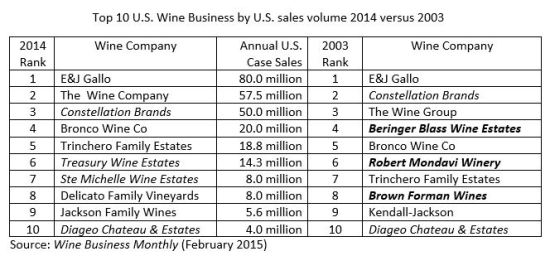
Wine is one exception to the dominant corporation rule. Here (above) is a table of the ten largest wine businesses in the U.S. market (measured by estimated or reported volume not value of sales) for 2014 and 2003. The data are from Wine Business Monthly, which publishes an analysis of the 30 biggest U.S. wine firms each February.  I’m looking at just the top ten to keep the analysis simple, although I should note that these ten firms collectively account for about three-quarters of all wine sold in the U.S.

Looking at the 2014 data, you will note that only four of the top ten firms (those in italics) are public corporations or subsidiaries of public corporations. The other six are family-owned or, like The Wine Group, privately-held and together they produce more than half of all the wine sold in America. [editors note: There was a typo in te graph, which should list The Wine Group not The Wine Company.] The bias towards private- and family-ownership is even stronger if we look at the next 20 wineries where only a few corporate names like Pernod Ricard make the list.

Looking closely at the 2014 numbers it is hard not to be impressed by the growth of family firms Delicato and Jackson Family Estates and also the success of Ste Michelle Wine Estates, which seems to behave like a privately-held firm even though it is a subsidiary of a public one, albeit in a different line of business (Altria specializes in tobacco products, not drinks).

All in the Family

Family- and private-owned wine companies are if anything more important today than they were before the Great Recession. Why are family-owned wineries so vibrant despite their structural economic limitations?

The conventional answer to this question — and there is in fact a substantial academic literature dealing with family businesses and even family wine businesses — stresses the ways that family businesses take a multi-generational approach and are able to negotiate the trade-off between short run returns and long run value. Corporations, it is said, are sometimes driven too much by quarterly returns and end up sacrificing the long term to achieve immediate financial goals.

When business requires a long run vision, it is said, families gain an advantage. Wine is certainly a business where it is necessary to look into the future if only because vines are perennials not annuals like corn or soybeans and successful brands are perennials, too.

Another school of thought examines issues of trust and transactions costs within the firm and the ways that family ties can reduce internal barriers and make interactions more effective.  It is commonplace to say that wine is a relationship business and family firms may have advantages in this regard. I have knows some family wine businesses that even go out of their way to work with family-owned distributors and so forth.  I think one author saw family-to-family links (the Casella family and the Deutsch family) as keys to the success of Yellow Tail brand wine.

Maybe the Real Question Is …

There are good explanations for the success of family-owned wine businesses, but sometimes they feel a bit ad hoc, tailored to explain a particular case and less capable of generalization.  And they often fail to fully account for the fact that many family businesses (and family-owned wine businesses) either fail or, like the Taylor family, end going over to the dark corporate side. Family relationships can be good, bad or ugly — you cannot think of the Mondavi family story without channeling an episode of Family Feud) and not every new generation wants to stay in the business. So there must be something more here than simple families think long-term. But maybe we are actually asking the wrong question.

Maybe the question isn’t why family-owned wine businesses are so strong and instead why corporate owned wine businesses are sometimes so ineffective. Is there something about wine that turns smart corporate brains to mush (not all of them, of course, but maybe some of them)? Come back next week for some thoughts on this provocative question.

The Curse of Corporate Wine-Think?

 May 12, 2015

Protecting Assets versus Leveraging Them

One difference that I have noticed about family wine businesses versus some of the corporations regards the role of key assets such as brand and reputation.  Many family wineries that come to mind seems to see their role as protecting brand and reputation so that they will continue to provide benefits well into the future. Some corporations that come to mind, on the other hand, seem to focus on leveraging brand and reputation in order to increase short run returns.

What’s the problem with leveraging a brand? Leverage has the potential to increase returns in any business, but it also increases risk. And one risk is that the integrity of key assets can be undermined by the leverage process itself.

An example? Well, I hate to pick on Treasury Wine Estates because they have seen enough bad news in the last few years, but one of my readers emailed me in dismay when a news story appeared about Treasury’s latest market strategy. I’ll use this as an example, but Treasury isn’t the only wine corporation that I could pick on and maybe not even the best example

One element of Treasury’s plan is to develop brands for the “masstige” market segment, which means taking a prestige brand and levergaing it by introducing a cheaper mass market product that rides on the iconic brand’s reputation. 
Masstige? Sounds like something from a Dilbert cartoon, which means of course that it is a totally authentic contemporary business term. Prestige fashion house Versace, for example, seems to have developed a masstige product line for mass market retailer H&M. The line was launched in 2011 and I’m not sure where it stands today. Maybe it was a big success? If  masstige  worked for shoes and dresses, how could it be a bad idea for wine?

I’m sure a prestige association helps sell the cheaper mass market products, but I can think of some examples in the wine business (Paul Masson? Beringer?  Mondavi?) where it might have undermined the iconic brand itself a little or a lot, which seems self-defeating. I know that has happened in the fashion field (think about how the Pierre Cardin brand was diluted by cheap logo products) so I imagine it could be a factor in wine, too.

Think Global, Source Global

Here’s another example. Regional identity is more important in wine than in some other industries and Treasury owns some famous “wine of origin” brands — wines associated with particular regions, which are valuable assets.  But my worried reader was concerned about Treasury’s plan to source globally to expand the scale of some of these regional brands.

“Building scale via sourcing breadth is one of the most critical platforms necessary for the globalization of wine brands,” according to the report. Gosh, that even sounds like corp-speak, doesn’t it? Logical, I suppose, but maybe locally-defined brands need to be locally sourced to maintain authenticity? Maybe consumers would be suspicious of a Stags Leap wine, to make up an example, that is sourced from Australia or some other distant place as a way of leveraging its brand power? I wonder just how flexible these terroir-based brand concepts are in the real world where consumers are the ones who decide what is authentic and what is bogus.

Global Market Moral Hazard

Some big wine corporations that have had troubles in recent years seem to have made the mistake of thinking that big global markets will soak up all that they (and the other big firms) can produce. It’s a matter of global-think. The global markets are huge. There’s always a market for another dozen containers somewhere in the big world of wine, or so it might seem, and so the risk of failure is misunderestimated, to use a GW Bushism.

In finance we would say that the false sense that the global market is always there to bail you out leads to moral hazard and this is probably true in wine, too.  Moral hazard encourages excessive investment and promotes booms and the busts that often follow. What seems to be true for an individual company is not necessarily true for an industry and misunderstanding this sort of risk is downright dangerous in an industry like wine, which is by its nature subject to cycles and booms and busts.

If private- and family-firms avoid the tendency to think global when their markets are local and thus avoid misunderestimating risk and if they really do work to preserve rather than leverage key assets it might help explain their lasting power and influence. Lots of “ifs” there, but its a theory. What do you think?

Alcohol and the Idea of Wine

A brief rumination inspired by the Come Over October movement.

I was very fortunate to be appointed to an endowed university chair about 20 years ago, which afforded me great freedom in what I could teach, so long as the classes contributed to the college education goals. My first new class was called “The Idea of Wine” and it quickly became the school’s most popular course, with a waiting list longer than the class list itself, even though the students knew it wasn’t a wine-tasting course and certainly not a wine-drinking course.

That’s the Idea!

Why did I call the course “The Idea of Wine”? Because ideas are important and how we think about things affects how we act. Many people seem to think about wine in terms of its alcoholic content and it is true that alcohol is critical to wine production. Wine isn’t just grape juice with alcohol added. The process of fermentation transforms the grape juice into a very different product. That’s why non-alcoholic wines must first be fermented and then the alcohol removed. You can’t avoid that alcohol step if you want to have wine.

So alcohol is part of wine, but if your idea of wine is alcohol, then it distorts the situation. I noticed this when I wrote a column a few weeks ago questioning whether wine is a good value in today’s marketplace. A couple of readers wrote to me suggesting that I had missed the obvious point. If you think of wine as alcohol, then it can be an excellent value, with a cost per unit of alcohol lower than beer or spirits for inexpensive commercial wines. OK, that’s probably true. Many people probably think of wine as just cheap alcohol, and they are entitled to their opinion, but that’s not the way I see it.

Prohibition’s Long Shadow

You can see where thinking about wine as just an alcohol delivery system can lead if you look at the U.S. experience with Prohibition. Beverage alcohol in general was prohibited during the Great Experiment in sobriety (although illegal booze was available, of course). But one loophole in the law allowed for home production of up to 200 gallons of wine per year for “non-alcoholic” family use.

Home-made wine, therefore, became a ready source of alcohol and, it must be said, alcoholic content was often all it had in common with quality pre-Prohibition wine since it was produced by amateur vintners in make-shift facilities with grapes that often traveled long distances in trucks and rail cars before processing. The idea of wine for most people was pretty sorry indeed.

Wine changed when Prohibition was repealed, but the idea of wine as alcohol didn’t suddenly disappear. Alcoholic content was still very important (sales of cheap fortified wines soared). State-controlled and sometimes state-operated distribution systems treated wine as a dangerous substance. It has taken almost 100 years to change the idea of wine in America and now we confront the possibility that the pendulum has started swinging back again.

The Hunt for Grape October

The idea of wine as alcohol has gained primacy in recent years. It may be a bad idea whose time has come, as they say, but it behooves those of us who love wine to put forward altertnative visions.

And so I am glad that we are celebrating Come Over October (COO) this year because it is built on a bigger idea of wine. The idea of COO isn’t about what wine is or what it’s made of or what ten aromas and flavors you should try to pick out. The idea of COO is to focus on what wine does (bring us together) and how wine makes us feel when we share it with old friends and new ones, too.

Ideas are important. John Maynard Keynes wrote that ideas are powerful for good or evil. If alcohol is a dangerously bad idea of wine then COO is a dangerously good idea, don’t you think?

Is October the Month You Finally Try Non-Alcoholic Wine?

Is October 2024 the month you finally try non-alcoholic (NA) wine? Maybe you’ve never sampled NA wine before or perhaps you have and were disappointed. In either case, this might be a good time to see what’s going on.

The Case for NA Wine

The NA wine market in the U.S. is growing, which is worth noting since the overall wine market continues to struggle. NA wine sales have grown by more than 25 percent over the last year, albeit from a relatively small base.  On an anecdotal level, we have watched as the NA part of the wine wall at our local upscale supermarket has grown from one lonely bottom shelf to two shelves and now three. Given the competition for shelf space, that says a lot.

Sue and I got interested in non-alcoholic wine a few years ago when a good friend of ours was in a severe cycling accident. Recovery from the concussion she suffered was slow and the doctors said no alcohol, not even wine. But a glass of wine in the evening lifts the spirits, so the search was on for an alternative with the taste and feel of wine, but without the alcoholic kick.

Our initial research was a bit disappointing because NA wines were not always easy to find and the selection was generally limited. This was especially true in on-premise situations. There was almost always NA beer available, but NA wine? Not so much.

Since then the NA category has exploded, especially for NA beer and NA spirits. At one point, for example, U.S.-made Athletic NA beer was the best-selling brand of beer at Whole Foods stores. NA brews from Europe are popular, which makes sense because the combination of active anti-alcohol movements in Europe and strict drink-driving laws pushed up the demand for these products early on.

A recent shopping trip revealed three or four varieties of a single inexpensive California NA wine brand at the local Safeway store. But the Metropolitan Market across the street offered nearly 20 different NA wine SKUs ranging from about $10 to nearly $30. The wines came from the U.S. (Washington and California), Germany, New Zealand, and South Africa.

The Second Glass Test

Writing in The Wine Economist in December 2023, I proposed “The Second Glass” test for NA products.  NA beer and wine ought to remind you of the regular product and not be, like the sparkling apple cider we used to serve non-drinkers at our parties, a liquid placeholder for wine. And it should be tasty enough that you’d want a second glass and not just nurse the first one until it is time to go home.

Good NA beers satisfy the Second Glass test, but so far we have not found many wines that do. Either they don’t remind us of the equivalent wine (a NA New Zealand Sauvignon Blanc, for example, ought to remind you of a NZ Sauvignon Blanc) or they just don’t make you ask for that second glass. The growing interest in NA wines is such that the Second Glass test article is by far the most-read single article on Wine Economist so far this year!

The NA wine section at your local upscale supermarket probably isn’t as large as the equivalent NA beer space, but at least it exists (I still haven’t seen NA wine on a by-the-glass on-trade list), so maybe it is time you checked it out. October is just around the corner. Maybe that’s the time.

Why October?

October has sort of evolved into a month to think about how wine fits into your lifestyle. It started, I think, with the advent of something called Sober October, which is sort of an echo of Dry January. Why October? Because it rhymes with Sober, I suppose. Sober October provoked the creation of a movement called Come Over October (which only rhymes if you have a pretty bad head cold), which stresses the sort  of social gatherings that are wine’s natural environment.

Water keeps us apart, I like to say, but wine brings us together. That’s the spirit of Come Over October to me and the program is receiving lots of support from wineries and retailers that are happy to remind consumers that wine is about people and sharing, not alcoholic content.

Since Come Over October is about bringing people together, alcohol is neither necessary nor sufficient to participate and it seems to me that this is your opportunity to give NA wine a test run if you haven’t tried it or a second chance if you have. I know some readers will object to bringing NA wine into the conversation, but if consumers are interested in NA products and if wineries can profitably make good ones, then it seems like we should embrace the opportunity. Imagine if cola makers rejected the idea of sugar-free colas or if coffee producers turned their backs on caffeine-free coffee. You’d think they were nuts.

Meet ZERONIMO and Dr. LO

Our most recent NA wine experiments have involved brands from ZERONIMO and Dr. LO. The ZERONIMO wines are imported from Austria. Although they are produced in relatively small quantities, they have found markets in both Europe and America. Production has expanded from 3000 bottles to 60,000 bottles of four different wines.

White wines and sparkling wines are the types of NA wines we most often see on store shelves, so we were interested to try the ZERONIMO Sparkling Select ($39.30), a blend of Pinot Blanc, Chardonnay, and Sauvignon Blanc. It was very dry and refreshing. It passed the second glass test for me, but Sue said it was on the edge for her because of the acidity.

We have not seen or tried many red NA wines. The highly-rated (98 points!) ZERONIMO Leonis Red Blend ($69.40) is a blend of Blaufränkisch, Zweigelt, and Cabernet Sauvignon that spends two years in oak.  It is light-bodied, as you might expect from an Austrian red, and showed oak influence without tasting woody. It is the first red NA wine we’ve tried to pass the second glass test, but I wish I had been more successful in teasing out the fruit.

Dr. LO is a line of NA wines from Loosen Bros., the well-known producer of Mosel wines. There is both an alcohol-removed Riesling and an NA carbonated Riesling in the portfolio. Sue and I are predisposed to like Mosel Riesling wines in general and we admire Loosen wines in particular. And it seems like they might be a particularly good base for NA treatment since the regular wines start out with relatively low alcohol levels. The alcohol is removed using the vacuum distillation method which, Loosen argues, creates a more balanced NA wine, when combined with the low initial alcohol level.

We really wanted to like still Dr. L Riesling (and we did) but it didn’t fully pass our second glass test. It was tasty and refreshing, giving us the fruit we missed in the earlier tastings, so we’d happily have another glass, but to be honest it didn’t remind us of Riesling wine. That’s a subjective assessment, of course, but that’s our finding. Your mileage may vary.

Come on Over

If October is the month when we make a point to invite friends and family over to share wine, food, and fun, then it is not a bad time to try out some of these non-alcoholic wine products. There will be some folks who want to avoid or limit alcohol consumption for health or religious reasons or who have volunteered for the role of designated driver.

They are going to be looking for something tasty to drink while avoiding alcohol. Why shouldn’t it be wine?