
Recently, I’ve noticed that Wine Economist posts and pages that reference my book Wine Wars II: The Global Battle for the Soul of Wine (2022) (such as “Countdown to Wine Wars II and Wine Wars II) are getting a lot of attention. I think I know why.
The biggest updates in Wine Wars II is a new closing section called Wine’s Triple Crisis. As I re-read this section (and reflect on current wine market conditions), I see why current readers might be especially interested. I’ve pasted below a very brief summary of this part of the book (clipped from the introductory chapter) so that you can see what it is about.
The environmental and economic crises are clear (and I hope I did them justice), so I want to draw your attention to the third issue, wine’s identity crisis. What is wine (is it just alcohol)? Who is it for (just for boomers or just for the wealthy or just for elites)? What does wine do to us (does it make us happy or does it make us sick)?
The identity of wine has changed dramatically in the last 100 years. No wonder the wine business has changed, too. Here’s that excerpt from Wine Wars II.
WINE’S TRIPLE CRISIS
The global wine industry is in the midst of a triple crisis, and I am not really sure how it will end. The climate change crisis comes first. It affects everything if we consider both direct and indirect effects, so it may seem odd to think of it as a wine crisis. Wine grapes generally can be made to grow under quite extreme conditions; in some colder regions, they actually bury the vines in the winter to protect them and unearth them each spring so that they can come back to life (you might call this Lazarus viticulture). But specific wine grape varieties thrive in only very narrow bands of average temperature, and wine regions defined by particular grapes or wine styles are threatened by relatively small changes in environmental conditions. Wine is, therefore, the canary in the coal mine when it comes to climate change. It will feel the impacts before many other industries, and so it is not a surprise, as I explain later, that wine businesses are among the strongest advocates for progressive environmental action.
The climate change crisis dwarfs everything else in the long run, but because the long run can seem far away and we often misjudge how fast it is approaching, climate concerns do not get the attention they deserve. Indeed, as the global reaction to the coronavirus pandemic crisis has demonstrated, climate change generally isn’t treated with the “drop everything” or “operation moonshot” urgency that real crises warrant. But even if the climate change threat were to disappear tomorrow, wine would still be in trouble.
The second crisis is economic. Wine is a magical beverage, but it is a crazy business. Wine’s economic environment is characterized by cyclical, structural, and “wild card” forces that make it difficult to prepare for or successfully execute a business plan.
Global wine consumption grew steadily for the twenty years that ended in about 2008, the date we associate with the global financial crisis. Rising wine sales were important because they slowly soaked up a surplus of wine. Too much wine? Well, for many years the European Union in effect subsidized wine
production to stabilize agricultural economies, especially in France, Italy, and Spain. Wine farmers were paid to grow grapes and to make wine that could not be sold, so some of it was distilled into industrial alcohol. Yuck! Those policies are history, and European winegrowers turned from government subsidy wine to wine aimed at global markets. This is a good thing, but it happened just as wine production increased in other parts of the world, too. The result: a lot of grapes, a lot of wine, and a lot of jobs and incomes at risk.
Rising global wine sales were most welcome in this context, and when sales dropped a bit in 2008, no one was very concerned. “It’s just the economy, dummy,” they said. “Wine will spring back when the economy improves.” But it didn’t, and the next ten years were what I have called “wine’s lost decade.” Why did wine lose its mojo? There are many possible reasons (I explain them later), but the sudden loss in momentum changes the nature of the game from a positive-sum fight, where a rising tide raises all ships, to a zero-sum fight for market share. And the battle isn’t just between Old World and New World or among the growers and producers in these regions; the opponents are now more diverse and unexpected than ever before.
The reason? Wine’s identity crisis. Wine has never been just one thing. It is, after all, both that fancy French Champagne at the top of the wine wall and that big box of Franzia at the bottom. Wine is healthful (think Mediterranean diet) and dangerous (read the government required warnings on wine labels in the United States). It is culture to some and just another commodity to others.
The cartoon character Pogo famously said, “We have met the enemy, and he is us,” and this is true in a way for wine. The biggest threat to wine’s identity is something inherent to wine’s existence: alcohol. You might think that wine is just grape juice with alcohol, but wine doesn’t taste much like the grapes it is made from except in a few specific cases. Fermentation doesn’t just add an alcoholic kick; it transforms the product in complex ways. It’s the same with the way that fermenting yeast makes bread different from flour and water. So wine as we know it is impossible without alcohol, but it may also be impossible with it if antialcohol forces have their way.
Wine’s identity crisis is significant because it seems like those who see wine as a social or health problem, not an essential element in our culture, have seized the momentum. If wine doesn’t know who it is and what it is and cannot tell its story to the world, then how can it survive?
 “Globalization versus Terroir” is the title of my first published essay on wine economics. It appeared as a chapter in my 2005 book


 The Portuguese translation of my book
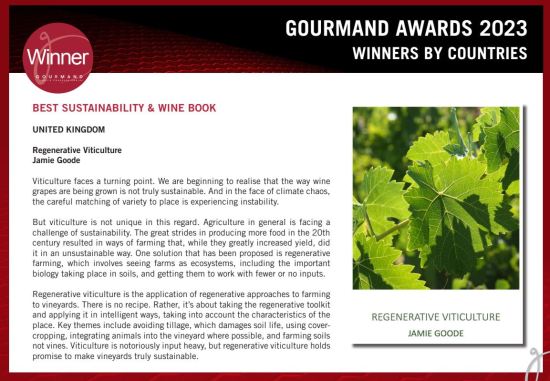
  A Volta Ao Mundo em 80 vinhos, by Mike Veseth and translated by Editora Valentina, was named Best Wine Book Translation in the World at the Gourmand Awards, during the Cascais World Food Summit in Portugal.
 The Wine Economist first appeared on May 29, 2007, with a report called “
 The original idea was simply to take advantage of the blog format to work out ideas in public and get feedback from a broad group including consumers, industry professionals, and other academics. This worked better than I might have expected.
 The Portuguese translation of my 2018 book
  Authors don’t get rich from translation rights, but it’s exciting to see the new edition because it promises to expand the global audience for my book. Brazil and Portugal are important wine-producing and consuming countries and the Portuguese-speaking world is, well, worldwide. It seems like I find Portuguese and Brazilian influence wherever I go. Europe, Africa, Asia, the Americas, everywhere!



 My latest book,

