The Three Faces of the American Wine Dilemma

We live in a time when problems we face are complicated but many of the answers proposed to address them are very simple.  I am suspicious of simple answers to complicated questions, both in general (this was the theme of my 2005 book Globaloney) and when it comes to the American wine industry.

Draining America’s Wine Lake

Wine Economist readers already know about the American wine industry’s general over-supply problem.  Despite several short harvests in a row in California, wine inventories remain very high and prices are falling. As Jeff Bitter pointed out at the Unified Wine & Grape Symposium last month, many thousands of acres of wine grape vines have been removed and more grubbing up is necessary before supply has been downsized to balance with demand. Similar adjustments are taking place throughout the world of wine.

I was interested to learn from Jeff that California’s Central Valley is perhaps closer to equilibrium than, say, the Central Coast. This is in part because growers in the valley can more effectively switch to alternative crops, which cushions the blow of vine removal. Indeed, many large growers already farm multiple types of crops, so the switch is a change of ratio and proportion, not a move into a new line of business.

Some growers would like to “furlough” their vineyards, to pause production until the market has stabilized. But, at least in some areas, this is made difficult because of water use regulations. Water rights can be withdrawn if the land is not actively farmed for several years. So in some areas, where alternative crops are not feasible and water rights are tightly controlled, vineyard removals or furloughs are hard to manage. No wonder there are reports of some vineyards simply abandoned! (I have also heard of one vineyard that was offered at a zero-dollar lease to anyone who would keep production going and, therefore, keep water rights safe.)

Unemployment: Cyclical, Structural, Frictional

The wine market situation is complicated in other ways, too. Both Glenn Proctor and Danny Brager talked about the problem at the Unified in terms of structural versus cyclical adjustments and this got me to thinking about the way economists explain unemployment as the interaction of three forces. I will explain briefly since I think these concepts apply to wine, too.

Cyclical unemployment is caused by cycles in the economy. Workers lose their jobs as firms scale back during a recession, for example, and gain them back (or get other jobs) when economic growth returns. Macroeconomic stimulus (tax cuts, interest rate reductions) are tools of choice to address cyclical unemployment.

Structural unemployment is joblessness due to changes in the essential structure of the economy. Changing patterns of trade, environmental shifts, and technological change are some of the causes of structural unemployment. Some newspaper employees, for example, suffer structural unemployment as demand shifts from physical to digital platforms for information, entertainment, and advertising. One of the concerns about artificial intelligence technology is that it might contribute to structural unemployment.

It is significant that policies designed to address cyclical unemployment such as interest rate cuts will do little to correct (and could even accelerate) structural unemployment problems.

Finally there is frictional unemployment, which is joblessness caused by inefficiencies in the labor market, as happens when there are jobs available in one city and jobless workers in another city, but information inefficiencies, high transaction costs, and other barriers prevent them from productive connection. The current housing market, with higher mortgage interest rates and historically high prices, is one source of frictional unemployment, for example. Job market policies tailored to either address cyclical or structural unemployment problems may have little impact on frictional unemployment. There aren’t many easy answers to complicated questions.

The American Wine Dilemma

These concepts apply to the wine industry in America and other countries today. The wine market has long been subject to medium-term (7- to 10-year) cycles, for example, although “wild card” events such as the COVID pandemic have distorted the pattern. Some wine industry folks have never seen the bottom of the wine cycle before. The fact that the previous “boom” part of the cycle was characterized by a ratchet-up of wine prices (premiumization) makes the down cycle more difficult to predict.

There are also structural changes at work. Demographic transition (baby boomer rise and fall) is part of the situation, but so is the structural shift in attitudes and behavior towards beverage alcohol generally.  There also seems to be a structural shift in consumer preferences away from red wines toward white wines. It is hard to predict how and when these structural forces might run their course and when or whether they might reverse.

Finally, there are frictional concerns that take many forms around the world, but here in the United States are perhaps most apparent in wine distribution and retailing. Wine distribution pipelines have narrowed in recent years. I have written that every industry organizes itself around its most important inefficiency (or “bottleneck,” if you know what I mean). Distribution is wine’s bottleneck, not growing grapes or making wine. The fact that this bottleneck has narrowed is significant and could well reshape the industry broadly.

The Age of Uncertainty

If you are looking for a simple answer to the dilemma of American wine, you are not going to find it here. The point, as stated above, is that complicated questions seldom have simple answers. Complexity leads to uncertainty because each of the cyclical, structural, and frictional forces is difficult to predict and their dynamic interaction is sometimes best modeled by chaos theory

So, as I wrote here a few weeks ago, we have entered the Age of Uncertainty. In economics, uncertainty equals risk and risk discourages investment, innovation, and growth. Not what the wine industry needs at this moment. But understanding uncertainty and risk is better than charging ahead in ignorance.

American Wine 2025: Field Notes from the Unified Symposium

Sue and I recently attended the Unified Wine & Grape Symposium in Sacramento, California, North America’s largest wine industry gathering. Attendance was about 10,000 for the meetings, seminars, and the massive trade show. The event is simply too big to summarize, so we jotted down field notes instead to give you a sense of the action. Here, in no particular order, are some of our observations.

>>><<<

Wine industry trends. White is the new red. Stable sales are the new growth. Wine sales are down in terms of both volume and value. The number of wineries in the U.S. actually fell. Most of the decrease was in the category of “virtual wineries,” which sell wine that is actually made by other companies under contract (a surprisingly common practice).

>>><<<

Tough times for the nurseries that supply grape plants. One vendor said that if the best year was 100, the current status is about 20. Vineyard acreage in California and elsewhere continues to fall with more removals to come.  This is part of a global trend.

>>><<<

The luncheon speaker was Alecia Moore, better known by her professional name Pink (later that week she performed along with other artists including Stevie Wonder, Billie Eilish, Lady Gaga, and others at the FireAid benefit concert).  What’s her wine connection? As she put it, she is a “celebrity winemaker,” but not a marketing play as is sometimes the case. Her Two Wolves vineyard and winery in Santa Barbara County is a serious operation and significant commitment. Many in the audience were inspired by her story and obvious enthusiasm.

>>><<<

Heard on the floor of the trade show from a first-timer: “How do you take it all in? There’s so much!” Answer: A piece at a time.

>>><<<

The Unified is an opportunity for those in the wine industry to meet with friends and colleagues. Lots of hugging, hand-shaking, back-slapping, high-fiving. Wine is a people business and this is the place to make and maintain personal and business relationships.

>>><<<

Bottle weight. Producers are opting for lower-weight bottles, and looking to source them domestically. Shipping costs and schedules — and their uncertainties —  are big factors. Heavier bottles are harder to move around. So, shipping and schlepping. Some producers are opting for lighter-weight bottles to maintain a price point. Question: Do consumers (still) think that bottle weight indicates wine quality?

>>><<<

Multilingual wine. The Unified is designed for the California wine industry, but it is an international event. Languages heard: American English, Canadian English, Australian English, British English, Spanish, Italian, French. No doubt there were even more. There are several Spanish-language sessions.

>>><<<

The locavore paradox. Many restaurants highlight their locavore credentials. Farm to table. Locally sourced meat and produce. Think global, eat local. But how many feature local wines? Aren’t wines the ultimate product of place? Shouldn’t they have a place on the locavore table?

>>><<<

There is not much wine actually consumed during the day at the Unified (the nights are a different matter) because it is a business meeting and trade fair, not a consumer-tasting event. We had wine at the keynote luncheon and there were  tastings sponsored by regional wine associations on the trade show floor on Wednesday afternoon. This year we focused on New Mexico’s wine industry, which is celebrating its tradition of fine sparkling wines by hosting the first Global Sparkling Wine Summit this summer. Great wine. Learned a lot.

>>><<<

Sauvignon Blanc. Each year the organizers choose a particular wine grape variety to showcase and this time around it was Sauvignon Blanc. Aromatic white wines are popular right now and Sauvignon Blanc is doing well. The audience heard from several winemakers and tasted wines from California and Washington State.

>>><<<

Sue never gets tired of walking the trade show floor. So many interesting people, products, and services. It is the American wine industry, deconstructed, and brought together in one very large room.

>>><<<

New York Times wine critic Eric Asimov moderated a session on the challenge of telling wine’s story in the context of strong headwinds such as the WHO’s finding that no level of alcohol consumption is safe. But is this a challenge or an opportunity? Maybe the wine industry needed a nudge to get its act together and make the case for wine and not just individual wine brands or regions.

2025: Wine & the Age of Uncertainty

The Unified Wine & Grape Symposium, North America’s largest wine industry meeting and trade show, is only a few weeks away. I will be in Sacramento to moderate the State of the Industry session, which features an impressive lineup of wine industry experts:

  • Jeff Bitter, Allied Grape Growers
  • Glenn Proctor, The Ciatti Company
  • Stephen Rannekleiv, Rabobank
  • Danny Brager, Brager Beverage Alcohol Consulting

The panelists have decades of experience in the wine industry, which informs their analysis of current problems and future prospects. It is a tremendous opportunity to hear what the experts are thinking now and to talk about it with the other attendees.

There are many other sessions at the Unified covering all sorts of topics in winegrowing, winemaking, marketing, and business operations. I am particularly interested in the Thursday general session on Crafting a Positive Narrative: Promoting Wine in the Face of Challenges, which will be moderated by New York Times wine critic Eric Asimov. One of the biggest challenges, of course, is the rising anti-alcohol movement. Telling wine’s positive story is as difficult as it is important in the current environment.

There is something for everyone at the Unified (click here to view the complete program and click here to read the speaker bios). Sue especially appreciates the big trade show where more than 900 exhibitors will highlight what’s new in the wine industry from the biggest machines, smartest technology, and best products and services from vineyard to cellar to bottling line all the way to market.

Always the Age of Uncertainty?

I always start the State of the Industry session with a few remarks to set the stage and this year I have chosen a theme, the Age of Uncertainty. This is a time of great change in the wine industry and change makes people nervous.

Age of Uncertainty? I know what you are thinking. It is always the Age of Uncertainty in the wine business. Growing grapes is risky, making wine is risky, and selling wine is risky. There is no part of the wine business that does not have an uncertain component. Wine is a global business, too, and while global markets create opportunities they also introduce additional layers of risk.

I specialize in international and global wine markets, so I am especially concerned with how international economic policies add more layers of uncertainty to wine business today. We have been told to expect high tariffs (on wine and just about everything else) in 2025. Depending upon how they are structured, and how our trading partners react to them, tariffs can have a number of direct and indirect effects.  There’s a lot at stake and the final outcome is difficult to predict.

Indeed, the International Monetary Fund recently identified the threat of tariffs as a major global economic concern. The possibility of tariffs has driven up long-term borrowing costs around the world, according to the IMF, which will release its new report on the global economy later this week.

And this week’s Economist newspaper highlights uncertainty about tariffs and other policies as a main cause of global instability.

It is easy to see why uncertainty has spread. Will Donald Trump deport millions of people? Nobody knows. But if he succeeds inflation could jump as employers lose workers. The story is similar for tariffs, which would also increase prices. At the same time, potential Chinese counter-measures in a trade war, such as a devaluation of the yuan, could prompt a global deflationary shock.

The rising perceived risk, according to the Economist, helps explain falling bond prices, rising mortgage interest rates, and many other current trends. They say that what you don’t know won’t hurt you, but uncertainty clearly has a cost.

Not by Wine Alone

I know many people who think a tariff on imported wine would benefit American growers and producers and others who strongly oppose the idea. But it is important to remember that we aren’t talking about tariffs just on wine. Although it is hard to know right now (that uncertainty thing), it looks like the new administration will impose tariffs on most imported products from many or most of our trading partners, with the highest tax rates on China, Mexico, and Canada, the countries with whom we trade the most.

Border taxes on such a long list of imports have different effects than a tax on a specific product category like wine. That’s part of the uncertainty problem. U.S. producers may gain from protection from imports but lose from higher costs for imported supplies, equipment, and technology. Labor costs, interest costs, and insurance costs would all likely be pushed higher by rising inflation.

And U.S. tariffs aren’t the end of the story. How will other countries react? Will European nations retaliate with tariffs on U.S. wine? Probably not. I think they’d focus on spirits, not wine. Would Canada target U.S. wine? Yes, I think they might and that’s a problem because Canada is a good market for U.S. wine exports.

The  Dollar Also Rises

President Trump favors a falling dollar value on foreign exchange markets because that would reinforce his trade policy by discouraging imports and promoting exports. But tariffs tend to push the dollar higher as we have seen since the election results were announced. The dollar’s value rises when it sounds like tariffs will be used as a blunt weapon to keep out imports. The dollar falls, however, when the rhetoric suggests tariffs as targeted strategic tools to gain specific concessions. Which way will tariff policy lean in 2025? I don’t know, do you?

How are tariffs and the dollar related? Here’s one way. Tariffs tend to increase inflation, which forces the Federal Reserve to keep interest rates higher than they otherwise would be. This attracts foreign capital that boosts the dollar’s value, making imports cheaper in dollar terms and U.S. exports less competitive abroad.

Immigrant policies are the third element of the Age of Uncertainty for wine in my analysis. It is too soon to know how border controls and deportations might affect labor both generally and in industries such as agriculture and construction that are most exposed. So wine’s Age of Uncertainty is a complicated matter.What’s the bottom line? I’m saving that for the State of the Industry session.

Galbraith’s Uncertainty Principle

Why did I choose this theme for my remarks? The idea was inspired by an old book that strikes me as still relevant today. The Age of Uncertainty is the title of a 1977 BBC/KCTS television series and an accompanying book by the distinguished Harvard economist John Kenneth Galbraith. The book and videos, which survey two hundred years of economic history and the history of economics, were timed to coincide with the 200th anniversary of Adam Smith’s Wealth of Nations.

People tend to remember Galbraith as the sophisticated author, public intellectual, and Harvard professor that he became, but his personal story is more complicated. He grew up on his family’s small Ontario farm and seemed set for a farming career, graduating from Ontario Agricultural College in 1931. But the 1930s were not the best of times for farming and Galbraith soon found himself doing PhD studies in agricultural economics at the University of California and then working for the U.S. federal government’s Agricultural Adjustment Agency (AAA) trying to prop up farm prices.

I don’t think that wine is mentioned even once in Galbraith’s book, but his agricultural background and experiences are easy to trace. The world has changed a lot in the almost 50 years since The Age of Uncertainty first appeared (and nearly 250 years since Wealth of Nations), but American winegrowers and agriculture generally can certainly relate to Galbraith’s story and the concerns he expressed in this book.

The Road Ahead: Lessons from the Unified Symposium

What’s the state of the wine industry? Here are four observations inspired by things I learned at the Unified Wine & Grape Symposium‘s State of the Industry session and in hallway conversations. The theme, if there is one, is a spin on Robert Frost’s poem about the road not taken. The industry needs to choose a direction. Follow the well-trodden path that got us where we are or break away? Frost thought the choice was significant. What do you think?

One: The wine industry has a problem. But it isn’t just wine’s problem.

Everyone knows that the volume of wine sold has declined in recent years, which is a serious problem for many people in the wine value chain. Not every category has suffered equally and there are a few areas of growth. The picture improves a little if we look at the value of wine sold, but this mainly highlights segments where increases in average price have outpaced declining volume.

For many years the industry was built on an expectation of continued growth and it is difficult to re-gear for a declining market with high inventories from previous vintages that cloud prospects for the near future.

Some people were shocked when Jeff Bitter, President of Allied Grape Growers, called for the quick removal of 30,000 net acres of vineyards in California in order to bring supply into line with demand.  Jeff has been saying this for several years and I think his message is finally starting to sink in.

What’s behind the headwinds blowing against the wine industry? We used to blame spirits and craft beer. The story was that consumers were shifting to beer and cocktails in preference to wine. But that’s not true in general today. Both beer and spirits have falling overall demand, too.

Wine’s problem is not just a wine problem, it is a beverage alcohol problem. The situation is so bad that even once-hot tequila is cooling off. The Financial Times recently reported that some agave farmers in Mexico are balking at requests to replant for another harvest cycle. Maybe demand will be there when the plants mature. But maybe not, especially if U.S. demand tumbles (markets in other countries are not large enough to absorb a big U.S. surplus).

Two: We are not alone.

OIV data show that global consumption has fallen after a decade of stagnation. The soft wine market is just about everywhere you look, but especially noteworthy in the U.S. and China. I highlight the U.S. because it is the world’s largest consumer of wine (and still, many would argue, the best market around because American wine declines are relatively small compared to some others).

China? Well, that’s my own addition to the list. Chinese wine consumption increased dramatically before the pandemic struck and many imagined that its growth would be enough to offset declining sales elsewhere.

But then came covid, which crippled critical on-premise sales in China, and then the trade wars and tensions that have followed. The Chinese market is opening up again now (Australia has its fingers crossed that Aussie wine will be granted favorable access to China soon), but the market there has changed, and lost its dynamism. China after covid is not the growth market for wine that some counted on. It’s a small world after all and wine’s share of it has shrunk.

Three: The prisoners’ dilemma.

It is one thing to say that the wine industry needs to become smaller, more efficient, and more profitable (and it does!), but how do you do that when there are thousands of growers and wineries each protecting their own interests?  There is an element of the prisoners’ dilemma problem here. Collectively, the ideal strategy would be for many winegrowers to reduce vine acreage and take surplus grapes off the market. That would help everyone gain some control over margins.

But collective interests and individual incentives aren’t aligned. If everyone else is going to pull up their unprofitable vineyards, then it is in my interest to keep vines in the ground and gain from the higher prices while they suffer from smaller production. The private incentive encourages everyone to keep production high and the problem continues.

How do you overcome the prisoners’ dilemma created by this conflict of collective versus individual interests? Well, one solution is to play and replay the game over and over until the participants learn that cooperation is a better solution (even then, the “defect” strategy is always a problem). Or some sort of collective action mechanism can be employed, which is one of the things that the Spanish industry’s strategic plan hopes to achieve.

Four: A tale of two futures.

Susana Garcia Dolla, the director general of Spain’s broadest wine industry organization, framed the question in terms of two cycles, one a vicious cycle that reduces the wine industry through crisis and shake-out, and another, a virtuous cycle, that moves ahead toward sustainable profit by design.

Lots of forces will shape the wine industry’s future and it is impossible to expect any predictions to bear up over time. That said, it seems to me that the facts above suggest that we have reached a fork in the road and need to take the right path.

One road leads … well, it leads nowhere in terms of the future of wine. And it seems like the road we are on right now. This road blames consumers for the soft market and fails to confront over-supply in any coordinated way. The industry will lurch along until a critical point comes along, forcing action.

The other road leads to a smaller, more efficient, and profitable wine industry through timely and intentional actions.  The process is painful but follows Machiavelli’s advice to give the bad news all at once and the good news a little at a time. Which road will be taken for wine? And what’s the road not taken?

The Case for Cautious Optimism about the Future of Wine

Sue and I have just returned from the 30th edition of the Unified Wine & Grape Symposium in Sacramento. The Unified is the largest wine industry gathering in the Western Hemisphere with about 12,000 attendees over three days and 900 trade show exhibitors. If you want to take the pulse of the American wine industry, this is the place to go.

So how is the industry’s health? Well, if you go by the economic indicators such as sales trends (more about this next week), the patient is in bad shape.  There was bad news in the wine press and the expectation that more bad news was coming (it did).

Economic Pessimism

The situation reminded me of an essay called “The Economic Possibilities of Our Grandchildren” that the English economist John Maynard Keynes wrote in the depths of the Great Depression. “We are suffering just now from a bad attack of economic pessimism,” the essay began. “It is common to hear people say that the epoch of enormous economic progress … is over; that the rapid improvement in the standard of life is now going to slow down …

“I believe that this is a wildly mistaken interpretation of what is happening to us. We are suffering not from the rheumatics of old age, but from the growing pains of over-rapid changes, from the painfulness of readjustment from one economic period to another.”

I quote these lines here because I think that we are today also suffering from an attack of economic pessimism, both in the wine industry and more generally. We tend to look down and to look back, not ahead, and we avert our eyes from good news (about inflation or unemployment or, occasionally, politics) when it unexpectedly appears.

The only bright lights we allow ourselves to see (the Barbie movie, Taylor Swift) are ridiculously popular because of their novelty and scarcity. We look like the drab men and women of Keynes’s day. How sad.

I am part of this environment, of course, and because I am an economist and therefore a licensed deliverer of bad news, I am also part of the problem. I expected to meet a pessimistic wine industry at the Unified Symposium and that’s what I found. But only at first.

Cautious Optimism

Gloom and doom. But then in casual conversations Sue and I discovered a streak of cautious optimism that we didn’t expect. A friend we met at the registration counter who is involved in winery recruiting said she felt that hiring had turned a corner. Another friend who works in bottle closures was optimistic, too. He accepted the current problems but saw a path forward and was moving with confidence. This was not the first crisis he’d seen and he didn’t think it would be the last. Talking with him was a moment of quiet inspiration.

One winery owner was frustrated by all the bad news in the air because she worried about self-fulfilling prophecies. If we think the future will be dark and act accordingly then it will indeed be dark. Someone must turn on a light or at least acknowledge that the light switch is still on the wall.

Sue was working the trade show floor while I was moderating the State of the Industry session. She reported that it seemed like lots of business was getting done. There was a record number of trade show exhibitors and thousands of people in the aisles shopping for equipment and services or checking out what’s new. It was not a dismal scene, she told me. And it was still buzzing when I got there a couple of hours later after the press conference, even though a lot of people were at lunch.

Don’t Look Back!

What should we make of this uncomfortable combination of bad news and hopeful sentiments? In my remarks to the State of the Industry audience, I invoked the great American philosopher (and baseball pitcher) Satchel Paige, who warned, “Don’t look back, something might be gaining on you.”

How you see the future depends upon how you look at the past, which is your reference point. And that’s a dangerous thing because the past can be different depending upon your viewpoint.

If you look at today’s wine industry from the viewpoint of 2008 (as I discussed in last week’s Wine Economist), then you can’t help but be disappointed. The continued rapid growth that the industry expected then has failed to materialize in general. However, there are obvious market segments (thank you, New Zealand Sauvignon Blanc) that have grown beyond expectations.

But if instead, you look back 30 years, to the very first Unified Symposium, then your perspective is quite different. Seen from 1994, the wine market of 2024 is almost unimaginably prosperous. Wine has grown in every dimension: quantity, value, quality, number of producers and brands, global reach. It’s not where we thought we’d be back in 2008, but it is pretty damned amazing from the 1990s perspective.

The fact that the wine industry today is somewhere between the smaller market that they expected in 1994 and the much bigger one projected in 2008 should give us pause. There is a path forward from here; it is not without costs, challenges, and risk, but it is there for those who take it.

Don’t get me wrong. I am not denying the seriousness of the problems wine faces. Remember that I’ve been the frequent bearer of bad news for several years now. But cautious optimism is justified. The road ahead? Come back next week for more thoughts.

>><<<

Come back next week for more about what we learned at the Unified Symposium. In the meantime, follow this link for a pdf of Keynes’s essay.

A Look Back at the Future of Wine

The Unified Wine & Grape Symposium, North America’s largest wine industry conference and trade show, is happening this week in Sacramento, California. It is an exciting event where people from throughout the industry (and around the world) gather to share concerns and ideas about the challenges facing wine today.

Questions about the future of wine are never far below the surface of these discussions, which perhaps might explain why, in the run-up to the Unified, a very old Wine Economist column has suddenly started to get more clicks. The column was called “The Future of Wine” and it appeared in 2008 when The Wine Economist was in its first year as an online newsletter.

I am republishing “The Future of Wine?” now not because it got everything right, but rather because it illustrates how much recent events weigh on our vision of the road ahead and how hard it is to guess the future.

Please read all the way to the end if you have time because I think Kenneth Boulding’s point cited there is worth considering now and always. Come back next week when I will get out the crystal ball once again and speculate about the future of wine in the context of what I hear and see at this year’s Unified Symposium.

>>><<<

Wine Economist “The Future of Wine?” May 25, 2008

What will the world of wine look like in 50 years? A look in the crystal ball.

What if the Chinese were French?

A journalist with a Brazilian newsweekly called me on Thursday to ask for help with a story on China. The magazine is doing a sort of “worst case scenario” report on the potential impact of China’s economic growth on world markets. What would happen to oil prices, for example, if the Chinese used as much fuel per capita as Americans do? Yikes, that would be a lot of drivers using a lot of gas and it would send oil prices through the roof. What would happen if Chinese consumers generated as much waste and pollution per person as people in the West? Once again, the global effects would be dramatic.

What would happen, the journalist asked me, if Chinese tastes changed and they drank as much wine per capita as the current world champtions, the French? Well, that is a very interesting question, even if it isn’t a very realistic one. Annual Chinese consumption of wine is about a half-liter per capita and rising, according to my copy of The Global Wine Statistical Compendium (and a lot of that wine isn’t grape wine, as I wrote in The China Wine Syndrome). Wine consumption in France, on the other hand, is 55 liters per person and falling (it was more than 120 liters per capita in the early 1960s). The figure is about 8.5 liters per capita for the U.S. and 20 liters per capita for Great Britain.

It is hard to imagine how Chinese wine consumption could rise to the current French level. Heck, it is unlikely that the French will sustain their current level for long. But isn’t entirely out of the question that Chinese consumpion could rise to the world average, which is about 3.5 liters per capita per year. That’s a lot smaller increase than the Brazillian reporter was concerned with, but it would still have a huge impact on global wine markets. Much of the increase would probably be met by higher Chinese production; China is already a major wine producer — smaller than Chile but larger than Portugal in total production. But the global effects would be substantial and prices would surely rise.

We can already see some indication of the potential “China Effect” in the market for fine wine. Everyone seems to think that at least some of the rise in Bordeaux prices in recent years is due to Asian and especially Chinese purchases. This trend seems likely to accelerate now that Hong Kong has eliminated its high tax on wine transactions so that it can become the auction hub of the Asian wine market. The latest Wine Advocate reports prices of 2005 Bordeaux that reach stratospheric levels — $500, $1500, $2500 per bottle! This is what happens when a global market focuses on an object of speculation — huge rents (excess returns) are created. As China (and India, too) become more completely integrated into global markets for products like fine wine, these rents will likely rise higher still.

The View from London

The Brazilians are not the only ones interested in the future of wine. Berry Bros. & Rudd (BBR), the London fine wine house, recently celebrated its 310th anniversary with the release of the Future of Wine Report written by four of their top wine buyers (Alun Griffiths MW, Jasper Morris MW, Simon Field MW and David Berry Green). It makes pretty interesting reading if you are interested in what wine markets might look like in 2058.

I say wine markets (plural) because BBR correctly recognizes that there is not one wine market but many interrelated ones. The fine wine market, BBR predicts, will see the rise of China and India as important factors in terms of both demand and supply. “I absolutely think China will be a fine wine player rivalling the best wines from France,” writes Jasper Morris. Britain will become an important producer of fine wines, too, perhaps especially Champagne-like sparkers.

Wine prices will soar even higher, according to the report. “If values increase by 15% per annumn, as they have been doing recently, a case of 2005 Ch. Lafite-Rothschild, currently available for £9,200. could be worth just shy of £10 mllion by 2050,” according to Simon Staples.

The forecast changes are more dramatic in the volume wine market. China will be the world’s largest wine producer. Global warming will shift wine production from France to Eastern Europe and from Napa Valley to Canada. Australia, the report speculates, could see a collapse of its volume wine industry if recent droughts persist. Goodbye Yellow Tail. Hello boutique producers in cooler, wetter areas like Tasmania.

Brands will become even more important in the volume business, BBR suggest. “In 50 years, consumers will ask for wine by the brand name or flavour and won’t know, or care, where it has come from. Grapes will be genetically modified to change a wine’s taste,” according to Jasper Morris, “and producers will add artificial flavourings to create a style wanted by consumers.” Wait — OMG I think I drank those wines back in the 1970s when I was in grad school!

Bottles and corks? They’re history. Corks will disappear because they are inefficient — the contamination rate is too high. Bottles are heavy and environmentally problematic. Tetra pak containers (like the ones used in today’s French Rabbit wines) and other sustainable packaging systems will prevail for volume wine.

The Future of Wine?

So what should we think of these visions of the future of wine? Economists like to say that prediction is difficult, especially about the future, so long range forecasts need to be taken for the educated guesses that they are.

Some forecasts, will be wrong because they are more or less simple straight line extrapolations (How much wine would the Chinese drink if they were French? How much will fine wine costs if its price compounds at the current rate?). It seems to me that simple projections are usually wrong because they are sensitive to initial conditions. Who is to say if long term trends will match those of the recent past?

Some predictions, like the £10 million case of wine, are extreme, but others are probably too conservative. The wine world has a way of surprising us — who in 1958 would have predicted the importance of Chile and Argentina today or the decline of consumption and production in France? People matter, too. People and their ideas are powerful forces that do not always respect historical trends, as refelction on the recent death of Robert Mondavi remind us.

Kenneth Boulding, the great 20th Century social scientist, once wrote a history of the future. He looked back to see what people in the past had said about the world just ahead. What he learned, he told me, was that when the future eventually rolled around, it never matched the predictions, it was always unexpected. The best way to prepare for the future, he concluded, was to prepare to be surprised. I expect this rather general advice applies as well to wine.

Wine, Globalization, and the End of History

I have been thinking a lot recently about how much things have changed since the 1990s and what the future might look like in this light. The event that has provoked this unexpected thoughtfulness is the upcoming Unified Wine & Grape Symposium, which will be the 30th edition of what has become North America’s largest wine industry gathering.

A Golden Age?

Looking back at the program for the first Unified, it is clear that the American wine industry was worried about the future. It must have seemed like obstacles and headwinds were all around. Problems in the vineyards. Rising foreign competition. And concerns about both government regulation and uncertain consumer demand. One session was titled “Who Isn’t Drinking Wine and Why.” That’s a question we are asking again today.

Looking back it is easy to appreciate these concerns (because they never really go away). What folks back then didn’t realize, however, is that they were in some ways at the start of a wine industry golden age. Baby boomers were entering peak wine-buying years. The economy was growing, fueling the rising interest in wine. The “French paradox” infused popular culture with the idea that wine (especially red wine) was actually good for you because of its role in the healthful Mediterranean diet. Wine made you feel good, it was good for you, and you could afford to drink it. What could be better?

Things have changed a lot since the 1990s and some of those changes contribute to the challenges that the industry confronts today (and that we will strive to address at Unified 2024).

The Globalization Effect

This makes me think about other ways the world (and the wine world) have changed over these 30 years. Globalization was gaining speed in the 1990s, for example. It was controversial (think NAFTA debates and the Seattle WTO meeting riots), but eventually (when China joined the WTO, for example) it was seen by many as an inevitable tide, an irresistible force.

No one thinks globalization is inevitable anymore. The Global Financial Crisis made investors aware of the risks of international market contagion. The supply-chain disruptions of the COVID era made “nearshoring” an awkward but understandable concept. And now political tensions and uncertainties have driven “friendshoring” trends.

Economic globalization hasn’t collapsed. But it is different. Globalization was a powerful force in wine in the 1990s, too, as patterns of production and consumption around the world shifted and international wine trade volumes rose. They kept rising, too, as the graph above (taken from the most recent OIV global wine report) shows, until about 15 years ago, when the volume of wine exchanged across borders reached a plateau. (Click here for a pdf of the OIV report).

The value of the international wine trade has continued to rise, as the graph below shows, due to the general premiumization trend. The pattern of global wine trade has changed, too, both in terms of shipping patterns (think the sharp Australia-China shifts) and the commodity composition of shipments (packaged goods versus bulk wine, for example).

The End of History Effect

One of the forces that powered economic globalization was the collapse of Communism, which opened up a world of trading and investment opportunities. We called it “The End of History” after the famous book by Francis Fukuyama. History was ideological conflict, Fukuyama argued, which was all over. The liberal order was the only story left to tell.

Wine had its own “End of History” in the 1990s, although it understandably got less attention. The history of wine was defined, more or less, by Old World notions of appellations and terroir. Burgundy was Burgundy and Pinot Noir made anywhere else wasn’t the same. Ditto for Bordeaux and Cabernet Sauvignon.  New World producers might purloin Old World titles to market their wines (remember Gallo Hearty Burgundy?), but no one was fooled.

Jancis Robinson’s 1995 BBC television wine series was an important part of the movement to rewrite wine history. She didn’t organize her tour of world wine as you might expect — Burgundy, Bordeaux, the Rhone, the Loire. She sorted things by grape variety — Pinot Noir, Cabernet, Syrah/Shiraz, Sauvignon Blanc — and featured New World wines and producers alongside familiar Old World names.

Not everyone was convinced that the new history was valid. My favorite scene was where Robinson poured a glass of New World Pinot Noir and asked a famous Burgundy producer what she thought. The winemaker scowled at her glass and proclaimed that Oregon shouldn’t make something like this. They should find their own terroir, she said, invoking that mystical French phrase almost like a curse. Oregon on the same stage as Burgundy? It’s like the end of history. What next?

However, the curse was cast in the opposite direction. Not for the most famous names of Burgundy and Bordeaux, but for producers with less well-known names from less-recognized appellations. The fact that they were defined by their place turned out to be a disadvantage in the global wine world where grape variety was the new lingua franca. ( I am smiling at the irony of this phrase even as I type it.)

The baby boomer consumers that everyone was chasing didn’t grow up understanding appellations, but they rather quickly came to understand grape variety and to define their wine world that way. Thus the wines of emerging global powers New Zealand and Argentina became known for their signature grape varieties more than the particular regions that grew them. No one asked if France or Italy had a signature grape variety (a good thing, because they obviously don’t). But other regions asked the question themselves and decided that the lack of a grape of their own was all that was holding them back.

The End of History in terms of ideological conflict hasn’t exactly worked out. Old divisions have reemerged and new ones have arisen. There is plenty of conflict to go around and history endures.

History has returned to the wine world, too. Wine defined by grape variety was the great leveler and helped open up the world to wine. But today, with the market at a plateau, product differentiation is the name of the game, and claiming terroir is one strategy. AVAs are popping up all over in response.

Golden Age Worries

The golden age of the 1990s didn’t last for wine, but that’s how golden ages work. What’s interesting is that the golden age was already upon us before we realized it (and ended before we knew it, too).

I wonder what’s ahead for wine? My friend Kenneth Boulding used to say that history doesn’t repeat itself, but sometimes it stutters. Something to think about! Another golden age? Hard to see how the stars could align to make that happen. But I don’t think many people saw that golden age on the horizon either.

Unified Symposium XXX: Back to the Future for the Super Bowl of Wine Industry Meetings

As harvest 2023 draws to a close, many of us are gearing up for the 2024 edition of the Unified Wine & Grape Symposium in Sacramento on January 23-25, 2024. The Unified is sort of the Super Bowl of North American wine industry events, so I’ve decided to follow Super Bowl practice and call this Unified XXX.

A lot has changed in the economy and the wine business since the first Unified Symposium was convened. The 1990s were a very different time. This was the era of “The End of History” as the collapse of Communism was said to close the era of ideological conflict and open a world of rising liberal democracy.

Surfing the Global Wave

The economy was expanding and markets were becoming more open and more global. Although Ross Perot claimed to hear a “giant sucking sound” of jobs being pulled to Mexico by the new NAFTA agreement, economic growth was remarkably robust. I recall that interest in university economics studies declined because there didn’t seem to be any big economic problems to solve.

As the 1990s moved ahead, the budget deficit in the United States shrank and then eventually actually achieved a surplus! The budget deficit for the last fiscal year was more than $1.5 trillion. What a difference!

The wine world was changing very rapidly in the 1990s, too. Wine surfed the globalization wave much to the benefit of Southern Hemisphere producers. This was the time when Australia, New Zealand, Argentina, and Chile wines became more widely available in the U.S. market, for example.

Wine’s Golden Age?

The U.S. wine market was growing and a Wine Business Monthly article published at the end of the decade provides useful context. “Demographic and Macroeconomic Factors Fueling Increased Wine Consumption” by research analyst Kristine Koerber identified four forces driving American wine: demographic trends, moderate wine consumption’s image as heart-healthy (think “60 Minutes” and the French Paradox story), rising wealth among consumers, and a successful generic marketing campaign (think Got Milk? but for wine).

Koerber concluded her report by saying, “We expect favorable trends to persist. The aging of the baby boomer will be the key demographic trend providing robust growth for the wine industry in the coming years. This demographic group has more disposable income and is reaching its peak spending years at 46.5 years of age, which should further facilitate the consumption of premium wines. High-quality wines with strong brand recognition such as Beringer and Mondavi are positioned to benefit from the growing premium wine market.”

Changing Times

An insightful forecast! But the situation today is pretty much the mirror image of that report. Demographic trends are widely seen to work against wine and alcoholic beverages generally today. Some consumers are wealthier but don’t necessarily feel that way because of pressure from inflation, rising interest rates, higher housing costs, and other factors such as student loan obligations.
Wine was the healthful choice in the 1990s but that tide has turned, too, with anti-alcohol initiatives gaining steam.  The wine industry’s response has been muted, creating what I call in my recent book Wine Wars II the wine identity crisis. Wine has a positive case, but consumers seem to have trouble hearing it.

Which brings me back to Unified XXX. The Unified Wine & Grape Symposium has become the place where the American wine industry comes together to think about, talk about, and form strategies regarding the challenges and opportunities of the day. (A lot of relationships are strengthened and business takes place on and off the trade show floor, too).

Unified I in Perspective

Now flash back to Unified I. That first event drew about 500 participants to the symposium sessions and to visit the 20 exhibitor tables (too small to call a trade show back then). Five hundred wine industry players is a lot and that attendance would be impressive for most meetings today. But Unified XXIX (the 2023 edition) was a lot bigger. About 12,000 people attended over three days, harvesting insights from the 96 speakers and doing business with the 879 exhibitors at the trade show. Unified XXX is on course to be bigger yet.

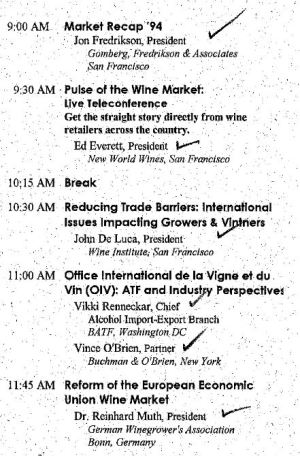
I have been involved with the Unified since 2012, mainly as moderator and/or speaker at the Wednesday morning State of the Industry session, the largest gathering of a three-day event. So I was interested to see what the equivalent program looked like at Unified I.

Jon Fredrikson was the lead-off speaker, giving a half-hour survey of market conditions. Knowing Jon, I’ll bet it was jam-packed with data and insights and that the audience hung on every word. Jon went on to be a featured speaker at almost every Unified meeting for the next 25 years until his retirement.

Jon’s lead-off presentation was followed by a teleconference that brought the voices of wine retailers into the room. This was not an easy thing to do in the landline era of the 1990s. Everyone wanted to know as much as they could about who was buying wine, who was selling it, and how the market looked for the future.

Globalization was obviously on everyone’s mind, too, as the next three sessions made clear, with a session on international trade effects, global perspectives, and how efforts to drain Europe’s wine lake might affect the American industry.

The Unified XXX State of the Industry lineup shows how the program has evolved to even more directly address the concerns of its wine industry audience.  Jeff Bitter and Danny Brager take deep dives into the trends and issues on the grower and consumer sides of the wine market respectively and Steve Fredricks analyzes the markets that connect them and the global market environment in which everything takes place. Susana Garcia Dolla, Director General of the Interprofesional del Vino de España, will provide an important international perspective, helping us understand how Spain’s wine sector has weathered the wine world’s storms and what lessons can be learned from their experience.

But Wait, There’s More!

There was a lot more going on at that first Unified meeting, of course. I am particularly struck by sessions titled “Monsters in the Closet: Major Issues Impacting Growers & Vintners” and “Government Landmines & Opportunities.” Monsters and landmines? Sounds like wine was a dangerous place! John Gillespie and Mike Boyd spoke on “Who’s Not Drinking Wine and Why?” — a question we are still asking today.

Unified XXX will feature a vast array of sessions (here is the complete schedule) that examine important issues in virtually every aspect of wine growing, production, distribution, regulation, and sales. Several sessions are offered in Spanish. It is quite a multi-discipline University of Wine.

A special treat this year is the Tuesday Keynote Luncheon. Karen Ross, Secretary of the California Department of Food and Agriculture, will be the featured speaker. Secretary Ross was President of the California Association of Wine Growers before taking her current job and in that role was instrumental in expanding the Unified into the impressive event it is today.

I am looking forward to hearing what Secretary Ross has to say about how the wine industry has adapted (and must continue to adapt) to the monsters and landmines that lurk around the corner. And to see everyone and learn as much as I can at Unified XXX.

Got Wine vs Not Wine? Wine and the Generation Gap

We are suffering just now from a bad attack of economic pessimism. It is common to hear people say that the epoch of enormous economic progress … is over; that … a decline is prosperity is more likely than an improvement.

The economist John Maynard Keynes wrote these words in a 1930  essay called “The Economic Possibilities of our Grandchildren” and I have been thinking about them quite a lot recently in the context of the wine industry. Keynes was writing in the depths of the Great Depression. Is wine in (or headed towards) a Great Depression of its own?

On the Other Hand …

Certainly the mood at last month’s Unified Wine and Grape Symposium was mixed. Obviously I didn’t talk to all the 10,000 people who attended the 3-day event, but I think I got a general sense of what wine industry people are thinking and feeling from those I encountered.

On one hand (a classic economist opening phrase), there was an upbeat mood because the meetings and trade show themselves felt back-to-normal after several years of covid-driven disruption. The house was packed for our State of the Industry session, for example, and there was a record number of exhibitors at the trade show (and a waiting list for next year). Glass at least half full, for sure.

One the other hand (you knew that was coming), it was impossible to ignore some of the discouraging news in the air (I reported on some of this in last week’s Wine economist column). Some people blamed this on the recently released Silicon Valley Bank report, but I think that is unfair. Like our State of the Industry session, the SVB report has an obligation to be objective — to report the straight facts without a lot of spin. And I think their report does that well. Facts are facts. The question is what you do with them and whether, like Keynes, you can see beyond the current crisis to the possibilities of the future?

The Generation Gap: Got vs Not

Keynes was thinking in generational terms when he wrote his famous essay and a lot of the analysis of wine’s current malaise is generational, too. The baby boom generation powered the golden age of American wine, the story goes, but the generations that followed haven’t embraced wine with the same warm hug. What can we do to make Gen Z consumers love wine as much as their grandparents do? How can we close the wine generation gap?

This is a good question (and I am glad so many people are asking it), but it by-passes part of the problem. Yes, boomers as a group drink a lot of wine, but in fact wine consumption is concentrated among just a small fraction of boomers. The baby boom generation is large — it contains multitudes. It is both Gen Got Wine and Gen Not Wine. Generalizing about generations like the boomers is a risky business.

This is true, I believe, for other generations, too. What makes the wine drinking boomers different from the boomers who don’t drink wine or don’t use alcohol at all? And what, if anything, does the boomer wine cohort have in common with wine-drinking members of other generations? Maybe generational differences aren’t the whole story (or even the most important part of the story)? Is the gap as much within generations as between them?

How Full is your Glass?

Should we be optimists or pessimists as we consider the future of wine? Well, our situation is nowhere near as dire as what Keynes faced back in Depression days. The wine market requires only relatively small adjustments by comparison to restore a balance and a bit more to kick-start growth. Not easy by any means, and it might not happen, but not at all hopeless.

Keynes was an optimist and he used this essay to look far into the future, peering past the short term problems necessarily on his readers’ minds. The prospects for our grandchildren are bright, he said, so long as we are able to avoid certain obstacles — over-population, violence and war, and the politicalization of science. Our current economic situation, since we are the future of Kaynes’s past, is indeed prosperous compared wtih 1930 if not quite so bright as he hoped.

A Half-Full Future?

Let me follow Keynes’s example in talking about the future of wine. Wine has endured for thousands of years and survived many dark periods, so it is not unreasonable to imagine a bright future for wine as both culture and industry. But there are obstacles to be avoided.

In my recent book Wine Wars II I propose that wine must deal with a triple crisis: environmental crisis, economic crisis, and identity crisis. The identity crisis is most relevant to today’s topic. Wine is an alcoholic beverage — the fermentation process doesn’t just add alcohol, it transforms the grape juice in miraculous ways. If, as I think is possible, wine becomes defined by its alcoholic content — grape juice alcohol the way that hard seltzer is fizzy water alcohol — then something very important is lost and wine’s future grows dark.

Another obstacle — and this allows me to circle back to the generational issue — is occasion. Opening a bottle of wine is an occasion (there is both an element of ceremony in the cork-pull and the more-than-single-serving quantity to deal with) and must align with occasions in consumer life.

Mind the Gap?

Dinner is an occasion sufficient to pull a cork at our house, but that’s not true for everyone. I wonder how much of the wine that is sold is consumed with meals versus other types of occasions and how this might differ for different demographics?  The wine industry would be wise to try to adapt to the occassions that younger consumers (and older consumers, too) actually experience rather than the ones we imagine they should enjoy.

An article in yesterday’s Wall Street Journal suggests that at least one big beer company is rethinking its marketing plans in light of the threat of recession. Home consumption is rising at the expense of on-premise, for example, so marketing will work to put beer at the center of home and family occasions. Smart thinking!

A recent Financial Times column by Gillian Tett provides food for thought regarding Generation Z attitudes. The article doesn’t talk about wine, but maybe there are implications for wine. Tett cites studies that show that Gen Z workers demand more control over work environments than employers are used to. If they can’t customize the job, they prefer to quit, one expert suggests. Dangerous to generalize, of course, but it makes me think about how the wine experience compares with, say, cocktails in this context?

The generation gap is complex. Lots of food (and drink) for thought!

Margins? What Margins? The Big Squeeze in Winegrowing 2023

I was talking with a group of California winegrowers just before the Unified Wine & Grape Symposium‘s State of the Industry session a couple of weeks ago and the stories they told me made me understand that The Big Squeeze, which I wrote about around this time last year, is still going strong.

Margins? What Margins?

The Big Squeeze? Many winegrowers have for some time been caught in a squeeze between rising costs and stagnant or sometimes even falling wine grape prices. Your margins are getting squeezed, I asked? Margins? What margins? they replied. Margins got squeezed away some time ago.

The Big Squeeze is significant and not limited to the United States. When I travel the world speaking to wine industry groups I will ask quietly about how the growers are doing? Often the reply is a shrug, downward look, and slow shaking of the head. Not so good, they tell me.

South Africa is a good case in point. Every year Vinpro, the important South African winegrowers organization, reports its survey of vineyard profitability. Rico Basson, Vinpro’s executive director, released the results for 2022 at the annual Nedbank Vinpro Information Day last month and the chart above summaries the conclusions.

Unsustainable Operations

Only about 9% of the South African winegrowers were earning a sustainable level of income per hectare — a high enough return to support long-term investment. Fifty percent were caught in a low profit zone, with positive net income, but less than they might earn elsewhere. (If you remember your Econ 101 definitions, this would be positive accounting profit but zero or negative economic profit — it’s an opportunity cost thing.)

The actual level of income per vineyard hectare (the green line in the chart above) is far below the sustainable income level (black line). Fully 41% of the South African winegrowers in the survey were either at break-even (3%) or bleeding red ink (38%). The average return on investment in 2022 was minus 2.4% and the gap between costs and revenues was widening. That, my friends, is a really big squeeze.

Volume or Value?

Which is the better strategy to escape the squeeze: volume or value? Do you push to raise vineyard yields or  try to raise price though lower yields  but higher value?

I don’t know the answer for South Africa today, but when I spoke at the Vinpro event a few  years ago the answer was clear. The higher the yields, the better the chance for success. Sacrificing quantity for quality didn’t consistently pay, I was told, because South African wine found it hard to break through the premium price-point ceiling on international markets. Most producers couldn’t manage to raise price enough to compensate for the higher unit costs. Ouch!

I told this South Africa story to my winegrower friends and they shook their heads. Pretty much the same here, they said. Given the limits on what buyers would pay for their grapes, the best way to profits was to increase yields to, say, 12 tons per acre or more depending on grape variety.

Limited Yields, Limited Opportunity

But there were two problems,, I was told. First, some buyers won’t go along — they were concerned about loss of quality at the higher yield, although modern viticulture practices make it possible to raise yields without loss of quality possible in certain circumstances. So in these situations raising yields is a non-starter.

And it isn’t always possible to get yields up to an economically sustainable level because many older vineyards just aren’t set up for that and have built-in limits that were OK when they were planted years ago, but make life difficult today.

So what are you supposed to do, one grower asked me, if you have an older vineyard that needs to be renewed at high cost? This is where the unsustainable profitability issue really hits. Do make a big bet that the Big Squeeze will loosen up in the future? My winegrower friend was less than optimistic.

Unsustainable?

Not all vineyards bleed red ink, of course. The situation is different in different winegrowing regions with different market conditions and vineyards of different ages and farming set-ups. But the problem remains. As I reported last year, wine prices have fallen in real terms recently and one result has been to make the already-serious vineyard squeeze even worse.

When you talk about sustainable vineyards, people naturally think about environmental sustainability. But economic stability is an issue, too.