 I have been thinking a lot recently about how much things have changed since the 1990s and what the future might look like in this light. The event that has provoked this unexpected thoughtfulness is the upcoming Unified Wine & Grape Symposium, which will be the 30th edition of what has become North America’s largest wine industry gathering.
A Golden Age?
Looking back at the program for the first Unified, it is clear that the American wine industry was worried about the future. It must have seemed like obstacles and headwinds were all around. Problems in the vineyards. Rising foreign competition. And concerns about both government regulation and uncertain consumer demand. One session was titled “Who Isn’t Drinking Wine and Why.” That’s a question we are asking again today.
Looking back it is easy to appreciate these concerns (because they never really go away). What folks back then didn’t realize, however, is that they were in some ways at the start of a wine industry golden age. Baby boomers were entering peak wine-buying years. The economy was growing, fueling the rising interest in wine. The “French paradox” infused popular culture with the idea that wine (especially red wine) was actually good for you because of its role in the healthful Mediterranean diet. Wine made you feel good, it was good for you, and you could afford to drink it. What could be better?
Things have changed a lot since the 1990s and some of those changes contribute to the challenges that the industry confronts today (and that we will strive to address at Unified 2024).
The Globalization Effect
This makes me think about other ways the world (and the wine world) have changed over these 30 years. Globalization was gaining speed in the 1990s, for example. It was controversial (think NAFTA debates and the Seattle WTO meeting riots), but eventually (when China joined the WTO, for example) it was seen by many as an inevitable tide, an irresistible force.
No one thinks globalization is inevitable anymore. The Global Financial Crisis made investors aware of the risks of international market contagion. The supply-chain disruptions of the COVID era made “nearshoring” an awkward but understandable concept. And now political tensions and uncertainties have driven “friendshoring” trends.
Economic globalization hasn’t collapsed. But it is different. Globalization was a powerful force in wine in the 1990s, too, as patterns of production and consumption around the world shifted and international wine trade volumes rose. They kept rising, too, as the graph above (taken from the most recent OIV global wine report) shows, until about 15 years ago, when the volume of wine exchanged across borders reached a plateau. (Click here for a pdf of the OIV report).
The value of the international wine trade has continued to rise, as the graph below shows, due to the general premiumization trend. The pattern of global wine trade has changed, too, both in terms of shipping patterns (think the sharp Australia-China shifts) and the commodity composition of shipments (packaged goods versus bulk wine, for example).

The End of History Effect
 One of the forces that powered economic globalization was the collapse of Communism, which opened up a world of trading and investment opportunities. We called it “The End of History” after the famous book by Francis Fukuyama. History was ideological conflict, Fukuyama argued, which was all over. The liberal order was the only story left to tell.
Wine had its own “End of History” in the 1990s, although it understandably got less attention. The history of wine was defined, more or less, by Old World notions of appellations and terroir. Burgundy was Burgundy and Pinot Noir made anywhere else wasn’t the same. Ditto for Bordeaux and Cabernet Sauvignon. New World producers might purloin Old World titles to market their wines (remember Gallo Hearty Burgundy?), but no one was fooled.
Jancis Robinson’s 1995 BBC television wine series was an important part of the movement to rewrite wine history. She didn’t organize her tour of world wine as you might expect — Burgundy, Bordeaux, the Rhone, the Loire. She sorted things by grape variety — Pinot Noir, Cabernet, Syrah/Shiraz, Sauvignon Blanc — and featured New World wines and producers alongside familiar Old World names.
 Not everyone was convinced that the new history was valid. My favorite scene was where Robinson poured a glass of New World Pinot Noir and asked a famous Burgundy producer what she thought. The winemaker scowled at her glass and proclaimed that Oregon shouldn’t make something like this. They should find their own terroir, she said, invoking that mystical French phrase almost like a curse. Oregon on the same stage as Burgundy? It’s like the end of history. What next?
However, the curse was cast in the opposite direction. Not for the most famous names of Burgundy and Bordeaux, but for producers with less well-known names from less-recognized appellations. The fact that they were defined by their place turned out to be a disadvantage in the global wine world where grape variety was the new lingua franca. ( I am smiling at the irony of this phrase even as I type it.)
The baby boomer consumers that everyone was chasing didn’t grow up understanding appellations, but they rather quickly came to understand grape variety and to define their wine world that way. Thus the wines of emerging global powers New Zealand and Argentina became known for their signature grape varieties more than the particular regions that grew them. No one asked if France or Italy had a signature grape variety (a good thing, because they obviously don’t). But other regions asked the question themselves and decided that the lack of a grape of their own was all that was holding them back.
The End of History in terms of ideological conflict hasn’t exactly worked out. Old divisions have reemerged and new ones have arisen. There is plenty of conflict to go around and history endures.
History has returned to the wine world, too. Wine defined by grape variety was the great leveler and helped open up the world to wine. But today, with the market at a plateau, product differentiation is the name of the game, and claiming terroir is one strategy. AVAs are popping up all over in response.
Golden Age Worries
The golden age of the 1990s didn’t last for wine, but that’s how golden ages work. What’s interesting is that the golden age was already upon us before we realized it (and ended before we knew it, too).
I wonder what’s ahead for wine? My friend Kenneth Boulding used to say that history doesn’t repeat itself, but sometimes it stutters. Something to think about! Another golden age? Hard to see how the stars could align to make that happen. But I don’t think many people saw that golden age on the horizon either.
 It is called a fiasco.
 I suppose that the move away from the distinctive fiasco was a bit of an identity crisis for Chianti, but it might not have been the only or most important one as
  The Cecchi family of wine producers invited us to sample their wines and taste the difference and it was an eye-opening experience. The
 But not all the news is good. Sue and I habitually consider wine bottle weight in our work, although we haven’t started keeping detailed records yet. We note when we find an unusually light bottle, for example, and when one seems heavier than we expect given the type of wine.
 Rodwell looked around the noticed that the bottled water shelves had already taken the bottle shape step to the next level. If you look at the water wall you’ll see that major brands have distinctive color and shape bottles. In many cases, you can pretty well guess what water someone is drinking from across the room without seeing the label.
 There is no particular reason why the trend toward custom bottles should conflict with the lighter-bottle movement. A blue bottle doesn’t need to weigh more than a brown one. But some of the custom bottles we have seen, with embossed logos or textured surfaces, are heavier than average. And I doubt that they are cheaper than standard glass.
 Sue and I always give some thought to what wines to serve with our Thanksgiving feast and over the years
 We love Joseph Phelps Cabernet Sauvignon wines, but we hadn’t really explored the other varieties in their lineup, so jumped at this opportunity to test out this
 White wine makes lots of sense for pairing with the classic Thanksgiving side dishes, many of which are rich and cry out for something with a little acidity. Sauvignon Blanc is the hottest white varietal wine at the moment and this Napa Valley was an excellent choice.
 Sue and I recently attended a German wine dinner at
  I did not expect that our experiments would take us in this direction, but once I learned about
 Washington is no stranger to wine crisis, as I have written on The Wine Economist, and it is interesting to review two cases in particular: the California Wine Bill of 1969 and the Langguth wine bust of the 1980s. Both situations were damaging at the time, but proved useful in the longer-term evoluations of the industry.
 As harvest 2023 draws to a close, many of us are gearing up for the 2024 edition of the
  An insightful forecast! But the situation today is pretty much the mirror image of that report. Demographic trends are widely seen to work against wine and alcoholic beverages generally today. Some consumers are wealthier but don’t necessarily feel that way because of pressure from inflation, rising interest rates, higher housing costs, and other factors such as student loan obligations.
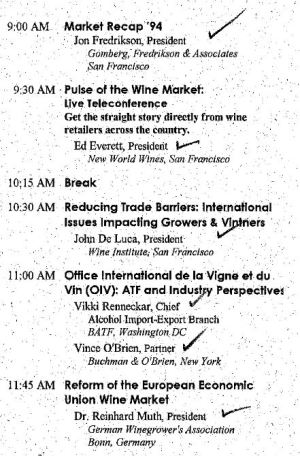 I have been involved with the Unified since 2012, mainly as moderator and/or speaker at the Wednesday morning State of the Industry session, the largest gathering of a three-day event. So I was interested to see what the equivalent program looked like at Unified I.
 Rebecca Gibb,
  Joanne Gibson and Malu Lambert,
  Daniel E Bender,
 I didn’t think it was a waste of time because learning about nice wines is almost always a good thing, but I admit I sometimes fall into a less extreme variant of this point of view, favoring native over traditional or international much of the time. But his strong reaction made me think. The vines for this wine had been planted by the winemaker’s grandfather and had helped support three generations of his family. That seems pretty well rooted in terroir, don’t you think?
 A highlight of our
  The 45 Rugientes Corte de Blancs was a fascinating blend of Gewurtztraminer, Pinot Gris, and Chardonnay, with layers of bright flavor and savory herbs. Sue and I have had blends like this from Northern Italy and they can be fantastic. A lot of attention was given to this wine. Hand harvested, fermented in concrete eggs and tanks, aged in a combination of oak and concrete. I really enjoyed it, but Richard prefered the White Malbec. Two very distinctive and unexpected white wines!
 Will success spoil Marlborough Sauvignon Blanc? That is the question that haunts the
  Marlborough Sauvignon Blanc isn’t the next big thing. It is the big thing right now and has been for some time. I charted the rise of this distinctive wine more than ten years ago in the first edition of my book
  Appellation Marlborough Wine