“Some New World regions are adopting European-style AOC rules,” the Italian journalist I met in Sardinia explained, “Do you think this is an important trend?”
“No. Just the opposite. I think the Old World appellation system is under attack and will need to change to survive.”
He looked at me like I had dropped down from Mars. This was clearly not the answer he was looking for, but I think it is true. I wasn’t able to explain my logic very well in the rush of the interview, so let me try to explain here.
We Have Met the Enemy …
New World wine appellations are geographical indicators that specify a wine’s origin and help differentiate a region’s products. Some of these designations are very valuable (Napa and Sonoma, for example) in terms of price premium. Others are of little economic value, but can sometimes be useful in other ways that I don’t have time to explain here.
The Old World appellation system starts with designation of origin and adds to that a system of rules that restrict grape choices, blend components and ratios, viticultural practices, and other factors. AOC rules can literally fill a book as Jancis Robinson shows us in the classic video above.
AOCs (and Italian DOCs, Spanish DOs, etc.) evolved as essentially protective structures based on the experience in Champagne, which was the model for the current system. (I wrote about this in my book Money, Taste, and Wine). The first goal was to protect regional reproducers from fraud by outsiders passing off their imitation wines as the real thing.
The second goal (and the reason for such detailed regulation) was to protect quality producers in the region from neighbors inside the region who might cut corners and sacrifice quality to increase profit while benefiting from the regional “brand”.
Very high yields, for example, might increase a particular winery’s profit, but the lower quality dilutes the value of the appellation to all others. It is a cut-throat situation. “We have met the enemy and he is us” describes this element of the AOC program.
So AOCs seek to defend the regional brand from threats from the unscrupulous both outside and inside the region. Today, however, there are two powerful forces that threaten this system and will force it to change. Indeed it is already changing.
Shifting Center of Gravity
The first force is the global market, where the fastest-growing segments and categories are not closely aligned with the AOC system and where the premiumization syndrome is strongest. American consumers have shifted their market’s center of gravity to higher price points, but not higher prices for the same products. They will pay more than before but the product has to be differentiated and appealing. So innovation, which is not a strong point of the AOC system, is increasingly important.
Sue and I saw this when we visited the Valpolicella region a few years ago. The AOC system basically provides opportunities for Valpolicella wines, Ripasso, and Amarone in ascending order of retail price (I am leaving out details to simply, but you get my drift).
We met producer after producer who responded to this situation by creating proprietary blends of grapes that were “downgraded” to IGT status (because the blends don’t strictly adhere to the rule book), but upgraded in terms of price because of their effective branding and high quality. These new IGT wines were designed to fit price points created by premiumization that were not easily attainable with existing AOC products.
There is nothing new about the IGT movement — remember when super-Tuscans were controversial, which feels like a very long time ago? But the IGT trend, which basically slips out of the AOC handcuffs, has gathered unstoppable momentum. We see these wines everywhere now — France, Italy, Spain, everywhere. And some of them of fantastic. AOC? We don’t need no stinkin’ AOC?
In a sense the rise of these “super-” wines represents a shift in mentality that is worth noting. If the AOC system if defensive at its core, the IGT movement is entrepreneurial, seeking out new opportunities and breaking rules to get them.
Climate Change Challenges
The AOC system can withstand these market forces, although some regions will find it in their interests to adapt as Chianti did in the face of super-Tuscan success. But a second force is harder to ignore and will be even more threatening in the long run: climate change.
AOC rules are often promoted as an evolutionary pinnacle. We’ve had hundreds of years to figure out what grapes and blends are the very best for our terroir and here they are laid out in the rule book! Best of the best. You cannot improve upon the AOC rules.
It is a nice argument, but what happens when the terroir changes due to new climate patterns? The answer is that the wines need to adapt and evolve to remain at the peak, which is hard to do if the rule book doesn’t change. AOC standards need to evolve with the climate or become irrelevant or, worse, counter-productive.
Bordeaux Adapts
Some Old World regions already see the writing on the wall, as Jane Anson reported in Decanter earlier this year. Bordeaux and Bordeaux Superieur producers now are able to experiment with “accessory grape” varieties that may better withstand climate change than the traditional (and designated) grape varieties such as Cabernet Sauvignon and Merlot.
“The red grapes for trial,” Anson reports, “will be Marselan, Syrah, Zinfandel and Arinarnoa. In white, Liliorila, Chardonnay, Petit Manseng Blanc and Chenin Blanc will be tested.” A recent VinePair article called this “a small revolution,” but I see it as something bigger and this is just the start.
Anson’s article continues,
Veronique Barthe of Chateau la Freynelle, who is working on the project with the Bordeaux and Bordeaux Superieur Union, told decanter.com this was not a form of sacrilege.
‘We are not trying to make 100% Syrah in Bordeaux, but to test which grapes work best on which terroir in the region with the intention of introducing them only if they offer real quality,’ she said.
This sounds like exactly what a winemaker should be doing, don’t you think? “When the facts change, I change my opinion. What do you do?” according to Keynes. When the climate changes, what will the AOCs do?
So the AOC system is under attack from the inside by IGT wines and from the outside by climate change. The system will adapt, but it won’t be the same. We can debate whether this is a good thing or not (I’m on the good thing side), but it is going to happen. And that’s what I wish I had time to explain to that Italian wine journalist.


 By Sue Veseth, Contributing Editor
 Over the years, our OTBN celebrations have included additional friends. A few times, one or two people from the core were unable to attend because of work or family needs. Some years, we met at someone’s home for an elegant dinner. Other years, we met at restaurants (with our own wine, of course). We even held potluck dinners for OTBN.
 By coincidence, but not by design, our wine selections and stories have complemented each other. This year, with a decade of OTBN experience, a theme of “firsts and lasts” developed with our wines:
 One particular Romanian sweet wine — Grasa de Cotnari — has an important place in wine history. Grasa de Cotnari, Tokaji of Hungary, and Constantia of South Africa were once
  We spent a day in the
  It is in a way the most American of wines, even though it actually comes from a Portuguese island off the African coast. When it came time to toast the signing of the Declaration of Independence in Philadelphia, this is the wine that filled the Founding Fathers’ glasses.


 They say that there is strength in numbers, which may explain why wine cooperatives tend to emerge during periods of crisis, when individual winegrowers are practically powerless to defend themselves and only collective action holds hope.
 The Reserve Rouge Carmin, for example, is a blend of Grenache, Syrah, and Carignan (the Carignan was vinified with carbonic maceration while the Grenache and Syrah use conventional methods) that was one of my favorites. Delicious with the food we were served and impressive generally. Its packaging is modern and appealing and it sells for a premium price — about 8 to 10 euro, as I recall, which is impressive for a wine from this region.
 Aimé Guibert and Robert Skalli — these were the key protagonists in my analysis of globalization and wine in the Languedoc in my 2011 book

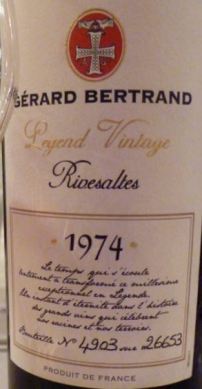 Ambassador Bertrand
 Wine Globalization: A New Comparative History