 Sue and I hadn’t given much thought to non-alcoholic wine (NA wine) for a while but then we read Florence Fabricant’s NY Times article on “8 Non-Acoholic Wines for the Thanksgiving Table” and we knew we had to take another look at this growing category.
The “Second Glass” Test
There are more and more wines in the “No and Low” alcohol category and when we have occasionally tried one or two we have been disappointed. Although we’ve had a sense that the quality is rising along with demand, nothing really passed the “second glass” test. I might be OK with a glass of one of the NA wines we’d sampled if I needed to avoid alcohol for some reason (designated driver role, for example, or a prescription drug issue), but I probably wouldn’t ask for a second glass.
I’d probably choose an NA beer over an NA wine. NA beers have made big strides. Both imports and domestic products like the ones from Athletic Brewing are high on my list. They taste good, remind me of the kind of beer they are made to represent, and cost about the same as the real thing. I’d be happy to accept a second glass. That’s what we are looking for in NA wine, too.
Journey to NA-ville
Fabricant’s column in hand, we made our way to the local big box beverage superstore and asked for directions to the NA wine section. We were led to the opposite side of the store to a section where all of the NA products (beer, wine, spirits) were on display. There were more NA wines on the shelf than I had imagined, many of them fruit-flavored. Since NA products are regulated as food, not booze, they all had full nutritional information and ingredient lists, so calories, carb counts, and additives were easily identified.
 We found one of Fabricant’s recommendations on a lower shelf, the Giesen NA Pinot Grigio from New Zealand, and bought that along with the Giesen NA Sauvignon Blanc. Both wines were mixtures of de-alcoholized wine and a bit of grape juice and some other ingredients. I suspect the juice adds some body that is lost in the de-alcoholization process. We know and respect this producer (and even visited the winery a few years ago), so we were interested in how they would stand up to our tests.
The Giesen wines were better than the NA wines I remembered from past experiments (easy to see why they’ve become so popular), but for me, they didn’t pass the “second glass” test. They tasted fine and cost about the same as the regular Giesen wines, but they didn’t really remind me of Pinot Grigio or Sauvignon Blanc. But, a step in the right direction.
JØYUS Discovery
Then, by happy coincidence, we received a sample bottle of JØYUS NA sparkling wine. Sue had speculated that sparkling NA wine might be the right direction based, in part, on our experiments with canned wine; she was right. The bubbly wine tasted very good, reminded us of sparkling wine (and not sparkling cider), and at less than $30 per bottle it was priced between Prosecco and Champagne and so in the range you might expect for sparkling wine.
The main ingredients are de-alcoholized wine, water, white grape juice concentrate, natural flavors, and carbon dioxide (to make the bubbles). By the numbers: 30 calories and 6 grams of carbohydrates per 8-ounce serving. (Eight ounces? Yes. Remember that this is a non-alcoholic beverage so larger serving sizes apply.)
Seattle-based JØYUS makes other varieties of NA wines, both still and sparkling, including a Cabernet Sauvignon. The wine we tasted won best-in-category at the Sunset magazine competition. Because it is non-alcoholic and regulated as food not booze, JØYUS is available through Amazon.com!
So 2023 ends on a bright note for NA wine. There are NA wines out there that pass the “second glass” test after all, we just have to find them and hope that the list will grow. New Year’s “cheers” to wine (and NA wine) lovers everywhere.
>>><<<
Many of my friends insisted that they would never drink an NA wine. But they are only partly correct. A lot of them have been drinking partially non-alcoholic wine for years.
Alcohol levels have been rising along with vineyard temperatures and it is one of the wine industry’s open secrets (along with the use of Mega-Purple to deepen wine colors) that they have been forced to take action to bring high abv down.
A common practice is to take some of the wine, de-alcoholize it, and blend it back in to get to the desired alcohol level. This is better than the dark art of adding “Jesus units” (water) to the fermenting wine to accomplish the same. I guess water is the ultimate NA beverage, isn’t it?
 This is a report of our recent experiment pairing various
 I have been thinking a lot recently about how much things have changed since the 1990s and what the future might look like in this light. The event that has provoked this unexpected thoughtfulness is the upcoming
 One of the forces that powered economic globalization was the collapse of Communism, which opened up a world of trading and investment opportunities. We called it
 Not everyone was convinced that the new history was valid. My favorite scene was where Robinson poured a glass of New World Pinot Noir and asked a famous Burgundy producer what she thought. The winemaker scowled at her glass and proclaimed that Oregon shouldn’t make something like this. They should find their own terroir, she said, invoking that mystical French phrase almost like a curse. Oregon on the same stage as Burgundy? It’s like the end of history. What next?
 It is called a fiasco.
 I suppose that the move away from the distinctive fiasco was a bit of an identity crisis for Chianti, but it might not have been the only or most important one as
  The Cecchi family of wine producers invited us to sample their wines and taste the difference and it was an eye-opening experience. The
 But not all the news is good. Sue and I habitually consider wine bottle weight in our work, although we haven’t started keeping detailed records yet. We note when we find an unusually light bottle, for example, and when one seems heavier than we expect given the type of wine.
 Rodwell looked around the noticed that the bottled water shelves had already taken the bottle shape step to the next level. If you look at the water wall you’ll see that major brands have distinctive color and shape bottles. In many cases, you can pretty well guess what water someone is drinking from across the room without seeing the label.
 There is no particular reason why the trend toward custom bottles should conflict with the lighter-bottle movement. A blue bottle doesn’t need to weigh more than a brown one. But some of the custom bottles we have seen, with embossed logos or textured surfaces, are heavier than average. And I doubt that they are cheaper than standard glass.
 Sue and I always give some thought to what wines to serve with our Thanksgiving feast and over the years
 We love Joseph Phelps Cabernet Sauvignon wines, but we hadn’t really explored the other varieties in their lineup, so jumped at this opportunity to test out this
 White wine makes lots of sense for pairing with the classic Thanksgiving side dishes, many of which are rich and cry out for something with a little acidity. Sauvignon Blanc is the hottest white varietal wine at the moment and this Napa Valley was an excellent choice.
 Sue and I recently attended a German wine dinner at
  I did not expect that our experiments would take us in this direction, but once I learned about
 Washington is no stranger to wine crisis, as I have written on The Wine Economist, and it is interesting to review two cases in particular: the California Wine Bill of 1969 and the Langguth wine bust of the 1980s. Both situations were damaging at the time, but proved useful in the longer-term evoluations of the industry.
 As harvest 2023 draws to a close, many of us are gearing up for the 2024 edition of the
  An insightful forecast! But the situation today is pretty much the mirror image of that report. Demographic trends are widely seen to work against wine and alcoholic beverages generally today. Some consumers are wealthier but don’t necessarily feel that way because of pressure from inflation, rising interest rates, higher housing costs, and other factors such as student loan obligations.
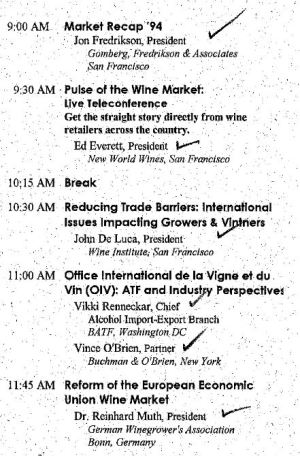 I have been involved with the Unified since 2012, mainly as moderator and/or speaker at the Wednesday morning State of the Industry session, the largest gathering of a three-day event. So I was interested to see what the equivalent program looked like at Unified I.
 Rebecca Gibb,
  Joanne Gibson and Malu Lambert,
  Daniel E Bender,
 I didn’t think it was a waste of time because learning about nice wines is almost always a good thing, but I admit I sometimes fall into a less extreme variant of this point of view, favoring native over traditional or international much of the time. But his strong reaction made me think. The vines for this wine had been planted by the winemaker’s grandfather and had helped support three generations of his family. That seems pretty well rooted in terroir, don’t you think?