Four Faces of Wine and Sustainability

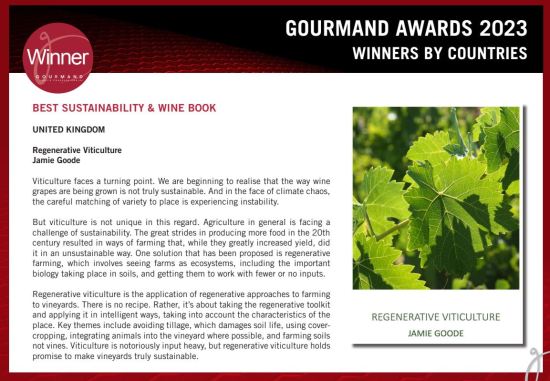
I made a virtual visit to Umeå, Sweden last week to accept (via video) the Gourmand award that my book Wine Wars II: the Global Battle for the Soul of Wine received as an outstanding contribution to the analysis of wine and sustainability.

Wine Wars II is one of four books that received this special award and I think it is revealing to consider them together to appreciate the complexity of the sustainability and wine issue.

As I understand it, sustainability is all about the tension between and among seemingly opposite poles and the need to navigate the force fields thus created.

First, Sustainability is a global concern (think United Nations Sustainable Development goals), but it is a battle that must be fought one locality at a time. Think global, act local. (One scholar coined the term “glocal” to describe this situation, but I avoid it since it sounds like my cat coughing up a hairball.)

The first pair of books on the award list, Manifeste Chateau Cheval Blanc and  Agroecologie: Quatre Saisons du domaine de l’Apocolypse  examine the problem from the local level in France and Greece respectively, giving us a look at how global principles are translated into local practice, with attention to the specific challenges and opportunities.

Science and business are often seen as opposite sides of the sustainability issue, too, but is this the case? The second pair of books explores this tension in two very different ways. Jamie Goode’s book on Regenerative Viticulture  takes a scientific approach to sustainability, developing a toolkit to be applied thoughtfully to specific situations to make viticulture more truly sustainable.

If business and its profit motives are the enemies of sustainability, what can drive wine firms to adopt the tools and follow the examples that the first three books listed here provide? My answer in Wine Wars II is risk. Adopting sustainable practices may come at a cost, but not taking action is costly too and wine businesses are increasingly being forced to confront those costs both in the field and on their business accounts.

Climate change creates material risks that businesses must report and attempt to manage and it is informative to see what wine sector businesses see as the most important risks and what they are doing to address them.

But there is most to consider from the economic perspective. Sensible practices in the vineyard and cellar are only truly sustainable if they are also economically sustainable. The final section of Wine Wars II explores wine’s “triple crisis” (environment, economy, identity) and tries to help readers think clearly about the complicated issues the wine industry faces today.

>>><<<

Many thanks to Edouard Cointreau and the Gourmand awards team, both for the specific recognition for Wine Wars II and for their efforts to draw attention to the many faces of wine and sustainability. Congratulations and thanks, too, to Pierre Ly who accepted the award certificate for Wine Wars II. Adventures on the China Wine Trailby Pierre Ly and Cynthia Howson, also received a Gourmand award at the ceremony.

Back to the Future with Dry Rosé Wine?

More than five years ago, I wrote in these pages that “dry rosés are increasing in popularity not only among open-minded wine drinkers but also among California winemakers.”

If I could write these words today they’d make me look like a pretty savvy wine economist. Dry rosé wines have experienced a boom in recent years and not everyone was convinced back in 2018 that the pink wave was real.

But I didn’t write this sentence. Mark Bittman did in an article titled “The Perfect Summer Wine?” that appeared in the August 1998 issue of Cook’s Illustrated magazine. (This issue sort of fell into our hands when Sue found it in the Little Free Library down the street. Someone in the neighborhood must be cleaning magazines out of the basement.)

Tutti Fruity?

You might be surprised to know that dry rosé was fashionable back in 1998, but actually that’s not the point that Bittman makes in this article. You see way back in 1993, Bittman’s tasting panel found lots of dry rosés that pleased them. But by 1998 things were going downhill, he writes. Too many of the wines they tasted were sweet, not dry. “Tutti fruity” one tasting note reads. “Just drier than black cherry soda, not unlike it,” says another.

That’s not to say that Bittman’s team couldn’t find delicioous dry rosés for the 1998 tasting. The thing that struck them was that most of them came from France and only a few from California. Three out of four of the “not recommended” wines were California products. Not exactly a Judgement of Paris result.

All but one of the “recommended” and “highly recommended” wines came from France. The sole California selection? Heitz Cellars Napa Valley Grignolino Rosé!

The Curse of the White Zinfandel?

I wonder if this was a “white Zin” effect? There was a time when sweetish pink California wines were very popular and the leader of the pack was White Zinfandel. Do you suppose that the popularity of that style of wine influenced Calfifornia rosé wines generally the way that the success of Kendall-Jackson Private Reserve Chandronnay influenced a lot of California Chardonnay producers?

The sweet/dry cleavage isn’t the only one that Bittman’s article highlights. There is also pale and dark to consider.

The top rosé wine, according to the tasting panel, was the same in both 1993 and 1998: Chateau de Trinquevedel Tavel. Younger readers may wonder in what part of Provence is Tavel found? This is a trick question because Tavel is in the Rhone valley and the wines are dark and full-bodied. I have always thought of them, in my simplistic way, as pink wines for red wine drinkers. Pale Provencal wines (like the #2 wine in 1998: Domaine de la Gautiere en Provence) are, by contast, pinks that appeal a bit more to those who like white wine.

Delightful and Affordable

The wines were not especially cheap in 1998: $15 for the Tavel and $8 for Provence. That is much more than Beringer White Zin in those days, but worth every penny, Bittman assures us, and I am sure he was right. The most expensive wine reviewed cost $22 in 1998 prices, which was a lot for a rosé back then. But what a wine: Domaine Tempier Bandol 1996.

Dry rosé is back with the French in the vanguard. But darker rosés like the Tavel are hard to find (Tavel wines are very hard in my local market). Everyone tells me that consumers strongly prefer pale pink to dark pink, even though the experts say that color and hue don’t determine flavor and aroma. If the conventional wisdom is correct in this case, then I feel a certain loss. Those Tavel rosés and wines like them deserve more attention.

Mark Bittman concluded his 1998 Cook’s Illustrated article saying

I wish I could write, as I did in 1993, that this was a “group of delightful, affordable wines.” But there are some delightful and affordable wines in the group; you just have to be a little more picky than you did a few years ago.

I wonder what he’d write today? Certainly there are many more rosé wines and a lot of them are surely delightful (how affordable they are is a matter of judgement I leave to you, but the majority seem affordable by the standards of the 1998 tasting). You probably still need to be a bit picky, however, to find what you want.

Wine Book Review: On the Wine Trail with Lonely Planet

Lonely Planet Wine Trails 2 (Lonely Planet Food, 2023).

The Lonely Planet Guide folks have released a new guide to global wine trails. The big book (320 pages, 2.4 pounds) lays out itineraries for 52 potential weekend wine country visits. It is a colorful book, full of maps and photos, and worthy of consideration if you are planning trips, interested in how wine tourism has developed, or just want to make imaginary vineyard visits.

Each chapter is organized according to a set structure, starting with an overview and map followed by brief profiles of six or seven wineries (a reasonable number to think about for a weekend trip). Accommodations?  A couple of options are provided along with three dining choices and some ideas for non-wine things to do. Just enough to get you started.

Sue and I have visited many of these regions and, in general, I’d give the Lonely Planet itineraries solid marks. They might not always be the wineries we would choose to visit or the hotels and restaurants we’d pick, but they would certainly steer a first-time visitor in good directions. This is not a surprise, since the wine tourism chapters were written by an international team of experts.

Creating a big book like this is an exercise in choice. What do you put in? What do you leave out? You can’t possibly include everything in 300+ pages. Something has to give! This fact became apparently to me some years ago when I was asked to edit a book for a New York Times series. I was given the entire 20th century of New York Times content (all 100 years) and tasked with telling the story of globalization. What I learned was that you have to begin with a story and build around that, which is sort of a top-down approach that prioritizes the narrative. A bottom-up approach, which relies upon the facts to form their own images, is fiendishly difficult to pull off.

The decisions when looking at wine tourism begin with the question of what regions to include. Fifty-two is a big number, but there are many more wine trails around the world. When a French wine periodical published a list of the 35 best wine tourism destinations back in 2012, they found that 29 of them were in France. Zut alors! That’s not much for the rest of the wine world.

The Lonely Planet guide lists eight French itineraries including the “greatest hits” of Burgundy, Bordeaux, and Champagne. Italy and Spain get seven entries each, including the most famous and most-visited regions.  So far just as you might expect. But while Australia has seven entries, big-name Barrossa is not one of them. And Napa is not anywhere on the USA list, which takes you from the Finger Lakes of New York, through Pennsylvania wine country, to Grand Valley, Colorado, and on to Walla Walla, the Willamette Valley, Sonoma, and Santa Ynez.

Other parts of the wine world receive less space. Argentina, Canada, Chile, England, Georgia, Germany, Greece, Lebanon, Portugal, Romania, and Slovenia get one entry each. New Zealand and South Africa get two entries each.

At first this inconsistent treatment of famous regions versus the rest bothered me, but I’ve decided that it is probably OK within the context of this book. Reading about the charms of Colorado wine country, for example, might encourage someone to look beyond the big name appellations when visiting France or Italy. And that would be a good thing.

This method of mixing the famous with the lesser-known continues within the chapters in terms of the winery choices presented, accommodation options, and dining recommendations. Some of the choices left me scratching my head (why list hotels and restaurants in Portland, for example, when there are so many good choices in the Willamette Valley wine country itself?), but in general I’ve decided that the Lonely Planet guide is quite useful. It gives readers the basics and invites them to explore.

Readers who don’t go beyond the recommendations here will have a good time. Curious types who use this as a springboard to dive deeper into the wine tourism pool will have even more fun because when it comes to wine the wines, wineries, restaurants, etc. that  you discover yourself are often the most satisfying.

America’s Wine Regions: Re-Imagining Colorado

What do you think of when you think of Colorado? Chances are that Colorado wine isn’t the first image that comes to mind, but it should be somewhere on your radar screen. Wine is both old and new in this Rocky Mountain state.

Peaks and Valleys

Wine was first produced in 1890 from grapes grown on 60 acres of vineyard and orchard land on Rapid Creek above Palisade along the Colorado River. The decades since these first wines were made have been full of peaks and valleys for Colorado wine and Sue and I have had sort of a rocky road experience ourselves with these wines.

We’ve had several chances to taste Colorado wines over the years, especially when I spoke at the state’s annual VinCO Conference in 2018. While we’ve been impressed by some of the wines, we were disappointed by others.

Peaks and valleys. This uneven experience is a problem because you seldom get a second chance to make a first impression when people taste your wine. But it is also understandable. Honestly, I don’t know any wine region that doesn’t have its share of peaks and valleys.

Climbing to the Heights

It is also understandable because, although the Colorado wine industry is surprisingly old, it is also unexpectedly young. You see, Colorado citizens embraced Prohibition even before the national policy was enacted and the vines were ripped out more than 100 years ago. Wine really didn’t restore its foothold in Colorado until the 1970s (Warren Winniarski, of Judgment of Paris fame, made some of those early wines). The industry has charted an upward path since then, but the road has remained rocky.

Sue and I were delighted when offered the opportunity to taste Colorado wines from The Ordinary Fellow winery, a project of the winemaker Ben Parsons and located in the old United Fruit Growers COOP peach packing shed in Palisade. I don’t know Parsons personally, but his career path reminds me of Randall Grahm. Grahm is a brilliant brand-builder who is also a committed terroirist. Both land and brand, if you know what I mean. I think Parsons might be the same.

Parsons achieved brand-building fame with The  Infinite Monkey Theorem winery. He started out making wine in a quonset hut in Denver, far from the vineyards but up close to the urban customer base. He set out to be different, which drew him to keg wine and then to cans. Infinite Monkey Theorem became a canned wine phenomenon to such a degree that at one point a second winery was opened in Austin. Parsons and the Infinite Monkey Theorem brand were way ahead of the curve in terms of cans and creating an image and environment that appeals to younger consumers.

Parsons left Infinite Monkey Theorem in 2019 to found The Ordinary Fellow (named for a favorite pub in England), making wine in Palisade from grapes grown on two high-elevation vineyards in southwest Colorado.

More Than Mile High

We tasted three of the Colorado wines. Our favorite was a 2021 Riesling ($18) from the Box Bar vineyard, elevation 6200 feet. It had intense Riesling character and developed nicely in the glass with dinner. We also enjoyed the 2021 Cabernet Sauvignon ($25) from the same vineyard. Can you taste high elevation? I wonder. This wine reminded me of some high-elevation Malbecs from Salta in Argentina. The acidity really lifted the and balanced the tannins. Was it really an elevation effect? Probably the power of suggestion, but very interesting.

The 2021 Pinot Noir ($25) from the 6800-foot Hawk’s Nest vineyard struck us as a work in progress, but one we’d be interested to follow in the years to come. What a beautiful light color and nice nose! But Sue thought it tasted more like a Grenache than Pinot Noir, which is not necessarily a bad thing. Me? I’m just amazed that Pinot Noir can be grown in Colorado, but I guess I need to reimagine what’s possible in Colorado. Overall I would say these wines are a “peak” experience for sure. I hope we have a chance to visit the winery in Palisade somewhere down the road.

Parons produces about 2500 cases of wine these days with plans to grow to 5000 cases. He’s working hard to develop the vineyards and to make wine that reflects their particular terroir.

Rocky Road Ahead?

Colorado has 163 wineries according to Wine Business Monthly’s annual survey, which puts it just ahead of Missouri and just behind of North Carolina (two important wine producers) on the list. A WineAmerica economic impact study suggests wine is an important driver of jobs and income.

I asked my friend Doug Caskey, who is executive director of the Colorado Wine Industry Development Board, about the road ahead for the state’s wine industry and he provided a very realistic assessment. On the plus side, innovation is rising, including new sparkling wines that expand the state’s wine menu. But scale (and therefore economies of scale) is limited by several factors including water availability, the risk of severe winter weather, and the cost of vineyard lands.

Colorado recently expanded wine sales from specialized shops to include supermarkets and convenience stores and this change introduces a big question mark for Colorado wines. On one hand, wine will be more readily available for the state’s shoppers, which is likely to increase wine sales. But will it increase Colorado wine sales, or will those supermarket shelves be filled with bigger-volume wines from California and elsewhere? Lots of uncertainty.

Will the rising tide lift all wine boats? Maybe. Supermarkets like to demonstrate their commitment to local products and producers. What could be more local in Colorado than Colorado wine? However, based on what we’ve seen in other states, it’s a tough problem to solve.

Sue and I are glad we had this opportunity to revisit Colorado wine and look forward to learning more about this state’s evolving wine industry in the future.

>>><<<

As you probably already guessed, The Ordinary Fellow wine isn’t ordinary at all. Its exceptionalism begins with the colorful labels, which are actually more complicated and interactive than they appear in the photos. There are two parts to the label. The first is a very colorful inner label that reminds me a little of the Beatles’ “Yellow Submarine” type of art, then a plain white outer label that rotates to reveal different aspects of the inner art. Kinda psychedelic! Not ordinary at all.