San Felice Vigorello and the Rise of the (Super) {Super} Super Tuscan

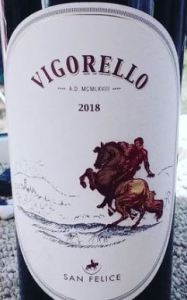
San Felice, the distinguished maker of wines from the Chianti Classico, Brunello di Montalcino, and Bolgheri, is celebrating the release of the 50th vintage of Vigorello, their iconic super-Tuscan wine. Vigorello was the first super-Tuscan from the Chianti Classico region when the 1968 vintage appeared and it remains a signature wine today.

No Badges Needed

Super-Tuscan wines were radical departures from the norm when they first appeared. They were “Badges? We don’t need no stinking badges!” kind of wines. The orthodox approach was to follow the rules of the Chianti or Chianti Classico appellations and formulate a traditional blend of wine grape varieties. Break the rules and your wine couldn’t wear the famous appellation designation, a significant disadvantage in the market of the day.

Breaking the rules meant giving up a valuable trademark, in effect. Relegated to a lower market division, your wine would have to stand on its own and not rely on the regional reputation for support. It took a bold (and confident) winery to take the risk.

But it paid off, at least for the best wines, and helped create a whole new market for IGT wines in Italy, where winemakers have more freedom to make wine and more ability to create and promote their own brands. Italian wine has improved enormously in the last fifty years and the super-Tuscan-driven creation of the IGT wines (and the constructive competition they have provided to the DOC and DOCG wines) is an important part of the story.

So what radical step did the San Felice winemakers take back in 1968. Well, you won’t believe it. They released Vigorello as a 100% Sangiovese wine. A mono-varietal Sangiovese. I am not sure that there is anything that would seem less radical today, when wines defined by grape variety are commonplace. But it was a big deal back then.

Revolution and Evolution

Free of DOC shackles, Vigorello evolved over the years much as its fellow super-Tuscans did. Cabernet Sauvignon was added to the blend in 1979, for example, and Merlot came on board, too, in 2001. Sangiovese, Cabernet, Merlot — that’s pretty much what you think of when someone says super-Tuscan today.

But that’s not San Felice Vigorello today. We opened a bottle of the 2018 vintage to have with Sue’s classic Tagliatelle al Ragu (we lived in Bologna when I taught at the Johns Hopkins School of Advanced International Studies center there and developed a taste for the region’s rich cuisine). Sue took a sniff and sip and her eyes opened wide. Wow, she said, this isn’t what I expected.  Lighter and brighter and more interesting that the usual super-Tuscan wine. The finish went on and on and on.

The reason for the striking difference was not hard to track down. Sangiovese, the defining grape of Tuscany, was completely missing from the blend (it was actually removed back in 2011), replaced by a rare grape variety closely associated with the San Felice winery: Pugnitello.

Small Fist, Big Impact

Pugnitello? Don’t be embarrassed if you’ve never heard of it. According to Wine Grapes, the standard reference for such things, Pugnitello is “a rare variety of unknown origin rescued in 1981 by researchers at the University of Firenze …”. The name means “small fist” the scribes the compact grape clusters. Some believed it was Montepulciano, but DNA analysis ruled otherwise.

The potential for Pugnitello was obvious from the beginning and San Felice quickly planted it in their experimental vineyard, where rare and endangered varieties are cultivated, and then into larger vineyard spaces. Thirty years after its discovery, Pugnitello was introduced as the backbone of  Vigorello. Quite a story!

Super Duper

So Vigorello is unique — kind of a super-super-Tuscan if you know what I mean. But is Pugnitello the key? There are lots of factors that go into the making of an iconic wine. How much is San Felice’s Pugnitello responsible for the wine’s success?

Fortunately, there was a way for us to find out. Since 2006 San Felice has made a necessarily small amount of 100% Pugnitello wine (the beautiful label is shown here) and we were fortunately to receive a bottle. We opened, sniffed, and sipped and it was “wow” all over again. Complex, delicious, a wine that really tells a story. One of the most enjoyable wines we’ve tasted this year. And the perfect foundation for Vigorello. We aren’t the only Pugnitello fans. It is easy to sense Ian D’Agata’s enthusiasm in the Pugnitello entry in his Native Wine Grapes of Italy.

So there are several reasons to join San Felice in their celebrations this year. Fifty years of Vigorello, the first super-Tuscan from Chianti Classico and the innovative Pugnitello are both worth an enthusiastic cheer.

This rule breaking thing has really paid off for San Felice. Badges? You can leave them at the door.

Storm Clouds Ahead for Global Wine Trade

Storm clouds are on the horizon for the global wine trade and I am worried because I can’t really say how things are going to develop in the short and medium terms.

The problem is that the disruptions are both broad and deep. They are widespread throughout the commodity chain and impact both the supply- and demand-sides of the market. It’s a lot to take in. Herewith a brief sketch of the situation as I see it today.

Storms on the Supply Side

Some of the storms on the supply side are literally storms — wind, hail, freezing temperatures in the main winegrowing regions of Europe plus drought and wildfire smoke taint elsewhere, especially California.

The increasing extreme weather impacts are unlikely to diminish and inject elements of risk and uncertainty into the supply side of the market. Some of this risk is inherent to agriculture, of course, but it seems like the factors that punctuate equilibrium are both larger and more frequent. Increasingly hard to predict what’s coming over the horizon.

Storms on the Demand Side

From a global perspective, as I explain in my recent book Wine Wars II, a small number of countries and regions (France, Italy, Spain, California) shape supply conditions and an equally small number (USA, UK, Germany, China) are key forces on the demand side.

Each of these countries if facing its own economic crisis and taken together they suggest major impacts on both global wine imports and, according to a recent IMF report, the prospects for a global recession. JPMorgan CEO Jamie Dimon is predicting a US recession within six to nine months.

The storm clouds are somewhat different in each country but the fact that they have come together at the same time raises concerns. Inflation is both high and persistent in the US, for example, causing the Federal Reserve to double down on interest rate increases. The hope is a “soft landing” that would slow the economy enough to reduce wage growth without actually increasing joblessness and tipping the economy into recession.

This is a tough target, especially because monetary policies are subject to what are called “variable lags.” You roughly understand what will happen, but not when. Imagine driving a car with variable lags on the brakes, accelerator, and steering! In theory you might be fine but in practice you will probably end up in the ditch.

The recent declines in equity prices and widespread cooling of the housing market is another concern. A recent Rabobank report suggests that sales of super-premium wines, which seem to persist even when income takes a hit, are not immune to changes in net worth.

So it is entirely possible, following Dimon’s lead, that the US will spend 2023 with both falling income and rising prices. Some wine market niches might be little affected by this combination, but the broad market will certainly suffer.

German and UK Problems

Germany is known for its bulk wine imports, and these are likely to be squeezed by rising energy prices and falling output in its energy-dependent manufacturing sector.

What will German consumers choose: shivering in the cold while they drink their usual ration of wine? Or staying warmer but cutting back on price or quantity? I will leave the answer to you.

The UK market, which is in some ways the wine trade’s most important, will suffer higher energy bills this year and next, too. But its problems go deeper. Already more economically fragile than the other countries discussed here, it must now confront the fact that its new government seems to be both economically reckless and politically tone-deaf (an unusual combination — it is usually one or the other). So the Bank of England has had to raise interest rates even faster than expected and invoke emergency measures to prevent fire-sale losses among pension funds.

To invoke the car example once again, the UK’s drivers are stomping down on both the brake and accelerator pedals at the same time. Not a very safe situation according to most driving instructors. Jeremy Hunt, the newly appointed chancellor, signaled a big U-turn in economic policy yesterday, but much damage has already been done and fundamental problems remain. Watch for more shoes to drop.

Although there was some good wine business news in the original “mini-budget (scheduled duty increases had been postponed), the alcohol tax increases have been restored and the outlook for the wine trade is grim. Will UK consumers spend their inflation-reduced purchasing power on the higher mortgage bills that are coming soon due to rising interest rates … or will they buy wine? Once again, the answer’s up to you.

China’s Economic Bicycle

A few years ago we would have looked to China for a ray of sunlight in the global storm, both in terms of the wine trade and more generally. But not today. The Chinese economy is fragile right now, with many risks to consider, especially in the possibility that the property bubble might burst or deflate.

I have argued that the Bicycle Theory of Economic Growth applies to China. A bicycle is only really stable as long as it keeps moving forward. Once it stopes, staying upright is a real balancing act. I think China is much the same — it has to move ahead rapidly to keep its inherent contradictions from tipping it over. The property market crisis is a clear example of this. As growth has slowed, consumers are now refusing to pay their mortgage bills for housing still under construction.

Five years ago, China would have been the engine we counted upon to pull the global wine trade and, indeed, the global economy, out of its storm. Now its weakness on both fronts (covid lockdowns prevent a return to normal wine market conditions, for example) stand in the way of recover.

What Next?

What next? That’s the question on the cover of last week’s Economist newspaper. The Economist speculates that we are entering a new era of global economic policy. Hard to know where that path will lead.

What’s next for the global wine trade? The combination of demand- and supply-side storms I have outlined here make it hard to know. What next? Too soon to tell, I think. Stay tuned.

Flashback: Confessions of a Rookie Wine Judge

I’ve been sidelined by a medical issue for the last couple of weeks and, while I am fine now, I won’t be able to taste wine for another week or two. This situation reminded me of the time I tasted literally dozens and dozens of wine every morning as a judge at the International Wine Competition Bucharest i(now rebranded as VINARIUM International Wine Contest) n 2018.

Here’s a flashback column about my “Confessions of a Rookie Wine Judge.” Enjoy!

Confessions of a Rookie Wine Judge

The Wine Economist / November 27, 2018

I have declined several invitations to serve on wine competition juries, but when Catalin Paduraru asked me to be be part of the International Wine Competition Bucharest I just couldn’t say no.

Sue and I had never visited Romania and there was much I wanted to learn about the country and its wines. Besides, Catalin (along with Lucian Marcu) had somehow managed to publish a Romanian version of my book Wine Wars. So we headed to Iași, Romania’s cultural capital, where this year’s competition was held.

Reservations? I had a few because of my lack of formal training in wine tasting and my rookie juror status, so I asked a few experienced friends for advice. It’s not so hard, one veteran juror told me. You know how to taste wine, just concentrate and focus. Taste them one at a time. A Master of Wine advised me to be generous in general, except when there were clear faults, and then to cut no slack.

Wine by the Numbers1mbc2

The wine competition was organized according to OIV regulations. We were grouped into three teams or “commissions” of five jurors each, three internationals and two from the home country Romania. We used the “Australian” system, I was told, where we could talk a bit amongst ourselves rather than sitting solo. As in the old days of figure skating scoring, the highest and lowest scores are thrown out for each wine and the three middle ones averaged.

The wines were evaluated on a 100-point scale divided into a number of different categories. The tablet-based OIV software made it easy to focus on thinking about the wine and my friend was right — if you think about one wine and one sensory element at a time the task is difficult, but not overwhelming.

The software gave each juror a report of his or her score for a wine along with the average score. Wines that received an average between 82 and 84.99 points earned a silver medal. 85 to 91.99 point wines were gold. 92 points and over received the Great Gold Medal. This is a pretty tough grading curve, but with many elements evaluated critically and individually, maximum scores are hard to achieve.

My team tasted 50 to 60 wines over the course of about 3 hours each morning for  three days in a row.  Lunch followed the judging and the wines were revealed, giving us an opportunity to see what labels were inside the closed bags.

60 wines in three hours does not leave much time for chit-chat and if you watch the video about the event you will notice how serious we all were. Staying focused for so long and moving through the wines so quickly was a challenge.

Rookie Mistakes

There were several aspects of the competition that took some time for this rookie to figure out. The wines were assembled by category not region (or country of origin) or grape variety. So a flight of dry white wines might include several different grape varieties and countries or regions of origin. It was therefore important to approach each wine with an open mind because the variation from glass to glass was sometimes dramatic.

Because the software reported both my score for each wine and also the team average, I was initially tempted to see the average as the “right answer” and try to think about what I must have missed if I was far off the mark.  There was a certain satisfaction when we all gave a wine exactly the same total score, but I’ll bet we differed in the details.

Eventually I realized that this second-guessing was another rookie mistake since there really isn’t a right answer.  Or, rather, it wasn’t my job to try to guess what the other jurors thought, but to provide my own careful judgement. The economists’ motto is degustibus non est disputandum!iwcb1

Mining Gold and Silver

Sue had the best view of the process. She and an official OIV observer sat apart from the rest of us. They got to taste the wines along with one of the commissions (not mine) and they could see all of the scores come in and follow the dynamics of the tasting. It was interesting, she told me when it was all over, to see how different jurors reacted to particular wines and how the individual scores were forged into gold and silver medals.

My fellow wine economists often criticize wine competitions in general because they make seemingly objective awards on the basis of necessarily subjective and sometimes inconsistent sensory evaluation.  The jurors I spoke with were aware of this problem and familiar with the research on the issue, but committed to the project nonetheless, which might account for the serious concentration and focused work ethic they all displayed. I was impressed.

Would I agree to serve on a jury again? It would depend on the circumstances. But I have already started to think about what I would do differently — how I would organize my scoring so that the final number better reflects what I sense in the glass.

>>><<<

Sue and I would like to thank all the wonderful people we met in Iasi. Special thanks to Catalin and Lucian, of course, and to my fellow jurors Diana Lazar, Richard Pfister, Roberto Gaudio, and Carole Cliche. Thanks as well to Prof. Valeriu Cotea, who gently coached me through my rookie experience and to Cristian Ionescu, who kept the technology working efficiently and made life easy for all of us.

Sue took these photos at one of the post-jury luncheons, where the wines were revealed and we could finally see the labels behind our scores.

Two New Guides to Global Wine

Two new guides to the global wine scene are scheduled for release next Tuesday, October 11 and this coincidence of release dates provides an opportunity to compare their different approaches and to consider the problems that such books necessarily confront today.

Hugh Johnsons’s Pocket Wine Books 2023 (general editor Margaret Rand) is  the latest annual edition in this best-selling series. The new third edition of Wine Bible by Karen MacNeil is as big as Hugh Johnson volume is slender. Both books are jam-packed with information and insights.  Both are addictive page-turners that reflect all the creativity, attention to detail, and pure hard work that has gone into their production. No wonder they are so successful.

A global wine guide has got to be exceptional to succeed these days. Consider the challenges that authors and editors face. First is the vast domain of the topic. Fifty years ago the world of wine was pretty big in theory, but much smaller than today in practice. New Zealand wines existed, for example, but you might not need to talk much about them. Who would ever encounter a kiwi wine outside of kiwi-land?

Now, of course, wine production takes place in more places and efficient wine trade brings an enormous number of the bottles to our doorsteps. More wines from more places made in more styles with more different wine grape varieties. Incredible.

How is a book supposed to approach such a huge topic? And how can a book compete with the internet, which can provide smartphone-equipped wine enthusiasts with vast storehouses of wine data? A physical book simply has to have a lot going for it to find a market in the smartphone era, don’t you think?

And then there is the problem of readership. Physical books and e-books there to be read, but more and more people want to listen to information instead of reading it. Podcasts and audiobooks are very popular today. When I checked the Amazon sales figures for my wine books back in August, for example, and I think the audio-book versions usually topped the tables.

My books might have had more listeners than readers during the peak summer weeks, but my books have lots of stories and so lend themselves to audio narration. Reference books and guides might not be as easy to transform from printed word to spoken voice.

You probably have earlier editions of both these books on your bookshelves, but it is worth considering their different strategies for capturing the world of wine in print.

The Hugh Johnson Guide takes a sort of pointillist approach, with lots and lots of very short entries in each of the major sections such as vintage reports, wine grape varieties, food and wine pairings, ten wines to try in 2023, and so on.  The chapters on wine producing countries take the same approach, featuring lots of  star-rated thumbnail producer reviews. The classic Old World regions — think Burgundy and Bordeaux — get special attention.

The Wine Bible takes a more broad-brush approach, with many of the same topics and topics covered, but in a more flowing narrative style with many of colorful illustrations. The Wine Bible encourages deep reading and focused study more than browsing. The Hugh Johnson chapter on Washington State, for example, has short sketches and star ratings of more than 60 wineries while The Wine Bible focuses on the stories of just eight iconic producers that help define the region. Both approaches are useful — it depends on what you are looking for.

Both books confront the inevitable question of where do you stop? The world of wine is so broad today, how much coverage should emerging countries and regions receive given the obvious constraints of the book format? There is no right answer to this question, but I admit that I was a little disappointed in the Hugh Johnson treatment of Asia and especially China, which received less space on the page than New Jersey. The Wine Bible’s treatment was more in line, in my view, of China’s current and potential position in the wine world.

The Wine Bible and Hugh Johnson’s Pocket Wine Book both have a lot to offer and much that is new. Wine enthusiasts are fortunate to have these great guides to global wine.

Flashback: Lawyers, Wine, and Money

Recent Wine Economist columns have reflected on the Judgment of Paris and its impact on the Napa Valley.  I couldn’t help myself thinking back to 2010 and the column below, which I present here as a “flashback.”  Where do “lawyers, wine, and money” come into the Napa picture? Read on to find out.

>>><<<

Stag’s {Stags’} (Stags) Leap

Originally published April 4, 2010.

The Stags Leap District Winegrowers Association has invited us to their V2V (Vineyard to Vintner) program later this month and we are looking forward to the event.

I have a particular interest in the Stags Leap District. My study of wine economics can be directly traced to a conversation with one of this area’s leading winemakers in his cellar many years ago. I’m looking forward to this focused opportunity to learn more about the Stags Leap District today and see what has changed since my last visit.

Money, Wine and Lawyers

The first stage of my research to prepare for the Stags Leap trip took an unexpected turn that reminded me of Warren Zevon’s song “Lawyers, Guns and Money.” Most stories of famous wine regions are about places, faces and wine. They start with places (the terroir), then move to faces (of the famous winemakers who helped establish the region’s reputation) and end with the wines themselves.

Stags Leap AVA certainly has the terroir. The district, about six miles north of Napa on the Silverado Road, is marked by a 1200 foot vertical basalt palisade that is both landmark and a source of the particular soil and microclimate that helps define the district. The growing season is longer in Stags Leap than in other parts of Napa Valley, with bud break coming two weeks earlier. The grapes ripen more slowly during their longer time on the vine, which seems to have a positive effect.

Stags Leap has it famous wine faces, too. The most notable is Warren Winiasrski of Stag’s Leap Wine Cellars. A former lecturer in Greek at the University of Chicago School of Social Thought, he was one of the early movers in Stags Leap. His second vintage, a 1973 Cabernet Sauvignon, was declared the red wine winner at the famous 1976 “Judgment of Paris” wine tasting that Steven Spurrier organized to test California wines against the French originals.  (You know about this event if you’ve read George B. Taber’s excellent book on the subject or seen the fictionalized film version, Bottle Shock.)
(Incredibly, the winning wine was made with grapes from three year old vines — infants! Unfortunately, according to my sources here, the vineyard was not in the Stags Leap District but rather farther north in Napa Valley. It established the winery’s and the region’s reputations at once.)

There is even a hallmark Stags Leap style — “perfumey fruit” according to Bruce Cass, although not every wine is made in a way that highlights this.

Lawyers, Wine and Grammar

So where do the lawyers come in? Well, the first thing I did when I started this project was to grab my copy of James Halliday’s classic Wine Atlas of California. Halliday devotes seven pages to Stags Leap places and faces and its distinctive Cabernet Sauvignon wines. But he begins his report with the most controversial part of the AVA’s history: its name and the legal battle over the the valuable intellectual property rights (IPRs) associated with it.

The area takes its name from the legend of a prodigious jump that a stag (or maybe several stags) took on the palisade while fleeing hunters. Warren Winiarski naturally included this colorful reference in the name of his winery, Stag’s Leap Wine Cellars, when he founded the operation in 1972.

But so did Carl Dounami, who started founded Stags’ Leap Winery just up the road, also in 1972.  Two wineries, two strong personalities — they battled for years over the right to the Stag’s / Stags’ Leap name. More than an apostrophe separated them, of course, although any grammarian can tell you that where the apostrophe is placed makes all the difference.

The right to label your wine with some variation of Stag’s/Stags’ Leap had obvious economic advantages and both winemakers wanted clear title to the designation. The IPR battle reemerged and intensified when the AVA was formed and its geographic lines drawn.

Clashing economic interests made the process of choosing a name and drawing AVA lines particularly contentious, according to Halliday. The compromise name — Stags Leap (no apostrophe anywhere, purely plural, nowhere possessive) settled the legal squabble, leaving the real task clear: making great wine.

Challenges Old & New

The old wine economics story of Stags Leap was about intellectual property. The new one — the one I want to explore when I visit later this month — is how the winegrowers are dealing with the current economic challenge and will respond to the future ones.

The current challenge, of course, is the continuing economic crisis, which has hit some upscale producers especially hard.

The future challenges? The future is hard to predict, but I’d suggest globalization (with its many threats and opportunities) and climate change, which would seem to be an especially scary prospect for a micro-region like Stags Leap.  But maybe I’m missing an even bigger story? I guess I’ll have to go there and find out!

>>><<<

The title of this post reminded me of a Warren Zevon song.

Dry Creek Valley and Napa Valley’s Road Not Taken

Last week I wrote about the Napa Valley and the Judgment of Paris. What would Napa look like today, I asked, if the Judgment of Paris hadn’t happened? Or if California wines had not done so well in the famous Paris blind tasting?

I think Sue and I stumbled upon a possible answer a few weeks ago when we were in the Santa Rosa area, where I spoke at a meeting of the Allied Grape Growers. The alternative history of Napa — the road not taken — is there for you to see … and it is very appealing.

If you want to know what I mean, set your GPS for the Dry Creek Valley.

A Tale of Two Valleys

Dry Creek Valley?  Comparing DCV with the Napa Valley is crazy from a quantitative standpoint. Napa had about 46,000 vineyard acres and around 420 wineries in 2013 according to American Wine by Jancis Robinson and Linda Murphy. DCV is much smaller, with about 9300 acres and 65 wineries according to the same source. It is a real apples and oranges comparison for sure.

But the two winegrowing regions are not so different in other ways. George Calvert Yount planted the first Napa vineyards in 1836 and Charles Krug established the first commercial winery in 1861. The first DCV vines were planted a bit later, in 1869, by George Block, who with Alex Colson established the first winery a few years after that. Wine was a growing business in both valleys by the 1880s.

Prohibition took its toll on the wine industry in general and it took a long time for growth to return. The Robert Mondavi Winery, for example, was the first significant new Napa winery since Prohibition when it opened in 1966. David Stare’s Dry Creek Vineyards was the first post-Prohibition DCV winery when it opened in 1972. Both valleys were moving ahead by the time of the 1976 Paris tasting.

Both valleys have grown and changed over the past 50 years, but in different ways that take many forms. The city of Healdsburg, for example, has nice places to stay and to eat, but seems to have retained its comfortable small-town feel. The local baseball team — part of a summer college-level amateur league — are the Prune Packers because the valley floors hereabouts were once as carpeted with prune trees as they are today with grape vines.

You can find Napa-style luxury in Healdsburg (see this and this as examples) but you can also have the sort of experience that Napa offered years ago, too, but is harder to find there today.

95 Years in Dry Creek Valley

Driving through Dry Creek Valley with its narrow, quiet roads contrasts with the traffic on Napa’s Highway 29 (or even the usually quieter Silverado Trail that runs parallel to it on the other side of the valley).  Sue and I had only a few hours available, so we picked two wineries that we wanted to visit for different reasons:  Sbragia Family Vineyards and Pedroncelli Winery

Pedroncelli Winery is a multi-generation story. Julie Pedroncelli St. John’s great grandparents, Giovanni and Julia Pedroncelli, started the business in 1927 (making this year the winery’s 95th birthday). Nineteen-twenty-seven? You are correct: it was during Prohibition. The business was selling wine grapes to home winemakers, who were allowed legal production of 200 gallons of wine per year for non-intoxicating family consumption.

Zinfandel was the mainstay at the beginning and still probably the wine that Pedroncelli is best known for. But this steady theme hides constant change. The first Cabernet Sauvignon (first for the winery and for Dry Creek Valley, too) appeared in 1965 and now a full range of wines is produced, totaling about 50,000 cases a year. We enjoyed all the Pedroncelli wines, but Sue was particularly taken by the distinctive tastes of the different Zinfandels.

Julie explained that each of the wines was connected in some way to the Pedroncelli family, and the way its history is intertwined with that of Dry Creek Valley. A lot has changed in 95 years and Pedroncelli has worked hard to adapt to the changing natural and economic environments.

Dry Creek Valley Roots

Ed Sbragia, the superstar winemaker best known for his award-winning Beringer wines, established his eponymous winery in Dry Creek Valley, not Napa as you might guess, because it was an opportunity to return to his roots. Sbragia’s grandfather immigrated from Tuscany and settled near Healdsburg, where he planted a vineyard, of course, to Zinfandel grapes, which he both sold and used to make wine for the family. Ed Sbragia grew up working in that vineyard and I guess it put him on the path that led to Beringer and fame and then back to the Dry Creek Valley, too.

Adam Sbragia, Ed’s son, worked with him at Beringer and is the winemaker here. Kevin Sbragia, another son, runs the hospitality side of the business. It really is a family affair. We met with Kevin and with Steve Cousins, who is the winery CEO.

The wines reflect Ed Sbragia’s complicated journey. There are Cabernets and Chardonnays from Napa Valley fruit, as you might expect, including one Chardonnay that might remind you of the one that was named Wine Spectator Wine of the Year at Beringer. There are also wines from the Sonoma Valley, including a Zinfandel made from grapes that Ed’s father Nonino planted (and Ed worked) and another from a vineyard his uncle Italo planted.

The wines were excellent, as you would expect, and noteworthy for their balance and freshness. We were drawn to the wines made form the varieties that you’d expect to find in a field blend in this region. Sue was particularly taken with an old-vine Carignane from the Forchini’s vineyard.

Sbragia Family Vineyards shows one path that Dry Creek Valley has taken — sort of a hybrid of Old Dry Creek and upscale Napa Valley. But I think the taste of Dry Creek comes through clearly. Adam Sbragia has created a $25 red blend (imagine that, Napa Valley!) called Home Field. This video gives a sense of the project’s purpose — and a taste of Dry Creek Valley, too.

What If …

So what if the Judgment of Paris never happened. Napa Valley might have ended up looking a bit like Dry Creek Valley, with lower land and bottle prices, fewer tourists than now, and perhaps more diversity in wine grape varieties.  It would be a different Napa Valley — that’s for sure — but a very appealing one.

In the meantime, this thought experiment provides a useful lesson. There are many very interesting winegrowing regions in Napa, Sonoma, and Mendocino Counties and beyond  that will reward wine enthusiasts who want a taste of what might have been.

You’ve just got to take the road not taken.

>>><<<

Thanks to everyone at Sbragia Family Vineyards and Pedroncelli Winery for this hospitality.

Apologies to Wine Economist subscribers who received a fragment of this column in their email in-boxes a couple of weeks ago. It was what they call in finance a “fat finger” problem. I was trying to schedule the text and keep working on it, but my fat fingers hit the wrong button and it went live. I took down the post quickly, but couldn’t do much about the resulting email but apologize. Sorry!

The Judgment of Paris and Napa Valley’s Road Not Taken

A journalist recently asked me to comment on the impact of the famous 1976 “Judgment of Paris” tasting of California and French wines. The California wines were very competitive, according to the scores given by the panel of French judges, and wines from the Napa Valley actually topped both the Cabernet and Chardonnay lists. Amazing.

Time magazine reporter George M. Taber was the only journalist in attendance and his exclusive story about the unexpected American victory was a shot heard round the world. His 2005 book, Judgment of Paris is worth reading and even re-reading today.

What if … ?

Would Napa Valley have grown and developed if the Judgment of Paris had not taken place? Well, yes, I answered, there was already a good deal of momentum stimulated by, among other things, the successful opening in 1966 of the Robert Mondavi Winery, the first major new winery in the valley since Prohibition.

In fact, local residents were already concerned about the masses of wine tourists clogging local roads and highways and over-whelming winery facilities back in 1972 when a KPIX Eyewitness News reporter paid a visit to see what was happening. Click here or on the image below to watch the vintage video report.

And there was already international attention, too. Domaine Chandon, the Yountville outpost of the famous French Champagne house Môet Chandon, opened in 1973, three years before the famous Paris tasting.

On the Road Again

So the Napa Valley was already on the road to big things even before the Paris tasting. But just about everyone agrees that the international recognition changed things.

It changed things for Napa and for California, but the impact didn’t stop there. Towards the end of his book, George Taber takes a bit of a global tour, showing us how the world of wine broadened as the result of a number of forces including, of course, the new perspective on New World wine that the 1976 tasting provoked.

Second Thoughts?

Revisiting the Napa Valley years after the Paris tasting, to gather insights for his 2005 book, Taber could see the result of the intense focus that his astute reporting helped create. There was growth, for sure, and lots of new investment, both domestic and by a long list of international wine luminaries including, of course, the Rothschilds who partnered with Robert Mondavi in 1978, just two years after the Judgment, to build Opus One.

Taber was concerned about how the boom was unfolding. Enormous wealth, vanity vineyards, trophy wines. “The Napa Valley unfortunately became another proof of the maxim that nothing succeeds like excess.” And a good indicator of excess, he proposed, was the price of vineyard land. Warren Winiarski paid about $2000 per acre in 1970 for the first Stag’s Leap vineyard, Taber reported.  In 1999 the owner of Far Niente winery paid $100,000 an acre for a 42-acres vineyard, which seemed like a lot. Francis Ford Coppola raised the stakes just a few years later, paying $300,000 an acre, a jaw-dropping price at the time.

Now, of course, $300,000 an acre for Napa Valley vineyards is not noteworthy or exceptional. $300,000 to $500,000 per vineyard acre (adjusting for the value of any production or housing assets) seems to be the norm, with some particular parcels going for even more.  The excess that Taber saw 20 years ago has not diminished.

Money, Taste, and Wine

Naturally this is reflected in the wine. Not all of it, of course, but it is easy to see a pattern. The focus in Napa is increasingly on its signature grape variety, Cabernet Sauvignon. I am sure this is about taste — the best Napa Cabs I’ve tried are really good — but it is also about money, I think.

Cabernet is the grape of Bordeaux, too, and some people are happy to pay much more for Cabernet than they would for Zinfandel, which was once widely grown in the valley but now not-so-much. Sky-high land prices require high grape prices which mean high bottle prices for the wine. King Cabernet is the surest bet, many believe, and so it increasingly carpets the valley floor.

Many of the wines are really distinctive — Sue and I have tasted some real stunners! — but some of them taste the same to my amateur palate. I call them Napa Valley Red Wine. Maybe this is true of all wine regions, even the great ones? In Napa they often sell for more than $100 a bottle and seem to satisfy the thirst of buyers looking for the taste of Napa.

They Think I’m Bragging

I am not the only one who is concerned about how the wines of Napa Valley have changed and how the flood of tourist dollars and investor wealth has led to excess. But whenever I bemoan certain aspects of the Napa wine industry environment to international audiences, they think that I am just bragging. All those tourists and fancy restaurants! All the celebrities and trophy wines! Such economic success and pure opulence!

Napa Valley is a dream to international wine visitors, and for foreign winery owners who long for their own Napa moment, their own Judgment of Paris. Who can blame them?

But what if the Judgment never happened? If you know the story, you can appreciate that it could easily not have taken place (of the results could have turned out differently).  Napa Valley would still have grown the thrived, I think, but it would be different today. What might it look like? Come back next week to see what might have been … and is.

>>><<<

Thanks to Tony Correia for his help nailing down vineyard valuations. Thanks to Silicon Valley Bank’s Rob McMillan for his help locating the KPIX video, which was originally featured in a very memorable post on Rob’s blog.

Wine Book Reviews: “Dragon Vine” and “Vine and Prejudice” (a Scienza)

Here are two brief out-of-the-ordinary wine book reviews for your late-summer reading pleasure: “Dragon Vine” (or “Dragonvine”) and “Vine and Prejudice.” Special thanks to guest-reviewer Pierre Ly.

>>><<<

Steven Laine, Dragon Vine (iUniverse, 2022). Reviewed by Pierre Ly.

Carmine Cooper had never planned to take over the family winery. But when his father dies in a wildfire during harvest season, he puts his Master’s degree in architecture on hold to finish the vintage and decide whether to sell the winery. Having already lost his Chinese mom earlier in life, Carmine is the only one left to take care of his little sister Ava.

Steven Laine’s novel, Dragon Vine, begins in the terrifying but now sadly familiar context of the deadly wildfires that regularly affect California wine country. The turning point in Carmine’s life would be hard enough to deal with as it is, but it’s about to get much worse as he discovers his father’s outstanding debt and a land dispute with a disgruntled neighbor, faces ICE investigations, and, last but not least, San Francisco Chinatown gangs get involved!

There are many things I enjoyed in this book. First, the author takes the time to develop several key characters’ personalities and back stories. He does so in stages, never giving it all away at once, which kept me eager to learn more. Second, I enjoyed how Laine uses various elements of the story, often via dialogues, to educate readers about wine. Carmine’s journey lends itself naturally to show how difficult a business making and selling wine is. Experts and members of the wine trade will recognize many things, while readers less familiar with these issues will learn about them through Carmine’s eyes. After all, he’s a newbie himself, thrown overnight into the high pressure situation to run a winery, and we feel for him as he continues to learn the hard way.

As the story develops, we even learn about the Federal Bureau of Alcohol, Tobacco Products and Firearms, and also about how ICE raids affect wineries. Here again, the chosen characters help weave these topics seamlessly into the story. More surprisingly, we learn about wine tasting, sommeliers, and wine sales from a prominent Chinatown gang member, Jessica, a wine newbie herself, seeking a new profitable venture. Many readers will enjoy rolling their eyes along with Jessica as she discovers wine speak, tasting notes, and more. I especially liked the important part played by her Coravin, the device that allows you to preserve your nice wines in the long run by pouring small glasses without opening the bottle. I use one myself, and had never thought of how organized crime could take advantage of it.

The book is structured around 58 short chapters and goes back and forth between several separate story lines before connecting the dots. One of them is more separate than the others, and it could almost form an independent short piece of historical fiction. It is set in imperial China between 235 and 210 B.C., during the reign of China’s first emperor, and serves as a backstory for an ancient grape variety.

Throughout the first part of the book, I must admit to being a little impatient to see how the distinct story lines would eventually connect. The lengthy development of the imperial China story, while interesting and fun for its own sake, does delay the development of the central thriller plot a little. But I pushed myself to accept the author’s approach and stuck with it. My patience was rewarded once the dots started to connect more explicitly and the rhythm accelerated. Despite my early doubts about the length of the imperial China chapters, I found the aha moment very satisfying when Laine connects this back to the central plot.

The last two-thirds of the book are fast-paced and action-packed. The author excels at building vivid scenes made for TV, and his passion for the wine industry and the people that make it shines through. Overall, I greatly enjoyed this book and recommend it to wine enthusiasts and fans of thrillers and family drama.

Reviewer Pierre Ly is professor of international political economy at the University of Puget Sound and co-author with Cynthia Howson of Adventures on the China Wine Trail. 

>>><<<

Atilio Scienza, Vine and Prejudice: Fake Science and the search for the perfect grape. Forward by Stevie Kim. Illustrated by Miriam Ferrari. Translated by Richard Hough. Mamma Jumbo Shrimp publishers, 2022. Reviewed by Mike Veseth.

Someday, perhaps, there will be a distinct word for writing about the science of wine and vine that we will call a “Scienza.”

This thought is provoked by a San Francisco newspaper review of Richard Brautigan’s book Trout Fishing in America. “… there is nothing like Brautigan anywhere,” the review suggests. “Perhaps, when we are very old, people will write “Brautigans,” just as we now write novels. Let us hope so.”

Well, there is nothing quite like a Scienza either, as represented by this new book, Vine and Prejudice. Like a Brautigan, it is a short paperback with relatively short chapters (Brautigan’s are shorter than Scienza’s or just about anyone else), each telling a story that builds, sometimes directly sometimes obliquely, towards the point, which might not be exactly what you expected.

Trout Fishing in America, for example, talks a lot about trout, but it is more about America. Vine and Prejudice talks a lot about science and viticulture, but it is really more about how people think of wine than the wine itself. That said, a Scienza, like a Brautigan, is by its nature open to interpretation. Different readers, stimulated by the contents, will walk away with different insights and conclusion.

My reading of this Scienza, for example, is especially shaped by the chapters that address the role of science in society. The world is like a sculpture — how you see it depends upon how you choose to look at it. You can stand in one place as see only one side, for example. Or you can move around, taking in many points of view and seeing many sides and angles.

Professor Scienza is clearly of the “walking around” viewpoint. The scientific perspective is very important and must not be ignored, but it isn’t enough by itself. He is deeply concerned, however, by recent anti-science and “fake” science trends and, I suppose, the possible reaction to them. Science has become part of the culture wars in some places, blunting its benefits.

Scienza makes this concern relevant to his wine-lover readers in many ways, but perhaps especially by discussing the role of science (and anti-science) in the history of phylloxera, the controversial status of hybrid grape varieties in that history, and the strong prejudice against hybrid varieties today. As you may know, some argue that hybrid varieties will be more and more important as the wine industry copes with climate change. It is important, therefore, that the science of the situation be considered.

A Scienza is not as easy to read as a Brautigan — the Professor is a professor, after all, and discussions of science are necessarily technical at times. At the end of the day Scienzas and Brautigans make us think and re-think and avoid prejudice against science and other things, too.

Using Food to Drive Wine Sales the Italian Way

The conventional wisdom holds that wine and food are a match made in heaven — wine was food in many cultures in the past and still is in some places.

We would call food and wine complements in economics terminology. Products that are complements tend to be purchased together. Beer and pizza. Hot dogs and mustard. Burgers and fries. Get consumers to buy more of one and the sales of the complement will follow.

Problems with the Conventional Wisdom

There are always problems with the conventional wisdom, of course, and it is true that most food is eaten without wine (the US wine-drinking population is relatively small) and much (most?)  wine is imbibed away from the dining table. But the logic of pairing food and wine still holds along with the potential to exploit the complement relationship to broaden the wine drinker base.

Yet, apart from those supermarket wine displays throughout the store and restaurant wine pairing suggestions, I wonder how much effort has gone into exploiting the food/wine link? Certainly there are some worthy efforts — popular magazines like Wine Spectator and Food & Wine routinely feature chefs and restaurants as well as winemakers and wineries. Sometimes there are recipes and wine pairing suggestions. Wine selling food. Food selling wine.

But there are obvious missed opportunities. How many cable food programs bring wine into the frame, for example?  Last year I complained bitterly that Stanley Tucci’s CNN series on food in Italy was ignoring the obvious connection with wine! The preview episodes of the second season suggest that this situation has improved, but it is only a small victory.

Food needs to be treated as a key lever in developing a sustainable wine culture in the U.S. Regular wine drinkers are a small group, but everyone eats food. Most people love food. Some people (you know who you are) think about little else. Wine needs to find ways to insinuate itself more fully into that dynamic. Herewith two interesting approaches.

The Italian Dinner

Sue and I were invited to a dinner at Assaggio Ristorante in Seattle organized around the theme “From Italy to Your Table” as part of the Italian Denominations of Origin 2022 U.S. tour. Most of the usual suspects of the Seattle wine scene were in attendance and, although wine wasn’t the main attraction, a really useful food-wine connections was made.

Anyone who is interested in the wines of Italy soon comes to appreciate the many protected designations — DOC, DOCG — that define the national wine treasury (and also the often-exciting IGT wines that sprout up in the gaps that the DOC structure creates). Well, the gist of the dinner is that there is a world of food products in Italy with similar protected status and that pairing the food and the wine is a way to explore and understand Italy’s complex culinary world.

Thus, for example, a spaghetti al pomodoro with Pasta di Gragnano IGP and San Marzano DOP tomatoes was paired with a Chianti Classico DOCG wine. And a rather spectacular risotto al tartufo highlighting carnaroli rice IGP and Pecorino Romano DOP (plus black truffle, of course) paired with a Montepulciano d’Abruzzo DOC.

Like its neighbor France, Italy has made a point of recognizing its many special foods. Do you think there are a lot of DOC, DOCG, and IGT wine designations? Trust me, there are many more PDO and PGI food products. Sue started a list that ran from various sorts of meats and cheeses (of course) to garlic, olives, saffron, olive oil, vinegar, oranges, asparagus, basil, bergamot, turnip, artichoke, capers, chestnuts, cherries, spring onions, mussels, dry beans, flour, farro, hazelnut, figs, licorice, apples, aubergine, plums, breads, pistachios, and tomatoes before she gave up and poured herself a glass of wine.

The dinner was very successful — thanks so much to the chefs and the great service staff at Assaggio — but it wasn’t just that the food was good and the wines were good and pairings were tasty. It was also that the idea made sense. A room full of wine professionals was coaxed into thinking more seriously about their food using the familiar vocabulary of designated origin.

The next step is to switch things around and help foodies (and there are millions of them) translate their passion more directly to wine!

The Cheese Box

Wine and cheese are an obvious pairing — one local supermarket has located the cheese counter directly opposite the wine wall. Wine should sell cheese. Cheese should sell wine. Both offer a world of interesting choices. The combinations are almost endless. But curious consumers might need a little help get started.

This is what the people at curdbox and The Italian Selection have done with their curated wine and cheese offerings. curdbox offers monthly subscription shipments of cheeses and associated products to introduce consumers to different elements of the world of cheese (the September box features cheese selected in consultation with Food Network celebrity Justin Warner). Each $49.95 box contains

• 3 artisan cheeses
• 3 specialty food pairings
• Pairing info card with wine suggestions
• In-depth blog post
• Themed Spotify playlist
• Curdcast podcast

Cheese subscribers can add wine to the mix, which is where The Italian Selection comes in. Add wine to the subscription and The Italian Selection will send two bottles of Italian DOC or DOCG wine chosen to pair with the cheese selection.

We received the July 2022 curdbox, organized around the theme “Born in the USA.” Our box included

The Cheeses:

  • Hoop Cheese by Striplings General Store
  • Grand Cru Surchoix by Roth Cheeses
  • San Geronimo by Nicasio Valley Cheese Co.

and The Pairings

  • Speck Americano by La Quercia
  • Michigan Blueberry Preserves by Brownwood Farms
  • Everything Goes Nuts by Bobby-Sue’s Nuts

Here is a List of past curdbox seelections.

I was impressed with the thought that went into the wine pairings. We received a white wine (Cantine Terre Stregate “Trama”  Falanghina from Campania) and a red (Quartomoro di Sardegna “Òrriu” Cannonau di Sardegna). I asked the folks at The Italian Selection why they picked these particular wines and received a detailed reply.

The wines have the general characteristics that pair well with wine (no hard tannins, for example, good acidity) and also particular attributes of note. The floral notes of the Falanghina were cited as adding a feature to the pairing, for example, and the fruit of the Cannonau could play the role of fruit usually included on a cheese tray, too.

So what did our test crew think? We liked the cheeses quite a lot and enjoyed tasting new and different varieties. If the point of curdbox is to nudge subscribers to think outside the box a bit, we think it works.

We liked the wines, too, and enjoyed the pairings. The Falanghina was an immediate hit with everyone and changed with each bite of cheese. The Cannonau took a while to show the fruit we were looking for, but it came around eventually. The Falanghina was the discovery for us, however, and demonstrated clearly how curdbox subscribers might come for the cheese and stay for the wine.

>>><<<

Many thanks to curdbox, The Italian Selection, and our friends at the Italian Trade Agency for their help making this column possible.

Wine Book Review / North Adriatic: Three Countries, One Terroir

Paul Balke, North Adriatic: Friuli Venezia Giulia – West Slovenia – Istria – Kvarner.   Wine & Travel Atlas.  Order the book via email: paulbarolo@gmail.com

Anyone who has seen Charles & Ray Eames’s famous 1977 video of “Powers of 10” (see below) understands that the way you see the world depends in part on how you choose to look at it.

In the video an everyday scene is examined first from steadily expanding scales (rising by a power of ten each ten seconds) and then deconstructed by repeatedly drilling down (by powers of ten again). Which view is correct? Why all of them, of course, it just depends on what you are looking for.

Bigger and Smaller

One view makes things seem bigger and the other makes them seem smaller (an Alice in Wonderland situation). It is important to keep perspective along the way.

The bigger/smaller problem applies to wine in many ways. Tasting notes, for example, have for a long time focused on breaking down wine flavors and aromas into their elements, like the second part of the Eames video, which is useful enough unless you are more interested, as many consumers may be, in how it makes you feel (a higher-level perspective).  The whole, we hope, is greater than the sum of its parts, but that doesn’t always come through.

Here in the United States one trend has been to try to break the terroir of wine=-growing regions into smaller and smaller American Viticultural Areas as wineries and regions seek to communicate their distinctive features and to build solidarity among producers. But deconstructing terroir in this way is not the only story and sometimes not the best one.

Or at least that is Paul Balke’s argument in his colorful and informative book, North Adriatic, and he makes his case in a way that will remind you of the Eames film. First, he steps back repeatedly, probing what connects the people and territory of the North Adriatic, with chapters on the trans-national regional history, geography, climate, and gastronomy (this volume is meant to double as a travel guide, so food is never far from the surface!)

Central to this section of the book is Chapter 4, which is a very short essay on borders. Its purpose is to make you think about borders, fences and divisions in an age of globalization.

Down the Rabbit Hole

The book soon reverses course with very detailed chapters on the wine regions of the North Adriatic. Each chapter is an enticing rabbit hole (another Alice metaphor) full of photos, maps, facts, and analysis.

The wine regions are Colli Orientali, Collio and Brda, Isonzo, Grave, Aquileia, Karst, Vipava Valley, Istria, and Kvarner. There are also chapters on the many grape varieties and orange wines, which are very much a thing here. Wine is the focus here, but not just wine. Given the first part of the book, it is impossible to see wine without taking in elements of the broader context.

It is not a criticism to say that these chapters are so full of interesting images and ideas that it is possible to get lost. The images of chefs and their food made me hungry.  Balke intends the book to be both a reference resource and a travel guide and I think he achieves his goal. I learned something new on each page.

What you won’t find here are detailed reviews of individual wines and profiles of specific wineries. That would require another book. This one is already bursting at the seams.

>>><<<