Fine Wine Investment: Reading the Tea Leaves

My third column on the fine wine investment market for Wine-Searcher.com appeared recently — it’s an end-of-year analysis called  “Reading the Fine-Wine Tea Leaves.” Tea leaves? Yes, because I look ahead to 2014 using the recent Hong Kong auction results as my “tea leaves” leading indicator.

Please click on the link to read the whole  article — be sure to leave a comment if you agree or disagree strongly with my analysis.

One of the missions of The Wine Economist project is to promote objective analysis of the wine industry — to treat wine as a business, which it is, and not as a completely special “planet wine” where the laws of physics (and economics) don’t really apply. Although it is fair to say that I am still getting the hang of writing about the very specialized fine wine investment markets, that’s what I try to do with my Wine-Searcher columns, too.

One of the points I make this time is that we perhaps should not be too surprised that the blue chip fine wine market (read “Bordeaux”) is not booming right now. If fine wine is an “alternative investment” category like gold, for example, then it is natural that interest wanes when there’s a boom market for more  conventional investments (the alternatives to the alternatives, if you get my drift).

Equity indices are up strongly in the U.S. and Japan this year. Gold — perhaps the ultimate alternative investment asset — is sharply lower. Should we be surprised that Bordeaux-heavy fine wine investment indices (which have declined much less than gold) are not on the rise?

That said, I am cautiously optimistic about fine wine investment in 2014. Read the Wine-Searcher column to find out why!

>>><<<

Special thanks to Wine-Searcher editor Rebecca Gibb for her help.

European Wine Economists to Meet in Lyons — June 2014

Update 17 December 2014. The date of this conference has changed — now scheduled for June 4-7, 2014.

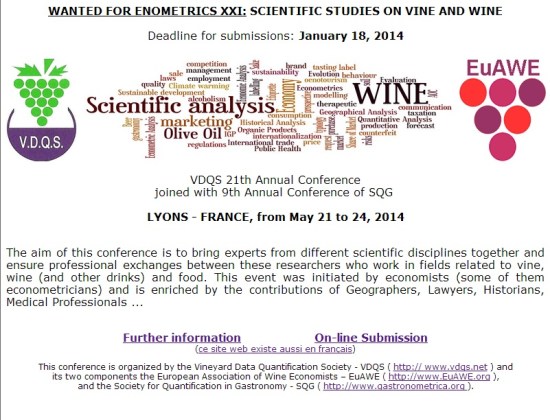
Our friends at the European Association of Wine Economists have asked us to announce the “Call for Papers” for their upcoming annual conference. As you can see below, they are interested in broadening the academic discussion of wine economics to include scholars from other fields — a great idea! And Lyons is great location for wine and food. Interested? See details below.

call_1_EuAWE

  For more information please click through to these websites:

Vineyard Data Quantification Society – VDQS http:// www.vdqs.net

European Association of Wine Economists – EuAWE http://www.EuAWE.org

Society for Quantification in Gastronomy – SQG http://www.gastronometrica.org.

Thanksgiving: American Wines for an American Celebration

Thanksgiving is the distinctively American holiday and we are happy to share the idea of a day of appreciation with other nations. A festive meal is generally part of the Turkey Day plan and so the question always comes up, what wines should we serve?

America: Beyond the Usual Suspects

There are many good choices depending upon the components of the meal, but we tend to lean towards American wines here at The Wine Economist office. And as Jancis Robinson and Linda Murphy’s recent book American Wine reminds us, we do not need to limit our choices to wine from the “usual suspect” states and regions. While most of America’s wines are produced in California, most of America’s wineries (by a small majority) are in other states!

Wines & Vines reports that the United States boasted more than 7400 wineries in 2012 and of those about 3500 were located in California. The Californians made a vast majority of the wines measured in either value or volume, but there are active wineries in all of the states and so lots and lots of  “local wines” for anyone wanting to support the local industry.

Most of us have tasted wines from California, Washington and Oregon and while some wines are surely better than others, it is clear that the best are world class products. Perhaps fewer have sampled wines from further down the list: New York, BC, Virginia, Texas and so on. What is the state of the art of wine in these states and regions?

Well, I have tasted many New York, Ontario, B.C. and Michigan wines at Riesling Rendezvous and other tastings and I can attest to the high quality of the best wines. Idaho with 50 wineries doesn’t make this list, but we tasted many outstanding wines when we visited there in October.

An opportunity to sample the wines of Missouri, for example, or Oklahoma does not frequently present itself. Most of the wineries are small and rely mainly upon cellar door sales. Very few make it into the broader distribution channels. It is a rare treat to be able to taste them.

Great American Wine Festival

Which is why we motored down to Portland recently to join the fun at the Great American Wine Festival, an event organized to coincide with a wine tourism conference. I’ll paste a list of the wine regions represented and the specific wines that they poured at the bottom of this column.

The event presented a cross section of American wine ranging from regions with high name recognition  (Sonoma County, Santa Barbara) to others that would be better known to wine historians than to contemporary wine consumers (Maryland, for example, plus Virginia and Missouri).

How were the wines? Well, first a couple of caveats. No one is going to send a bad wine to an event like this even if some questionable wines are made. And I might have cheated a little bit — there were too many wines to taste them all so I let the winery recommendations from Jancis’ and Linda’s book steer me to particular labels in many cases.

Wine Thanksgiving

And as with any tasting, we liked some of the wines better than others. But I would say that overall the quality of the wines we tasted was impressive and they can make us proud of American wine. There was something to enjoy at each table and several of the wines really surprised and delighted us.

Choose well, Americans, and your local wine (or in any case an American wine) will be the highlight of your Thanksgiving table — something we all can give thanks for!

>>><<<

Thanksgiving update: Our wines were

Appetizers: NV Domaine Ste Michelle Columbia Valley  Brut sparkling wine

Turkey dinner: 2006 Boedecker Cellars “Stewart” Willamette Valley Pinot Noir

>>><<<

Here is a list of wines presented by the regional wine groups present at the Great American festival. Click here to see all of the participants, including individual winery representatives not on the list below. Thanks to the Great American Wine Festival for their hospitality and to everyone we met at the tasting. Keep up the great work!

COLORADO WINE

Boulder Creek: 2011 Cabernet Franc

Canyon Wind Cellars: 2012 Anemoi Apeilotes

Carlson Vineyards: 2012 Cougar Run Dry Gewürztraminer

Colorado West: 2012 Elks Gewürztraminer

Ruby Trust Cellars: 2011 Gunslinger

 >>><<<

COLUMBIA GORGE WINEGROWERS ASSOCIATION

Cathedral Ridge Winery: 2010 Cabernet Reserve

Cathedral Ridge Winery: 2012 Riesling

Jacob Williams Winery: 2012 Chardonnay

Jacob Williams Winery: 2009 Syrah

Memaloose Winery: 2011 Cabernet Franc

Memaloose Winery: 2012 Trevitt’s White

>>><<<

IDAHO WINE COMMISSION

Cinder Wines: 2012 Dry Viognier

Clearwater Canyon Cellars: 2009 Renaissance Red

Koenig Vineyards: 2010 Syrah

Ste. Chapelle: Soft Huckleberry

>>><<<

Livermore Valley Wine Country

Concannon Vineyard: 2010 Conservancy, Cabernet Sauvignon

Garre Vineyard & Winery: 2009 Primitivo

John Evan Cellars: 2010 The Paracelcian, Cabernet Sauvignon

Las Positas Vineyards: 2009 Casa de Vinas, Cabernet Sauvignon

Little Valley Winery: 2010 Tempranillo

Longevity Wines: 2012 Livermore Valley, Chardonnay

McGrail Vineyards & Winery: 2010 McGrail Reserve,Cabernet Sauvignon

Murrieta’s Well: 2012 The Whip, White Blend

Nottingham Cellars: 2011 Casa de Vinas, Petite Sirah

Retzlaff Estate Winery: 2006 Cabernet Sauvignon

Tamas Estates: 2010 Double Decker Red (blend)

Wente Family Estates: 2012 Morning Fog, Chardonnay

>>><<<

 MARYLAND WINE

Basignani: 2007 Lorenzino Reserve, Cab Sauvignon, Cab Franc

Big Cork Vineyards: 2012 Chardonnay

Big Cork Vineyards: 2012 Late Harvest Vidal

Boordy Vineyards: 2012 Dry Rose, Merlot, Cab Franc, Cab Sauvignon, Syrah & Petit Verdot

Boordy Vineyards: 2010 Cabernet Franc, Reserve, Eastern grown Cabernet Franc

Crow Vineyard and Winery: 2012 Barbera Rose, Barbera, Vidal

Elk Run: 2011 Syrah

Knob Hall Winery: 2012 Willow, Traminette, Chardonnay, Pinot Gris, Vidal Blanc

Knob Hall Winery: 2011 White Oak, Chardonnay, Traminette, Vidal

Old Westminster Winery: 2012 Chardonnay

Sugarloaf Mountain Vineyard: 2010 EVOE!, Cab Franc, Petit Verdot, Merlot, Cab Sauvignon

2011 Columbia Valley Viognier

 >>><<<

MISSOURI WINES

Hermanhoff Winery: 2010 Vidal

Les Bourgeois Winery: 2011 Premium Claret

Montelle Winery: 2012 Chambourcin

Montelle Winery: 2012 Dry Vignoles

St. James Winery: 2009 Norton

St. James Winery: 2012 State Park Seyval Blanc

Stone Hill Winery: 2012 Chardonel

Stone Hill Winery: 2011 Chambourcin

 >>><<<

OKLAHOMA GRAPE GROWERS & WINEMAKERS ASSOCIATION

Chapel Creek Winery: 2012 Oklahoma Tempranillo

Chapel Creek Winery: 2011 Oklahoma Norton

Coquelicot Vineyard: 2010 Estate Sangiovese

>>><<<

SANTA BARBARA COUNTY VINTNERS’ ASSOCIATION

Dragonette Cellars: 2012 Sauvignon Blanc Happy Canyon

Dierberg/Star Lane: 2011 Dierberg Chardonnay

Fess Parker Winery & Vineyard: 2012 Fess Parker Santa Barbara County Chardonnay

Foxen Winery: 2012 Pinot Noir

Hitching Post: 2008 Hitching Post Pinot Noir Perfect Set Sta. Rita Hills

Lafond Winery: 2011 Pinot Noir AVA Sta. Rita Hills

Lucas & Lewellen: 2008 Cabernet Franc

Refugio Ranch Vineyards: 2010 Barbareno, Santa Ynez Valley – Syrah / Petite Sirah

Santa Barbara Winery: 2012 Chardonnay AVA SB County

>>><<< 

SOUTHERN OREGON WINERY ASSOCIATION

Agate Ridge Vineyard Ledger-David Cellars

Cliff Creek Cellars Plaisance Ranch

Deer Creek Winery RoxyAnn Winery

Del Rio Vineyards & Winery Serra Vineyard

Devitt Winery TesoAria Vineyard & Winery

EdenVale Winery Trium Vineyard & Winery

Kriselle Cellars

>>><<< 

VIRGINA WINE

Barboursville Vineyards: 2012 Viognier Reserve

Rappahannock Cellars: 2010 Meritage

Rappahannock Cellars: 2012 Viognier

Tarara Winery: 2012 Nevaeh Red

 >>><<<

THE WINE ROAD NORTHERN SONOMA COUNTY

Alexander Valley Vineyards: – 2009 CYRUS

Alexander Valley Vineyards: 2010 Sin Zin

Silver Oak Cellars: 2009 Alexander Valley Cabernet Sauvignon

Stonestreet Winery: 2011 Gravel Bench Chardonnay and Broken Road Chardonnay

Trione Vineyards and Winery: 2012 Russian River Valley Sauvignon Blanc

Trione Vineyards and Winery: 2010 Russian River Valley Pinot Noir

Twomey Cellars: 2011 Russian River Valley Pinot Noir

Catching Up with Chilean Sauvignon Blanc

P1070230A shipment of four Chilean Sauvignon Blancs arrives at our door (courtesy of Wines of Chile) along with a request to see how they paired with seafood. That’s the kind of challenge that we like, so we called our friends Cynthia Howson and Pierre Ly and organized a dinner tasting.

The conversation was stimulating, with Pierre and Cynthia exchanging tales of their wine research in China (which has been reported here at the Wine Economist) and their WSET classes for news of our recent travels in  Idaho and Australia. Then we got down to business with the food and wine.

For appetizers I decided to focus on wines from the coastal areas and the pairings were very successful. The Santa Carolina Leyda Estate Reserva Sauvignon Blanc 2013 was good on its own but fabulous with a rich smoked salmon dip. And the Los Vascos Casablanca Sauvignon Blanc 2012 that we have enjoyed before was even better with fresh oysters from nearby Hood Canal and white prawns.P1070228

For the main course I selected the wines from the central valley and Andes foothill areas. The minerality of these wines (Calcu Colchagua Valley Sauvignon Blanc 2012 and Santa Ema Select Terroir  Maipo Valley Sauvignon Blanc 2012) really stood up to and enhanced a special brodetto (a seafood stew from Romagna) made with Lynne Rossetto Kasper’s recipe from The Splendid Table cookbook.P1070232

The meal was great (especially topped off with Sue’s raspberry-currant crostata) and the Sauvignon Blanc-seafood pairings really worked.

Taken as a group these were the best Chilean Sauvignon Blancs yet — an indication that perhaps Decanter reviewers were right when they said that Chilean wines just get better every year as site selection is fine tuned and the winegrowing and winemaking techniques continue to improve. Significantly, the wines were not carbon copies — either of other wine regions (think Marlborough SB) or of each other — we appreciated the diversity as much as the overall quality.

Four wines can’t possibly tell the whole story of a complicated wine country like Chile. But if these four are representative of the kind of Sauvignon Blancs being made there today, I think Chile has finally arrived!

>>><<<

Thanks to Emily Denton of the thomas collective for arranging this tasting. Thanks to Pierre and Cynthia for their help and to Sue for the photos.

What’s Ahead for Idaho Wine?


Everyone we met in Idaho was keen on the potential of this sometimes overlooked wine region but at the same time aware that greater success — in terms of sales, recognition, and premium prices — is far from guaranteed.

Idaho, as I discussed in last week’s column, is unique in many respects, but it is typical of emerging American wine regions in that it is searching for the key that will unlock the latent potential of the people and the land.

Idaho Wine Surprises

One thing that surprised me was the vitality of the local wine market. Although Idaho has wine roots going back to the 1860s, the industry and the local wine culture was destroyed by Prohibition and was slow to recover afterward even by American standards.

Boise — the state capital and largest city — has changed enormously since I first visited over 30 years ago. The downtown now boasts both a Whole Foods Market and a Trader Joe’s — a sure sign that there is a critical mass of resident upscale consumers — and the wine department of the Boise Co-op supermarket grew so large that it took over a nearby building (it was crowded with interesting wines from Idaho and the world and buzzing with activity when we visited).

Pluses and Minuses

Boise impressed me as quite cosmopolitan. We had lunch on the Basque Block, for example, a cluster of Basque restaurants, social clubs and community center. Boise celebrates the cultural diversity that its Basque community brings and is working to strengthen ties (including wine connections) with the Old World. A group of local winemakers recently traveled to Spain to exchange ideas with wine people there, which seems like a great idea given the success some wineries are having with Tempranillo. A lot of pluses here.

And some minuses, too. Idaho wine is not well known outside the region and this is a disadvantage for those with national ambitions for their wines although obviously less of a factor if you define your market territory carefully to include the mountain states and parts of the Pacific Northwest.

Focused effort seems to be what is needed. Greg Koenig looks to be on the verge of success in China, for example, where buyers may not know where Idaho is but they understand what he has to offer — delicious Snake River Valley Riesling Ice Wine!

Building Brand Idaho

The economic structure of the Idaho industry is not ideal with big dog Ste Chapelle dwarfing the rest of the industry. It would be great if Ste Chapelle were to play a hegemonic role, working to grow markets and develop the supply chain for all of Idaho wine the way that Chateau Ste Michelle did for Washington wine in that industry’s early days. Or at least that’s what I was thinking  before my visit.

But these are different times and Idaho is a different place. Ste Chapelle is part of the dynamic Precept Wine group which has important wine assets in Washington, Oregon and Idaho and competes in a market environment where important new players (Gallo in Washington and Kendall Jackson in Oregon) have recently entered. Ste Chapelle must necessarily act as part of an ensemble, not as a solo performer, and while I think that great success is possible for the winery itself, it might not necessarily be able to pull the rest of Idaho wine along with it. The smaller wineries need to make their own paths and they seem to realize this fact.

I noticed that some of the new Ste Chapelle “soft” releases were designated “American Wine” even though they are for now at least made using only Idaho grapes. This will help the Ste Chapelle brand if and when they scale up production using fruit from other areas, but it doesn’t promote Brand Idaho. Not a criticism,  because I understand the business logic, but true nonetheless. On the other hand, however, it must be said that the Idaho wine industry would be much less vital without Precept’s key vineyard investments, which provide grapes for many smaller producers.

Opportunities

What will it take to bring Idaho wine to the next level? Well, I’m tempted to say that a big critical success would do it and high scores certainly help. The quality of the best wines makes strong ratings more than a dream (and in the case of a few wines, already a reality). But the market is very crowded right now and my winemaker friends tell me that even 90+ scores don’t always have the impact on prices and sales that they would like.

Wine tourism is another strategy that holds promise. The Sunnyslope area is a short drive from Boise and a wine trail is in place although it is hampered a bit by state restrictions on signage that limit the ability of individual wineries to direct buyers to their tasting rooms. Visitors from adjacent states represent an obvious marketing opportunity that effective wine tourism promotion could enhance.

New investment in vineyard assets would be welcomed hereabouts, as I wrote last week. But what will it take to get major vineyard investments that would fill the barrels and bottles that Idaho winemakers long to produce? Well, it’s complicated of course. From a strictly economic point of view the situation is that land must be worth more as a vineyard than at its next best alternative use — orchard, pasture or residential development — and this isn’t always the case.

Economic Impact

Idaho wines are often a bargain given their quality and tend to sell for much less than the Walla Walla wines that some makers compare them to. This helps sell the wines, but it also limits vineyard growth. Low wine prices dictate low grape prices, which means low vineyard land valuation.

 An economic impact statement prepared in 2008 projected that the number of Idaho wineries would continue to grow from 11 in 2002 to 38 in 2008 to 78 in 2015. The current number is around 50, much less than that estimate, and the number of vineyard acres has probably declined a bit from the 2008 level.  Is this just an understandable (given the Great Recession) pause in the upward trend or has the industry plateaued?

Too soon to tell, really, but I am cautiously optimistic. The land is there and the people, too, both thoughtful consumers and smart, hand-working producers.  I sense a new energy in America’s regional wine industries (this energy was captured in the book American Wine by Jancis Robinson and Linda Murphy). Idaho’s time will come.

>>><<<

Here’s a list of some wineries from our visit. Sorry that we didn’t have time to visit others!

Bitner Vineyards

Huston Vineyards

Koenig Vineyards

Fujishin Family Wine Cellars

Hat Ranch Winery

Ste Chapelle Winery

Cinder Winery

Coiled Wines

Mouvance Winery

Telaya Wine Co.

Shifting Perspectives on Idaho Wine

P1060910

The view down toward the Snake River from Bitner Vineyards

>>><<<

We spent a weekend in the Idaho wine country last month and I’m still trying to make sense of the experience. It seems like every time I think I know what Idaho wine is I shift my ground a little bit and see something new and usually something different.

So the view keeps changing. Rather than trying to ignore this problem, I thought I’d make it the theme of this column.

Snake River Valley Views

Let’s start with the natural elements. The main vineyard area in Idaho winds along the Snake River and some of the views are spectacular — the photo above taken from Bitner Vineyards shows one of the best.

The vineyards reach down towards the river and the slope is key both because these  hillsides provide a natural solar-collector effect (the area is called Sunnyslope), but also because cold air drainage is an important factor in preventing frost damage to the crop and freeze damage to the vines.

The view shifts when you move along a few miles. This region is a high desert plateau. A lot of the land is pancake flat, ideal for many crops but not necessarily wine grapes, especially given the cold issues. Rainfall is surprisingly sparse here so access to irrigation water is key.

Although Idaho shares borders with both Washington and Oregon, there’s no question that its wine industry is more Columbia Valley than Willamette Valley. This might seem obvious since the Snake River joins the Columbia River on its way to the Pacific Ocean, but it’s mainly because they share that dry plateau feature.

No sense looking for a “signature variety” in Idaho as they do (in Pinot Noir) in Oregon. No, Idaho is more like Washington — lots of grapes can thrive here (in the right spots) and lots of interesting wines are possible. A blessing from a winemaker standpoint and a bit of a curse from a marketing point of view. Riesling to Tempranillo and lots of options in between.

P1060919

Looking down to the plateau from Sawtooth Vineyard

Big Dog Ste Chapelle

From an economic point of view, on the other hand, Idaho is a world of big and small without too much in between. This is also a bit like Washington state wine, where Ste Michelle Wine Estates (including Chateau Ste Michelle, Columbia Crest, 14 Hands and other wineries) dominates making more than half of all the state’s wine. Ste Chapelle is the big dog in Idaho to an even greater extent producing a total of about 300,000 cases of wine under the Ste Chapelle label plus other brands.

Ste Chapelle is part of the Precept Wine group these days, having been bought and sold several times since it was founded in the 1970s as the U.S. wine business went through consolidation and then financial crisis. I think there is a sense that the stability that Precept can provide is welcome after some years of drama. The largest privately held wine company in the Pacific Northwest, Precept controls half of Idaho’s vineyard acreage (variously estimated at 1200-1500 acres) in addition to its assets in Washington and Oregon.

Ste Chapelle makes several lines of wine. Their “soft” (read sweetish) wines are technically well made and perfectly in line with current sweet red and moscato-style market trends. The soft red and a soft pink wine with a subtle huckleberry flavor are the top selling wine SKUs in the state, crowding out the California “usual suspects.”

Ste Chapelle also makes smaller (but still substantial) quantities of dry wines, including 40,000 cases a year of an off-dry Riesling that nearly stole the show at Riesling Rendezvous this year. And they produce Precept’s wildly popular Chocolate Shop and Almond Roca wines at their facility.

Limits to Growth

If Idaho is the land of the big it is also a world of small. From 300,000 case Ste Chapelle we drop sharply down to 12,000 – 15,000 case Sawtooth (also a Precept Wine brand) and Greg Koenig’s operation of about the same capacity, where he makes his own products as well as those of four other wineries including Bitner. That’s a big gap between #1 and the rest in terms of size and market penetration. Not too many of the remaining 40+ wineries in the state have total production as high as 5000 cases.

What limits growth? Well, you have to sell what you make, so market demand is an obvious factor. But I got the strong sense from several winemakers that they could sell more if they could make more. Vineyard capacity is a real roadblock.

While they were glad to be able to purchase fruit from the Precept group’s 400 acre Skyline vineyard, they needed even more. Land surveys indicate that there are many good sites that could contribute to the industry’s growth if only new investors would enter the region.

Made In (But Not of) Idaho

If Idaho has not attracted as many wine growers as it needs, it certainly has attracted wine makers who see this area as a good place to live and to work. A number of small urban wineries have sprung up as wine enthusiasts from other regions are attracted here and others who have left to establish careers elsewhere return home.

Many of their wines are clearly Idaho products, but we tasted a number of them that were made from grapes imported from Washington, Oregon and even California. The practice of using out-of-state or region grapes or juice is not that uncommon in the Pacific Northwest. Oregon’s largest winery, King Estate, brings in fruit from the Columbia Valley for its NxNW wines, allowing them to produce a more complete portfolio of wine varieties and styles. And the  Pamplin Family Winery in the Willamette Valley is one of several that make high quality Bordeaux blend wines using Columbia Valley fruit. And of course most of the grapes used in Seattle-area wineries are trucked over the mountains from Eastern Washington.

Necessity (and limited local grape supply) dictated the use of non-Idaho grapes in some cases, but we met several winemakers who cited passion for a particular style of wine as a driving force. I did a University of Puget Sound alumni program at the Mouvance Winery tasting room while we were in Boise and enjoyed their Pinot Noir and Pinot Gris wines made from the fruit of the family’s own vineyard in Oregon. Pinot passion drives this project and so Idaho grapes just won’t work.

What should we think about Idaho’s cross-border wineries? Well, just like everything else in Idaho wine it depends on your point of view. They certainly do contribute to the critical mass of winemaking that the industry needs to move ahead and clearly help foster what I see as a vibrant emerging wine culture (more about this next week). But I also picked up understandable concern that their efforts didn’t contribute as much as some would like to building the local industry from the ground (the vineyards) up.

Where is Idaho wine headed? My thoughts next week.

>>><<<

Thanks to everyone who met with us during our Idaho visit. Special thanks to Jim and Melissa Thomssen, Ron Bitner, Greg Koenig, Gregg Alger, Maurine Johnson, Moya Shatz Dolsby, and the Idaho Wine Commission. Thanks to Sue Veseth for the photos.

Telling Australia’s Wine Story the Old School Way

“Restaurant Australia” (the subject of two recent columns) was not the only attempt to re-brand Australian wine that we experienced at Savour Australia 2013. Other groups are busy getting the message out in their own ways using both high tech and “old school” approaches.

We encountered two memorable statements that deepened our understanding and appreciation of Australia and its wines. One had wine-making families tell their stories up close and personal. The other let the wine itself do the talking. Together with the Restaurant Australia campaign they made a compelling case. Here are the details.

First Families 

Sue and I were fortunate to be invited to a dinner hosted by Australian First Families of Wine and it was an eye-opening experience. The First Families are principals in twelve family-owned Australian wineries that together span the continent’s history, wine regions, and styles.

The member wineries are: Brown Brothers (based in Victoria, founded in 1885), Campbells Wines (Rutherglen, 1870), d’Arenberg (McLaren Vale, 1912), de Bortoli Wines (Victoria and New South Wales, 1928), Henschke (Eden  Valley and Adelaide Hills, 1868), Howard Park Wines (Western Australia, 1986), Jim Barry Wines (Clare Valley and Coonawarra, 1959), McWilliam’s Wines (several regions, 1877), Tahbilk (Victoria, 1860), Taylor’s Wines (Clare Valley, 1969), Tyrrell’s Wines (Hunter Valley and other regions, 1858), Yalumba (Barossa and Eden Valley, 1849 — oldest of them all!).

Founded in 2009 (dark days for Brand Australia) this is an exclusive club, as Graeme Lofts explains in his history of these wineries, Heart & Soul: Australia’s First Families of Wine. What do they have in common? Australia, of course, and family ownership plus the longevity to be able to offer a vertical tasting of at least 20 vintages. Some are very large and others relatively small, but they are all top quality producers with a multi-generation point of view.

AFFW

They are all export focused, too, and so naturally worry about how their wines in particular and Australian wines more generally are viewed by global consumers, especially those in China and other growing markets. James Halliday writes in the book’s foreword that “The underlying rationale for the formation of Australia’s First Families of Wine was the realization that export markets had either lost sight of or had no way of knowing about Australia’s rich history, its diverse regional and wine styles, and the fierce personal commitment of the best winemakers to the production of high-quality wines true to their variety and geographical origin.”

Medium and Message

The idea was to provide counterpoint to the stereotype of Australian wines abroad, according to Halliday. “The wines have none of the corporate or industrial aroma attached (no matter how unjustly) to the brands produced by the largest Australian producers.”

So how do the First Families make their case? Not by relying on flash websites and streaming video, as effective as they can be. If the medium is the message, those media might send the wrong message about these fine wines.

No, in fact, they do it the hard way, the old school way. The families (all of them, or at least representatives of each and every one) travel to key markets and host dinners and events like the one we attended. There is real wine in real glasses, real people tell their stories and make their case. These are family wineries, you see, and family is always personal. So the message is personal and the medium must be the same.

I was impressed by the commitment. There were no empty First Family places at our dinner despite the group’s recent return from a grueling round of more than a dozen events in East Asia. The show must go on, as they say in the theater, and they seemed to draw energy from their audience, their mission, and each other. Quite an experience!

Yalumba Museum Tasting

The second effort to define Australian wine was necessarily even smaller and more focused, but the impact may still be substantial. Yalumba’s proprietor Robert Hill Smith (who was also at the First Families dinner) invited a few of us to The Old Lion Cellar & Tunnels  in Adelaide to take part in a special tasting of museum wines.

Our meeting was only the 24th in a series that began in 1977. Initially the focus was internal, I’m told, to let Australia’s young winemakers taste some of the very best wines across both time and space and be informed and inspired by them. A sure cure for “cellar palate” complacency!

P1060465Gradually the focus has evolved and it was clear that our tasting was meant for export — to leave a strong impression on Savour Australia 2013’s international delegates. And it (plus Robert Hill Smith’s engaging personality and a bit of excellent cuisine) certainly did the trick. Scroll down to see the list of wines we sampled.

Australia Three Ways

Restaurant Australia aims to use the power of modern media to cast a spell on consumers that will entice them to experience Australian food, Australian wine and … Australia! It targets the big global stage and seems well suited to its role.

Australia’s First Family of Wines is a more  personal experience that lets a dozen families speak for the nation’s fine wine. It’s a different stage (an intimate theater versus a huge IMAX screen) and a different audience, but powerfully effective because of that.

The Yalumba tasting, for those of us lucky to experience it, is the ultimate personal experience — a conversation where the wines literally speak for themselves, telling stores of the past and present with implications for the future.

Taken together, these efforts make a strong statement about Australian wines! Here — because I can’t resist sharing them — are the wines of the Yalumba tasting. Enjoy!

Riesling

  • Pewsey Vale “The Contours” Eden Valley Riesling 2002
  • Pewsey Vale Eden Valley Riesling 1973
  • Yalumba Riesling 1938

Viognier

  • Yalumba “The Virgilius” Eden Valley Viognier 2010
  • Yalumba “The Virgilius” Eden Valley Viognier 2007
  • Yalumba “The Virgilius” Eden Valley Viognier 2003

Chardonnay

  • Giaconda Estate Vineyard Chardonnay 2010
  • Vasse Felix Heytesbury Margaret River  Chardonnay 2008
  • Heggies Vineyard Reserve Eden Valley Chardonnay 2006

Shiraz — Eden Valley

  • Henschke Hill of Grace Eden Valley Shiraz 2006
  • Henschke Hill of Grace Eden Valley Shiraz 2004
  • Henschke Hill of Grace Eden Valley Shiraz 2002

Shiraz – Clare Valley

  • Jim Barry “The Armagh” Shiraz Clare Valley 2006
  • Jim Barry “The Armagh” Shiraz Clare Valley 1994
  • Jim Barry “The Armagh” Shiraz Clare Valley 1989

Cabernet Sauvignon

  • Vasse Felix Cabernet Sauvignon 2010
  • Vasse Felix Cabernet Sauvignon 2004
  • Vasse Felix Cabernet Sauvignon 2001

Cabernet Sauvignon & Shiraz

  • Yalumba “The Signature” Barossa Cabernet Shiraz – The 3 Amigos 2004
  • Yalumba “The Signature” Barossa Cabernet Shiraz – A. “Eddy” Waechter 1992
  • Yalumba “The Signature” Barossa Cabernet Shiraz – A Harold Yates 1966

Fortified

  • Yalumba Shiraz Port No. 9 1922

>>><<<

Special thanks to Robert Hill Smith for including us in the museum tasting. Thanks as well to the First Families, especially Victor De Bortoli, Prue and Stephen Henschke, Chester Osborn of d’Arenberg and Tom Barry.

World Tour Update: VinPro and the Unified Sympoisium

The “Wine Economist World Tour” (my calendar of talks and book signings) is starting to fill up and the end of January 2014 looks like a particularly interesting couple of weeks. Lots of frequent flier miles — and maybe a bit of jet lag, too!

On January 23 I will be in Somerset West, South Africa to give the keynote at the Nedbank VinPro Information Day program. VinPro is a key service organization for 3,600 South African wine producer members. It strives to both represent the wine sector and to further its development. I’m pleased to be invited to speak to South African growers and producers at this important event.

Fast forward a few days and I will be in Sacramento, California at the Unified Wine and Grape Symposium, the western hemisphere’s largest wine industry gathering speaking in two of the sessions.

On Tuesday, January 28 I will be moderating an afternoon panel on “Using Data for Better Decision-Making.” The premise is that you can’t manage what you don’t measure and many in the wine industry would benefit from a more systematic approach. Here is the official description of session.

This session will explore how to use data to better understand and run your business. Presentations will include operating and financial benchmarking data and how these data can be applied to your business for improved decision making. Attendees will hear how benchmarking data are gathered and analyzed, and what it means. A winery and a grower representative will provide examples on how they started measuring various forms of data, what tools they acquired or developed, and lessons learned. They will also share best practices and identify the biggest problem areas for good data measurement and use. The session will end with key takeaways to consider in implementing better data tools for your business.

Then on Wednesday I will be one of three speakers, along with Jon Fredrikson of Gomberg, Fredrikson & Associates and Nat DiBuduo of Allied Grapegrowers of California, at the “State of the Industry” session (Extreme Wine readers will recall that I wrote about this event in Chapter 6).

The State of the Industry session will provide a comprehensive look at every aspect of the wine industry, from what’s being planted to what’s selling. This 2½ hour session features highly regarded speakers and delivers incredible value for attendees who need to understand the market dynamics of the past year and are seeking insight into the market trends that will define the year ahead.

My job will be to bring a global perspective to the discussion. It’s an honor to share the stage with Jon and Nat, who have both earned the respect of those of us in the industry. Looking forward to hearing their remarks!

Hope to see you in Cape Town or Sacramento or any of the other stops on the world tour!

Anatomy of Australia’s New Wine Strategy

Click on the image to view one of the Restaurant Australia videos.

>>><<<

In my last column I talked about Australian wine’s plans to re-brand itself on the global market through an integrated food-wine-tourism campaign called “Restaurant Australia.”  Delegates to Savour Australia were treated to four specially produced videos  (click on the image above to see one of them) that introduced the concept and, not coincidentally, also introduced the chefs and purveyors who would be providing some of our (delicious) meals over the next few days.

Beyond Sensory Overload

The audience seemed to pause, slightly stunned, after each video. At first I thought that it was just sensory overload. And it was. The stunning images presented on the big screen with rich surround sound was an intense experience, to be sure. The fact that we experienced it all again later, meeting the chefs, tasting the produce– that was intense too.

But now that I am back home and reflecting on the experience, I think that perhaps we also paused for a different reason. The whole purpose of our gathering was wine. We had journeyed long miles to Adelaide to see and hear Australia tell its wine story. But where’s the wine?

Yes, wine and a winemaker appeared in each video, but they seemed a bit of an add-on rather than the featured element of the message. What would happen if you left out the wine ? Nothing much else would change. Is that the way we want people to think about Australian wine — an afterthought in the grand “Restaurant Australia” concept?

Now There’s Your Problem

Obviously not — and it would be a mistake to judge the marketing campaign by a few introductory videos. But, as I thought about it, I began to recognize that it was related to a bigger problem.

One of the chapters in Extreme Wine is about wine and modern media — I call it Extreme Wine Goes to the Movies — and it concludes in part that wine’s inherent sensuousness seems to be difficult to translate to video. Yes, wine famously unlocks all the physical senses and a few of the mental ones, too. But it is an experience good. Like fly fishing and some other things you might be able to think of, its more fun to do than to watch someone else do.

That’s why there are surprisingly few films where wine plays a really central role. There are a few excellent ones (Sideways fans please put down your pitchforks!) but you’d really expect there to be far more than I found in my research. Food, on the other hand, seems to be something that video can capture very well. Does watching someone drink wine in a movie make you thirsty? Maybe. Does watching a celebrity chef eat a delicious dish make you hungry? You bet it does!

Hungry?

No doubt about it. Wine’s magic is difficult to capture on the silver screen (or that little screen on your tablet or smartphone). That’s why we have Master Chef but not Master Enologist.  There are rock stars in wine, but they don’t generally transcend the wine category the way the foodie celebrities increasingly do.

Wine Porn versus Food Porn

My foodie friends are always taking X-rated “food porn” photos of the the plates they are served at fancy restaurants. But my wino buddies generally don’t bother to snap “wine porn” images of their glasses (although I admit to some G-rated bottle/label shots myself).

Assume that I’m correct about this for a moment (or, better yet, grab a copy of Extreme Wine and read a more detailed account, which uses Sideways to show why really powerful wine films are so rare). Given video’s undeniable importance in communications today, what is wine to do? Well, one answer is to do what Australia wine seems to be doing, which is use what works (the foodie side of the campaign) to drive the message.  They call it “Restaurant Australia,” but I have a better name.

Strongest Brand in the World?

I call it The Italian Way. What region has the strongest generic wine brand? Well, here in the United States I would say that it is Italy (although France can make a claim because of Champagne’s powerful brand). Americans love everything about Italy — the food, the people, the art, the scenery, the food again, and now with the new Fiat 500, even the cars.

Americans love Italian (or sometimes Italian-style) coffee. And they love Italian wine. Just the fact that it’s from Italy gives it an automatic advantage at supermarkets, restaurants and wine shops.

It seems to me that “Restaurant Australia” aims to get Americans to love warm, friendly Australia in the same way that they have always loved warm, friendly Italy. A good idea? Yes. But not easy to do. If it was easy to achieve Italy’s reputation, everyone would do it. But it is worth trying. Australia has authenticity in its favor — it really is warm and friendly and the food and wine you can find there really are great– and that’s worth a lot.

Is it the only way to re-brand Australian wine? No — tune in next week for my report on another approach to this problem.

Two New Wine Guides: The Hedgehog and the Fox

Two new wine guides have appeared just in time for the holiday wine-book-gift-giving season. Informative and interesting, they present us with two very different ways to think about wine and buying it. Perfect for a comparative review!

The Wine Curmudgeon’s Guide to Cheap Wine by Jeff Siegel (a.k.a. The Wine Curmudgeon) 2013 (also available as Kindle e-book).,

Complete Wine Selector: How to Choose the Right Wine Every Time by Katherine Cole, 2013.

These books remind me of the parable of the hedgehog and the fox that served as the inspiration for one of Isaiah Berlin’s best known essays. The fox knows many things, the story goes. But the hedgehog knows One Big Thing!

The Complete Wine Fox

Complete Wine Selector is the fox in this story.  Gosh, it sure does deliver on its promise to be complete. There is just so much useful and interesting information packed these 250+ pages. Sue and I were both impressed.

And it really does focus on choosing wines, providing both general principles and specific recommendations. Cole builds the book around the idea that people should learn about styles of wine and not just focus on varietals, appellations, etc . The ten wine glasses on the book cover represent the ten wine styles that she analyzes in the book, including crisp, lean whites; rich full-bodied whites; light, refreshing reds; sparkling wines and rosés; continuing down the list until we reach fortified wines.

The idea of thinking about wine in terms of style is very useful even if it is not really new. Hugh Johnson stakes a claim to it in his foreword to the book and I have seen many restaurant wine lists that focus on style versus grape or country of origin. There is even a chain of stores called WineStyles organized along these lines.  Cole’s comparative advantage is in the execution of the wine styles strategy, taking us from general principles to specific wines and wine recommendations very effectively.

The final pages of the book present more general background information, such as how wine is made, how it should be served and stored, good places to buy it and so on. Interesting and good to have, but the stories behind those ten glasses on the cover are what you are here for. Like the fox of the famous fable, this book knows many things and organizes them in a way that will delight many readers.

My only real criticism is that the graphic design sometimes seem to overwhelm the book’s content, although I acknowledge that some readers (especially those under 30 years of age) will disagree. Trying to fit content into design-determined boxes sometimes results in text that is hard to read. And sometimes images seem to just fill a designed illustration space rather than usefully illustrate a key concept. On the other hand many of the graphics (such as the detailed wine label illustrations) are really good, so perhaps I am being too picky (Sue didn’t object to the design at all).

I loved Cole’s previous book on biodynamic viticulture in Oregon. I’m happy to have her new wine guide on my bookshelf!

The Hedgehog Curmudgeon

Jeff Siegel’s new book is the hedgehog. Although Jeff knows as much as any fox about wine, his book digs deep into a single topic — his One Big Thing — cheap wine. Like Rodney Dangerfield, cheap wine “can’t get no respect” and Siegel aims to change that.

Some people treat cheap wine as if it were a contagious disease, but not Jeff Seigel. He knows that bad wine (of any price) is a curse and good wine, especially if it doesn’t cost an arm and a leg, is a blessing.  Cheap wine today is the best in history. Celebrate!

The table of contents gives you an idea of how the story is developed.

  • Why cheap wine matters
  • Cheap wine’s long and winding road
  • The revolution in cheap wine
  • Understanding cheap wine
  • How to buy cheap wine: The basics
  • How to buy cheap wine: Advanced course

There is a lot to like in this book — lots of fascinating stories. I like the strong sense of history that comes through and the appreciation that the rise of quality cheap wine was in a way the triumph of technology and business competition over entrenched attitudes among consumers and industry politics that resisted change. This book is about more than cheap wine, you see, although Siegel takes care never to stray too far from his hedgehog focus.

There are many twists and turns on the path that Siegel chooses and, as I look at my notes, his hedgehog touches on a lot of topics that Cole’s fox also explores. No surprise there, I suppose — they inhabit the same wine forest even if they focus on different elements of  it. Both are interesting books that you should consider if you are looking for wine guide that wants to shake up your way of looking at things!