Money, Power, Memory, Taste and Wine

A review of Liquid Memory: Why Wine Matters by Jonathan Nossiter (FSG, 2009). Original French edition published in 2007 as Le Goût et le Pouvoir (Taste and Power).

Jonathan Nossiter is famous for his 2004 film Mondovino. Love it or hate it (or love to hate it), Mondovino has given Nossiter standing in the world of wine and he takes advantage of this fact in Liquid Memory: Why Wine Matters.

Remembrance of Terroir Past

Although it is not intended to be a supplement to or continuation of Mondovino, I certainly learned quite a bit about the making of the film and its characters and about Nossiter, too. Indeed, the book is really about Nossiter and how wine inspires his memories and provokes his emotions just as a small cake, a madeleine, famously provoked Marcel Proust. It’s not my favorite book because I guess I’m not that interested in Nossiter’s memories, or at least not as interested as he is, but I did find things to like in it.

In one of my favorite scenes from the book, Nossiter and a film-making colleague are driving back from a day of Mondovino pre-shoot research in Burgundy and they talk about why they are so attracted to terroir. Members of a somewhat rootless transnational artistic class, they recognize that perhaps terroir is so precious to them because it is something they feel they have lost. Nossiter, the American raised in Paris, now lives in Brazil, well you can see how he would feel nostalgic for the authentic home terroir he maybe never had. That’s an emotion many of us can appreciate.

The Bland Taste of Peace?

Another passage subtly probes this same feeling in a different context. Why is terroir and regional identity so important now? Because sharp divisions have caused so much pain and hardship in the past (think Europe and the two World Wars).  Suppressing differences and rounding off sharp corners to create a more peaceful whole has been the agenda of the last 50 years.

Now we find that universalism has gone pretty far, creating the terroir-free transnational world of the European Union and we start to value what we have lost. Sharp edges seem pretty desirable now that we’ve lost them, even if they  sometimes bruise or cut.

I tasted both sides of this problem when we visited Friuli in the Italian Northeast a few years ago. We stayed outside of Cormons with the Venica family at their winery estate and the Sirk family at La Subida.

The land and people of this area where brutalized by the two Great Wars and so, when postwar peace appeared, they gathered grape varieties from around the world and planted them all together in one serene vineyard. The wine from these grapes, Vino della Pace (wine of peace) isn’t especially distinctive on the palate as I recall, but is memorable nonetheless for its optimistic symbolism.

We longed for the taste of peace when we didn’t have it. Now that we do, we find it a little bland. So we seek out terroir, even if it threatens to divide us once again.  Interesting, isn’t it?  Even in Friuli it is the intensely distinctive local wine of long memory – Pignolo, Schioppettino, Ribolla Gialla – that attracts our attention today, not the wine of peace.

Wine and Money

Although this is a book about cultural politics (if you believe the French title) and social philosophy (if you consider the American one), it seems to me that a great deal of space is actually given over to wine economics. The business of wine with its commercial pressures, and especially the ethics of wine pricing get a great deal of space.

“It occurs to me,” Nossiter writes, “that it is impossible to talk about wine without talking about money” and I think he is right. “Wine is inextricably linked to money like all objects of desire in a capital-driven world.”

Though a given bottle’s price varies even more peculiarly than the price of fine arts, a given bottle’s price is supposed to be a reflection of its intrinsic values. Whether it is the producer who sets the initial price, or the importer, distributor, or end seller, each time the price of the wine is set an ethical decision has been made in relation to the wine’s origins and contents.

Nossiter is disgusted by the religion of money, but in this passage he seems instead to be seduced by it, to accept the premise that market prices are moral judgments even as he protests their verdict. I think the premise is wrong and that intrinsic worth is measured by a different scale.

But that’s just the economist in me talking, I suppose.

A review of

Anatomy of Australia’s Wine Crisis

Australia’s wine bubble seems about to burst (as I reported in my last post) and a number of observers have jokingly compared it to the global economic crisis.  You have too much wine? Ha! We have too much bad debt! Shall we swap problems?

Since I’ve just written a book about about the financial crisis (Globaloney 2.0 — it will be out in December 2009), I started to wonder if I could learn anything by seriously comparing the two crises. Here’s a first draft of my report.

This Time is Different

One of the arguments I make in Globaloney 2.0 is that financial investors and speculators convinced themselves that their risky, highly leveraged holdings were really “safe as houses” (irony intended).  Although they saw the bubble building and realized that bubbles often burst, they convinced themselves that “this time is different.” (They always do this, as a new book by Carmen Reinhart and Ken Rogoff makes clear.) It’s what I call Financial Globaloney.

Their false assessment of risk (which created  moral hazard, which encouraged even riskier behavior) combined with leverage and liquidity to produce the boom and bust we are living through just now. Booms and busts are a persistent feature of financial markets and we shouldn’t be surprised when they come ’round again. This time is not necessarily different. Is the same true for wine?

The Twenty Year Wine Boom

Everyone knows about Australia’s recent wine boom and its imminent bust, but it is important to put these events into a broader context, to understand that the present crisis is nothing new. University of Adelaide Professor Kym Anderson’s 2004 book World Wine Markets: Globalization at Work tells the story.

The current Aussie wine boom began in the mid 1980s. Wine production had closely tracked slowly growing domestic demand for the forty years after World War II (Australia was a net importer during this period), but began to rise dramatically after 1987.

Changes in retail sales laws in the UK transformed the wine market there (I wrote about this in an earlier post). Supermarket chains became mass market wine sellers that searched the world for good value product to fill their shelves and own-brand bottles. Australia stood ready to answer this call. Wine was identified as a key potential export industry. Private and public resources were organized to support and expand it. Vineyards and cellars started to grow to meet rising export demand.

A number of factors contributed to the boom, including liberal trade laws, increased international investment flows and of course the French Paradox findings that made red wine popular for reasons of health. Here in the US the partnership between the Casella family of Australian winemakers and the Deutsch marketing/distribution family firm produced the Yellow Tail phenomenon, which helped create what we now call Brand Australia. The high ratings that Robert Parker and others gave to Australian fine wine didn’t hurt demand, either.

Vineyard area doubled then doubled again over the 20 boom years (see brief data appendix below). Since domestic demand did not increase nearly this fast exports had to rise, and they did. It must have seemed that the global markets could and would absorb any amount of wine, an attitude that encouraged further investment. This belief in infinite world wine markets gave investors confidence to make what might otherwise (or with hindsight) be seen as quite risky investments. Thus a classic bubble was born. Parallels between the wine bubble and the mortgage credit bubble are easy to see here.

The level of output was unsustainably high given modest Australian consumption, rising production costs, realistic limits to global market growth and increasing international competition. Recent problems such as drought and recession-induced collapse in demand for high priced wine may have triggered current crisis talk, Australian wine was already at the tipping point,

Not So Different: Australia’s Wine Bubble History

This is not the first time that Australia has experienced wine boom and bust. In fact, according to Professor Anderson, this is the fifth time Australian wine has experienced a wine boom.

The first boom (1854-1871) was driven increased domestic demand and ended when over-production caused prices to collapse. A gold rush brought lots of thirsty prospectors and business people to Australia (as happened in California a few years before), inflating a wine bubble. Protectionism abroad and high shipping costs limited export potential so when domestic demand stopped growing the over-sold market tumbled.

The second boom (1881-1896) like the current one was more export driven. Wine exports increased by 23 percent per year due to a combination of factors including liberal trade regimes abroad and preferential access to the key British market.

The third boom (1915-1925) was, like the first, internally driven but with an emphasis on supply over demand. Government policies and incentives combined with irrigation-generated high yields contributed to over supply. Wine production rose 12.7 percent year year during this decade — hard to support that kind of compound growth.

The fourth boom (1968-75) was mild by comparison and followed 20 years of much slower postwar growth. A number of factors contributed to the rising market including income growth, changing consumer preferences and improved wine marketing programs. As in all the other cases, the market soared until the momentum ran out and then slumped as prices fall back to earth.

So wine booms are nothing new for the Australian wine industry. Each boom was different in the details, of course — so “this time is different” is not entirely a lie —  but similar in the overall pattern and final result. No wonder, writing in 2004, Professor Anderson asked “… the obvious question of whether Australia’s current wine boom is to be followed by yet another crash. at least in wine grape prices if not in wine production and export volumes.”

Past as Prologue

Re-reading Kym Anderson’s essay today, five years after its publication, I am impressed by his foresight.  Anderson found several hopeful factors in the current boom — reasons why this time might be different — but everything about the essay is really a warning not to ignore the lessons of history.

Anderson’s concludes with a rather serious analysis what Australia needed to do to make its growth sustainable. The analysis was wise in 2004 and still looks very much on the mark today, although the problem is obviously deeper now. It is recommended reading for wine people in Australia and everywhere else, I think.

Wine and finance are very different economic sectors, but there are some parallels — cycles of boom and bust, for example, and a tendency to assume “this time is different.” I hope both industries take advantage of the opportunity the current crises present to rethink, relearn and restructure. If they don’t — if they simply reload —  then I think the next crisis won’t be far away.

>>><<<

Here’s a bit of data to flesh out the story, taken from The Global Wine Statistical Compendium 1969-2005. Data are for Australia in 1995 and 2005.

  • Total vineyard area increased from 73,000 hectares to 153,000 hectares. Vineyard area roughly doubled between 1985 and 1995 as well.
  • Grape yield rose from 10.5 tonnes per hectare to 13.2 t/h.
  • Wine grape production rose from 577,000 tonnes to 1.8 million tonnes due to the combination of greater vineyard area and higher yields.
  • Per capita production rose from 27 liters per capita to 71 l/c.
  • Per capita consumption rose from 18 liters per capita to 22.5 l/c. That leaves nearly 50 l/c for export markets.
  • Total value of exports increased from USD 301 million to USD 2.129 billion. All that increased production had to go somewhere.
  • Average unit value of bottled wine exports rose from USD 3.04 per liter to USD 3.65.  New Zealand was getting more than USD 6.50, however.
  • Average unit value of bulk wine exports fell from USD 1.12 per liter to USD 1.04.

Australia at the Tipping Point

I’ve been writing about Australia’s developing wine crisis for a couple of years now and I’ve often felt like Chicken Little, warning that the sky was falling. The problems kept accumulating, to be sure,  but the ultimate crisis never seemed to come. Was I being too negative, too dismal, exaggerating the woes and ignoring the underlying strength of the industry?

Unfortunately not. It’s just that the tipping point hadn’t been reached. But we’ve arrived there now, at least according to a report called “Wine Restructuring Action Agenda,” which suggests that the crisis is already here and there’s nothing to do but deal with it.

Cold Hard Facts

The report was issued yesterday in the form of a joint statement by four industry groups, the Winemakers’ Federation of Australia, Wine Grape Growers of Australia, the Australian Wine and Brandy Corporation and the Wine Research and Development Corporation. It went out to all winemakers in Australia and will be followed by regional meetings in the coming weeks and months. The statement makes sobering reading.

Structural surpluses of grapes and wine are now so large that they are causing long-term damage to our industry by devaluing the Australian brand, entrenching discounting, undermining profitability, and hampering our ability to pursue the vision and activities set out in the Directions to 2025 industry strategy.

Coupled with inefficient and/or inappropriate vineyard and wine operations, oversupply is amplifying and exacerbating fundamental problems in the industry, notably our decreasing cost competitiveness. As such it is compromising our ability to adopt new pricing structures and market solutions and adapt to changing market conditions.

Comprehensive analysis and consultation suggests at least 20% of bearing vines in Australia are surplus to requirements, with few long-term prospects. On cost of production alone, at least 17% of vineyard capacity is uneconomic. The problems are national – although some regions are more adversely affected – and are not restricted to specific varieties or price points. The industry must restructure both to reduce capacity and to change its product mix to focus on sales that earn viable margins.

Bailouts are not an option and neither governments nor industry bodies should be expected to provide the answers; tough, informed decisions must be made by individual growers and wineries, from as early as the 2010 vintage.

Mountains of Wine

Australia has an accumulated surplus of 100 million cases of wine that will double in the next two years if current trends continue, according to the report. The annual surplus is huge – equal to all UK export sales and there is no clear prospect of finding additional demand, either domestic or foreign, to fill this gap.

New Zealand Sauvignon Blanc, I understand, is now the best-selling white wine in Oz. Not the best selling import, but outselling any category of Australian white wine!

In fact, wine exports have fallen by 8 million cases or more than 20 percent in the last two years, according to the statement, with the largest declines in the high value wines that Aussie winemakers hoped would be their future.

Inexpensive and bulk wine sales have grown, but at prices that are unsustainably low. One of the messages here is that a great deal of the Australian industry is the red, unable to meet operating costs. Even the domestic market is under attack, with falling consumption and rising imports.

The problem is structural, not cyclical or temporary. The surplus won’t be cured by a return to global economic prosperity, for example. The demand is not responsive enough to rising income.

Better weather will make the surplus worse, of course, by increasing supply and not even bad weather will make much of a dent in it. Drought, water shortages, global warming – these factors that continue to plague Australia — would reduce the surplus by 10 percent at best.

Continued over-production will put further pressure on price, the report says, making all the problems worse. There is only one solution: restructuring.

Grubbing Up

So Australian wine producers will be meeting in the coming weeks and months, getting the bad news and hopefully acting on it so that restructuring, including grubbing up uneconomic vines, can begin. Here is the timetable:

• From 23 November 2009, detailed and confidential supply data summaries will be provided to regional associations. These will examine each region in isolation and in relation to the national picture, with a focus on levels and patterns of viability.

• From 30 January 2010, a package of tools will be available to help individual vineyard operators assess their performance and viability. This will include: a checklist; an upgraded Deloitte Ready Reckoner to assess winery profitability by market, channel and price point; and an upgraded Vinebiz program to assess vineyard profitability.

• From early next year, briefings will be held in 14 regional centres (covering all states) to discuss regional data and issues and offer business stress testing to assist with decision making.

The Federal Government has been approached to help facilitate this initiative, and state input is being sought.

• WFA and WGGA will hold discussions with the Federal Government about improved exit packages for growers and small wineries seeking to leave the industry along the lines of drought and small block irrigator exit packages.

Chicken Little Talk

So now we have two of the most important actors in the world wine game committed to restructuring — Australia and the European Union. The EU reached its tipping point a couple of years ago and adopted a restructuring program in the slow, torturous EU policy way.

Many people were disappointed with the final EU reform package — too little, too late. But maybe that’s Chicken Little talk. It will be interesting to see if the Australian producers are more decisive and if they can find a way to pull themselves back from the tipping point.

Marketing the Wines of Spain

Mario Batali famously said that there is no such thing as Italian food – there are only the diverse regional cuisines of Italy. I believe the same idea applies to the wines of Spain. Spanish wine? No such thing. 

The many regions are so different and the wines, grapes and styles so diverse that it is impossible to say very much about them as a group. They are best understood individually.

Something for Everyone

This is a great advantage for wine enthusiasts who are seeking diversity. And it is an advantage for Spain’s producers too just now because their wines are seen to be good values and at time when value is so important.

Diversity and value mean that Spain can offer something for everyone and indeed sales of Spanish table wines are up 3.7 percent in the last year (same as the overall market), rising at an annual rate of 9.4 percent in the last quarter according to Nielsen Scantrak data.

The Diversity Challenge

But diversity is also a challenge because it means that you need to be both a winemaker and an educator. Spain’s regions and grape varieties are unfamiliar to many wine enthusiasts and to engage them you need to inform them. How do you establish a market identity for such a diverse group of wines? It’s a real problem and I decided to look closer at how Spain’s wine establishment is trying to solve it.

What image or images do current marketing campaigns project of the wines of Spain and how do they compare with other national or regional advertising efforts? Raphaela Haessler and Lily Chiang, two of my students, volunteered to help me find out. I loaded them up with a stack of wine and lifestyle publications (Wine Spectator, Wine Enthusiast, Wine & Spirits, Bon Appétit, and Gourmet among them) and asked them to prepare a comparative analysis of the advertising they found. Here, in part, is what they had to say.

The ads portrayed Spanish wines as new, different, fresh, and lively.  In contrast, the French seemed outdated, austere, cold, and inaccessible.  The Spanish ads had bright but earthy colors connoting Southern Spain, late summer and late evening parties; whereas Italy’s romantic black and white photos and France’s monotone or beige imagery did not pop out as much to the reader.  The French, Italians, and even Americans based their advertising off of their reputation, family, and tradition.  The Spanish, on the other hand, focused more on moments of joy and lightheartedness.  While the traditional wine producers said “you should buy our wines” the Spanish message was “anyone’s invited to our party.”

I think this is a great message for the current economic climate. Wine enthusiasts don’t want to simply trade down because wine is a lifestyle product and trading down means accepting a lower self-image for many buyers. They would rather “trade over” to a different lifestyle that is more fun and relaxed (and, incidentally, less expensive to support).

Reputation versus Lifestyle

Reputation and tradition are still powerful marketing tools, to be sure, but the lifestyle message is potent in today’s market

The Spanish wine ads also highlighted the wine’s uniqueness and diversity with the national wine slogan being “far from ordinary” (and the national tourism slogan being “Smile, you’re in Spain.”)  The ads mention that there is great variety and something for every taste.

Something for every taste — yes!  And every wallet, too, I suppose. Good to see the diversity advantage being exploited. But there are two sides to diversity when it comes to wine.

The ads promoted a specific state of mind, but what they were lacking was a sense of place.  While one ad had historical sights of the country, there were no images of vineyards, cellars, or even winemakers.  There was also a lack of refinement.  Most of the other advertisements presented wine as a cultured, luxurious form of leisure, or at least a family endeavor resting on tradition.  In contrast, Spain’s ads came across as youthful, energetic, social, yet naïve and flippant.

Faceless and Placeless

As you can see, Lily and Raphaela really reacted quite strongly to the lack of terroir in the Spanish wine advertisements. The association with a fun Spanish lifestyle is a plus in their view, but compared with other marketing schemes Spain was surprisingly faceless and placeless. That’s the diversity challenge.

So what is my bottom line of Spain’s wine identity? First it is important to acknowledge the limitations of this study — these conclusions are based on a snapshot of Spanish wine marketing at the present moment in a small number of important publications. A more detailed analysis over a longer time frame might produced different conclusions.

I think that the current campaign is right for the times, but incomplete as an overall stragegy. I hope Spain’s wine marketing gurus are prepared a follow up program that will educate and inform about the particular wines and regions (or an orchestrated set of private marketing campaigns by the major producers and distributors to accomplish the same thing).  It is important to drop the second shoe and not leave well enough alone.

That’s the message that Australian producers have learned the hard way. Their inexpensive Shiraz wines were so successful that they let them become Brand Australia. Now that they have fallen from favor, the job of re-branding Australian wine in terms of its fabulous regions is very hard. Spain should start now on this project and not wait until the fun lifestyle fad fades.

>>><<<

Thanks (and a bottle of Las Rocas Garnacha from Calatayud) to Raphaela and Lily for their research assistance on this project.

Bottoms Up: Extreme Value Wine Demand

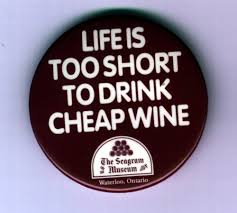
“Life is too short to drink cheap wine,” but either life is getting longer or the definition of cheap is changing, because cheap wine (or extreme value wine, as I called it in my last blog post) is a booming market category.

The US off-premises wine market grew by 3.7 percent dollar value in the last year, according to Nielsen Scantrak results reported in Wine Business Monthly, but sales of wine under $3 per bottle equivalent rose by more than 5 percent and sales of $3-$5 increased by 9.4 percent. This gives the old toast “bottoms up” a new meaning. The bottom of the wine wall is currently leading the way.

Bottoms Up!

Since I’m an economist I tend to approach market problems from the perspective of supply and demand. It is easy to understand where the supply of extreme value wine is coming from. The global wine surplus combined with structural falling demand in the Old World and recession-induced slow growth in the New World means that there is a lot of wine out there searching for a home. Some of it ends up being deeply discounted or dumped in stores like the Grocery Outlet chain.

A lot of it goes into own-brand wines at mainstream stores. Safeway has introduced its Quail Oak brand and 7-Eleven just announced a line of $3.99 wines called Yosemite Road.  Both wines (and many other own-brands) are made by The Wine Group, the giant privately held California winemaker that, like Fred Franzia’s Bronco Wines, seems to specialize in making wines to hit particular price points.

Demand Side Puzzle

Although it just seems wrong, let me assure you that supplying wine to sell at $5, $4, $3 or even two bucks per bottle is not that difficult once you set out to do it. Cheap surplus grapes, cheap surplus wines, low-cost winemaking processes and economies of scale all contribute to extreme value supply. Nope, supply is easy. The challenge, until recently at least, has been selling the stuff.

Studies have repeatedly shown that wine drinkers are influenced by price – but not in the way you learned in Econ 101.  A lower price does not always produce more sales because insecure buyers infer quality from price. They assume that higher price means better wine. In a blind tasting of two identical wines, buyers will often rate one above the other if they are told it costs more.

So why are many wine drinkers now stooping down and buying cheaper (sometimes very cheap) wines – and shopping at stores like Grocery Outlet — when in the past they have been programmed to consider these products inferior? I think there are three forces at work.

Two Buck Chuck Effect

The first factor is what you might call the Two Buck Chuck effect. Trader Joe’s stores have led the way in introducing American wine drinkers to inexpensive own-brand wines. Because shopping at Trader Joe’s is cool, trying Trader Joe’s discount wines is cool, too (or at least not as un-cool as buying Carlo Rossi at Kroger would be).

You might ask “How good can a $3 wine  be?” elsewhere, but at Trade Joe’s it’s “How bad can it be?” TJ’s lends its reputation to the wine, which is the key to all own-brands. It is clear that Safeway, 7-Eleven, Target, Wal-Mart and many other chains that have introduced own-brand wines believe that they can do the same.

Costco Effect

Costco, the big box store chain, is the largest retailer of wine in the United States. Although their selection of wines is surprisingly limited (fewer than 150 different wines in each store compared with 1000-2000 or more at a typical upscale supermarket), it draws people in with low prices, made possible in part by the fact that buyers pay annual membership fees for the right to shop. The maximum markup on Costco wines is 15 percent above wholesale, which is hard to beat if you want to buy what they want to sell.

Costco has trained its upscale clientele to look for low price, but that’s not the Costco Effect I’m talking about here. Costco doesn’t sell extreme value wines – it leaves the bottom-feeding market to others.

The Costco Effect refers to the fact that shopping for wine at Costco is a lot like a treasure hunt. The wine selection changes all the time and so you need to come back often. Costco makes a point of stocking limited production wines, which run out. So if you see something you like, you better buy it now. I have friends who have scored one or two spectacularly good buys on impossible to find iconic wines at Costco and who are now completely addicted – they stop by as often as they can just to see what might be in the bin today.

Costco’s success with its treasure hunt strategy has generated a group of upscale customers (including perhaps my friend Jerry who was featured in the last blog post) who find the hunt almost as pleasant as the wine they buy. It’s a big a step but not an impossible one to go from Costco to Grocery Outlet since both position themselves as happy hunting grounds.

Trading Down Effect

The final piece of the demand puzzle is the recession, which made most of us stop and think about what we are paying and what we are getting. The data indicate that trading down (lower price), trading over (adopting a more casual and lower cost wine lifestyle) and drinking up (drinking from the cellar rather than buying expensive wines) are significant effects. Paying less for wine doesn’t carry the social stigma it might have in the boom-boom days and it doesn’t dent your personal wine identity as deeply either.

When you combine these three effects you get a market where extreme value wines can enter the mainstream. The demand for these wines is increasing, with different wine buyers responding to different motivations. It will be interesting to see if the market shift is permanent or if wine buyers will go back to their old habits.

Good, Bad or Ugly?

It is easy to conclude that the extreme value trend is a bad thing for the wine industry. People are paying less for wine, buying more generic wine and less of the quality product. I don’t see this as a completely negative trend, however. At least they are buying wine and not switching to other beverages. That would be ugly. This is part of the story of the collapse of wine demand in Europe. Wine became just another beverage and faded away as a quotidian pleasure. That hasn’t happened here, at least not yet.

I am actually hopeful that the extreme value trend will ultimately benefit the wine world, although I admit that my viewpoint is backed up by anecdotes more than hard data. I spoke with a young couple at the local Grocery Outlet who seem to me to be an optimistic future of wine in America. They had parked their shopping cart (with two small kids) in the wine corner and were busy picking out three or four bottles of wine from the huge selection of inexpensive bottles.

Do you buy wine here often? Yes, every week. We try different wines, which is fun. Some of them are disappointing, but it doesn’t cost very much to try them and we can also buy something different the next time. It’s been a long time since we found something that made us want to come back and buy a case, but that’s OK – it’s still fun.

Serious Business

What I like about this couple is that they use the extreme value store as an opportunity to experiment and they have the confidence to trust their own taste rather than some wine critics ratings. If they keep this up I think they will work their way out of the bargain bin. But I hope they never lose their sense of fun and willingness to take a chance on something different.

Wine is a serious business, but it is a mistake to take it too seriously. Wine can be intimidating, that’s for sure, especially the high-stakes wine game. It might be a healthier business in the long run if more people learn to love its treasure hunt side. If mainstreaming extreme value wine helps accomplish that, I think it is a positive development.

Extreme Value Wine Goes Mainstream

groc_receiptOur friend Jerry doesn’t seem like the kind of guy who would go digging around in the closeout bin or shopping for wine at Aldi — too classy for that — but there he was at Joyce and Barry’s house on Friday showing off his latest finds: cheap wine from a Grocery Outlet store.

The wine wasn’t so much good or bad as simply intriguing — is it really possible for a sophisticated wine enthusiast like Jerry to be satisfied shopping for wine at an “extreme value” store? Only one way to find out, so we got in the car the next day and headed for the strip mall.

Searching for Extreme Values

Headquartered in low-rent Berkeley, California, Grocery Outlet bargain market is America’s largest extreme value grocery chain with more than 130 independently owned stores in six western states. It has been in business since 1946. Prices are low, low, low. The website tells the story:

The premise is simple: We offer brand name products at 40% to 60% below traditional retailers. Our offering is wide: groceries, frozen, deli & refrigerated, produce, fresh meat (selected stores), general merchandise — seasonal products, housewares, toys, and gifts — health & beauty, and a most impressive inventory of beer & wine.

How can they charge such low prices?

We source product opportunistically. Simply put, we buy brand name products directly from their manufacturers for pennies on the dollar. When a manufacturer has surplus inventory like excess packaging or manufacturing overruns they call Grocery Outlet first.

About 75% of our product is sourced this way. Some of our greatest buys are in Health and Beauty Care, Wine, Frozen Foods, Organics and Produce. To ensure that the basics are always available at Grocery Outlet, some product is sourced conventionally, like other grocery stores. Because we cannot source these products opportunistically, the savings may not be as phenomenal; however, we think it’s important to provide them for your convenience—to save you that extra trip.

Grocery Outlet stores here in the Pacific Northwest are supermarket sized spaces filled with off brand and closeout products along with a wide enough selection of fresh goods to allow families to do all their grocery shopping in one place. They are nice if not especially fancy stores. I can see why budget-minded families shop there.

Mystery Wine

The wine corner at the nearest store was large and well-stocked. Most of the brands were mysteries (one was even named “Mystery” as in “Mystery Creek” or something like that), although a few third and fourth tier products from recognized mass-market makers were available. Mainly, I think, these were leftover wines closed out by distributors to raise cash or make room for incoming shipments along with no-name brands “dumped” under a bogus label.

The wines came from all over — California, naturally, Australia, France, Italy, Chile. There was even a $3.99 “Champagne” from Argentina. Honest — it said “Champagne.”

Prices were suitably low — most of the wines sold for $2.99 to $5.99. It isn’t hard to make money selling extreme value wine when you can buy up surplus bulk wine for just pennies a liter and package it up for quick sale.  Extreme value retailers are the perfect distribution channel for wines like these.

As you can see from my receipt, I walked out with three bottles of wine for a total of $13.97 plus tax. “By shopping with us you saved $28.00.”  That would mean an average of 67% off the retail price.

Unexplained Tales from Down Under

I wasn’t really surprised at what I saw as I surveyed the wine wall. Then, slowly, a different kind of wine mystery began to unfold.nz_wines

Sue must have sharp eyes because she picked out the first surprise. Sam’s Creek Marlborough Sauvignon Blanc 2008 for $3.99.  That’s awfully cheap for a New Zealand wine here in the U.S. I’ve read about heavily discounted NZ wines in Great Britain but not here in the U.S. — until now.

New Zealand is a high cost wine producer that has succeeded in charging a premium price for its wine. Indeed, NZ earns the highest average export price of any country in the world despite surging production that threatens to create unmarketable surpluses. Everyone worries that one day the export limit will be hit and prices will start to tumble from $12-$20 down to, well, $3.99. Is that what this Sam’s Creek wine really means? The end of NZ wine’s premium price?

Frighteningly, Sam’s Creek isn’t a no-name closeout wine. The label says that it is made and bottled by Babich, one of the famous names in New Zealand wine, and the internet tells me that Waitrose sells it for about $10  in Britain. I wonder if the unsold British inventory has somehow made its way here?

Prestige Wine at Extreme Value Prices

Two more bottles raised more questions about New Zealand wines. I paid a whopping $5.99 for a 2008 Isabel Estate Marlborough Sauvignon Blanc.  I almost overlooked it, but the label caught my eye. Isabel Estate is one of the most famous Marlborough quality producers, exceedingly well-known in Great Britain where this wine sells for about £10, but not so widely distributed here in the U.S., I think.

How did it get here and who among the Grocery Outlet clientele would recognize its quality sitting there surrounded by cheap and cheerful closeouts?

The third wine makes the puzzle more complicated. It is a 2004 Te Awa Merlot from the Gimblett Gravels of Hawkes Bay. Te Awa Farm is another famous NZ producer and, while this wine — a estate product from a distinguished producer in a famous region — may be slightly past its prime and therefore a typical closeout risk, it is still very surprising to see it sold at a place like Grocery Outlet for $3.99 rather than the $16-$20 retail price.

These three New Zealand wines may be random surplus wines found in the sort of place where random wines go to be sold. Or they may be indicators of important changes in the world of wine. Kinda makes you wonder, doesn’t it?

Wine markets are all about supply and demand. It is pretty clear that a supply of interesting wines has appeared along with the rock-bottom remainders at extreme value stores like Grocery Outlet, pushed along, no doubt, by the slump in fine wine sales.

What about demand? And what does Grocery Outlet tell us about the wine market more generally? Some thoughts in my next blog post.

Wine as a Liberal Art

csm

David Rosenthal at Chateau Ste Michelle

I  teach a class called “The Idea of Wine” at the University of Puget Sound. It isn’t your typical wine class. It’s an examination of wine in the context of geography, history, science, business, politics, culture and globalization and how these various forces create different and sometimes conflicting “ideas of wine.”

I guess it is really about my idea of wine – that wine is a liberal art and a fascinating social mirror. The fact that it tastes so good is a wonderful bonus.

Wine isn’t usually included in the liberal arts curriculum, reflecting  America’s prejudice against anything that contains alcohol. But there is historical precedent. Symposium, in the original Greek useage, was a discussion over wine! Wine, as I think about it anyway, is certainly in the liberal arts tradition.

Chateau Warehouse sur Industrial Park

Part of my course involves fieldwork. In 2008 I took  the class to experience two ideas of wine that they wouldn’t get on a typical winery visit. Ken Avedisian at Cordon Selections wine distributors gave us a tour of his warehouse and explained how the distribution business works. We learned how Ken successfully balances his deep love for wine with the need to make a living selling it. Most of all, I think, we came away with an understanding that wine business is really a people business and that Ken is successful because he never forgets this fact.

Then we visited owner/winemaker Tim Narby at Nota Bene Cellars, where he makes spectacularly good red wines in an anonymous South Seattle industrial park. No fancy chateau here, just focused winemaking using exceptional fruit. We were fortunate to be there during crush, so my students got a clear sense of how wine develops by tasting at many stages from fresh juice to fermentation bin to barrel to finished product. The field trip popped some romantic visions of wine by revealing the reality of how it is made and marketed.

The Big and the Small of It

This year we headed to Woodinville, Washington, which is home to four or five dozen wineries that range from tiny family operations to the large and magnificent Chateau Ste. Michelle. The fruit comes from Eastern Washington, but the wines themselves are made and sold here, close to the market in a classic “cluster” of inter-related businesses. Our agenda was to compare and contrast big and small winemakers to see what we could learn from the experience.

We started the day at JM Cellars, a family winery that has in just a few years  expanded from a couple of barrels to 5000 case annual production. The setting is so spectacular – perched an a hillside next to a wetlands – that Wine Advocate praises the view almost as much as the wine.

Owner/winemaker John Bigelow took us through both the cozy winery and the hands-on production process (it was crush time once again) and I think everyone learned a lot about the art, craft and science of winemaking. It was easy to see that John enjoyed the opportunity to talk with a group that really wanted to learn about wine, not just swirl, sip, spit and move on. It was a great experience.

After an alcohol-free lunch at the Red Hook Brewery pub (I think this made some of my beer-loving students want to cry!) we headed to Chateau Ste. Michelle, which is Washington’s largest wine producer by a big margin. CSM and its sister wineries like Columbia Crest produce about three-quarters of all Washington wines. The beautiful Woodinville chateau-style facility makes nearly 2 million cases of white wine each year. The reds are made in Eastern Washington.

Enologist David Rosenthal took time out from the rush of crush to show us how a big winery works. Tanker trucks were arriving every few hours from the Eastern Washington vineyards full of fresh Riesling juice. We were able to taste the fresh juice and at several stages of the fermentation produces, with David drawing wine from the giant stainless steel fermentation tanks. Quite a difference in scale compared to JM!

The Little Winery Inside the Big One

One of the most interesting parts of the visit, for me at least, was to learn the extent to which CSM’s winemakers keep the lots of wine separate through fermentation and aging and, in the case of Chardonnay, make a point of experimenting with many different oak treatments. Instead of just making one big volume wine they actually make dozens and dozens of smaller lots, which can then be assembled in different ways that both reflect different geographic and geologic terroirs, different market ideas of wine (price points and so on, since CSM is in the wine business) and different aesthetic concepts of wine as well.

I’m impressed with CSM’s commitment to keeping wine small while making it big – I don’t know if there are many other wineries that pull off this trick quite so well. Maybe this is why Ted Baseler, CSM’s CEO, was recently name Wine Enthusiast’s Man of the Year. The citation reads

Ted Baseler is President/CEO of Ste. Michelle Wine Estates, the most prominent wine company in Washington State. Under his leadership, it has evolved into a high performance organization known for its top quality, world-class wines; for its strategic partnerships with leading wine producers in Italy and Germany; and for collaborating with fellow members of Washington’s wine industry to help raise the region’s profile, worldwide. For his vision, leadership, brand-building, team-building, and region-building accomplishments, Ted Baseler is Wine Enthusiast’s Man of the Year.

Sounds like Chateau Ste Michelle thinks big and global while acting small and local. Sounds like a contradiction, but it is an appealing idea of wine.

>>><<<

Special thanks to Ken, Tim, John and David (and to Marci Clevenger at JM Cellars) for making time in their busy schedules for my students and several parents who came along on the trip. Thanks, as well, to the anonymous donor who established the Robert G. Albertson Professorship at the University of Puget Sound, which makes my class and this educational fieldwork possible.

Cracking the Coffee-Wine Paradox

My last post, Starbucks and and Coffee-Wine Paradox, raised questions about the relative price of wine. We think of coffee as being expensive, especially coffee drinks at Starbucks and other gourmet espresso bars. But compared to wine they seem like a bargain.

You can get an excellent coffee drink for less than the cheapest glass of on-premises wine. And the price difference between generic coffee and the best (a factor of 16 according to a Decanter article) looks great compared to wine, where the cheapest bottle costs a couple of bucks and there’s almost no upside limit.

Coffee and wine are both simple quotidian pleasures (or should be). Why are their relative prices so different? Several readers and colleagues offered answers to this question.

Cost Plus Wine

Suggestions (click on the article link above and scroll down to the comments section) focused on cost differences . Coffee is cheaper to ship and store, for example, and as Rob Boyd pointed out coffee isn’t typically aged for years like red wine, which increases cost.

Wine is typically bottled at the source, so to speak, which also contributes to the cost difference. Weight gets added relatively early in the wine supply chain whereas coffee gains weight at the point where it is combined with water, brewed and served — a real advantage. “If coffee was brewed in Colombia and then shipped to Starbucks around the world,” Steve DeLong wrote, “the price would be astronomical.” (See note below.)

Steve also had the insight that, while Starbucks-style coffee products are pretty labor intensive to make, this cost also comes at the final stage of production, whereas wine’s high labor costs come much earlier and are magnified by multiple mark-ups in the distribution system. An additional  dollar of labor in the cellar translates to maybe $2 higher retail price for wine here in the US with our three-tier distribution system. An extra dollar of barista wage cost at the end of the coffee product chain has less of an impact on price.

Cost and Price

The comments I’ve received go a long way toward unraveling the paradox. As I expected, however, most people try to solve the puzzle on the cost side — focusing on why wine costs are relatively higher than coffee costs. These are good answers, but it is important to consider the demand side, too. Everyone knows that some prices are determined by production cost, but others are dictated by what people are willing to pay.

Cost rules in highly competitive markets, where products are undifferentiated and good information is readily available. Willingness to pay is more important in imperfectly competitive markets with highly differentiated products and asymmetric information.  The markets for generic coffee and wine fall into the first category, fine wines and specialty coffees into the other.

What Will You Pay?

Why do highly-rated wines cost so much to buy? Production cost is a factor, particularly for generic coffee and wine, but it alone doesn’t explain the big price gap between the bottom shelf and the top. Fine wine and gourmet coffee cost so much because people are willing to pay these prices — and they lack the confidence to pay less in some cases because they associate lower price with lower quality (or maybe lower status).

So I think Steve Kirchner is on to something when he points to differences in marketing between coffee and wine. Gourmet coffee, Steve argues, is a relatively new phenomenon and it is certainly true that the range of choices is still limited compared to wine.

Closing the Coffee-Wine Gap

How many different coffees does your grocery store sell? Probably a few dozen at two or three price points. How many wines? Probably one or two thousand at many more price points!

Fine wine is more complicated than fine coffee and there is more uncertainty surrounding it. This makes the market more “imperfect” in the jargon of economics, and price and cost are more likely to deviate.

Will coffee producers ever catch up to their wine-making cousins? Not soon, I suspect, but I think they will close the gap!

>>><<<

Note: Steve’s comment about brewing coffee and then shipping it reminds me of a story I picked up back when I did tax policy economics.

When coffee was first introduced in Great Britain, it was subject to high excise taxes intended for luxury goods. Coffee shops reacted by adding non-coffee ingredients to the brew to stretch their precious grounds. Adulterated coffee. Ugh.

The tax authorities, seeing a revenue shortfall,  responded by ordering all coffee to be brewed in designated central canteens, then transported full-strength to the shops and reheated there. Twice cooked coffee. Ugh again! More expensive, of course, and adulteration was still possible, but at least the tax was paid.

Thus did high taxation ruin Britain’s taste for coffee, which has only recently recovered thanks in part to market entry by quality sellers like Starbucks.

Starbucks and the Coffee-Wine Paradox

The Water-Diamond paradox is a classic problem in economics. Water is essential to life, but it is relatively cheap in most situations. Diamonds, on the other hand, are non-essential luxuries in most uses, yet they cost the earth compared to water. How is this possible? How can market price deviate so clearly from practical value? A tough problem. John Law, John  Locke, Copernicus and Adam Smith all tried to provide sensible answers.

In Vino Paradox

Starbucks (the Seattle-based company that sells coffee with a side of lifestyle) presents us with a similar puzzle today. I call it the coffee-wine paradox in honor of the original problem.

Starbucks has started selling wine. Not at branded Starbucks stores, but at three experimental “15th Avenue Coffee and Tea” shops in Seattle.  As near as I can tell they have not yet begun to market a Starbucks wine (the image here, courtesy of Google Image Search, is apparently bogus), but who knows what will happen in the future?

I know a number of coffee bars here in the Pacific Northwest that double as wine bars and authentic espresso bars in Italy nearly always serve alcoholic beverages including wine. Starbucks knows how to sell branded goods. Connect the dots. Maybe there is Starbucks Pinot Grigio in your future?

So what is the paradox? Well, the joke is that Starbucks coffee products are very expensive. You know what I mean — the mythical four dollar caffè latte? But when you compare Starbucks coffee to wine, it looks like coffee is unbelievable cheap. Thinking in terms of absolute price both wine and coffee cost a lot but, as in the water-diamond problem, their relative prices seem totally out of line. Why is wine so expensive compared to coffee and why is coffee so darn cheap?

Pulling the Supply Chain

Coffee cheap? Well, consider what a diagram of the global supply chain for a Starbucks latte would look like. The high tech espresso machine is usually Italian-made. The milk is probably a local product and the labor likewise, but the coffee and flavorings such as chocolate and vanilla come from all over the world and pass through many processes and middleman hands on their way to you.

Wine, by contrast, is the simplest of products. It practically makes itself. Even with the notorious three-tier distribution system here in the US, it is a whole lot easier to get wine into your glass than coffee into your 20-ounce cardboard takeaway cup.

And think about the wine bar versus espresso bar experience. Servers at the wine bar retrieve the bottle and pour some in your glass.  Pretty simple. At the espresso bar, by contrast, your coffee made to order with sometimes extravagant special requests (a tall half-caff soy vanilla latte with caramel?). No doubt about it, in terms of both global sourcing and labor-intensive local production,  Starbucks coffee seems like it would be a lot more expensive to produce and serve than my mythical Starbucks wine.

So here’s the paradox. $4 for a cup of coffee (or espresso-favored coffee drink) seems impossibly expensive. Ridiculous. A joke. But $4 is impossibly cheap for a glass of decent wine these days when you are dining out. What do you think Starbucks would charge for a glass of wine? If they conform to the industry rule of thumb (and I don’t know if the 15th Avenue shops do) the price for each glass would equal the wholesale cost for the bottle. So you’d expect to pay $6 and up for fine wine (wine poured from a bottle in this context) or less if it is drawn from a bag-in-box hidden somewhere in the back room.

Generic industrial wine sells for more than a premium custom-brewed coffee product. No question about it. Wine costs too much and coffee is too cheap. Why? That’s the first part of the coffee-wine paradox.

A Factor of Sixteen

A second aspect of the coffee-wine paradox is revealed in the November 2009 issue of Decanter magazine in a short but very interesting article on coffee. It seems that coffee, like wine, comes in all sorts of variations from cheap bulk product to the equivalent of vineyard-designated grand cru coffee cuvées (if that isn’t stacking the adjectives a bit too high).

Coffee connoisseurs will pay enormous sums to get the finest, rarest coffees. Decanter quotes the price of the winning coffee from a recent international competition at £13 per 250 grams of roasted beans or roughly 40 U.S. dollars per pound. On a per-cup basis, according to the article, the top coffee sells for about sixteen times the most humble Cup of Joe. That’s a pretty high premium to have the best instead of the simply pretty good.

Consider the corresponding wine ratio. If we take Two Buck Chuck as our Nescafé equivalent, the most expensive wine on the market would cost $32 in California (where Two Buck Chuck really costs $1.99) and $48 dollars per bottle nearly everywhere else in America. But this is ridiculous. The most expensive wines cost much more than this. If you read the wine magazines you frequently encounter prices of hundreds and even thousands of dollars for the finest, rarest wines. The coffee factor is sixteen from bottom to top. The wine factor, by comparison, is fifty, sixty, a hundred, even more.

What is the solution to the coffee-wine paradox? Why does wine seem to cost so much more than coffee despite the factors that would seem to raise coffee’s cost? And why do the best wines cost so much more, in relative terms, than the best coffees? What’s your answer? Watch this space for mine!

Wine and the China Syndrome

A few years ago I edited a book on globalization for a New York Times series. I was given everything that was published in the NYT in the 20th century and asked to tell the story of globalization’s rise and fall and rise again. One of the things I uncovered as I studied the history of world trade over those 100 years was what I call the China Syndrome.

Nightmares and Dreams

The China Syndrome is both the dream that China will buy all the goods we try to sell her and the fear that she will return the favor and take over our markets. The Times was full of China Syndrome a hundred years ago. History buffs might want to look up an article called “The Future of our Trade with China” that promoted the dream on April 13, 1900 and an early suggestion of the nightmare in “Japan and China find a Ready Market Here” published on September 3, 1905. Both are reprinted in my NYT volume.

The same dreams and nightmares are commonplace today. I was reminded of this recently while reading the Grape Wall of China blog, a reliable source for China wine news and views.  An article by Jim Boyce (aka Beijing Boyce) caught my eye: “No Worries: Australian targeting China wine market at every level.” The article tells of Australia’s dreams for Chinese wine sales.

The Blunder Down Under

The Australian wine industry is dreaming about a Chinese future because their present reality is an emerging nightmare. Australian wine is being battered by a number of factors, both natural and market driven. Australian wine sales are falling here in the United States and in Britain, too, I understand. Although there are many distinctive and delicious Australian wines, “Brand Australia” is pretty much defined by one-dimensional Shiraz and over-oaked Chardonnay, both of which have fallen from consumer favor. The “brand” was easy to understand and promote, but it didn’t have legs. Many consumers seem to have moved on and there are plenty of options for them to choose from. The recession only makes things worse.

The situation in some parts of Australia is really dire. Constellation Brands, for example, is closing its second Australian winery for lack of either a market for its output or a buyer for its assets. The global recession puts the big multinationals like Constellation under more pressure than in the past. They are less able to afford to nurse along failing brands. That’s bad news for the particular part of Australian wine that seems to define the brand. It’s time to dream up a better plan.

Australia has adopted a new marketing plan called Landmark Australia that is meant to highlight the quality and diversity of its fine wine industry. It’s a good idea but a difficult one to put into practice — hard to un-ring the Yellow Tail bell, if you know what I mean. And I am generally suspicious of regional or national marketing plans because I think collective brands (especially quite diverse and ill-defined ones) are always harder to sell than private brands.

Working in China … or Not

The Landmark Australia plan may be working in China. Or maybe not.

Beijing Boyce reports that Australia is promoting its new image pretty vigorously and has risen to #2 in bottled wine imports after France. The French have 40% of the fine wine market to Australia’s 20-22%. The U.S., Italy and Chile trail far behind. So perhaps Australia will be successful in redefining itself in a new market and maybe, ultimately but with more difficulty, in markets like America and Britain where it is already established. The geographical proximity to China is certainly an advantage.

There’s evidence of the China Syndrome dream in the data, but also hints of a possible nightmare. It seems that Australia is doing even better (in terms of rising market share) in the bulk wine market than in sales of bottled wine. Grape Wall reports that

… in the first half of 2009, Australia ranked second as a source of imported bulk wine. While Chile (~15 million liters) represented half of the ~31.5 million liters entering China, Australia came second with a quarter. Argentina (last year’s number two, with a quarter share) and the United States (~6.5 percent each), Spain (~5 percent), and South Africa and France (just over 1 percent each). This is quite a leap from the past four years, when Australia represented from 2 percent (2005) to 10.5 percent (2007).

One reason for higher sales at the low end of the market is that surplus bulk wine is being dumped (sold below cost). Hard to compete with that, of course. I know it is better to get something than nothing for all that surplus wine, but it is hard to be optimistic when this market segment is Australia’s greatest Chinese success. Australia wants to get out of the bulk market, in terms of its brand, not deeper into it.

China versus Colorado

How real is the dream part of the China Syndrome for wine? I asked Tom Hedges of Hedges Family Estate (an important independent producer here in Washington State and a pioneer in the Red Mountain AVA) because he is particularly knowledgeable about export markets in Asia. Tom put the dream into perspective. Here is his take:

As an American producer, we have the U.S. market, which today is number one or number two in the world for total consumption.  An example is flying to Denver costs $300 round trip, and takes no time.  Our potential to sell in Colorado alone is equal to or better than that in all of China;  the Chinese consume very little wine, in total, of which 85% is Chinese production.  And, being [an emerging] consuming market, they want only two kinds of wine:  Famous and cheap.  About 99% of the world’s wineries are neither, which means you have to develop a market for your brand.  Costly!

Tom’s clear conclusion was that he could achieve more and do it more economically by focusing on Denver and Boulder instead of Shanghai and Beijing.The allure of China is great,” he says, “the economic reality not so great.  American producers still have lots of Colorados to conquer here in the U.S.

This view aligns perfectly with my own, for now at least. Not many of those folks who dreamed the China Syndrome dream a hundred years ago woke up to great wealth, although a few probably did. I guess that’s why the call them dreams.