Fair Trade Wine’s Long Journey

In this global age we are accustomed to having the world’s assorted products (including wine) wash up conveniently on our local supermarket shores. We seldom give much thought to how they got there or why, but wines don’t make, move or sell themselves so there is always a story to tell.

Case in point: this bottle of 2008 Fairhills Mendoza Vineyards Carbernet Sauvignon purchased last week at a Cost Plus World Market store in Tacoma, Washington. It is the product of a rather complex process of globalization.

Uncorking a Bottle’s Biography

The Fairhills brand is South African, but the wine is from Argentina. Must be a story there. The logo at the bottom proclaims that it is Fair Trade certified – wine with an ethical intent. You don’t see Fair Trade wines every day. The red tag up on the bottle’s shoulder indicates market reality: marked down from $9.99 to $8.88.

(Some studies suggest that wine buyers are not willing to pay more for “ethical” organic or biodynamic wines. In fact, one study found that wines labeled “organic” sold for less than identical wines without the ethical indicator. I wonder if this inverse price/ethics relationship holds for Fair Trade wine as well?)

Fair Trade products, like this wine, ask us to think about supply chains more seriously because they promise to return a bit more to the original producers to help build sustainable communities. I’m interested in the Fair Trade wine movement (I wrote about Fair Trade wines here, here and here), so I thought I’d try to learn a bit about this particular bottle’s long journey.

Twists and Turns

The story begins, unexpectedly, at the Du Toitskloof Winey in South Africa, founded in 1962 as a cooperative by six wine families. Originally a bulk wine producer in the bad old days of South African wine, DTK as it is known has moved upmarket in the post-apartheid export-driven era and Fair Trade wines are part of its strategy.

Since 2005 DTK has worked with the Fairhills Association to produce Fair Trade wine. Fairhills brings together a group of South African vineyard owners and their workers, with the workers having a majority of votes. Fairhills wine farmers supply the grapes, DTK makes the wine and Origin Wine, the third partner, provides logistical and market support. The growers receive a premium for their Fair Trade grapes and funds are returned to the Fairhills Association for community investments, a typical Fair Trade practice.

The initial market for Fairhills wines seems to have been Great Britain, since they worked closely with the UK-based Fair Trade certification group there. Susy Atkins,  the Telegraph’s wine critic, reports that Fair Trade wines have good penetration in London through supermarket chains including Co-op and Sainsbury’s and are featured in annual Fairtrade Fortnight programs. Click here to view a list of Fair Trade wines available in the UK. Fairhills has the largest listing (44 wines).

Fair Trade Pipeline

The South Africa-UK wine pipeline proved very robust (South African wines are now the fastest growing segment of the British market) and helped to expand the market both in terms of supply (drawing Chile and Argentina into the mix) and demand (introducing Fair Trade wines to the U.S. and other markets). Argentina is the biggest supplier of Fair Trade wines to the U.S. and the Fairhills Mendoza Vineyards Cab that I purchased at Cost Plus is part of that pattern. Organic Wine Trade Company distributes Fairhills here along with their other “ethical” wine products.

Whole Foods Market is one of the most important retailers of Fair Trade wine in the U.S., which makes sense since they sell so many other Fair Trade products (coffee, tea, chocolate, sugar, energy bars, body care products, flowers and rice according to one list). Other national retailers that stock Fair Trade wine include Sam’s Club, Target and of course Cost Plus World Market where I bought this bottle.

TransFair USA reports that over 120,000 cases of Fair Trade wine were sold in the U.S. in 2009, up from about 20,000 cases in 2008. The growth rate is a source of optimism, but the absolute quantity is relatively modest  – about the production of a single medium-sized domestic winery. TransFair says that the 2008-2009 sales produced a “premium” of over $130,000 that was returned to the grower cooperatives — quite a lot relative to the low wages they receive as farm workers. The distributor website reports that:

Fairhills Cabernet Sauvignon benefits the local farmers of Bodegas y Viñedos de Marañon and three small producers along with their farm worker community in Mendoza, Argentina.  The Fair Trade initiative is dedicated to ten farms to improve the quality of life for 210 members and 300+ children. The initiative is one of the first in Argentina and has used their sales to upgrade various schools in the region, purchasing new toys, establish a soup kitchen, and purchase an ambulance for the local health care center.  Future plans are to convert from conventional farming to all organic, building a sports club, and continue improving health care clinics and schools.

The journey that brought this bottle to my cellar is thus quite complicated. The wine comes from Argentina, but it wouldn’t have got here without help from people in faraway London and South Africa. The fact that this complex web can return community benefits to Mendoza farm workers is heartening, even if the amounts are quite modest at present.

The Future of Fair Trade Wine

Fair Trade coffee is easy to find these days — in fact it is impossible to buy anything other than Fair Trade coffee on my university campus. Fair Trade chocolate is everywhere, too. But Fair Trade wine remains a tiny (but growing) market niche. I wonder if this will change and what barriers Fair Trade wine must overcome to achieve the success of Fair Trade coffee? With this question in mind I’m starting a small research project to learn more about Fair Trade wine’s present market condition and future prospects. Watch this space for occasional related posts in the coming months.

>>><<<

Thanks to Kazuko Golden at TransFair USA for helping me with statistics about the Fair Trade wine movement. Thanks to Leigh Barrick for sharing her research on Fair Trade wine with me.

Secrets of Argentina’s Export Success

#1 Wine

Argentina’s wines are hot here in the United States. Recent Nielsen Scantrak off-premises  data show a 38.7 percent dollar value rise in sales of Argentinian wines for the 52 weeks ending April 3, 2010. That’s an enormous percentage increase, much greater than the total market (up 3.5 percent) and a good deal above the next biggest gainer (New Zealand with a 17.2 percent rise).

What’s Argentina’s secret?

The secret? As usual, there is no one simple answer. There are important factors on both the supply side and the demand side: good products, the right products at the right time and favorable economic policies.

Argentina produces excellent wines. Decanter magazine recently (June 2010 issue)  published a report on Argentinian Malbec that featured the largest tasting in their history — a record 255 wines. Four of them received  five stars, the highest designation. The Achaval Ferrer Mendoza 2008, which often sells for less than $20 here in the U.S., led the pack with 19/20 points.

Argentina is fortunate to be producing wines for the times. Many Argentinian wines are good values at a time when consumers are careful with their money and they represent good choices for ABC (anything but Chardonnay) and ABS (anything but Shiraz) buyers.

International Influences

#1 Export Brand

Argentina’s economic policies are another consideration. The favorable dollar/peso exchange rate contributes to Argentina’s competitiveness on the export market. And although I don’t know very much about them, I think that barriers to foreign investment in the wine industry must not be very high because so many important producers have international connections.

Bodega Colome is owned by Donald Hess of Switzerland, for example, who also owns The Hess Collection in the United States. Achaval Ferrer is a joint venture with a Montalcino winemaking family. Bordeaux wine investors are players in Diamandes and Clos de los Siete. O Fournier’s owner is Spanish. Cheval des Andes is a joint venture of Moët Hennessy’s Terrazas de los Andes and St-Emilion’s Cheval Blanc. Bodega Norton is owned by the Swarovski family of Austria (famous for their crystal.) Dig deeper and you’ll find even more international money and talent at work.

Top Export Brands

These are good reasons for Argentina’s recent success, but a recent article on WineSur.com titled “The Top 5 Export Brands” got me thinking that there might be other factors at work. I was particularly intrigued by the table showing the top bottled wine export brands to different markets. I’ve pasted the table below so that you can analyze it along with me. Click on the table to read the full article and view a larger image of the data.The first thing I noticed is how heavily weighted Argentina’s recent exports are toward the North American market. Britain, still the most important wine market in the world, has much lower export volumes as shown here. I suspect that one reason for this, however, is that these data are for exports of bottled wines (including bag-in-box and Tetra-Paks) and I’ll bet that Tesco and some of the big supermarket chains import their Argentinian value wines in bulk and bottle them in the U.K as house brands. Those export sales don’t show up here.

The second thing that caught my eye was the wide range of export prices. Alamos, the U.S. leader, sells for $30.57 per case export price, about the same as #2 Don Miguel Gascon. Marcus James, the top export wine in volume but only #3 in value, sells for just $12.54 per case.  Catena, the #4 brand, exported just 39,000 cases in the time period under consideration, but received an average of $64.97 for each one. Argentina’s exports to the U.S. (and the other markets shown here) span the price spectrum — another advantage.

Location, Location, Location?

Finally, I became interested in the particular brands that topped the export market tables and I think I discovered another secret weapon: distribution. It’s a cliche that in business the three most important things are location, location, location. Location is important in wine, too (ask any terroirist), but efficient distribution sure makes a difference and Argentinian producers have been wise in making good use of the most efficient distribution networks in each country.

Alamos has the highest export earnings by a good margin — why? Well Alamos is made by big gun Bodega Catena Zapata. It is a value line and is imported and distributed by the Gallo company. I suspect that Gallo’s large and efficient distribution network and its marketing prowess are reasons for Alamos’s great success. Significantly, Gallo also handles Don Miguel Gascon, the #2 export brand.

Marcus James, the #3 export brand, is a Constellation Brands product and is also backed by substantial marketing and distribution power. I was actually surprised to see Marcus James on this list because I didn’t realize they sold Argentinian wine. Guess I need to pay closer attention.  They used to source their wine from … Brazil!

Fuzion (a Shiraz-Malbec blend, I understand) is the best seller in Canada. It is made by Familia Zuccardi and distribution is one of its advantages, too. In Canada government wine and liquor shops are key sales vectors. The support of Ontario’s Liquor Control Board (in addition to successful viral marketing) seems to have made Fuzion a hit in a market that is otherwise very difficult to penetrate.  (At one time the Ontario Liquor Control Board was the world’s largest retailer of wine. I think Tesco is #1 today.) Distribution is key and both Alamos and Fuzion seem to have it.

Trickle Down [Wine] Economics Jitters

The stock market has the jitters these days and one of the causes is the fear that, even with massive fiscal and monetary stimulus, we may be experiencing a jobless recovery. Things looks OK from the outside (some of the numbers are pretty good), but bad things are still happening deep down where it counts.

A Wine-Free Recovery?

There is some concern that the wine economy is suffering a similar fate. Not a wine-free recover, but just not the big turnaround everyone was hoping for. Although retail sales numbers are cheerfully positive, with overall sales rising at close to double-digit rates and increases even in the $25+ “death zone” range, there’s still enough disturbing news around to give anyone the jitters.

Are jitters justified? I decided to do some fieldwork to see what I could learn about conditions on the ground in my local wine market. An upscale supermarket down the street has recently undergone a major remodel and is have a grand re-opening. One of the areas that seems to have received a lot of attention is the wine wall. Since the supermarket chain is known to do very thorough market research I wanted to see what the redesign would tell me about state of the wine economy today.

First Impressions

My initial impression was very positive. The wine wall is substantially increased in terms of the number of square feet of display space. The quality of the space is much improved, too, with the old industrial shelving replaced in part by the sort of dark wood cases and racks that you see at fine wine shops. Good news! A big investment like this suggests optimism about the future of the wine market.

A second glance provided more information. The wine wall is large enough to need directional signs to help customers find their “comfort zone” area.  Some of the signs were what you would expect: “France/Italy,” Australia” and so on. Just what you’d expect. But other signs pointed to continued “trading down.”

I found areas marked “premium 1.5 liter,” “value wines” and “box wines” and one that said simply “White Zinfandel.” It’s obvious that the marketing and design people knew that many of their customers would be looking for low cost or basic wines and they wanted to help them find them.

Box wine sales surged in the “trading down” wine economy that wine people like to think is over, but apparently isn’t.  There were a number of quality bag-in-box wines for sale in this section, which was conveniently located adjacent to the expanded take-out  delicatessen and bakery areas.

The White Zin section held both the expected Sutter Home and Beringer products plus a limited range of inexpensive domestic rosé wines and a small selection of fruit wine and fruit-flavored wines. My wine snob friends are probably shocked to learn that White Zin, the wine they love to hate  is so popular that it has its own part of the wine wall.  That would be trading down in both price and quality, they say.

Unexpected Discoveries

Now it was time to study the main section of the wine wall carefully. I was impressed by the large selection, of course. Lots of wines. Lots of brands. But some of the wines had unfamiliar labels that I think may be part of a “dumping” strategy where big producers sell off surplus wine under an ersatz value brand to avoid weakening the price position of established brands.

This is a very common practice in Australia, where the wines are sold with very generic labels. They call them “cleanskins” and I guess they are selling like hotcakes. The surplus wine, some of which could be very good, may be trickling down into a sort of  branded cleanskins market here in the U.S. But there’s another trickle down effect that got my attention.

As I surveyed the wine wall I was struck by a small number of hard-to-find or impossible-to-buy wines that were sitting quietly waiting to be found — fine wine that I suspect didn’t find a home in the usual wine club / fine wine shop / restaurant supply chain.

Since we’ve recently returned from a Napa Valley research trip, I was especially struck by the presence of two wines from Stag’s Leap Wine Cellars – their  Fay Vineyard Cabernet and the famous Cask 23. The Fay sold for $87 or $79 for buyers with the store loyalty card. Buy a case and get a further 10 percent discount. The Cask 23’s price was $164.

You can buy Opus One for $209 ($179 with your loyalty card) or Sassicaia for $245 ($213). The Chimney Rock SLV Cab that I liked a lot when I tasted it in California was a bargain at $60 ($48 with your card).

Pétrus at the 7-Eleven?

It’s hard to believe that these great wines can be found on neighborhood supermarket shelves. I could be wrong, but I suspect that they would not be found there during good economic times. But bad times drives good wines down the supply chain. That’s trickle down [wine] economics.

What’s next? Pétrus at the 7-Eleven? No, although 7-Eleven does have an own wine brand called Yosemite Road.

I’m glad there is finally good news about wine sales in the U.S., but while trading down may have stabilized I don’t think the sour economy’s effects will soon disappear. And so the trickle down effect continues. No wonder everyone’s got the jitters.

Malbec Boom … and Bust?

Malbec is hot and Argentinian producers are harvesting the benefits of a boom market. The Nielsen Scantrack multi-vector retail sales data reported in the April issue of Wine Business Monthly tell the story.

Total U.S. table market sales up 3.0 percent in dollar value over the last 12 months and up 3.5 percent in the quarter.

Argentinian wine sales (mainly but not entirely Malbec) are up 41.4 percent for the year and 36.6 percent in the last quarter.  That’s a rate of growth unmatched in the current wine league table —  much higher than other New World producers like Chile (5.2 percent growth for the year), South Africa and Australia (falling dollar volume sales).

Only New Zealand is remotely in the same sales growth ballpark with an 18 percent increase in the last quarter.

That’s Why They Call It the Dismal Science

Only an economist would look at this picture and wonder if Argentina’s Malbec boom might foreshadow a coming Malbec bust. Sorry to be so gloomly … can’t help it. That’s why they call it the dismal science. When economists see silver linings they start looking around for the dark clouds that come with them.

Personally, I hope the boom continues for a while at least. It has to come to an end some day, of course, since 30+ annual percent growth quickly compounds its way to All The Wine in the World.  Only someone named Ponzi could sell that vision of Argentina’s future.

The idea that bust follows boom isn’t just my dismal side talking, it is a persistent feature of agricultural markets. High prices are great, but when everyone expands production the result is a collapse. Low prices convince producers to invest elsewhere, so supply fails to keep up with demand the prices rise again. Rinse and repeat.

World Wine Wheel

I learned about this cycle back in Econ 101 in the form of the cobweb model of market dynamics. The Turrentine Wine Business Wheel of Fortune (click here for the pdf version) applies this idea to the U.S. wine market in particular.

The 2007 version of the wheel shown above predicted that the U.S. wine industry would be deep into the Emerging Shortage zone in 2010. This obviously didn’t take into account the Great Recession, which has created substantial surpluses of wine today, but I think the general logic still holds.

Data suggests that vineyard plantings are down (at least one major grape vine nursery has shut its doors).  My sense is that wine producers have scaled back supply to the level of current demand and that the persistent overall market surplus is mainly the overhang from previous years. Once that is dealt with (easier said than done!) and demand begins to come back, that “emerging shortage” situation could come to pass.

Having a Good Crisis

Meanwhile, Argentina is having a good crisis, at least in terms of wine, as their good value Malbecs have benefited from consumer trends to trade down and trade over.  WineSur (a great source for Argentinian wine news) reports new vineyard plantings and winery expansions, calling it “a risky supply and demand game.” Risky and high stakes.

The Catena Family group exported 12 million liters of wine in 2009, according to the article, but has expanded its capacity so that it can produce 19 million liters this year to sell in 2012.  “We are running a risk and investing according to our estimates,” chief winemakers Alejandro Vigil reports, “We also continuing buying vineyards … This year we’re planning to implant around 200 hectares … 75% of which will be implanted with Malbec.”

You’ve got to think five or six years ahead in Argentina’s dynamic Malbec market. New vineyards today, more grapes in three years or so when the vines have matured, market-ready wine a couple of years after that. I wonder what the wine market will look like then? No wonder they say that the only person crazier than a winery owner is his banker! Easy to get caught leaning the wrong way under these circumstances.

Will Argentina’s Malbec boom lead to bust? Possibly, but there is reason to think it might not. Nicolás Catena, head of one of the largest firms, is a recovering economics professor (he taught at UC/Berkeley at one point). He  came back to wine and Argentina at his family’s request.  If, as I think, skepticism is hardwired into the economist’s brain, then perhaps Catena’s big investment in the future is more cautious than it seems and will pay off handsomely.

Conventional Wisdom versus Mark Twain

The decision to expand output and exports forces a second risky choice: focus (on Malbec) or diversify? It is conventional wisdom not to put all your eggs in one basket. But Mark Twain once advised the opposite:  Put all your eggs in one basket and watch that basket!

A new article on WineSur addresses this question and the majority viewpoint seems to be with Mr. Twain but this is perhaps understandable since it is Malbec that has put Argentina on the world wine map. Malbec has established Argentina’s identity and reputation and winemakers are understandably reluctant to bet against their own success.

But it must be said that rapid export expansion focused on a single varietal does magnify the risks. I would advise Argentinian wine industry leaders to watch that basket very carefully — invest in their markets so that Malbec becomes a durable phenomenon with good length and not a short sharp boom/bust fad.

Wine Spectator 100: North and South

The lists of the Top 100 wines have started to appear — just in time for holiday buying. Wine Spectator released their Top 100 last week and now Wine Enthusiast has followed suit. Other lists are showing up, too, such as Paul Gregutt’s list of the 100 best Washington wines.  Fun and informative, these lists provide wine lovers with endless opportunities to discuss, debate and of course pull corks. Gotta love ’em.

But you’ve gotta hate ’em, too. Top 100 lists are a mixed blessing on the supply side of the market. Although they do promote wine and wine drinking generally, they necessarily privilege some wines over others and this is always problematic given the thousands and thousands of good wines that are produced each year. Why this wine and not that one? It’s an inevitable question that matters because wines on the list get more attention than the wines that don’t for some reason make the cut.

Dancing in the Streets

Top 100 lists slice up the market in many ways and this year my email inbox has revealed a North-South divide. Here in Washington State we are very happy with the 2009 Wine Spectator league table. Nine Washington wines made the list — more than any previous year — including the #1 spot, which went to the 2005 Columbia Crest Reserve Cabernet Sauvignon (95 points, $27 dollars). Two Oregon wines were also listed, so altogether this was a banner year for the Pacific Northwest.

While they are dancing in the streets in Woodinville and Walla Walla, the mood is more sober down south in Mendoza.  Two Argentinian wines appear on the WS100, which is welcome recognition of course, but that’s down from four last year. This is really Argentina’s year to shine in the U.S. wine market, with overall sales surging by more than 40% in dollar value according to Nielsen ScanTrack data. But only half as many WS100 wines! You can’t blame members of the Argentinian industry for kinda hoping to see their success more enthusiastically celebrated in the Top 100 lists. Hmmm. Maybe next year.

A Nobel Prize for Wine?

It seems to me that these top 100 wine lists are a little bit like the Nobel Peace Prize. Highly publicized awards like the Nobel and the Top 100  end up being both reflections of excellence and opportunities for the judges to send a message (political, economic or otherwise). There are many worthy nominees for each award so the final choice is always arbitrary — and the opportunity to send a message is irresistible. Or at least I wouldn’t be able to resist it.

There are obviously many factors that go into a Top 100 wine list and a wine’s objective quality  is just one of them. This is easy to see if you take numerical ratings seriously. The WS100 #1 wine this year earned a 95 score, for example, but the #2 wine received a higher score (96) and the #8 wine’s score was even higher (99). A 100-point wine was placed in the 21st spot last year. This is a numbers game but not just a numbers game.

Don’t Cry for Argentina

Wine Spectator uses four criteria in making their list: quality (the score), value (the price), availability (the volume) and excitement (the X-factor). The Columbia Crest wines (both the Reserve that won this year and their other wines) generally do very well on the first three factors year in and year out. The X-factor this year, I believe, was the recession and the desire to inspire some excitement among American buyers by giving them a #1 wine they could find and afford. That $27 Columbia Crest wine says that American wine drinkers can enjoy truly excellent wines at relatively affordable prices. Time to start pulling those corks! A good message to send in this economic climate.

What about Argentina? Well, I understand their situation. No problem with quality, volume or availability. But I think the market excitement is already there and doesn’t need any help from the wine lists at this point (as much as the Argentinian makers would love to have it). The U.S. industry (like President Obama?) could use some encouragement right now, which may be a good enough reason to draw attention to its outstanding, good value wines like the Columbia Crest Reserve.

Note: Congratulations to Juan Manuel Muñoz Oca, the 34-year old Argentinian winemaker who made the #1 Columbia Crest Washington State wine. What a great North-South connection!

Wine Recession: Winners & Losers

Some people think that the long hard winter of the economic crisis is coming to an end and “green shoots” are emerging. It is too soon to tell if this view is correct, but not too early to begin to assess which parts of the wine economy have been hardest hit by the recession and which have actually benefited. Herewith a brief analysis of winners and losers.
Wine Market Breakdown

There are several ways to break down the winners and losers in the wine market. The first and most obvious is by price segment. Distributors are finding wines in the $25 and up category difficult to move through normal retail or “off premises”  sales channels. This doesn’t mean that everyone is buying Two Buck Chuck, however. The “super-premium” $10-$15 segment continues to grow, for example, although the trading down effect is still significant. The woman who was willing to pay $20 two years ago now aims to spend $15 or less, with similar changes further down the line.

Some wine brands have been particularly well positioned to attract value-seeking buyers. Gallo’s Barefoot wines, for example, have gained market share among the “fighting varietals” and the CMS by Hedges red and white blends have done well in the $10-$12 category, as have many others.

Since most Wine Walls are arranged with the most expensive wines on the top shelf and the cheapest at the bottom, it is almost as if the top shelf has been eliminated and all the other wines moved up one rank. Whether this is a temporary or a permanent shift remains an open question. I explicitly do not assume that everything will reset back to “normal” once the recession’s game of musical chairs has come to an end.

On-premise sales have declined, too, as restaurants have felt the recession’s sting. It has been especially interesting to watch as restaurants adjust by switching to lower cost wines from beyond the “usual suspect” regions. Reds from Spain and whites from Oregon, for example, can be sold profitably at lower price points than the better known French and Californian alternatives. Because buyers may not be as familiar with these wines they can enjoy the adventurous experience of “switching over” rather than simply “trading down.” Restaurants can maintain their margins at lower prices.

Wine Geography

Inevitable the recession has had uneven effects on different regions and countries. The news from Northern California is not good, for example, with many reports of surplus grapes, some that will not find a buyer this year. Cost is a big factor. Napa and Sonoma are high cost growing regions. The rule of thumb is that $2000/ton grapes produce $20/bottle wine — that’s how it pencils out when all the costs and mark-ups are accounted for. It is difficult to know who will buy wine made with $3000/ton grapes in the present market if, as we are told, the $25+ segment is a “dead zone.”

There is better news here in Washington state, on the other hand. Sales of Washington wine are rising at a 9% rate according to recent data. This makes sense because so much of Washington’s wine is positioned in the $15 and under category. About three quarters of all Washington wine is produced by Ste Michelle Wine Estates’s brands such as Chateau Ste Michelle and Columbia Crest that provide good quality and good value.

Argentina is another winner. Much like Washington State, Argentina produces good value wines at every price point and has increased sales across the board, although I suspect that Malbec at $10-$12 leads the way. While the overall US wine market has grown by 4.8% over the last year according to the most recent Nielsen Scantrack numbers, sales of Argentinian wines have risen by 46.8% — a tremendous if unsustainable rate of growth. By comparison Chilean wines sales have risen by 12.7%.

New Zealand’s wine industry is heading toward a crisis, as I have written before, but this seems less about the recession than a simply matter of demand and supply. You cannot double and redouble vineyard acreage forever and expect the export market to absorb every drop.

Australia is suffering, too, but like New Zealand I think the recession is a secondary “tipping point” factor. Wine imports from Australia are down 2.5 % for the last 52 weeks and Syrah/Shiraz sales are off 5.2% for the same period. Australia is facing all sorts of problems — drought, fire, recession and so forth — but the biggest problem maybe that “brand Australia” has gone out of sytle, taking the whole Syrah/Shiraz category with it. Even unfashionable Merlot has done better, with 0.8% growth.

The French Connection

I think France is the big loser from the recession, especially the segments that previously earned a “prestige premium,” particularly Bordeaux and Champagne. There is enough Champagne squirreled away in producer cellars to supply the market for several years. I think the big houses would pass on making any new wine this year if they could.

Even the famous chateaux are cutting price in Bordeaux this year, so I can only imagine what things are like for the producers of ordinary bottlings and bulk wine. French wine is a drag on the market even in Britain, where South African wines are surging ahead. Brand France, like Brand Australia, is in steep decline, although for different reasons.

There is a lot to be learned from a close study of the wine recession. The most important, at this point, is that it is more than a decline in demand. There are hints of more profound structural changes taking place. The more things change, the French say, the more they stay the same. I wonder if that will be true this time as the recession’s grip slowly weakens?

8/31/2009 update: An article in today’s Times of London suggests how severe the crisis is in Champagne. (Click on the link to read the rest of the story.)

Hopes of a glut of cheap champagne are set to be dashed when vineyards meet next week to agree on a big cut in production to prop up prices.

With sales falling, producers may be ordered to leave up to half their grapes to wither on the vine in an attempt to squeeze the market.

Merchants are pushing for an historic reduction in yield as they seek to ensure that champagne remains an expensive luxury. “Everyone agrees that production has to be cut because no one here wants to see prices fall,” an industry insider said. “The only disagreement is on the scale of the cut.”

The backdrop to the debate is a slump in sales for champagne makers, from 338 million bottles in 2007 to 322 million last year and a predicted 270 million this year. The fall stems in part from a slide in demand, estimated at about 10 per cent, and in part from destocking by distributors, notably in Britain and the United States.

9/3/2009 update:  A great article in today’s Wall Street Journal on the crisis in Champagne. Check it out!

Wines from Spain: Challenges and Opportunities

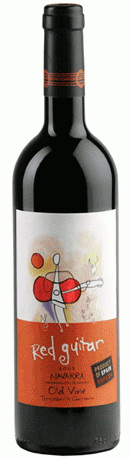
You know that a market niche is expanding when Constellation Brands decides to move into it, as it  has done with Red Guitar, an old vines Tempranillo-Granacha blend from Spain’s Navarra DO that sells for about ten bucks.

Red Guitar is marketed as “a rich, smooth and stylish celebration of the Spanish lifestyle” — a wine for the times, I guess, when consumers are looking for products that let them trade down in terms of price while trading up to a fun, more casual way of living.

Don’t Know Much

I didn’t know very much about the wines of Spain and the Spanish wine industry, so I went back to the classroom this week to try to catch up at a three day seminar on Spain’s wines organized by The Wine Academy of Spain and taught by Esteban Cabezas. My fellow students came mainly from within the wine industry — sommeliers, distributors and retailers. I learned a lot and sampled dozens of great wines. We didn’t taste Red Guitar, but we did survey the market from $5 bottles on up to the highest levels, including table wines, Sherry and sparkling Cavas. Yes, I know. Tough work …

Education is important to the future of the wines of Spain.  As I have written before, the number of unfamiliar regions and grape varieties is a challenge that must be addressed if wines from Spain are to achieve their obvious market potential. Constellation Brands’ decision to market Red Guitar as a “lifestyle” brand probably reflects the difficulty of selling wine from unfamiliar places made with unfamiliar grapes in a market where the international  varietals and styles are the lingua franca. Spanish winemakers need to get the word out — to educate consumers and sellers. Classes like the one I attended are a good step in this direction.

Uncorking the Potential of Wines from Spain

It’s useful to think about Spain’s wine industry using a basic SWOT (Strengths-Weaknesses-Opportunities-Threats) framework. Wines from Spain have many strengths that go beyond their obvious quality in the glass. Spanish food and culture are hot and Spain is a popular tourist destination, factors that can be leveraged in the marketplace. Intangible cultural factors have always helped sell Italian wines, so it is not unreasonable to think that Spain will benefit from them as well. Red Guitar’s marketing strategy is an obvious attempt to do just this.

There are weaknesses, too, of course. While the sparkling Cavas are very popular, offering Champagne quality at beer prices in some cases, other segments of the Spanish industry suffer from consumer ignorance or indifference. Sherry wines from Andalusia, for example, suffer the same challenge as Riesling wines. Consumers think they know what they are (simple, sweet stuff) but they are wrong. The diversity of styles and complexity of the best wines gets lost. For those who know them Sherry wines are the great bargains of the wine world. But most consumers never find out what they are missing. That needs to change.

The amazing diversity of Spain’s table wines is a strength in this market, where consumers are unusually willing to try new products if they perceive good value. But diversity is also a weakness to the extent that it confuses consumers (especially American consumers)  who are looking for a “brand” identity and can’t find it. Spain doesn’t have  a distinct regional identity that would draw in consumers initially and then encourage further experimentation as some other wine producing areas do.

In Search of “Brand Spain”

New Zealand has “brand” Marlborough Sauvignon Blanc, for example, which put that country on the wine map and gave millions of wine drinkers an excuse to try NZ wines. Oregon has its Pinot Noir, which has helped make it a wine region of international note despite its surprisingly small total production. Spain (like Washington State wine in this regard) produces so many different types and styles of wine that no one of them defines it. The regional identity is unclear. This is a barrier when trying to break into new markets, but a strength once a market beachhead has been established.

Although my terrioriste friends cringe when they hear me say this, I think it would be great if Spain had a Mondavi or Antinori who could define a “brand Spain”  in the global market. I think that a number of quality producers are trying to achieve this, but the industry is still pretty fragmented. Perhaps the consolidation that is sure to accompany the current economic downturn will move this process along.

The continuing economic crisis  is a great opportunity for Spain to expand export market share, especially in the United States where the market for wine is till growing in the mid-market segments. Spain, like Argentina, has a reputation for good value and distinctive wines and this is very useful right now.

Catch-22

It is important, however, to avoid being defined by low price alone. Spain’s first and fourth largest export markets (Germany and France) buy mainly low cost wines to stock the shelves of Aldi and similar discount sellers. Spain needs to focus on the UK and US (numbers two and three on their export table) where higher prices and margins are possible.

Another threat to Spain’s success in the international market is the temptation to conform too closely to the international market style (Pancho Campo, Spain’s leading wine authority, called this “the Australian style” in a Skype-dialogue with my class). Wines that are all alike become commodities at some point and it seems to me that Spain, with its already huge lake of surplus wines, wants to get out of that part of the market.

But there’s a Catch-22. It is easier, perhaps, to break into the market with a good value me-too wine. But it is hard to build upon that foundation (hence Australia’s current wine slump). Better to be yourself, distinctive, even quirky, it you can get consumers to give you a try.

As you can see, the prospects for Spain are as complex and multi-dimensional as the wines themselves.  I am optimistic that Spain’s wine industry will navigate this complicated passage successfully. Look for more on this topic in future posts.

Note: I would like to thank the Wine Academy of Spain and Catavino for allowing me to participate in the seminar on wines of Spain. Special thanks to my professor, Estaban Cabezas, and to Simone Spinner.

Tasting Note 8/11/2009: We tried the Red Guitar with dinner tonight and it was completely lacking in distinguishing qualities. It is hard to imagine that anyone who was introduced to the wines of Spain by Red Guitar would try another Spanish wine. Last night, however, we had the Borsao Tres Pichos, an Old Vines Granacha that sells for only a few dollars more, which was completely enchanting. You need to try Spain’s wines to know if you like them, but quality varies (and not just with price), so choose with care.

Wine, Recession and Argentina

The global economic crisis has been bad news for Argentina, but good news so far for Argentinian wine. Will the wine part of the story have a happy ending or, like so many Argentinian economic booms, turn eventually to bust?

Bad News and Good

The Economist Intelligence Unit reports that Argentina’s economy has been hard hit by the economic crisis. The economic forecast is gloomy (see below) with the only good news being that inflation, while still high, is falling.

Given rapidly declining business and consumer confidence, the government’s fiscal stimulus measures will have a limited effect, and we expect the economy to contract by 3% in 2009, before only a mild recovery in 2010.

Unofficially measured inflation will ease to 10-15% in 2009, as private demand falls. The official rate will end 2009 at 6.8%, with a similar rate in 2010.

The peso will continue to depreciate in 2009 owing to weaker foreign-exchange inflows, before the pace of depreciation slows in 2010. The current-account position will weaken in 2009-10.

The Argentinian wine economy situation is sunnier.  The May 2009 issue of Wine Business Monthly includes two reports that paint a bright picture of Argentinian wine trends.

The first story is a competitive analysis of Argentina wine in the United States market.  It reports that U.S. imports of Argentinian wine have risen dramatically in recent years, from 2.6 million cases in 2006 to 4.3 million in 2008.  The total value of Argentinian wine in the U.S. rose from $75 million to $146 million in this period.

It is important to put this increase in perspective, however. Total Argentinian imports are roughly equal to the annual output of a single US winemaker, Washington State’s Chateau Ste. Michelle. So the Argentinian presence is rising, but from a modest base.

Molto Malbec

Unsurprisingly, Malbec is Argentina’s calling card in the U.S. market. Malbec’s share of Argentinian wine imports increased from 35% to 48% over 2006-2008 measured by volume and from 44% to 55% measured by dollar value. I was interested to learn that Argentina wine sales are rising at all price points, not just in the value brand segment as you might imagine.  But value is still important.  Argentinian wine prices are rising, but still relatively low.  The article reports that the average FOB price has increased from $29 to $33 per standard 9-liter case.

In the same issue the results of the Nielsen company wine market survey for the period ending 2/7/2009 are reported.  Argentinian table wine imports were up 40% by dollar value for most recent year.  This compares to a 10 percent increase for Chile, one percent for Italy and a one percent decline for Australia.  Overall growth in imported wines was 2.4 percent by dollar value for the most recent year.

The 40 % annual rise is spectacular, but  Argentinian wines account for just 1.4 percent of U.S. domestic wine volume compared with two percent for Chile, nine percent for Australia, almost 10 percent for Italy. This shows that Argentina either has a lot of room to grow in the U.S. market, as optimists will perceive, or a lot of work to do to escape niche player status.

American Exceptionalism

I think the Argentina producers were wise to focus on the U.S. wine market for their export surge.  Although the European Union is more important to Argentina in other major export sectors, the U.S. is the target wine market, and that’s a good thing in this economic environment.  EU wine consumption has long been in decline because of demographic and market shifts, for example, while wine sales have been rising in the U.S.

The recession is likely to depress wine sales growth in both the U.S. and the EU, but the impact will be less in the U.S., I believe, if only because I think the recession will be shorter here. My current thinking is that the U.S. economy will benefit from greater short term fiscal and monetary stimulus, compared with the EU, and more effective medium term structural adjustment.  That said, the recession is and will be very severe.

Early U.S. evidence suggests that wine sales have actually continued to rise during in the first year of the recession, when measured by case volume, although the dollar value of those sales has declined as consumers trade down.

Opportunities and Threats

Reading the latest articles on WineSur, a noteworthy Argentinian industry website,  it pretty clear that Argentina producers appreciate both the opportunities and threats inherent in the current situation.  The opportunities — to establish a market presence built around good value and the rising popularity of Malbec — are significant. But I think it must be hard for Argentinians to see silver linings without looking around for associated dark clouds — their country has suffered repeatedly from the global market booms and busts.

Some of the threats are strictly economic. Argentinian producers are currently benefiting from a falling peso value relative to the US dollar, for example, which helps their wine hit market-friendly price points in the US.  But the falling currency is in part a reflection of high domestic inflation rates, which ultimately lead to higher production costs. A lot will depend upon how the inflation (cost) and exchange rate (export price) factors balance out in the future.

Some of the threats relate more to the fickle nature of the wine market itself.  Malbec and Argentina are nearly synonymous today, but this could change as other wine regions adopt their signature varietal. A recent visit to the Walla Walla AVA, for example, found many producers experimenting (successfully, I think) with Malbec.  Argentina has the first mover advantage in Malbec and must capitalize on this because it will face more competition in the future.  This happened to New Zealand (Sauvignon Blanc) and Australia (Shiraz) and I do not think Argentina will be different.

In exploiting its Malbec lead Argentina will need to strike another difficult balance, between establishing a useful “house style” that will build market identity and letting this deteriorate into a stylistic “monoculture” that soon bores consumers.  It seems to me that Australian Shiraz is currently suffering from the “monoculture” curse, perhaps unfairly, while New Zealand still benefits from a popular “house style,” although I’m not sure how much longer it can ride the gooseberry wave, especially given the vast quantities of Sauvignon Blanc that need to be sold.

Argentina is at a crossroads at a critical moment and moving in the right direction.  Count me cautiously optimistic regarding the future of Argentinian wine.

Update: Just hours after I posted this piece about Argentina the following item appeared on the Decanter.com website.

Argentine wine harvest down 25%

May 1, 2009  / Jimmy Langman

Due to climatic conditions, this year’s wine harvest in Argentina will be down 25% as compared to last year.

According to Argentina’s National Wine Institute, hail in some provinces, and overall higher temperatures in February and March, are factors in the lower production output this year.

The lower production this year has occurred despite Argentina having a 12% increase in land under cultivation for wine grapes.

Guillermo Garcia, president of the National Wine Institute, said: ‘If there had not been an international crisis, we would not have been able to provide wine to countries with developed markets.’

Garcia added that Argentine wine companies need to begin keeping more than three months of stock on hand to make up for such production shortfalls.

Exequiel Barros of the Mendoza-based Caucasia Wine Thinking consultancy told decanter.com that many Argentine wineries are worried about their ability to supply medium-priced wines but added: ‘We need to see how the international outlook develops this year before we can dare to make any projections.’

In Chile, wine growing areas that are not irrigated, such as Cauquenes in the Maule Valley, are predicting a similarly low harvest, with an estimated drop in production from 30 to 40% because of higher temperatures and low rainfall.

Most wineries in Chile, however, are reporting a good harvest. ‘The lack of rain has been good for this year’s harvest. But wineries in the far south, such as in the Bio Bio, may experience changes to quality because of the higher temperatures,’ said Edmundo Bordeu, professor of oenology at Chile’s Catholic University.

Crisis and Change in the Wine World

When the economic crisis began to unfold last year many people said that it wouldn’t affect the world of wine — people will still want to drink, they said, even more so when they are worried or depressed.  Recession is good for wine, they assured us.

Well, we all know now that that line of reasoning was misguided.  The crisis is hitting almost every shelf on the Wine Wall as consumers cut back and trade down (only a few value brands like Barefoot Cellars seem to be benefiting).  The most recent issues of Wine Spectator and Decanter feature cover stories that are designed to appeal to recession-shocked bargain-hunting wine enthusiasts. (See note below.) Wine industry publications are packed full of stories about how producers, retailers and restaurants are coping with declining demand.

Cycle or Shift?

Now that we know that economic crisis is having a real impact on wine, it is time to think more seriously about what form that impact is taking. Most people that I have talked to are thinking in terms of boom-bust cycles. The current downturn will be very difficult — and a shake out will take place across the industry — but, they say, the wine economy will bounce back again once the economy itself starts to recover.  This is probably the correct way to think about the future of wine markets, but it isn’t the only way.

A second possibility is that the crisis will produce a long term structural change in the wine market.  The market won’t bounce back from its low, but rather will reset itself and proceed along a new and possibly unpredictable future path. Economists who study other sectors (finance, automobiles, agriculture) and taking the possibility of structural shifts seriously.  Could it be happening in the world of wine?

I have given a lot of thought to question of cycles and shifts over the years.  My best known work in this regard is a comparative economic history of public debt in advanced economies called Mountains of Debt: Crisis and Change in Renaissance Florence, Victorian Britain and Postwar America (Oxford University Press, 1990).  (Mountains went out of print in the Clinton years when the US deficit went away, but George W. Bush and the current crisis convinced the publisher to bring it back).

One point of the book is that some crises are more significant than others.  Sometimes a crisis is a tremor that shakes things up for a while but leaves the landscape pretty much unchanged.  Other crises are major earthquakes, with more lasting long term implications.  Maybe this is a “Big One,” at least in terms of wine. I’m going to use the next few blog posts to think through this important question.

The Market Center Shifts

One early indicator of structural change comes from London, the center of the wine world.  Great Britain, as I’ve said before, is the most important wine market in the world. The British don’t drink the most wine in the world or produce the most, either, but they buy a lot of wine from other countries, making them the largest import market and therefore the focus of international competition (Germany and the United States along with Britain form the Big Three import markets).

But this may be changing.  Britain’s economy is being badly battered by the economic crisis, as an article in yesterday’s Financial Times makes clear.

As the UK economy contracts at its fastest rate since the second world war, the … Industry Watch report predicts that more company casualties will follow in 2010. It says 39,000 businesses, or one in 50, are likely to fail next year.

Britain’s banking sector is in bad shape, perhaps even worse than the US industry, and its government budget deficit is also spiraling into the red.  This has general wine market effects similar to those in the US (cutting back, trading down, switching over), but some different ones, as well, the most important of which is due to the exchange rate.

As Britain’s economy has imploded the pound has collapsed as well. The pound has fallen by about 25% against both the dollar and the Euro. It took about $2 (or €1.30) to buy a pound a year ago, now it is selling for $1.45 (or €1.06) today.  This means that imported wine (which in Britain is, well, wine) costs much more because of the exchange rate at the same time that the slumping economy (and lowered expectations) are undermining demand. The US dollar, on the other hand, has appreciated relative to most currencies apart from the yen, promising wine buyers lower prices to match their reduced economic circumstances.  So the recession is affecting wine in Britain more than the US wine market.  A shift is taking place — is it temporary or will it be permanent?

Although it is too soon to know for sure, I think it is possible that these factors could cause London to lose its preeminent position in the world wine market.  I see indicators in the decline of the Australian industry (complicated by other factors, I know — but the collapse of the British market is part of it) and the recent global focus on Argentina and its excellent wine values (both Wine Spectator and Decanter make this point).

Although Argentinean producers are looking to export wherever they can get a foot in the door, my strong sense is that they see their future in the U.S. market more than Great Britain.  Perhaps they are at the head of the pack as the world wine market resets and proceeds on a different path.

[Note: Wine Spectator includes 18 tips on stretching your wine dollar. My favorite is tip #7: buy by the case and get a discount (page 55 of the April 30, 2009 issue).  Sound advice, although the particular example cited may miss the point: “A 10 percent discount on a $300 case translates into a saving of $2.50 per bottle. That adds up fast.”  The problem, of course, is that the people who used to buy those $300 cases are cutting back the hardest and I’m not sure that $2.50 a bottle  is going to turn them around.]

Fair Trade Wine

p11802461A Sam’s Club purchase provokes some thoughts on a new wine movement.

The Economics of Ethical Consumption

Fair Trade products attempt to use globalization to offset some of the negative potential effects of globalization.  Global market forces can sometimes lead to the exploitation of natural resources and unskilled labor, for example. The “sympathy” that Adam Smith thought would condition market relations breaks down when producer and consumer are separated by thousands of miles and multiple commodity chain links.

Fair Trade products and other ethical consumption goods seek to create a global market for products that provide more benefits to those at the first stages of the global product chain.  Some consumers are willing to pay a bit more for such products once they are aware of the problem and even a small slice of a global market can have real economic clout.  Global markets for ethical good thus have the potential to offset somewhat any “race to the bottom” forces and to educate consumers in the bargain. You have almost certainly seen Fair Trade coffee and I think Fair Trade chocolates are pretty widely available, too. Look for Fair Trade roses on Valentine’s Day.

Enter Wal-Mart

Sam’s Club, the membership warehouse store arm of Wal-Mart, is currently selling a Fair Trade wine called Neu Direction.  It is a 2005 Malbec from Argentina and I think it illustrates the potential of Fair Trade.  It is a very nice wine, much more interesting than its $9.99 price tag would lead you to believe.  It was judged the best Fair Trade certified red wine at a competition organized by The Independent of London in February 2008. Sam’s Club is the exclusive U.S. distributor.

According to their website,

Neu Direction Malbec benefits the local farmers of Viña de la Solidaridad (Vine of Solidarity), an association based on preserving the rich, cultural heritage of the contratista-landowner relationship.  Ten small vineyard owners and nine contratistas make up the association.  The contratistas lives on the land with their families and are paid a percentage of the grape harvest by the vineyard owners.  The association currently owns 200 acres of vineyards with about a third certified organic, with plans to convert more over the coming years.

The association members receive a guaranteed minimum payment for their grapes and revenues are also channeled to community development projects such as schools.  2008 was the first year of the U.S. Fair Trade wine certification program, which is administered by a NGO called TransFair.

Neu Direction makes the positive case for Fair Trade wine very well.  It is, first of all, an excellent wine at a good price and so can attract buyers on these merits alone.  It is distributed in about 450 Sam’s Clubs across the U.S.  and benefits from the built-in market that Sam’s Club members represent.  Sam’s Club (and Wal-Mart) gains in some small way through its association with “ethical” productions (Fair Trade, sustainable and organic products) and so has a reason to promote them.

Leigh Barrick, one of my students who has studied both Fair Trade coffee and Fair Trade wine, argues that wine may be well suited to Fair Trade markets because consumers are often better informed and more interested in the origins of and production conditions associated with wine than for most other consumer goods.  Wine enthusiasts are thirsty for information about where wines come from, who made them and how.  Fair Trade provides this information in a way that informs, educates and potentially produces social and economic change.  A good fit, Leigh says, and I agree.

A Case of Trade-offs

But Fair Trade wines aren’t automatically going to be winners.  First, not every Fair Trade wine is likely to be as good or as inexpensive as Neu Direction – or to have the Wal-Mart distribution system behind it.  More important, however, the Fair Trade system itself is full of trade-offs.

Fair Trade certification is necessary, it seems, to prevent the designation from being exploited or debased. But certification is often expensive and time consuming (this problem applies to organic or biodynamic certification processes, too) so many small producers may be unable to bear the cost. The benefits of Fair Trade wine are therefore likely to be unevenly distributed and may required financial sacrifice in the short run to achieve gain in the long run.

That’s not to say that Fair Trade isn’ta positive force,  just that it is not a panacea. It is just one new direction — a progressive one– among many in the world of wine today.

Photo by Michael Morrell, my chief inexpensive wine research assistant.We’d like to thank Michael and Nancy for their hospitality during our stay with them in Tucson.