Grandi Vini (or Joe Bastianich is Nuts)

Joe Bastianich must be nuts.

The food business is crazy; you have to be nuts to own even a single restaurant in today’s market much less the twenty that Joe owns in partnership with the equally insane Mario Batali.  The wine business is maybe even crazier; Joe owns three wineries in Italy and several food and wine shops, too,  just in case he ever has a moment of free time with nothing else to do!

And now there’s this book, Grandi Vini.  You don’t have to be nuts to write a book (although I think it probably helps), but I’m not sure a really sane person would write this book, which aims to identify the 89 best wines in all of Italy and tell their individual stories.

Nuts? Oh, Yes.

Why is this nuts? Well, Italy is maybe the the most complex and varied vino terrain in the world. Here in the U.S. we often talk about “Italian wine,”  but really there is no such thing. Mario Batali once said that Italian food doesn’t exist, there are only the regional cuisines of Italy. It’s the same with Italian wine.

Just take a look at De Long’s nifty wine map of Italy shown below — what a crazy quilt! Local wines in Italy evolved from (largely) indigenous grape varieties and co-evolved with the local cuisines.  Common threads, to the extent there are some, are few and far between. 

Some of this complexity is hidden, submerged by regional wine appellations. Soave, for example, is a very familiar name — so familiar that we don’t always recognize it as a wine that comes from a particular place (the Soave zone outside of Verona), is a blend of grape varietals with the very unfamiliar indigenous Garganega playing the leading role and is made in a number of distinct styles (including Soave Classico and the exquisite Recioto di Soave).

The more you drill down into Italian wine, the more complicated (and interesting) it becomes and the more you start to understand how crazy Joe Bastianich must be to attempt to identify the very best wines.

Yes, yes, I know that Gambero Rosso’s famous annual guide Vini d’Italia has done this for many years now, bestowing their “three glasses” tre bicchieri designation on the year’s very best. (Receiving three glasses is like getting three Michelin stars.)

But their team tastes and rates thousands of wine (16,000+ in my dog-eared copy of the 2007 edition) from hundreds of producers (2,206  in 2007) and in the end bestows scores (262) of top prizes.

For Joe to try to do this all himself, despite his intense relationship with Italian food and wine (which now includes Eataly in New York — another Joe and Mario production)  and to narrow down the list even further than Gambero Rosso is … well, audacious at least if it isn’t actually insane.

What Joe Says … and Doesn’t Say

So what about the book? Well, it’s a great read (just because Joe is crazy doesn’t mean he can’t write). Wine is good, I tell my audiences, but wine and a story is much better and the 89 stories that Joe tells here make great reading, both individually and taken as a whole. I am fascinated by what he says … and what he leaves unsaid.

The unsaid is quite striking. Joe’s family is from Istria and he calls Friuli in Italy’s northeast corner his Italian home. That’s where you’ll find his wineries including the eponymous Bastianich. (The Bastianich Vespa Bianco is Wine Economist household favorite.) I consider Friuli one of Italy’s great wine regions, so I was surprised to see just three wines listed here (versus five for nearby Alto Adige and six for the Veneto).

Mind you the three are stunning wines (from Josko Gravner, Edi Keber and Silvio Jermann), but I think there are more Friulian wines that deserve to be raised to the vino Italiano pantheon.  Just sayin’ that Joe shouldn’t short change the home team in his attempt to be objective.

What Bastianich says is significant, too. As I have read through the various entries I find one strong theme: change. Joe is constantly recognizing winemakers who bring new ideas to Italian wine, especially “modernist” ideas. He wants his readers to understand that Italian wine today is not your grandfather’s rather flat raffia-clad Chianti. By implication, I think, he is saying that many “traditional” producers became lazy and let quality slip.

The best producers today are bringing new ideas and technologies to the vineyard and cellar and are making really distinctive wines of quality that honor tradition but are not slaves to it. These are the wines that are showcased in Grandi Vini.

It’s All in the Timing

The best Italian wines find a way to express their unique terroirs while also meeting international standards for quality. The worst Italian wines — and there are many of them — fail utterly and are part of Italy’s enormous overhang of unsold wine.

Italian wine is in a slump right now. U.S. off-premises sales of Italian wines have actually declined in the last year, although they have picked up a bit in the last few months. This is a good time to seek out the better wines. Hopefully Joe’s book will inspire many wine enthusiasts to take the plunge.

I still think Joe Bastianich is nuts for writing a book like this, but I hope he stays nuts for while.  I’d like to see his crazy vision of Italian wine develop and its consumer market grow.

>>><<<

Grandi Vini: an opinionated tour of Italy’s 89 finest wines by Joseph Bastianich. New York: Clarkson Potter Publishers, 2010.

Getting Serious About Washington Wine

“Wine is not a serious subject. Its point is to give pleasure.” This is what Jancis Robinson says in the opening segment of her BBC series on wine.

It is pretty obvious that Paul Gregutt (author of Washington Wines & Wineries: The Essential Guide 2/e; University of California Press, 2010) didn’t get the message because he seems to take wine pretty seriously and manages to do so without sacrificing pleasure. The new edition of his book is a serious analysis of Washington wine that is seriously interesting.

Wine for Nerds?

Is there an audience for serious wine writing? Certainly Jancis Robinson must think so, despite her disclaimer, since her books and articles are so comprehensive. Gregutt knows this audience, too. When he begins chapter 4 by saying “If you are the type of person who delights in reading through every scrap of information on the back labels of wine bottles …” he must be aware that this description will apply to nearly every one of his readers, of which there are sufficient numbers to justify a second edition of this book just three years after the appearance of the first.

Gregutt’s book is unusual in that it is neither a coffee table photo album nor a wine tourism guidebook (the two most popular formats for northwest regional wine books). Rather it is a comprehensive resource for anyone interested in the continuing development of the Washington wine industry. Gregutt takes us through the history of Washington wine followed by a detailed analysis of the terroir (Washington’s AVAs), the grape varietals (with recommended producers for each wine type) and the most important vineyards (what a great idea). Then and only then does he begin a survey of wineries. The message is clear: wine is made in the vineyard before it is made in the cellar and there is a lot to know if you want to understand it.

The focus is clearly on AVAs, vineyards and wineries — the constants of Washington wine —  not individual wines that can change from vintage to vintage, although an appendix contains Gregutt’s “Top 100 Washington wine” lists for the last few years for those who want to know more specifically what to look for on shop shelves.

What’s New?

What’s new in the second edition (and is it enough to justify replacing your copy of the first edition)? Well, there is a great deal of new material reflecting the fact that the Washington wine industry has experienced so much recent growth.  There are new AVAs, of course (Snipes Mountain and Lake Chelan) and many new wineries (now up to 650+ for the state). Gregutt has doubled the number of vineyards (a top twenty list) and wineries (about 300 in this edition), making this volume far more comprehensive in this regard than the first edition.

I’d say the additional and updated material easily justifies a new edition. And, with the way things are changing, I suppose a third edition will be needed in a few years.

One aspect of the book that is sure to be controversial is the way Gregutt has organized his analysis of the most important wineries in the state. If this were a wine tourism book, I suppose he would have organized them by regions or wine roads and provided tasting room hours and so forth. But he didn’t and that’s a good thing, since the internet is the best place to find that sort of often-updated information.

Instead, Gregutt organized the wineries into four categories, starting with “five star” superstars that both produce great wines but also provide important leadership, moving down through four stars, three stars and then a “rising stars” category.  Where you put a winery in this taxonomy is necessarily problematic, since each of us might use different criteria or weigh the same factors differently. Hence the potential for debate.

Some ratings are surely uncontroversial (Leonetti and Quilceda Creek are superstars, of course), but others are likely to generate discussion. Gregutt is interested in the wines, of course, but also the wineries’ impacts on the Washington wine industry, so the huge Chateau Ste. Michelle appears in the five star list alongside tiny Fielding Hills — each very important to the Washington industry, but in very different ways.

Hedges Family Estates and Corliss Estates (two wineries owned by University of Puget Sound graduates) receive four stars, but I think you could make a case for “promotion” to the top group. For Hedges it would be based upon its leadership in development of the Red Mountain AVA and promotion of Washington wine abroad. For Corliss, it is the single-minded commitment to the highest vision of excellence — an attempt to redefine what Washington wine can be. Four stars or five? Such questions are pleasurable recreation for wine nerds like me.

More for Wine Nerds?

The success of Gregutt’s book has me wondering what other products wine nerds might be willing to buy. Hopefully, of course, they’ll want copies of my book when it comes out in 2011, but maybe there’s an even broader market for wine nerd products.

De Long’s periodic table of wine grape varietals (see below) is a great wine nerd item. I can spend hours looking at it and thinking about the different relationships it proposes. Excellent! De Long’s regional wine maps are great, too.

And then there are wine games, like Winerd the Game shown above. Winerd has a colorful playing board (decorated with faux wine labels), 276 quiz cards and includes a blind tasting test component. Pretty nerdy and probably pretty fun, too, since it has a strong educational component and people always seem to enjoy learning about wine.

I actually have a sealed Winerd game box on my game shelf. Nerdy, yes — and I’m sure it will be fun to play when I eventually get around to it. But apparently I’d rather be drinking wine (and reading nerdy books like Paul Gregutt’s).

Inside Argetinean Wine: Vino Argentino

A review of Vino Argentino: An Insider’s Guide to the Wines and Wine Country of Argentina by Laura Catena. (Chronicle Books, 2010.) Photographs by Sara Remington.

I’m making plans for some fieldwork in Argentina next year and so I was very pleased when Laura Catena’s new book arrived in the mail.  I think it is the perfect reference for anyone interested in Argentinean wine or planning a visit to the vineyards there.

Laura Catena is part of Argentina’s most important winemaking family. Her father Nicolás is Argentina’s  Robert Mondavi. He helped reinvent Argentinean wine at about the same time that Robert Mondavi was leading the Napa Valley revolution. Laura has been an active member of the family wine business Bodega Catena Zapata (serving as research director at one point) and owns her own winery, Luca, which is named for her son. Somehow she also finds time to be a practicing physician.  Mother, doctor, winery owner and now author. too. I think she must have a lot of energy!

Family History

The first part of the book is a brief history of wine in Argentina, which becomes in Catena’s telling also her family’s history. Not that she claims that the Catena clan go back to the first Spanish plantings, of course. It is just that the Catena family story mirrors so well Argentina’s modern history. Immigrants from Italy, the Catenas followed the railroad to Mendoza and found their calling in the vineyard and cellar.

Starting with her great-grandfather, Catena shows us how the family business and the Mendoza industry evolved. At first bulk wines were shipped to the big cities where they were often bottled and sold by local firms under their own labels (the same pattern as California in the 1930s). This eventually made way for a greater focus on winery brands.  Nicolás Catena was a leader in developing branded wine in Argentina and implementing effective national marketing programs.

Fifty years ago Argentina’s per capita wine consumption was among the highest in the world — its Old World immigrant roots clearly showed — but like the Old World its wine drinking culture has changed and domestic consumption has fallen dramatically. This problem inspired Nicolás Catena to look upmarket for higher margins and abroad for export sales. The change from an inward focus on bulk wines to outward strategy created the need for better quality. Much of the “family history” presented here is the successful and on-going quest to make world class wine.

Places, Faces and Wine

Wine may be sold in bars, restaurants, supermarkets and elsewhere, but it is made in the vineyard, so any book about a wine region must get down to the dirt. Vinos Argentino does this in an unusual but very effective way. We go on a tour of the main wine areas in Mendoza, Salta and Patagonia. The discussion once again is very personal. It is as if you are walking through the vineyard with Laura Catena and she is telling you all about it in the way a conversation naturally evolves.

First she might talk about the terroir— the soil and climate. And this reminds her of the types of grapes that are grown here and their history in Argentina. This makes her think about the history of the region and her friends and colleagues who made that history and make wines today. The path of the conversation is sometimes not very straight — just like an actual conversation — but there is much to be learned in the meanderings and I find it perfectly charming. The occasional wine tourism references (eat there, go to see this) are quite as welcome here as they would be on a stroll through the vineyard. The last part of the book provides tourist tips for Buenos Aires and some Argentinean recipes, too.

Lessons Learned

I learned a lot from Vinos Argentino. The first lesson is how much the wine industry has been affected by the economic cycles of Argentina generally (and how much the economic uncertainty that continues today conditions this sector’s future). You can’t really take wine out of the context of the broader political economy and society — a fact that is as obvious as it is easy to forget.

Perhaps because of this,  international (notice that I didn’t say “foreign”) influences have been unusually important in Argentina. As you walk the vineyard with Laura Catena a great many of the wineries she tells you about have international linkages, some going back 50 years. Catena says that about 45% of Argentinean producers are internationally-owned or use international partners or consultants.

International wine-making expertise is part of the story of course (Michel Rolland and his Clos de los Siete project appear in the Uco Valley chapter), but really I think the issue is capital. Argentina’s economic cycles make investment funding very difficult and international interests can bring needed capital as well as technical expertise and international marketing and distribution connections.

Breaking Down Terroir

The final lesson was about the Mendoza terroir.  There are several distinct wine regions located within Mendoza and, like New Zealand, Argentina does not have a detailed appellation system that adequately reflects the diversity of its terroir.  This might not have mattered much in the past, especially since the tradition was to blend using wines from throughout the regions. But I think moving beyond Brand Mendoza to exploit the individual terroirs is important if Argentina is to avoid Australia’s fate (they are desperately trying to rebrand themselves in terms of regional diversity now).

Walking the vineyards with Laura Catena, I think I got a pretty clear sense of the shape and feel of the land and true diversity of the wines produced. It made me optimistic about Argentina’s wine future and curious to try more of the wines (especially her Luca Pinot Noir). If that was Catena’s purpose in writing the book, it worked. I hope it enjoys a wide readership.

>>><<

Dozens of color photos by Sara Remington give a real sense of the faces and places. I wish there were more detailed maps, but I guess that’s what I have my wine atlases for.

Questionable Taste [in Wine]

A review of Reading Between the Wines by Terry Theise (University of California Press, 2010).

It’s pretty easy to tell that Terry Theise isn’t an economist. The unofficial motto of economics is  degustibus non est disputandum, which is generally translated as “there’s no accounting for taste.” Taste is an individual matter, everyone is different and everyone’s entitled to their opinion. Accepting tastes as given is where economics begins.

Who Ya Gonna Call?

Terry Theise is worried about where a radical idea like this might lead. He sees taste as a slippery slope. You start with degustibus and pretty soon you start thinking that all ideas of taste are equal. If all tastes are equal, then it is obvious that majority should rule and, in any case, in the marketplace majority frequently does rule.

Since the taste of the masses tends toward the least common denominator McWine taste, the train of thought that starts with degustibus ends in a train wreck of poor taste and mediocre standardized quality. Accepting taste as given (instead of constantly questioning it) means giving up on taste. Someone’s gotta do something to stop this — who ya gonna call? Terry Theise!

I met Theise at the 2008 Riesling Rendezvous conference at Chateau Ste Michelle. He organized and moderated an end-of-the-day workshop on Old World Riesling Terroir. He was as complex, intense and interesting as the 15 German and Austrian wines we tasted. These were some of the most memorable wines (Hirsch, Nikolaihof, Josef Leitz and Dönnhoff) I have ever sampled presented in flights intelligently designed to help us drill down into the idea of terroir.

Almost Too Intense

Theise was so intense, so totally into what he has doing, that there were a couple of points where I just couldn’t stand it and had to take a break outside to catch my breath. At times his propensity to extended navel-gazing (in both English and German) was more than I could take, too.  But I always came back, drawn to the wines and the strong sense of place that each displayed and to Thiese’s addictive if sometimes irritating passion.

This book has the same intense energy and the same ability to frustrate — I like it a lot in small doses. Too much at a time and I feel overwhelmed.

Much of the book is a defense of elitism regarding wine — an attitude that I term Martian (after Martin Ray) using Thomas Pinney’s terminology (see Wagnerians versus Martians). Theise wants to “remystify” wine, for example. Attempts to make wine “accessible” so that the masses can understand and appreciate it have the bad effect of dumbing down consumers and dumbing down the wine.  Don’t de-mystify, Theise argues, educate and elevate.

Curse of the Blue Nun

It’s Theise’s business to sell wines, mainly German and Austrian Rieslings and some grower Champagne, and you can appreciate why his commercial experience would cause him to resist sacrificing authenticity for accessibility.  I’ve written about how the boom in simple cheap German wines in the 1970s nearly destroyed the industry (see Curse of the Blue Nun). If it could happen to Riesling, once the undisputed Queen of white wines, it could happen to any wine. To all wines. You see the problem.

So I could practically hear Theise moaning over my should as I wrote my last blog post on the Democratization of Wine. Making wine easier and more accessible? That’s the road to Hell.

And yet I think Theise and I could easily find common ground (especially if we opened a bottle of Dönnhoff as we talked about it). At one point in the book Theise backs away a bit and looks at the debate about wine from a broader perspective. There are some who believe that globalization has improved wine, he says, and they are right.  And there are others who fear that globalization will ruin wine. And they are right, too.

The rise of the global market for wine has raised the floor on wine quality, but has it also lowered the ceiling? Theise knows that the rising floor doesn’t need any help to sustain itself — the market will flush out flawed wines without his assistance. But someone’s got to keep the ceiling from collapsing and those great Rieslings and other unique wines from disappearing into the McWine vat.

Revenge of the Terroirists

It’s a matter of taste, of course. You might think the rising floor is great and that the ceiling is plenty high enough. Others might disagree. Well, if we can’t agree about taste, Theise writes, at least we may be able to agree about diversity and the need to preserve a great diversity of different wines.

I agree with Theise about the rising floor and I acknowledge that markets’ rationalizing tendency. But I am more optimistic than he is. I’m optimistic because the same global markets that allow for mass-production of wine also create the opportunity for small, quirky producers to find markets for their artistic output. (Josko Gravner is a good case in point.)

It’s not either/or. The market doesn’t either destroy small producers or preserve them, it does both. Finding a healthy mix is what we need to be concerned about.

I’m also optimistic because I believe that the the active force of globalization of wine has produced a reactive force that I call terroirism in my new book (watch for it in 2011). The terroirists will keep us from forgetting about the heights wine can reach and the diversity that wine can attain, even when we find ourselves reaching for ordinary everyday wine on Tuesday night.

Terroirists are key to the diverse future of wine. And Terry Theise is the über terroirist.

Wagnerians vs. Martians

I’ve spent the last couple of days reading Thomas Pinney’s masterful A History of Wine in America (Vol. 2: From Prohibition to the Present, University of California Press, 2005).  If you want to understand how wine in America got the way it is, this is the best general reference I have found.

Pinney devotes the last section of the book to what he sees is a fundamental battle for the idea of wine in American. It is a conflict between Wagnerians and Martians, he says.

Song of the Wine Maidens

The Wagnerians are inspired by the ideas of Philip Wagner, a Maryland journalist, viticulturist and winemaker who was especially active in the years that bracket the Second World War. Wagner believed that wine should be an affordable part of ordinary life and a constant companion at mealtime.  Pinney writes that

Wagnerians are always delighted to have a bottle of superlative wine, but their happiness does not depend on it, nor are they so foolish as to think that only the superlative is fit to drink. Their happiness does depend upon wine each day … good sound wine will not only suffice. It is a necessary part of the daily regimen.

Wagnerians sing an appealing but fundamentally radical song in the American context, where wine is just one of many beverages  and not always the cheapest or most convenient to purchase.  Regulations that treat wine as a controlled substance are very anti-Wagnerian.

Wagner founded Boordy Vineyads and was well-regarded by wine people from coast to coast.  He is an important figure in the history of American wine, according to Pinney, and one whose idea of wine lives on in many forms. I guess you could say that Two Buck Chuck is a Wagnerian wine, for example, although I think there’s a lot more to Wagner’s idea of wine than just low price.

Wagner promulgated his populist vision by promoting the so-called French Hybrid grape varieties on the East Coast and elsewhere. I think he wanted America to be Vineland (the name given it by the Viking explorers), a country covered with grapevines and abundant with honest, respectable wine. This is easier said than done, however, as Pinney’s history makes clear.

My Favorite Martian

Martians are inspired by Martin Ray’s idea of wine. Whereas Wagner was disappointed that America lacked a mainstream wine culture, Martin Ray was upset that the standard was so low in the years following the repeal of prohibition.  He persuaded Paul Masson to sell him his once great winery in 1935 and proceeded to try to restore its quality with a personal drive that Pinney terms  fanatical.

He did it, too, making wines of true distinction — wines that earned the highest prices in California at the time.  His achievement was short lived, however. A winery fire slowed Ray’s momentum and he finally sold out to Seagrams, which used a loophole in wartime price control regulations to make a fortune from the Paul Masson brand and its premium price points, starting a trend of destructive corporate exploitation that forms a central theme in Pinney’s book.

The Martian view, according to Pinney, is that “…anything less that superlative was unworthy, that no price could be too high, and that the enjoyment of wine required rigorous preparation.”

Ray’s history is therefore especially tragic since his attempt to take California wine to the heights through Paul Masson ended so badly. Paul Masson today is an undistinguished mass market wine brand — as un-Martian as you can get.

When wine enthusiasts of my generation think of Paul Masson (now part of the Constellation Brands portfolio), it is often because of Orson Welles’ classic television ads, like this one from 1980 promoting California “Chablis.” Roll over, Martin Ray!

Two Ideas of Wine

Martians and Wagnerians have two very different ideas of wine and it is a shame that one needs to choose between them. It seems to me that wine could and should be both a daily pleasure and an opportunity for exceptional expression. The good isn’t always the enemy of the great. But many people see it that way, including Pinney, who reveals himself to be a Wagnerian and expresses concern that the Martians have won the bottle for wine in America.

The people who write about wine in the popular press largely appear to be Martians, who take for granted that anything under $20 a bottle is a “bargain” wine and who routinely review for their middle-class readership wines costing $30, $40, $50 and up. Even in affluent America such wines can hardly be part of a daily supper. They enforce the idea that wine must be something special — a matter of display, or of costly indulgence. That idea is strongly reinforced by the price of wine in restaurants, where a not particularly distinguished bottle routinely costs two or three times the price of the most expensive entrée on the menu.

“No wonder, Pinney concludes,” that the ordinary American, unable to understand how a natural fruit product (as wine undoubtedly is) can be sold for $50 or more a bottle, sensibly decides to have nothing to do with the mystery.”

Monolithic Thinking?

I guess I am a Wagnerian, too, if I have to choose, but I’m not as pessimistic as Pinney. I’m about to throw myself into full-time book-writing mode: I need to finish my current project this summer so that it can be in bookstores in early 2011. The more I work on this project the happier I am with its upbeat title.

Grape Expectations started out as a simple pun on the famous Dickens novel, but it has evolved into something more. I have developed genuinely optimistic (if not “great”) expectations for the future of wine and I see the three forces I study in the book — globalization, Two Buck Chuck and the “revenge of the Terroirists” — as possibly bridging the Martian-Wagnerian divide.

Can wine be both common and great? Why not? Wine isn’t one thing, it is many things to many people. No purpose is served in my view, by monolithic thinking. That’s my hope … and my Grape Expectations!

Book Review: In Search of Bacchus

George M. Taber, In Search of Bacchus: Wanderings in the Wonderful World of Wine Tourism. Scribner, 2009.

While the Japanese are trying to wake up Bacchus through the Kami No Shizuku phenomenon I wrote about last week George M. Taber has been circling the globe tracking down the Roman god of wine. He reports on his adventures in this interesting new book, the third in a series that includes The Judgement of Paris (2005)and To Cork or Not to Cork? (2007).

Taber appears to be one of the luckiest wine enthusiasts on earth. He travels the world tasting wines, visiting wineries and then tells us all about it. It is understandable if we are a bit jealous and this book only makes matters worse.

The subtitle says that this is a book about wine tourism and I suppose it is. But sending a journalist like George Taber to study wine tourism is a bit like sending Alexis de Toqueville to study American prisons. You end up with a lot more than you expected (in de Toqueville’s case, of course, if was Democracy in America).

Taber spent the better half of a year traveling the world, visiting the most important wine-producing countries, talking with wine makers and doing some of the things that wine tourists do. He had to be selective in writing about his experiences, so he picked just one wine region in each country.

Chapters are devoted to Napa (but not Sonoma) Valley, California; Stellenbosch, South Africa; Mendoza, Argentina; Margaret River (but not Barossa), Australia; Central Otago (not Hawkes Bay or Marlborough), New Zealand; Rioja, Spain; Douro Valley, Portugal; Tuscany, Italy; Bordeaux (not Burgundy), France; Rheingau and Middle Mosel, Germany and Kakheti, Georgia.

Tourism is hard work, of course, and research is even harder, but Taber seems to have found ways to relax by reporting on typical wine tourist adventures in each spot. Thus he takes a cooking class in Tuscany, bikes along the Mosel, walks through Burgundy, goes wild game watching in South Africa, bungee jumping in New Zealand and so on.

Getting jealous? Yes, so am I. It seems like George Taber has stumbled upon the ultimate wine lover boondoggle.  He goes to great places, drinks good wine, does fun things –and we pay him to write about them!

But there’s more to this book than George Taber’s vacation slides, which is why I can recommend it enthusiastically.  Taber the hedonistic vacationer cannot shake off Taber the inquisitive journalist. Each chapter reveals some interesting and unexpected aspect of the wine, wine business or wine history of each region. The payoff goes much beyond wine tourism. Indeed, I think for me the wine tourism element is quite secondary.

I found the chapters on Georgia and Central Otago the most interesting. I know relatively little about Georgia’s wine industry and so every well-described detail about their practices is appreciated, especially since the traditional methods still in use are so completely different from anything I have encountered before. I know quite a bit about New Zealand wine, on the other hand, but I’ve never visiting Central Otago, so Taber’s history and report on the current status of the industry there usefully connected a lot of dots for me and in a very enjoyable way.

This book isn’t the last word on wine tourism and no one should view it as a textbook on wine tourism economics, but it is a very interesting examination of the wine world through a particular tourist’s sharp eyes. I’m looking forward to Taber’s next book to see where his search for Bacchus will take him next.

Money, Power, Memory, Taste and Wine

A review of Liquid Memory: Why Wine Matters by Jonathan Nossiter (FSG, 2009). Original French edition published in 2007 as Le Goût et le Pouvoir (Taste and Power).

Jonathan Nossiter is famous for his 2004 film Mondovino. Love it or hate it (or love to hate it), Mondovino has given Nossiter standing in the world of wine and he takes advantage of this fact in Liquid Memory: Why Wine Matters.

Remembrance of Terroir Past

Although it is not intended to be a supplement to or continuation of Mondovino, I certainly learned quite a bit about the making of the film and its characters and about Nossiter, too. Indeed, the book is really about Nossiter and how wine inspires his memories and provokes his emotions just as a small cake, a madeleine, famously provoked Marcel Proust. It’s not my favorite book because I guess I’m not that interested in Nossiter’s memories, or at least not as interested as he is, but I did find things to like in it.

In one of my favorite scenes from the book, Nossiter and a film-making colleague are driving back from a day of Mondovino pre-shoot research in Burgundy and they talk about why they are so attracted to terroir. Members of a somewhat rootless transnational artistic class, they recognize that perhaps terroir is so precious to them because it is something they feel they have lost. Nossiter, the American raised in Paris, now lives in Brazil, well you can see how he would feel nostalgic for the authentic home terroir he maybe never had. That’s an emotion many of us can appreciate.

The Bland Taste of Peace?

Another passage subtly probes this same feeling in a different context. Why is terroir and regional identity so important now? Because sharp divisions have caused so much pain and hardship in the past (think Europe and the two World Wars).  Suppressing differences and rounding off sharp corners to create a more peaceful whole has been the agenda of the last 50 years.

Now we find that universalism has gone pretty far, creating the terroir-free transnational world of the European Union and we start to value what we have lost. Sharp edges seem pretty desirable now that we’ve lost them, even if they  sometimes bruise or cut.

I tasted both sides of this problem when we visited Friuli in the Italian Northeast a few years ago. We stayed outside of Cormons with the Venica family at their winery estate and the Sirk family at La Subida.

The land and people of this area where brutalized by the two Great Wars and so, when postwar peace appeared, they gathered grape varieties from around the world and planted them all together in one serene vineyard. The wine from these grapes, Vino della Pace (wine of peace) isn’t especially distinctive on the palate as I recall, but is memorable nonetheless for its optimistic symbolism.

We longed for the taste of peace when we didn’t have it. Now that we do, we find it a little bland. So we seek out terroir, even if it threatens to divide us once again.  Interesting, isn’t it?  Even in Friuli it is the intensely distinctive local wine of long memory – Pignolo, Schioppettino, Ribolla Gialla – that attracts our attention today, not the wine of peace.

Wine and Money

Although this is a book about cultural politics (if you believe the French title) and social philosophy (if you consider the American one), it seems to me that a great deal of space is actually given over to wine economics. The business of wine with its commercial pressures, and especially the ethics of wine pricing get a great deal of space.

“It occurs to me,” Nossiter writes, “that it is impossible to talk about wine without talking about money” and I think he is right. “Wine is inextricably linked to money like all objects of desire in a capital-driven world.”

Though a given bottle’s price varies even more peculiarly than the price of fine arts, a given bottle’s price is supposed to be a reflection of its intrinsic values. Whether it is the producer who sets the initial price, or the importer, distributor, or end seller, each time the price of the wine is set an ethical decision has been made in relation to the wine’s origins and contents.

Nossiter is disgusted by the religion of money, but in this passage he seems instead to be seduced by it, to accept the premise that market prices are moral judgments even as he protests their verdict. I think the premise is wrong and that intrinsic worth is measured by a different scale.

But that’s just the economist in me talking, I suppose.

A review of

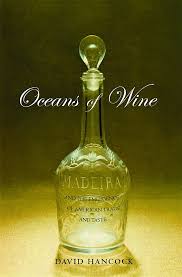
Book Review: Oceans of Wine

David Hancock.  Oceans of Wine: Madeira and the Emergence of American Trade and Taste. Yale University Press, 2009.

As the author of a book called Mountains of Debt I am predisposed to like a book called Oceans of Wine based on the title alone. In fact, it is a masterpiece. I wish I knew as much about anything as David Hancock clearly knows about the Madeira wine trade between 1640 and 1815. This serious social and economic history is filled with interesting facts, detailed analysis and thoughtful insights. What a delight!

America’s First Wine

Madeira was America’s wine in the 18th century, when we were a wine-drinking country but before a domestic industry had taken root. Wines from this small island found their way into shops, taverns and cellars throughout America, one element among many in what this book reveals to be a surprisingly complex network of trade connections that supported an unexpectedly cosmopolitan consumption culture.

Wine exports became a trade necessity when Madeira lost its comparative advantage in sugar production in the 17th Century and, unlikely as it may seem,  its wines soon dominated the Atlantic trade. Madeira could be found just about everywhere in America, from the cellars of wealthy families in big cities to humble country taverns and shops.

Although it would be nice to be able to say that its great success was the result of a unique terroir, in fact Madeira wine evolved into a highly manipulated manufactured product, blended, fortified, heated, agitated and tailored to the preferences of specific consumer markets. It was, in short, everything that wine snobs today hate and fear about wine, but it was treasured and enjoyed by the societies that created it. Give up romantic notions of wine’s pure and glorious past all who enter here!

Atlantic Commodity Chains

The wine trade evolved, in Hancock’s deft telling of the story, through complex formal and informal networks where information was successfully exchanged via “conversations” between buyer and seller and between and among network members at each stage of the complex production and distribution process.

If you think that the interactive, diffused global commodity chain of today is a new thing, you need to read this account of how the Madeira trade worked 300 years ago!

Hancock is not content to simply paint a landscape of Madeira trade. He uses each link in the commodity chain (from Madeira viticulture all the way to American country tavern) as an opportunity to drill down into detailed (and generously illustrated) essays on the economic and social institutions of the time. The result is a work of remarkable scope and depth — a noteworthy accomplishment.

Seriously Interesting

This is a great book of economic and social history told through the wine trade. It is a serious book of history that offers many lessons. Like Madeira itself, it will give much pleasure to many audiences, including historians, wine drinkers and economists. Bravo!

Note: Thanks for Francine Graf, my editor at CHOICE magazine, for suggesting this book.

Book Review: Doubts about Bordeaux

Benjamin Lewin MW, What Price Bordeaux? Vendage Press (an imprint of the Wine Appreciation Guild), 2009.

Wine is bottled poetry, I have read, and bottled geography, too. It is also liquid doubt.

Uncertainty is a key obstacle to the purchase of wine because it is so difficult to know what’s really in the bottle at time of purchase (and, of course,  if you will like it) . There are thousands of different wines from different places made in a myriad of styles. The uncertainty is magnified by the fact that wine changes with each vintage, each vintage changes as it ages, and we all have different tastes. Add to this the fact that some wines are frauds – not what they seem to be  — and others are “lemons” with bad corks or random flows. It’s surprising, when you think about it, that anyone buys wine at all.

Diluting the Brand

Doubt is one of the biggest obstacles to the successful intersection of demand and supply for wine and much effort is expended in making consumers more confident in their purchases. Brands are one solution. A brand that has established a reputation for quality and consistency is a valuable thing in the wine market. This applies to both private brands like Robert Mondavi  and to communal brands, like Champagne.

Champagne was the first wine appellation – a geographic designation meant to deter fraud and encourage confident consumption. It is probably the most valuable “brand” in all wine.

If Champagne is the top wine brand then Bordeaux must come a close second. Bordeaux wines are possibly the best, arguable the most famous and certainly the most expensive in the world. Or at least some of them are, because Bordeaux’s production includes much that is common, foul or unsellable at any price.

The paradoxes of Bordeaux and its famous brand are the subject of Benjamin Lewin’s new book, What Price Bordeaux? Although Dr. Lewin might disagree, I would say that one theme of his book is that the Bordeaux brand is a bit of a fraud. Bordeaux’s reputation is rooted in history, for example, as is the case of much Old World wine, but we learn that the Bordeaux wines of today bear little resemblance to wines of the past.

This is a good thing, in some respects. The Bordeaux wines of history were thin products, “corrected” to meet market demand by the addition of darker wines from Spain and the South of France. Bordeaux wines today are more like their arch rivals from the Napa Valley, both by choice and as a  consequence of global warming, which has nearly eliminated the climate differences between the two regions.

Wine Mythbusters

The top brands in Bordeaux were established by the Classification of 1855, which grouped the chateaux into a rigid quality hierarchy based upon market prices at that time. This, Dr. Lewin’s analysis suggests, was a bit of a fraud as well, and not a very reliable guide to wine choices today.

My favorite chapter examines the “second wine” phenomenon. Many Bordeaux producers (and almost all of the top chateaux) produce a second wine (selling at a lower price) in addition to the flagship bottling. The second wine is marketed to people like me, who probably can’t afford to buy the top wine but want an idea of what it might taste like. We buy the cheaper product and imagine the taste of the grand vin.

The problem, Dr. Lewin tells us, is that there is no fixed idea of what a second wine should be and no certain relationship between the greater and lesser products. Indeed, he says, many second wines are poor values – over-priced because they benefit from the borrowed reputation of the top wine. Better off with a better wine at lower cost from a lower-tier producer, he suggests. Good advice for people who taste what’s in the bottle, not what they imagine to be there based upon the label.

Dr. Lewin’s book is unusually full of data for a wine publication – wine writers are better with stories than bar graphs – but it fits perfectly his myth-buster approach. The maps and figures are colorful and engaging – or at least they engaged the wine geek in me. Each chapter examines some particular aspect of the Bordeaux brand and reveals the reality behind the curtain. I admire both the book and Dr. Lewin’s research and expertise, although I would have appreciated a stronger central argument.

It is pretty clear that this exposé is a labor of love not malice – Dr. Lewin is convinced that the wines and the Bordeaux brand could both be much better. The first step is to acknowledge the facts and that’s where this book comes in. Dr. Lewin has done a service to the Bordeaux producers in this regard. Now it is up to them.

The End of France?

The rumors of my death are exaggerated — Mark Twain

Rumors are flying about the death of the French wine industry. One source reports that France has fallen to third place in the key UK wine market (behind Australia and the US) and is losing ground to surging South Africa. Other rumors whisper that France will seek authority for crisis distillation payments to deal with the growing lake of unsellable wine. And now a new book with more bad news!

Michael Steinberger writes about wine for Slate and other publications. We share many interests so when I heard about his new book, I just had to get a copy. It’s called Au Revoir to All That: Food, Wine and the End of France. The end of France? Gosh. Although just one chapter deals explicitly with French wine, it seems to me that the whole book comments in one way or another on the French wine dilemma.

We have met the enemy …

French cuisine, like French wine, once ruled the world, Steinberger argues, but not any more. Spain has taken the culinary lead, it is said, and many rivals compete on the wine shelf. Who is responsible for this sad situation, Steinberger asks? The answer is clear: the French themselves.

French economic regulations are one factor. They make it very difficult to operate restaurants profitably in France and so encourage the top chefs to look  abroad. Flying chefs are like flying winemakers, I guess, leveraging their skills (and celebrity) on a global scale.

Critics are part of the problem, too. Not Robert Parker this time — the Michelin Guide. The pressure to earn and keep precious Michelin stars is enormous, Steinberger argues, making nervous wrecks out of France’s culinary elite. Worse, Michelin has “a certain idea” of French cuisine and service and it is not clear that it encourages the best from French chefs.

The French invented critics like the Michelin Man and now Robert Parker, it seems, and today suffer from their “tyranny.” Exquisite irony!

… and he is us.

France suffers as well from its distinctive institutions, we learn in the chapter about French wine. The French invented the appelation system which now seems to be running amuck as winemaking regions large and small seek the status that geographical indicators allegedly provide. The French have made appelations so important, Steinberger argues, that they have backfired.

Appelations should be a guarantee of quality or typical style if they are to be very useful economically. But, according to Steinberger, the pressure is on to give the stamp of approval to all the wines in a given region because the economic consequences of losing AOC status is so great. Result, bad wines as well as good ones earn the designation, diluting the commercial value of the brand for all (pun intended).

Stressed out

So it seems as though the French have only themselves to blame for their problems, but I think they are not alone in this. We are all frequently our own worst emenies.

Steinberger’s book does a nice job of plotting his personal love affair with France and his ultimate disappointment reflects his great admiration for what French cuisine at its best can be. It is a good read; I recommend it, unless you are trying to diet!

I love France, too, and I am dismayed by the state of the French wine industry, but I think that rumors of its death are exaggerated. The combination of EU reforms and the current economic crisis will certainly stress French winemakers over the next few years. I am hopefully that this stress will produce less wine but better wine. That’s happens when vines are stressed, isn’t it?