The Wine & S’mores Challenge 2025

Sue and I don’t really need an excuse to make s’mores. What could be better, especially on a warm summer evening, than Hershey’s milk chocolate and a toasted marshmallow wedged between crispy graham crackers? So when August 10 rolled around (National S’mores Day, but you probably already knew that), we were all set.

What Could Be Better?

What could be better than s’mores? Well, how about wine and s’mores? It is not a ridiculous idea and we are always on the lookout for unexploited wine-tasting occasions. So I asked my AI intern to scour the internet for wine and s’mores pairings and it turns out there are lots of interesting ideas.

Even better, my intern explained that there is more than one kind of s’mores. Yes, the Hershey’s milk chocolate bar is the classic, but you can make variations on the classic using other kinds of chocolate bars. The internet even suggested different wine pairings for different chocolate s’mores variants.

And so we established the Wine & S’mores Challenge 2025. Each night we would pit classic s’mores against a challenger made with chocolate bars from Alter Eco foods, which has been promoting National S’mores Day. We’d see if we liked the classic or the challenger better and try out wine pairings, too. A bit complicated (did anyone say “rabbit hole”?) but a lot of fun, too. Here are some preliminary results.

First Challenge: Inconclusive

Our first challenge test was a mixed success. We set the classic s’mores against a challenger made with Alter Eco Classic Blackout, which is 85 percent cacao (!). The internet suggested pairing this with an old vine Zinfandel. We chose the Husch Mendocino Old Vines Zin from the cellar.

The s’mores comparison was interesting. Milk vs dark chocolate was an interesting contrast. Sue preferred the classic Hershey’s, but was not mad at the Classic Blackout. But the wine pairing didn’t work. The Husch Zin was great with dinner, but got wiped out by the s’mores. Maybe that 85 percent dark chocolate was just too bitter? Or maybe the internet recommendation was based on one of those sweetish jammy supermarket  Zinfandels. (The Husch Zin is dry and elegant).  In any case, the result was interesting enough to justify further experimentation.

Second Challenge: Plausible Success

The second challenge was classic s’mores versus dark chocolate and raspberry paired with a Cabernet Franc. Interesting! Our challenger s’mores was made with Alter Eco Raspberry Creme (70 percent cacao chocolate). Our wine choice was a Paradise Springs Shenandoah Valley, Virginia, Cabernet Franc (a Virginia Governor’s Cup award-winning wine).

The Paradise Springs Cab Franc was a great choice for this. It was delicious with dinner and held up to the s’mores. I think it even enhanced the chocolate-raspberry s’mores. But, as Sue noted, the raspberry got lost a bit surrounded as it was by chocolate, marshmallow, etc.  So this was not completely successful, but very interesting because the result was unexpected by us.

Freewheeling Experiments

We decided to break away from the internet’s s’mores pairing list and see if we could come up with something spontaneously. Here are the wines and chocolates we mixed and matched for our experiments. Which combinations do  you think worked best? Which were doomed from the start?

Alter Eco chocolates: dark chocolate with burnt caramel, dark chocolate with brown butter, dark chocolate with creme brulee, dark chocolate raspberry,  and classic blackout 85 percent.

The wines: Lions de Suduiraut Sauternes (a Costco purchase), Valdespino Contrabandista Amontillado sherry, Kopke Ruby Port.

We don’t have final results to report because there are so many permutations to test (don’t you just love homework like this?). We need to consider the original Hershey’s s’mores versus each challenger plus the various possible wine pairings. So we don’t have conclusions as much as tentative observations. Here is what we think so far.

The OG is the OG. Sue enjoyed the experiments and kept coming up with new pairings to try. But she never found anything she liked better than the OG original Hershey’s s’mores. A classic. That milk chocolate taste nicely balances the other ingredients. And Hershey’s squares melt a lot better than more “serious” chocolate, which is a plus.

Fun to Experiment. But it is really interesting to experiment. The brown butter and burnt caramel s’mores were delicious, for example, sort of like more intense versions of the original. The classic blackout s’mores was challenging, but memorable.

Sweet Meets Sweet. We liked the sweeter wines for pairing. The old rule of thumb in pairing is that the wine needs to be sweeter than the dessert for pairing. The Zinfandel we started with was overwhelmed by the sweetness of the marshmallow. The Cab Franc just about held its own. The Sauternes was a good match for the brown butter and burnt caramel s’mores, although Sue thought that the wine might have been better on its own or with a cheese course.

And the Winner Is … What’s the most popular wine pairing so far? I would have to say it was the OG Hershey’s s’mores and the Alter Eco Brown Butter s’mores paired with the Valdespino Amontillado. The sherry is so opulent and both goes with and stands up to the s’mores, which are sort of variations on a luscious theme. Great together, but each is excellent on its own, too.

Endless Possibilities. There is a lot more work to do on this project because the chocolates, s’mores combinations, and wine pairings are nearly endless. Many thanks to the people at Alter Eco for putting us on this interesting wine pairing path.

Wine Economist Flashback: Stumbling into Sherry in Madrid

Sue and I are traveling in Spain and one of our goals is to learn more about what’s happening in the Sherry industry. It is our first visit to Andalucia, but not our first exposure to the world of Sherry wines. I thought you might be interested in this “Flashback” column from 2017 that reports on our very successful search for Sherry in Madrid. This flasback might especially timely given a recent Financial Times article on “How Sherry Got Chic Again.”

>>><<<

Can Sherry Be the Next Big Thing?

The Wine Economist / May 16, 2017

tioCan Sherry be the “Next Big Thing” in wine? I know what you are thinking. Sherry? C’mon! That’ll never catch fire in a big way. And you may be right, but give me a chance to make my case before you close the door on the Sherry cabinet.

One of the things that Sue and I wanted to do during our recent visit to Spain was learn more about Sherry. But the itinerary seemed to work against that. No time to jet south to Jerez de la Frontera in Andaluca, Sherry’s home. We would have to piece together our education in other wine regions. With a little luck and some helpful friends, we managed quite well.

Stumbling on Sherry in Madrid

Madrid is a long way from Jerez, but we found Sherry all around us, suggesting just how much it is a part of Spanish culture. Walking the aisles of the historic San Miguel market near the Plaza Mayor, for example, we stumbled upon a market stall called The Sherry Corner where dozens of different wines were offered by the glass at bargain prices. We had fun trying new Sherry wines and revisiting old favorites.

sherrycorner

The Sherry Corner offers a fun self-guided audio tour of Sherry wines. For €30 you get six glasses of different Sherries in a special carrier, coupons for six matching tapas from various market stalls, and an audio program available in six languages. It is quite a bargain when you do the math and it lets you both get to know the wines, experiment with pairings, and take advantage of the amazing tapas on offer at the market.

We found a completely different experience at the restaurant Zahara de Osborne in the Plaza Santa Ana, which was close by our hotel. The restaurant is owned by the Osborne wine group that is famous for its Sherry wines (you can see the Osborne bull staring down from hilltops all around Spain).

The idea of the restaurant was to bring the food and culture of Andaluca to Madrid. We challenged our waiter to create that experience for us and he did a great job choosing the dishes and helping us with pairings. Gosh, the Fino was delicious with a delicately fried whole fish!

Indigenous Sherry Culture

Not that Madrid does not have its own indigenous Sherry culture. There are Sherry bars in several parts of the city. Friends guided us to one called La Venencia, where the Sherry is served en rama, fresh and unfiltered, right from the barrel, which is a style I like a lot. My university colleague Harry uses La Venencia as his office when he is in Madrid (which is a lot) and he made introductions to José and Gabriel who worked the bar that day.

La Venencia has as much depth and character as the wines that are served there.  If you have any pre-conceptions, you must check them at the door and accept the bar for what it is, which is true of Sherry wines, too. And then, well, it is a complete pleasure. Sherry really isn’t like anything else you will ever drink and La Venencia is just the same.

I have seldom been anywhere that was so totally itself and I will always associate that strong impression with the dry Manzanilla Sherry wines we enjoyed at La Venecia.osborne

A Little Help from our Friends

We got a little help from friends at Osborne and Gonzalez Byass wineries in our quest to learn more about Sherry. Santiago Salinas arranged for a tasting of Rare Old Sherries when we visited Osborne’s Montecilla winery in Rioja. These were wines for philosophers and poets. It is stunning to discover what great Sherries can become with time. We were inspired by Santiago’s passion for the wines and, of course, by the wines themselves.

Our visit to Finca Constancia near Toledo was organized around a rather extravagant seminar and tasting of Gonzalez Byass wines ranging from their signature Fino, Tio Pepe, on to a special Tio Pepe en rama bottling, and then carefully and thoroughly all the way through the line-up to the sweet, concentrated Pedro Xeménez.

Marina Garcia, our guide on this Sherry tour, was not afraid to draw out the complexities of the wines, which is great. As I told my audience at the General Assembly, sometimes complicated things need to be understood in complicated ways. Our favorite? We discovered the Palo Cortado Sherry style and it made us think. I love it when a wine does that.

Sherry doesn’t have to complicated … or sweet either, for that matter, although many people put the wines in that category. A chilled bottle of very dry fino or Manzanilla is pretty pure pleasure and will change many minds. But you’ve got to try it yourself to be persuaded and that’s a  challenge.constancia

Sherry’s Moment?

If you look at the fundamentals, it is easy to conclude that this could be Sherry’s moment. The wines are great and well-priced. They come in a range of styles that variously make great aperitifs, pair well with food, or help unleash that inner poet. Apparently Sherry works really well as a cocktail base, too. Gotta check that out.

Tourism in Spain is on the rise and Spain’s tapas culture cuisine, which matches up so well with dry Sherry, is increasingly popular. Sherry, as much as any wine I know, is a product of time and place, and wears its authenticity proudly.  Authentic, affordable, food-friendly. Aren’t these the things that wine drinkers are looking for today?

Sherry’s burden is its reputation as that sweet old wine that grandma drinks. There is so much more to Sherry for those who pull the cork. If enough curious wine drinkers pull enough corks, perhaps Sherry’s “Next Big Thing” potential can be realized!

Is Sherry going to be the next big thing? Probably not. But it doesn’t have to be. It is a timeless wine waiting to be re-discovered by a new generation of wine drinkers.

>>><<<

Thanks to everyone who helped us with our Sherry research. Special thanks to Susana, Mauricio, Marina, Santiago, George, Cesar, Greg, Harry, Jensen, Gabriel, and José. Thanks to Sue for these photos of the big Tio Pepe sign in Madrid’s Puerta del Sol, the menu at The Sherry Corner, the rare old Osborne Sherries, and the many hues of the Gonzalez Byass Sherry wines.

Non-Alcoholic Wine: Three Questions

Sue and I continue exploring the world of non-alcoholic (or alcohol-removed) wines. NA wine is one of the few growing categories of wine (if it is wine — see below), so it makes sense to see what’s going on. That’s especially true since NA beer and spirits are booming, too. Here is our report, which examines NA wine from three perspectives.

On Trade: What Does an NA Wine Bar Look Like?

It has become easy to order non-alcoholic beer at a bar or restaurant — there is almost always at least one NA beer option available — and NA cocktails (a.k.a. mocktails) are ubiquitous. But NA wine remains hard to find (at least for us) in on-trade settings. I wonder what an NA wine bar would look like and who would go there?

I stumbled on the answer to this question a few weeks ago when I was researching French Bloom, the upscale line of NA wines that caught the eye of  LVMH, the French luxury conglomerate. French Bloom is in limited distribution at this stage and the website features a map of the world to guide you to on- and off-trade points of sale. I was surprised to discover that one of the relatively few U.S. sellers was just a few miles from The Wine Economist world headquarters in Tacoma, Washington.

Soulberry Coffee House and Dry Speakeasy is located about mid-way between the University of Washington/Tacoma campus and the Tacoma Dome district. It is a warm, inviting space that sort of reminds me of a cross between the family pubs that we knew when we lived in England and the original Starbucks concept of the “third space” that’s neither home nor workplace.  Soulberry bills itself as an “all-ages after-hours safe space” and that seems pretty accurate.

Soulberry’s owner, Terri Quintana-Jessen, says that she’s a coffee roaster, but Sue and I quickly noticed how much she talked about community and relationships. Coffee brings people together, which must be one of the reasons she is so interested in it. Wine brings people together, too, but alcohol can keep people apart.

Because NA wine is NA, selling and serving it doesn’t come with the burdens and regulations that must be considered for alcoholic beverages. Terri studied up on NA wine, spirits, and beer, and soon her coffee shop was also a bottle shop and “dry speakeasy” featuring a rotating selection of almost 40 NA cocktails. The French Bloom is popular as the base for Sunday mimosas and NA French 75s.

Soulberry is not alone. Dry wine and spirits bars and popping up much as natural wine bars did a few years ago. Is there a NA wine bar in your town? Maybe there is and, like me, you just didn’t know it.

Is NA Wine Really Wine?

Is non-alcoholic wine really wine? I know from previous columns that many readers believe that wine isn’t wine without alcohol. Studies have even shown that some consumers base their buying decisions on the amount of alcohol they can get for their money (more is better!). It is certainly the case that fermentation (which produces alcohol) is necessary for the transformation of juice into wine. But, once alcohol is removed, is the resulting product still wine?

Although opinions may vary, the use of the term “wine” is defined by regulations and therefore differs in different jurisdictions. Some producers are keen to call their NA products wine because they see a market opportunity. With sales of full-strength stagnant or falling, it makes sense to go after a share of the growing NA beverage market. But other producers think it important to defend the term “wine” from being debased or diluted, which might be a slippery slope.

It is interesting to observe the evolution of this debate in Italy, where it has been illegal to affix the name “wine” to anything with less than 8 percent abv. As Wein.plus reported a few weeks ago, The Italian Ministry of Agriculture has recently revised its regulations to allow de-alcoholized wines to use the term “wine,” but not for wines with protected designations. So you can have NA red wine from Tuscany, but not NA Chianti because Chianti is a protected appellation. This explains why the NA Mionetto wine that we found at Total Wine was labeled “sparkling non-alcoholic wine” and not “NA Prosecco.” Of course, the Mionetto brand is so closely connected to Prosecco that a mental association is almost impossible to avoid.

Before the new ruling, Italian winemakers could only call their NA products wine for export purposes. The use of “wine” was reserved for alcoholic wine at home. NA wine regulations are evolving with different interests pushing to liberalize the rules and others pushing back. But the question — is it really wine? — is ultimately up to you to decide.

That said, the OIV recently highlighted its work on dealcoholization of wine, which dates back to a 2012 resolution. The January 8, 2025, press release explains that,

Adopted in 2012 at the 35th World Congress of Vine and Wine in Izmir, Türkiye, OIV-OENO 394A-2012 “Dealcoholisation of wines” includes prescriptions to obtain vitivinicultural products with a reduced or low alcohol content through partial vacuum evaporation, membrane techniques, and distillation. It also specifies that this process must not be used on wines with any organoleptic defects and must be overseen by an oenologist or specialized technician.

The OIV’s framework for wine dealcoholisation provides producers with tools to innovate while navigating technical and market complexities. This progression supports the industry’s goal of quality and authenticity in a changing consumer landscape.

Can NA Wine Pass the “Second Glass Test”?

Sue and I have been trying NA wines and putting them to the “Second Glass Test.” We ask that NA wines (1) remind us of the wines that they represent and (2) be tasty enough that we would welcome a second glass. Our early research was full of failures. Either the wines didn’t remind us of the alcoholic version or they just weren’t to our taste. Often they were flat, lacking the fruit or aroma that were lost in the de-alcoholization process.

That Mionetto sparkler mentioned above did pretty well in the “Second Glass Test,” for example. It reminded us of Prosecco in a general way (could have done with a little more fruit and acidity), but was very nice to drink and was priced in the general range of Mionetto’s regular sparkling wines. We finished the bottle over dinner. The bubbles in NA sparkling wine come from carbonation, not the fermentation process, and in general we’ve found them to be more successful than still NA wines.

Recently Sue and I have been testing NA wines from Chavin Zéro, a French winery that has been in this business since 2010. The wines are being introduced in the U.S. market now by importer Kobrand. These NA wines were created to solve the same problem as French Bloom: what’s a wine lover to drink when she’s pregnant?

Pierre Chavin makes wines in France including a line of NA wines called Chavin Zèro. We focused on two still wines from Chavin Zéro, a Rosé and a Sauvignon Blanc. The Sauvignon Blanc came first and Sue declared it to be probably the best NA still wine we’ve tried so far even though it didn’t line up with our idea of Sauvignon Blanc. (To be fair, there is no universal definition of how a Sauvignon Blanc should taste and smell.) But it was very nice to drink and had better than average fruit and mouthfeel, probably because it contains 12 percent grape juice (concentrated grape must). We’ll add it to our list.

We were intrigued by the very pale pink Chavin Zèro Rosé, which features both an attractive bottle and an interesting blend of Cinsault, Syrah, and Grenache grapes. It was probably the most interesting and confusing wine we have tried so far. It was tasty for sure — no problem with the second glass. And it had the aromas, fruit, and mouthfeel that we have been looking for but seldom finding. But it didn’t taste like any Rosé we’ve ever had. The winery’s tasting note said to expect aromas of yellow fruit and white flowers. You don’t see “yellow fruit” very often in wine descriptions. Maybe the flavor was yellow plum? We couldn’t decide. Sue said it was more like wine, and likely was the best in terms of providing the complete package, but it didn’t remind us of Rosé or any other particular wine.

20 Years Behind Beer?

We finally opened the bottle of French Bloom sparkling wine that we bought at the Soulberry bottle shop. As we reported a few weeks ago, this wine has received a lot of press because of a connection to the Taittinger Champagne family and a highly-publicized recent investment by the LVMH wine, spirits, and luxury brands group. Terri at Soulberry said that her customers gave it high marks.

We shared our bottle of the sparkling blend of Chardonnay and a bit of Pinot Noir with two winemaker friends. Sue and I found the French Bloom to be dry and drinkable, but lacking some of the body, fruit, and aroma that we look for but often fail to find in NA wines. It would be a good base for the kinds of NA wine cocktails that Soulberrry serves.

I think we would have been more impressed by French Bloom when we started our research, but now we expect more, especially for the premium $40-plus price.

The NA wine, beer, and spirits category is growing (see graph), albeit from a low base, and there is a lot of research going on. A recent Economist article charts the market changes and suggests that, while NA wine might be 20 years behind the much more successful NA beer category, it might not take 20 years for it to catch up. Fingers crossed that NA wine drinkers (and producers) will find their respective sweet spots soon.

Understudy to Center Stage: The Unexpected Rise of Cabernet Franc

Wine made from Cabernet Franc is generally paler, lighter, crisper, softer, and more obviously aromatic than that of its progeny, Cabernet Sauvignon.

This is how the authors of Wine Grapes, my standard reference, describe Cabernet Franc. Sounds great, doesn’t it? So it is a bit of a surprise that Cabernet Franc’s place in French wine is relatively limited.

France: Two Faces of Cab Franc

Cabernet Franc is the headline red wine grape in the Loire Valley, but in Bordeaux (and most other places) it is best known as a blending grape (or an insurance grape, I am told, because it buds and blossoms earlier than Cabernet Sauvignon and so helps winegrowers hedge their bets against unfavorable weather). Apart from Chateau Cheval Blanc and a few other BDX wines, Cab Franc is a backup singer behind Cabernet Sauvignon.

I think I first began to pay attention to Cabernet Franc about 15 years ago when I found myself helping Mike and Karen Wade on the bottling line at their Fielding Hills Winery (my report on the experience was the very first Wine Economist newsletter post). All the wines, made with grapes sourced from their Riverbend Vineyard on the Wahluke Slope, were great. But the Cab Franc really blew me away. It was then and remains now my favorite FHW wine.

Cab Franc was suddenly a thing to us and Sue and I started to wonder if maybe it was a Washington state wine thing. We got this idea from Chris Carmada, winemaker and proprietor at the Andrew Will Winery on nearby Vashon Island. Carmada said that Cab Franc might be Washington’s best red wine grape variety and Andrew Will makes the most of its exceptional quality in both their varietal wines and in the vineyard-specific blends.

This video tells the story of Andrew Will Winery and its particular affinity with Cabernet Franc. We also admire the elegant Cab Franc that Robin Pollard makes from her vineyard in the Rattlesnake Hills (a.k.a. “The Hills”) area.

Once we started looking for northwest Cabernet Franc we began to find it in unexpected places. The Rocks of Milton-Freewater is a famous AVA on the Washington-Oregon border. It is best known for the Syrah and Grenache wines that wineries such as Cayuse and Reynvaan make from the vines there. So we were surprised to find that Watermill Winery makes a terrific “Hallowed Stones” Cabernet Franc from their rocky estate vineyard, very different from Andrew Will, Pollard, or Fielding Hills. Distinctive.

Many Faces of Cabernet Franc

Looking further afield we stumbled across our first Napa Valley Cab Franc, the Ehlers Estate Cabernet Franc St. Helena, Napa Valley. Cab is King in Napa Valley, but Cabernet Franc is an unexpected discovery. This wine had the power and depth that you expect from Napa (15% abv, 18 months in oak) with the slight green edge that said Cab Franc not Cab Sauvignon. Sue liked it but said that the Napa style almost dominated the Cab Franc character.

Recently we’ve been learning more about the wine industries in Virginia and the Niagara Peninsula in Canada and discovered that Cab Franc plays important roles in both places. Barboursville Vineyards is probably our favorite Virginia winery (it was featured in my book Around the World in Eighty Wines) and its Barboursville Cabernet Franc Reserve is both great quality and great value.

Cabernet Franc is one of the most important red grape varieties for Niagara producers. We visited the region earlier this year and enjoyed tasting wines at Leaning Post Wines and Westcott Vineyards. Both focus on Pinot Noir and Chardonnay, which do very well in that region, but both wineries also make exceptional Cab Franc wines inspired by the grape’s ability to express the character of particular sites.

The idea that Cabernet Franc is or could be a terroir wine — a wine that reflects its particular vineyard characteristics — comes as a surprise if you are used to thinking about it as a useful but secondary blending grape. Further study is required to explore this idea.

So we are starting to look for Cabernet Franc wines from Argentina. We know from our visits there that the differences in terroir, especially elevation, can be important. Malbec from Lujan de Cuyo can be very different from Malbec from the higher-elevation Uco Valley. So we are excited to taste the Durigutti Proyecto Las Compuertas Cabernet France (from Lujan de Cuyo) alongside the Bodega Andeluna Pasionado Cabernet Franc from Uco Valley vineyards situated at an even higher elevation 1300 meters above sea level.

Cab Franc World

It seems to me that Cabernet Franc has quietly exploded on the wine scene. Maybe it was always there and I just overlooked it. But maybe those qualities I found in Wine Grapes have become more important to wine drinkers. According to Wine Grapes, Cab Franc can be found almost everywhere: Northeast Italy, Spain, Romania, Hungary, Argentina, and Chile have significant plantings of the grape variety and there are patches of Cab Franc vines almost everywhere else. Even on Malta!

There is clearly a lot of work to be done to chart the Cab Franc universe. Once upon a time, Cabernet Franc was Cabernet Sauvignon’s shy understudy that has now taken center stage, at least some of the time. Either way, let’s celebrate Cabernet Franc.

Is Orange the New White?

Orange wine (white wine made with extended skin contact) isn’t new, but some people think it might be the next big thing. Is Orange the new White when it comes to wine?

White the New Red?

These are interesting times for the wine business, as recent OIV studies have shown. Not only is global wine consumption volume falling, but the composition of wine purchases is changing, too. White is the new red, for example, as global consumption of white wines has now exceeded red.

The rise of orange wine might be part of this market reversal because, as Ray Isle wrote in Food & Wine magazine, orange wines are sometimes seen as the white wine for red wine drinkers because of the tannins they pick up during their longer skin-contact period. But orange wine volumes are still small relative to the broader market, so it is too soon to make bold claims about the future.

That said, orange wines may appeal to younger consumers who are also attracted to natural wines. Wine producers today pay close attention to any trend that might draw younger consumers into the market. It is no surprise, therefore, that most wineries Sue and I have visited in the last few years have had at least one tank of orange wine over in the corner to explore the possibilities.

From Georgia to California

Sue and I started thinking about orange wines when we visited Georgia, the cradle of wine, a few years ago and tasted white wines made in the traditional qveri process. The best of the wines were alive in the glass in a way that we seldom experience and, although skin contact wasn’t the whole story, it was part of the experience. Wines from Gotsa Family WinesPheastant’s TearsIago’s Wine Cellar, and the Alaverdi Monastery especially stood out.

Last year we enjoyed what someone called an “entry-level” orange wine from Bonny Doon called “Le Cigare Orange.” A skin-contact blend featuring Grenache Blanc, it was indeed a good introduction to orange wines made in a modern style.

The Vice Orange

It was easy to say yes, therefore, when we were offered orange wine samples from a Napa Valley winery called The Vice. The Vice focuses on small-batch single-varietal wines. Significantly, orange seems to be the new white at The Vice in the sense that a majority of their “white wines” (including our samples) get extended skin contact treatment.

We started with “Pickleball,” an Orange of Viognier made with grapes from Napa’s Oak Knoll District and aged for a year in neutral French oak. Tiny production: just 420 cases today. I was especially curious about this wine because normal Viognier is sometimes recommended as the white wine for red wine drinkers. How would the extra skin contact (plus oak aging) change the equation?

The answer was revealing. The wine was more restrained than I expected. It was clear that the winemaker aimed to make a stylish Viognier (that just happens to be orange) rather than an in-your-face Orange wine (that just happens to be Viognier). Do you know what I mean? Given the choice, I think I’d opt for this restrained approach every time.

Next Big Thing?

Next up was “Brooklynites 5.0,” an orange wine made with Gewurtztraminer from Los Carneros. It had been aged eight months in a combination of stainless steel tanks and concrete eggs. It was pretty, especially with the classy white and gold label. The aromas jumped from the glass followed by a spell by Gewurtz’s character and flavor. Dry, savory, great with prosciutto-wrapped asparagus. Restrained, like the Viognier, but with more going on in the glass.

The Vice has embraced orange wine, suggesting that “Orange is the New Napa,” which ought to get your attention. Their latest release includes five count ’em five orange wines according to the recent press release:

  • Orange of Gewurztraminer “Brooklynites 5.0”, Los Carneros, 2022 / 13.7% Alc. SRP: $35.00.
  • Orange of Viognier, “Pickleball”, Oak Knoll District, 2022 / 13.7% Alc. SRP: $38.00.
  • Orange of Sauvignon Blanc, “Sierra”, 2023, Los Carneros, 2023 / 13.4% Alc. SRP: $36.00
  • Orange of Albarino, “Sevilla”, California, 2023 / SRP: $38.00
  • Orange of Chardonnay, “Las Amigas”, Los Carneros, 2023 / 12.8% Alc. SRP: $65.00

Is Orange the new White? No, it’s a thing of its own, based on our sampling so far, and not a gimmick, either. Red, White, Pink, Orange, let a thousand colors,  hues, and shades come out of the tanks in the corner and onto the dinner table.

Wine could use a burst of adrenaline just now. Orange wine can’t do the job on its own, but it is a shot in the arm for anyone looking for something new to like in wine.

>><<<

Roger C. Bohmrich, Master of Wine, is the author of an excellent analysis of the Orange wine market, ” Orange Wines: Bridge to the Past and Trending Wine,” which appeared in Wine Business Monthly (January 2024, pp. 60-65). WBM subscribers can access the article on-line by following the link.

What’s Your Wine’s Story? From 19 Crimes to 1000 Stories

“What Young Wine Drinkers Want” is the title of a recent Financial Times article by Hannah Crosbie, one of several recent reports probing the priorities and buying habits of younger consumers. Taken together, they give anyone concerned about the future of the wine industry a lot to think about. Compared to the baby boomers who drove the wine industry for many years, younger consumers differ greatly in terms of their economic situation, communications preferences, relationship to alcohol, and much else.

The Changing Nature of “Story Wines”

One common theme is that younger consumers want more than something to eat or drink. They want products that tell a story that they can pass on to their friends and make part of their own story, too, in one way or another. Wine is good, but wine and a story about the wine are much better.

To be fair, the story element of wine purchases is not new, it is mainly that the importance has increased and the type of story has changed. First-person stories of visiting wineries and meeting winemakers are powerful, for example. I have some boomer friends who like to tell some version of a numbers story. Sometimes it is about how much the wine cost and sometimes it is about how little they paid (hello, Two Buck Chuck). Often it is about critics’ ratings. These stories intersect with various identities ranging from aspirational to reverse snobbery.

I am sure that these stories resonate with many younger consumers, but recent articles suggest that today’s consumers are looking for narratives that better connect to their identities. So story-telling, which has always been important in wine, is even more critical today.

Don’t Need No Stinkin’ Badges

One of the most-read articles in Wine Economist history is a 2018 column about 19 Crimes wine, “Outlaw Wine? 19 Crimes Succeeds by Breaking All the Wine Marketing Rules.”   The article argues that there is no particular reason 19 Crime, which started as a brand featuring rather unfashionable Australian Shiraz, would have become a hit, especially with younger consumers. The key, I wrote, is the “outlaw” backstory, which resonated with many young male consumers.

19 Crimes is still a storied wine, but the story has shifted a bit since that column first appeared. Now it is also a celebrity story wine, with labels that feature Snoop Dogg and Martha Stewart. “Every bottle tells a story,” the wine’s website proclaims along with the outlaw motto, “It’s good to be bad.” And every bottle does tell a story via augmented reality technology. Just download the app and scan the label. Talk about a story wine.

One Thousand Stories

Sue and I recently took part in an online tasting of wines from a winery that has so completely embraced story-telling that it is even in its name: 1000 Stories wine. 1000 Stories is a line of California appellation wines produced by Fetzer/Bonterra, which is part of the multinational Concha y Toro wine group.

The name draws directly from the interest in story-telling. We all have stories, according to the website, and we want to add stories and share stories. Every bottle tells a story, too. The mood is upbeat compared with the darker 19 Crimes vibe, but wine as part of your identity theme is still there.

This umbrella story is supplemented by several (but not necessarily a thousand) supporting stories. 1000 Stories claims the title of the first bourbon barrel-finished wine (there are now several of these on the shelves). Used bourbon barrels are toasted and used to finish the wines. Since these barrels come from different distilleries and have different characteristics, each batch of wine is a bit different (that is, it tells a different story of its origins). In a world of homogeneous commodities, this will be a story that will resonate with many.

The use of bourbon barrels is not traditional, but I don’t see a problem. I remember visiting Justino’s winery on Madeira, where used barrels are so important to the process. They were using a few used whiskey barrels in an exchange with a distillery that was using used Madeira barrels to add some complexity to its whiskey. I thought that was pretty interesting, so I can’t criticize bourbon barrels for Zinfandel if the results are worthwhile.

The Bison Story

Concha y Toro and all its subsidiaries are certified B Corporation businesses, so there is a subtle social and environmental responsibility story told by the “B Corp” logo on the back label.

The back label doesn’t mention the story behind the bison on the front label, which is kind of puzzling. What does a bison have to do with the 1000 Stories? The answer is a good story. 1000 Stories is working with a group called Yellowstone Forever to support bison conservation in Yellowstone National Park. Why not advertise these efforts more clearly on the wine bottle? I speculate that perhaps it is left to the informed wine drinker to share the story with friends. Word-of-mouth is the most effective way to get a story passed around.

Sue and I have been tasting through the 1000 Stories lineup. The Zinfandel is balanced and rounded by its 5 grams per liter of residual sugar, but not avoids being the sugar bomb that many wines that target younger drinkers have become. It was great with BBQ brisket. The Red Blend is an interesting mix of grape varieties including Teroldego, Zinfandel, Cabernet Sauvignon, Petite Sirah, and Pinot Noir. It played nicely with a ham dinner.

I admit that I sort of wish that 1000 Stories really just focused on one story — it would make the wine’s story easier to tell. But I admit that people aren’t one-dimensional, so why should wines and their stories be monolithic.

I am not sure which of the many stories of 1000 Stories resonates with me, but then I doubt that I am the target audience. Pragmatically, what’s important for the wine industry is that wine brands pitch stories that connect with consumers, especially newbies who are looking for reasons to connect.

Anatomy of the Prosecco DOC Boom

Prosecco sales have boomed in the last decade, with the volume of Prosecco DOC global sales more than doubling. And, with the advent of Prosecco Rosé, they promise to continue their upward trend.

Booming Sales in a Stagnant Market

Sue and I had an opportunity to reflect on Prosecco’s surging popularity recently when the Prosecco DOC consortio invited us to participate in an online tasting timed to celebrate National Prosecco Week. The program included a webinar hosted by Mike DeSimone and Jeff Jenssen (aka the World Wine Guys)  and a tasting of Prosecco DOC and Prosecco Rosé DOC wines from Ruggeri, Anna Spinato, Pitars, Domus Picta, and Zardetto. The program was fun and informative. Many thanks to everyone involved.

The Prosecco boom is impressive, even more so when you consider that global wine consumption has been stagnant during the period shown in the table above. About the only wine market segments that have shown sustained growth have been sparkling wines (especially Prosecco), Rosé wines, and Sauvignon Blanc from New Zealand. Almost all other segments have been relatively flat or down.

The obvious questions to ask are why Prosecco and why now, but the a better question might be what took consumers in the US, UK, and elsewhere so long to embrace Prosecco’s many charms?

I Blame Champagne

I blame Champagne. Champagne has defined the sparkling wine segment for decades as a luxury product, which for most consumers means something to be saved for a special occasion. Weddings, birthdays, anniversaries, graduations. These were the times to uncork Champagne.  The substantial niche for sparkling wines at other times was largely unfiled. Prosecco — less expensive and easy to like — filled that niche, powered by a general willingness of consumers to embrace anything and everything associated with Italy.

I like to say that Prosecco is the Mark Twain of sparkling wine. The works of the great authors, according to Mark Twain, are like fine wine. Mine, he said with a certain false modesty, are like water. Everyone drinks water. And now everyone drinks Prosecco, too, and it doesn’t take a Hallmark greeting card occasion to pop a cork.

You can make Prosecco as simple or as complicated as you like. A large majority of the wines are Prosecco DOC (and most of those are quaffable Extra Dry wines), which forms the base of the Prosecco pyramid. Enthusiasts can explore higher elevations: Prosecco DOCG, wines from the Rive (designated vineyard areas), and finally Prosecco from Cartizze, a legendary hilltop vineyard area.  A Prosecco Pyramid tasting  expedition is fun, informative, and doesn’t cost an arm and a leg. You should try it!


The Rise of Prosecco Rosé DOC

Have you seen the new pink Prosecco? Prosecco Rosé DOC came into the market with the 2020 vintage. It is a blend of Glera, the Prosecco grape variety, with up to 15% Pinot Noir. We have started to see the wines on local store shelves in the past month or so — I think some shipments were held up a bit by the logistics problems that plague international trade.

Pink sparkling wines from the Veneto are not a new thing, but the wines couldn’t be called Prosecco until the DOC rules were modified to allow this use. Prosecco Rosé is a DOC wine — the DOCG rules haven’t changed.

Will Prosecco Rosé be a hit? As you can see from the graphic above, the Prosecco producers expect sales to more than double between 2020 and 2021. Demand might in fact be even higher — there is actually a supply-side constraint until new plantings of Pinot Noir come into production.

Sue said that she’s not sure there really needs to be a pink Prosecco. The traditional wine — such as the delicious Anna Spinato Extra Dry DOC included in our samples — is plenty good enough. But she enjoyed the pink wines, especially the pale and well-balanced Zardetto Rosè  Prosecco Extra Dry,  All the Prosecco Rosè DOC wines benefit from an extra month on their lees, which gives them a richer mouth-feel.

Is Prosecco Rosè DOC the next big thing? Too soon to tell, but the wines we sampled make a good case for a pink Prosecco boom that’s an echo of the boom that’s already here.

>>><<<

I enjoy drinking Prosecco so much that I’ve never thought about cooking with it. Until now. I was pleased to receive a book called The 100 Prosecco Recipes by Italian winemaker Sandro Bottega, which highlights both Prosecco and many of the indigenous food products of the Veneto. A beautiful volume, it has given me lots of new ideas.

There is one recipe in particular that I can’t wait to try once the summer heat wave has passed. It is a very different idea of risotto. You make a broth from water flavored with thyme and herbs. You cook the risotto in the usual way using the herb broth and  at the end, you mix in a bit of olive oil instead of butter and cheese.

Where does the Prosecco come in? At service! You pour a little Prosecco into a pool you have made in the risotto (and then, I think, you pour some more into yourself). It seems to me that this last-minute addition could be spectacular and set off the other flavors. Worth a try, don’t you think?  Many thanks to Bottega for the book and great ideas.

Too Much, Too Much, Too Little: Solving the Canned Wine Puzzle

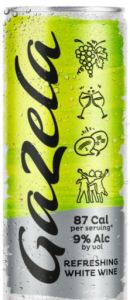
Sogrape, a leading Portuguese wine producer, recently sent us samples of their new entry into the canned wine market: Gazela. Gazela is characterized as a “refreshing white wine” and it certainly lives up to that billing. A really nice wine for those casual summer outdoor occasions and a strong entry into the booming  canned wine market segment.

There is a lot to like about Gazela, but I am especially interested in the way that it addresses three problems in the popular canned wine category: too much (alcohol), too much (cost), and too little (wine quality).

Too Much

Forget about what you read on the label, American consumers are trained to see a beverage can as a single serve container. I know, I know that this is wrong — 5 ounces is more appropriate for a serving of wine than 12 ounces. But if you are drinking directly from the can, as people often do, the can is a serving. And that’s way too much alcohol.

Gazela addresses this in two ways. First it’s a smaller 250 ml can. That’s still more than one serving according to the “Nutrition Facts” panel on the can (which also lists calories — 87 per serving). But the smaller can plus low 9% abv means that consumers who empty the can aren’t getting nearly as much alcohol as they might. That’s progress.

Less is more when it comes to wine in cans from the alcohol standpoint and Gazela leans in the right direction.

Too Much

Price is another hurdle to canned wine success. Consumers are used to paying maybe $10 or so for a six-pack of canned beer or hard seltzer, so you can imagine how they react to wine priced at $5.99 or $6.99 per individual can. Seems like a really big price difference unless you do the “per serving” math in your head. Even so canned wine isn’t bargain wine from the consumer cost standpoint.

Gazela is priced at $2.99 per can, which I think will make a difference. I have seen one or two other 250 ml cans at this price point.  It will be interesting to see if a lower price point can help unlock the untapped growth potential of canned wine.

Too Little

A third problem with canned wine is that sometimes the wine itself is disappointing — there’s no there there, if you know what I mean. Sue has complained that the taste and aroma often fade very quickly and there’s not much left to enjoy by the end of the glass. This is certainly not true of all the canned wine we have tried and I am not sure if the problem is mediocre wine to begin with or too much time in the warehouse.

The Gazela was different, Sue said. Better. The first sip and the last told the same story. And that’s what wine needs to do to be successful. Otherwise, hard seltzer is going to win in the long run.

How did the Gazela taste? Well, the Gazela brand is all about Vinho Verde when it comes to their bottled wines. The can, as noted above, identifies the contents as “refreshing white wine” which makes sense since, as I understand it, wine in cans isn’t allowed for the appellation designation.

It is refreshing and white, as the can claims, which is how Vinho Verde should be. We tasted it alongside Broadbent Vinho Verde, which is our go-to wine of this type. The Gazela was fizzier and tasted like Vinho Verde to me, but the Broadbent had sharper acidity. Sue liked the Broadbent better,  but we’d be happy to have the Gazela when the occasion is right.

Taylor Made Solution

Although we haven’t been able to taste yet (it’s rolling out nationwide just in time for summer), it looks like another Portuguese winery, Taylor Fladgate, has also figured out a canned wine success strategy. Taylor’s recently announced its new Chip Dry and Tonic premium RTD cocktail. It is a combination of 1/3 Taylors Chip Dry White Port, 2/3 tonic, with a bit of lemon and mint.

If you have ever visited Porto and the Port lodges just across the river, you’ve probably had a White Port and tonic. It is totally refreshing on a warm day. Seriously, you need to try this. Taylor’s Chip Dry Port is seriously good on its own, too, chilled or on the rocks.

Taylors cans hit the right notes. Small 250 ml can? Check. Low 5.5% abv? Check. Competitive price? Check — SRP $17.99 for a 4-pack should work in the premium RTD cocktail space. I hope Kobrand, Talylor’s U.S. importer, brings in enough to keep the store shelves stocked this summer.

I notice that the label is Chip Dry and Tonic — the word Port doesn’t show up, except the trademarked brand “Portonic”. I think this is probably due to the same sort of Portuguese regulations that affected the Gazela can. In this case, I think the omission might benefit sales. People think of Port as heavy and sweet, but Chip Dry sounds just the opposite. Many know that Port is fortified and alcoholic, whereas this beverage is in the same abv range as hard seltzers. Not many people know what White Port even exists. Chip Dry and Tonic stands well on its own.

And the can is beautiful, don’t you think? Who wouldn’t want to find out what’s inside?

Congratulations to Sogrape and Taylors for these refreshing new entries in the canned wine market.


Book Review: Getting to Know Saké

Brian Ashcroft (with tasting notes by Takashi Eguchi), The Japanese Saké Bible (Tuttle Publishing, 2020).

Saké has always been a mystery to me. I have only been served it a couple of times and never with much in the way of introduction. Lacking background and appreciation, I have generally defaulted to beer on occasions when Saké might have been the more interesting choice.

Getting to Know You

I never got over the first hurdle. The upscale supermarket down the street (the one that I wrote about in Wine Wars) displays Saké over in the corner next to the Port, Sherry, Madeira, and Vermouth. This is not necessarily a poor organization, since Sakés are generally fortified, but there is a certain ghetto effect, too.

I was surprised when I looked closely at the Saké wall and discovered more than two dozen choices, including two craft Saké selections by Momokawa in Oregon. Lots of choices –big bottles and very small ones at all sorts of price points. And while some of the terms on the bottles were familiar enough, the language barrier was impossible to ignore.

Clearly a resource like The Saké Bible  is needed to open the door to understanding and appreciation. The book, colorfully illustrated and written in a casual, engaging way, provides a good introduction for newbies like me without ignoring the interests of  more experienced Saké drinkers.

Getting to Know All About You

We begin at the beginning. What is Saké? It isn’t beer even though it is brewed and it isn’t rice wine as is sometimes said. Saké is Saké. It is made with five ingredients, according to Ashcroft, but in ten thousand ways. The ingredients are rice, water, koji, yeast, and soil (so terroir is part of the story for some Saké). Koji is a fungus that breaks down the rice’s starch into sugar during the brewing process.  Each ingredient has many variables and options, adding to the product’s complexity.

I found something interesting on every page of this book. Some of my favorite parts are the chapters that trace the evolution of the Saké industry from  temple to small breweries to producers with global reach. Craft Saké is a thing now, as you might guess, and so both tradition and innovation are flourishing in Japan and around the world (Saké is brewed in Brooklyn these days — of course!).

I was also fascinated by the chapter on tasting Saké and pairing it with food as well as the detailed tasting notes for 100 top drawer products. The tasting notes encouraged me to think in terms of wine, which I found comforting. But there were some complications because Saké can be enjoyed at many different temperatures — and getting the chill right can be important.

One of my favorite tasting notes explained that a particular Saké  displayed a brightness when chilled, but evolved with syrupy apricot sweetness at warm room temperature. Served piping hot it had a mellow silkiness like milk chocolate. But in between room temp and hot was a no fly zone — “rather unpleasant” according to the notes. Interesting.

Getting to Know What to Say

The Saké Bible tells you everything you need to know about Saké in theory, but where do you begin in practice? From a practical standpoint, which of the many Sakés on the shelf is best for a newbie consumer? The cheapest? The most expensive? The one with the prettiest bottle or label? (Some of them are very attractive).

I wrote to author Brian Ashcroft for advice and he told me to begin at the beginning, just as most of us did with wine when we were starting out.

The drink itself is incredibly approachable and unintimidating. To be honest, start there. Try sake. Drink it. Don’t get bogged down. Find what you like. If you enjoy a specific type or brand, make a note and remember it for next time. But as with wine, always be willing to try more. For any food or drink, your senses are your best guide, and the more experience you have with the drink, the more you’ll appreciate the various brands and styles. The good thing is that there is lots of breathing room in how you enjoy the drink because one of the best things about sake is just how flexible it is–you can drink brews at a variety of temperatures, in different style cups and glasses, and with a range of food. Experiment. Explore. Have fun.

Have fun! That sounds like good advice. So, armed with The Saké Bible, I returned to my upscale supermarket in search of a particular style of Saké called Ginjo. Ginjo is made with highly polished rice, giving it a more delicate and refined flavor. It is good both at room temperature and chilled. Expect fruity or floral flavors.

Getting to Like You

The clerk at my store told me they sold quite a lot of Saké. My choice was a 300 ml bottle of Shirayuki Junmai Ginjyo Saké made by Konishi Brewing Co. in Hyogo Prefecture, Japan, which is a historic center of Saké production. Ginjyo is the style, Junmai means that it is made with rice only in the classic tradition.

Served chilled, the nose was full of melon aromas, with melon and cream on the palate. Creamy texture. I could sense the warmth of alcohol, but no harshness. Surprising and much different from my vague memories of previous Saké experiences.

I don’t know how far I’ll go in my exploration of Saké.  I feel like I have only scratched the surface of wine and that wine not Saké is likely to be my focus for years to come. But, for me, trying to get up to speed with Saké is important because I think it might help me understand something about the barriers that wine consumers face when they start out.

Things I’m Learning About You

Think back to your first experience with wine. Unless you had a patient guide you probably stumbled over hurdles of various sorts and sizes, including vast number of choices, wide range or price points, foreign terminology, government health warnings, and the occasional need for specialized equipment just to open the bottle.

Everyone is a newbie at some point and maybe the wine industry needs to give a bit more attention to lowering hurdles for the next consumer generation. Jamie Goode recently pointed out that, for most people, the first taste of wine wasn’t a thrilling experience. How can we give newbie consumers the confidence they need to take a second sip?

Two Buck Chuck worked a miracle drawing a generation of cautious consumers into wine. Now I wonder if they might go for hard seltzer instead, which is far from a gateway to wine.

Have fun! Are there other things we can learn from the success of Saké and its growing global following? Food (or maybe drink) for thought!

>>><<<

Getting to know you? Here are the singing Lennon Sisters, just in case you didn’t catch all the musical references above. Enjoy!

Book Excerpt: On the China Wine Trail

chinaI thought you might enjoy using your imagination to travel to China along with Cynthia Howson and Pierre Ly via this excerpt from their new book Adventures on the China Wine Trail: How Farmers, Local Governments, Teachers, and Entrepreneurs Are Rocking the Wine World, which won the 2020 Gourmand Awards gold medal for wine tourism books.

Many thanks to Cynthia and Pierre and to Rowman & Littlefield for giving permission for publication here. This selection is from Chapter 2: Sea, Sand, and Shandong. Enjoy!

>>><<<

It was serendipitous that we ended up on the beautiful coast of Shandong, with its sandy beaches and romantic restaurants, on Qixi, the Chinese version of Valentine’s Day. We were travelling with our colleague, Jeff, an adventurous traveler with enough Chinese to get into trouble. This is even more so since Jeff’s then wife had stayed in Seattle and no matter how much he emphasized he was married, he seemed to get quite a bit of attention. That he found himself declining offers at 4:00 a.m. in the Qixi-themed night club was to be expected. The unsolicited calls to his hotel room from would-be escorts took him by surprise. We probably also got such calls, but since we didn’t understand them, we assumed a wrong number. For us, the city of Yantai was brimming with kitsch and romance. Our hotel bathroom was adorned with stickers with cute animals and hearts. And on the bed, we found towels folded into heart-shaped kissing swans.

We made the mistake of overfilling our schedule and requesting a meeting with renowned Chinese wine journalist, Jim Sun, just as he returned from a business trip on the erstwhile romantic evening. Of course, he and his wife were incredibly gracious as he led us through a tasting to showcase some of China’s best wine regions. It was only later that we considered the couple may have better things to do than a 7:00 p.m. meeting with economists.

His shop was in the perfect romantic space, near Yantai’s “World Wine Walk.” The pedestrian path connects the road to the crowded sunny beach and it’s lined with facades of shops named after world wine regions. A young man with a burgundy-colored shirt and black pants held his fiancée, whose red dress was a great match for the red circle shaped sign of a shop referencing wines of . . . Niagara. We never figured out why the gate that led to it was behind a giant yellow rubber duck, but this, too, was photo-worthy. In any case, Yantai is a must-see capital for a wine tourism enthusiast in China.

winewalk

Yantai’s World Wine Walk: a great place for wedding pictures

What makes the city so special? It turns out that this is where Chinese wine began, longer ago than you might think, in the late nineteenth century. When we prepared for our first China trip, we jumped straight to the index of our brand-new 2013 Lonely Planet China, and searched for the word “wine.” Of course, this was no California or France travel guide. But we were pleased to find at least one mystery wine destination: the Changyu Wine Culture Museum, in Yantai. Back when we began our China wine adventure, that was the only place the Lonely Planet sent English-speaking tourists looking for wine in the country.

Changyu was the first winery, and to commemorate this, in 1992, they built the Changyu Wine Culture Museum. Only a short walk from the waterfront, conveniently located near other top sights, bars and restaurants, the museum attracts large groups of tourists who are happy to take the guided tour and hear the story. Since then, a booming wine industry has developed in the province, including many wineries designed as attention-grabbing tourist attractions.

When Changyu opened the first modern winery in China, founder Zhang Bishi had help from an Austrian Vice Consul and winemaker, Baron Max von Babo.i It is one of the first names you learn on the tour, but it could have been someone else. When the company was founded in the early 1890s, the first foreign consultant, an Englishman who had signed a twenty-year contract, fell ill before he was due to arrive and died of a toothache gone wrong. The Dutch winemaker that followed him turned out not to be qualified. Von Babo got the job and the rest is history.ii “Babo” might ring a bell for dedicated Austrian wine enthusiasts. It is another name for KMW, the standard measurement of grape ripeness still used today to classify Austrian wines. KMW was invented by Max’s father, August Wilhelm Freiherr von Babo, an important figure of Austrian viticulture and enology.

The place was designed to promote Changyu’s brand, of course, which is well known thanks to its overwhelming market share and supermarket shelf space. But there is a clear effort to teach visitors about wine and viticulture, with details on each aspect of production. Armed with knowledge from the museum, tourists can head out of the city toward Chateau Changyu Castel, a joint venture with the Castel wine group from Bordeaux. It’s close to a popular water park and the new construction we saw in 2013 gave a sense of ever-expanding options. There is a museum component here too, but this one is a ginormous working winery. Unlike our Beijing Changyu trip, there were large buses of tour groups, exiting en masse, walking through the vineyard (“Don’t Pick!” one sign said). They took the guided tour of the winery, observing the large stainless-steel tanks and taking pictures of the long rows of oak barrels, or in front of the display riddling station for sparkling wine bottles. On the way, our taxi driver told us he didn’t drink wine, but he recited with pride how the winery got started in 1892 by Zhang Bishi. We invited him along, and he enthusiastically took even more pictures than we did.

The winery tour included a tasting in the bar with views over the vineyard, as well as a percussion set, two foosball tables, and coin-operated barrel dispensers. Families seemed to have fun with the tasting, studiously following their guide’s instructions. But tastings weren’t presented as the highlight of the tours. At the museum, the tasting was in the underground cellar, with pre-filled glasses lined up and covered with plastic wrap, leaving the white wine samples awkwardly warm. Unlike in Napa, no one came here hoping to get tipsy. As one Chinese expert told us when we asked about these tours, if the tasting is deemphasized, it’s probably not the best part. We knew that Changyu wine had won international awards, so why did they serve underwhelming wines to visitors? These museums did a good job promoting wine culture in beautiful spaces, but the wines themselves seemed to be extras on the set rather than main characters. Three years later though, on a return visit to the museum, the wines on the tour were good. Did this reflect a renewed focus on wine quality, or did we show up on a good day? Time will tell.

Changyu and wine street are just the beginning of a wine tourist route along the coast. We drove north to see where thousands of families plan their beach vacations, just a short hop from Beijing, Shanghai, and Seoul. Our hotel lobby was filled with an all-ages crowd, geared up with matching hats. The group was among two million visitors hoping to see a magical mirage at the Penglai Pavilion, one of the four great towers of China. Add glorious beaches, an ocean aquarium with dolphin shows, fresh seafood and nightlife opportunities, and you can see why investors see wine tourism dollar signs in the making.

Adventures on the China Wine Trail: How Farmers, Local Governments, Teachers, and Entrepreneurs Are Rocking the Wine World by Cynthia Howson and Pierre Ly. Rowman & Littlefield, 2020.  Reprinted by permission of Rowman & Littlefield Publishers.

Notes:

i His employment contract, in English, is an auction item at Christie’s. See Christie’s, “Wine in China,” Christie’s, January 16, 2014, https://www.christies.com.
ii Michael R. Godley, The Mandarin-Capitalists from Nanyang: Overseas Chinese Enterprise in the Modernisation of China 1893-1911 (Cambridge: Cambridge University Press, 2002); Jonathan Ray, “Wine: Is China the New Chile When It Comes to Wine?,” Telegraph, January 18, 2008, https://www.telegraph.co.uk/.