Unified Symposium XXX: Back to the Future for the Super Bowl of Wine Industry Meetings

As harvest 2023 draws to a close, many of us are gearing up for the 2024 edition of the Unified Wine & Grape Symposium in Sacramento on January 23-25, 2024. The Unified is sort of the Super Bowl of North American wine industry events, so I’ve decided to follow Super Bowl practice and call this Unified XXX.

A lot has changed in the economy and the wine business since the first Unified Symposium was convened. The 1990s were a very different time. This was the era of “The End of History” as the collapse of Communism was said to close the era of ideological conflict and open a world of rising liberal democracy.

Surfing the Global Wave

The economy was expanding and markets were becoming more open and more global. Although Ross Perot claimed to hear a “giant sucking sound” of jobs being pulled to Mexico by the new NAFTA agreement, economic growth was remarkably robust. I recall that interest in university economics studies declined because there didn’t seem to be any big economic problems to solve.

As the 1990s moved ahead, the budget deficit in the United States shrank and then eventually actually achieved a surplus! The budget deficit for the last fiscal year was more than $1.5 trillion. What a difference!

The wine world was changing very rapidly in the 1990s, too. Wine surfed the globalization wave much to the benefit of Southern Hemisphere producers. This was the time when Australia, New Zealand, Argentina, and Chile wines became more widely available in the U.S. market, for example.

Wine’s Golden Age?

The U.S. wine market was growing and a Wine Business Monthly article published at the end of the decade provides useful context. “Demographic and Macroeconomic Factors Fueling Increased Wine Consumption” by research analyst Kristine Koerber identified four forces driving American wine: demographic trends, moderate wine consumption’s image as heart-healthy (think “60 Minutes” and the French Paradox story), rising wealth among consumers, and a successful generic marketing campaign (think Got Milk? but for wine).

Koerber concluded her report by saying, “We expect favorable trends to persist. The aging of the baby boomer will be the key demographic trend providing robust growth for the wine industry in the coming years. This demographic group has more disposable income and is reaching its peak spending years at 46.5 years of age, which should further facilitate the consumption of premium wines. High-quality wines with strong brand recognition such as Beringer and Mondavi are positioned to benefit from the growing premium wine market.”

Changing Times

An insightful forecast! But the situation today is pretty much the mirror image of that report. Demographic trends are widely seen to work against wine and alcoholic beverages generally today. Some consumers are wealthier but don’t necessarily feel that way because of pressure from inflation, rising interest rates, higher housing costs, and other factors such as student loan obligations.

Wine was the healthful choice in the 1990s but that tide has turned, too, with anti-alcohol initiatives gaining steam.  The wine industry’s response has been muted, creating what I call in my recent book Wine Wars II the wine identity crisis. Wine has a positive case, but consumers seem to have trouble hearing it.

Which brings me back to Unified XXX. The Unified Wine & Grape Symposium has become the place where the American wine industry comes together to think about, talk about, and form strategies regarding the challenges and opportunities of the day. (A lot of relationships are strengthened and business takes place on and off the trade show floor, too).

Unified I in Perspective

Now flash back to Unified I. That first event drew about 500 participants to the symposium sessions and to visit the 20 exhibitor tables (too small to call a trade show back then). Five hundred wine industry players is a lot and that attendance would be impressive for most meetings today. But Unified XXIX (the 2023 edition) was a lot bigger. About 12,000 people attended over three days, harvesting insights from the 96 speakers and doing business with the 879 exhibitors at the trade show. Unified XXX is on course to be bigger yet.
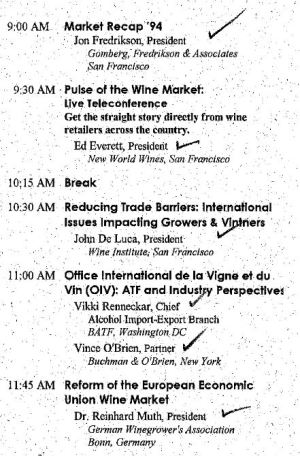
I have been involved with the Unified since 2012, mainly as moderator and/or speaker at the Wednesday morning State of the Industry session, the largest gathering of a three-day event. So I was interested to see what the equivalent program looked like at Unified I.

Jon Fredrikson was the lead-off speaker, giving a half-hour survey of market conditions. Knowing Jon, I’ll bet it was jam-packed with data and insights and that the audience hung on every word. Jon went on to be a featured speaker at almost every Unified meeting for the next 25 years until his retirement.

Jon’s lead-off presentation was followed by a teleconference that brought the voices of wine retailers into the room. This was not an easy thing to do in the landline era of the 1990s. Everyone wanted to know as much as they could about who was buying wine, who was selling it, and how the market looked for the future.

Globalization was obviously on everyone’s mind, too, as the next three sessions made clear, with a session on international trade effects, global perspectives, and how efforts to drain Europe’s wine lake might affect the American industry.

The Unified XXX State of the Industry lineup shows how the program has evolved to even more directly address the concerns of its wine industry audience.  Jeff Bitter and Danny Brager take deep dives into the trends and issues on the grower and consumer sides of the wine market respectively and Steve Fredricks analyzes the markets that connect them and the global market environment in which everything takes place. Susana Garcia Dolla, Director General of the Interprofesional del Vino de España, will provide an important international perspective, helping us understand how Spain’s wine sector has weathered the wine world’s storms and what lessons can be learned from their experience.

But Wait, There’s More!

There was a lot more going on at that first Unified meeting, of course. I am particularly struck by sessions titled “Monsters in the Closet: Major Issues Impacting Growers & Vintners” and “Government Landmines & Opportunities.” Monsters and landmines? Sounds like wine was a dangerous place! John Gillespie and Mike Boyd spoke on “Who’s Not Drinking Wine and Why?” — a question we are still asking today.

Unified XXX will feature a vast array of sessions (here is the complete schedule) that examine important issues in virtually every aspect of wine growing, production, distribution, regulation, and sales. Several sessions are offered in Spanish. It is quite a multi-discipline University of Wine.

A special treat this year is the Tuesday Keynote Luncheon. Karen Ross, Secretary of the California Department of Food and Agriculture, will be the featured speaker. Secretary Ross was President of the California Association of Wine Growers before taking her current job and in that role was instrumental in expanding the Unified into the impressive event it is today.

I am looking forward to hearing what Secretary Ross has to say about how the wine industry has adapted (and must continue to adapt) to the monsters and landmines that lurk around the corner. And to see everyone and learn as much as I can at Unified XXX.

Book Reviews: Wine Fraud, Klein Constantia, & Food Adventurers

Brief reviews of three new books that curious wine enthusiasts should consider.

Rebecca Gibb, Vintage Crime: A Short History of Wine Fraud (University of California Press). Reviewed by Sue Veseth.

As long as there had been wine, there has been fraud.  If there is money to be made, someone will figure out how to make it — and then how to make a little more, legitimately or not. Or, as Rebecca Gibb, MW, writes, “A splash of narcissism blended with greed makes for a toxic combination.” Gibb engagingly covers centuries of narcissism, greed, and wine fraud from ancient Greece and Rome to recent history, and efforts to root out and address fraud at all levels of the chain.

Gibb’s writing style reminded me in some ways of the style of another author and journalist I admire: Sarah Vowell. Gibb’s writing is light, breezy, and full of interesting content with contemporary references.

I started noting particular phrases from Gibb’s book that tickled me: a reference to Thomas Jefferson’s “inner wine nerd,” for example, and, in discussing Jefferson’s efforts to recover from a broken wrist, “… so he decided to do what we would all do when we are in pain: cross the Alps on the back of  a mule.” Another treat: using Bart Simpson to tell the story of Austria’s mid-1980s scandal involving diethylene glycol added to wine.

Make no mistake, however: behind the writing style is serious research, scholarship, and analysis. She digs into the numbers, sequences of events, historical context, and principal players. The chapter on the 1911 riots in Champagne — the subject of Gibb’s MW thesis —is particularly deep and wide.

No doubt, people will continue to commit wine crimes, likely with new technological tools, such as artificial intelligence. But, in the end, it all seems to come down to greed. The lesson from the 1983 movie Scarface may apply, as the character Frank Lopez (Robert Loggia) said, “Lesson  number one: don’t underestimate the other guy’s greed.”

>><<<

Joanne Gibson and Malu Lambert, Klein Constantia: The Home of Vin de Constance. (First Press Editions, distributed by Academie du Vin Library). Reviewed by Mike Veseth.

Wine is good, but wine and a story is better, so wineries everywhere love to tell their stories, often in the form of lavishly illustrated books. Sue and I have a love-hate relationship with winery books. We love to read them and look at the beautiful illustrations, but when we are on the road we fear that our winery hosts will give us copies of their books, which are typically large format, heavy from the glossy stock they are printed on, and nearly impossible to pack.

This new book about South Africa’s most famous winery conveniently arrived in the mail from the Academie du Vin Libaray and we were very happy to receive it. It is beautiful, of course, and tells this winery’s fascinating story with panache. Joanne Gibson focuses on the winery’s rich history while co-author Malu Lambert brings things up-to-date, showing the winery’s recent transformation into both a world-class producer and a wine tourism destination. A final chapter provided by the winery itself looks at the road ahead.

In a way Klein Constantia has grown into the reputation that its wines first established in the 17th century and that persisted through centuries. Once upon a time this signature wine was held in great esteem as one of the most desired wines in the world (and priced accordingly). The Constantia name rings in literature to signify opoulence, taste, luxury.

But, like South African wine in general, Klein Constania suffered from deep decline before rising again in the last 30 years. I was especially pleased to see the contributions of Duggie Jooste, who essentially resserected the winery and put it on the path back to prominence, and viticulturalist Ernst le Roux and winemaker Ross Gower who worked so closely with him. I had the pleasure of meeting Duggie’s son Lowell Jooste and Adam Mason, the winemaker who continued Gower’s work, on my first visit to South Africa. Both are prominently mentioned here.

Duggie Jooste and his team are the heroes of this fascinating story of rise, fall, and eventual rebirth spanning more than three centuries. Eventually the Jooste family realized they lacked the capital to take the winery to the next level and sold to the current owners, who have indeed taken that step and given us a wine, a place, and now this beautiful book that warmly honors its unique history.

>>><<<

Daniel E Bender, The Food Adventurers: How around-the-world travel changed the way we eat (Reaktion Books).  Reviewed by Mike Veseth.

I am pre-disposed to like books that take a global perspective (I guess that’s why I wrote Around the World in 80 Wines!) and I enjoy thinking outside the box, and trying to learn about wine by studying related fields.

So I could not resist Daniel E. Bender’s new book that looks at how around-the-world travel (think Jules Verne) changed the way we think about food. If travel could change food, maybe it could change wine? I was curious to start the adventure.

At first glance, the story is a bit discouraging. You want to hear that, if travel is broadening, then global travel is positively enlightening. But many of the early tourist circumnavigators, whether traveling over land or by ship, seem to become more parochial as the miles accumulate. Foreign food? Disgusting and sometimes even dangerous (don’t drink the water).

There are exceptions to the general rule that global travel tends to reinforce local prejudices about food in these pages. Ristafel, the Dutch-Indonesian colonial feast, always got high marks from travellers, we learn, although more for the elaborate service than for the food itself. And, zooming ahead to the jet age, the fake Polynesian experience of Trader Vic’s restaurants in Hilton hotel around the worlds was both ridiculous and ridiculously popular.  Both the ristafel and Trader Vic’s get full-chapter treatment.

Travel and exposure to foreign food, according to the accounts that form the base of Bender’s book, both open minds and palates and shut them tightly closed, which nicely illustrates Thomas Friedman’s theory that globalization is “everything and its opposite.”

Bender focuses on how these global tourists encounter foreign food, but wine appears frequently in the travel accounts. Not foreign wine, but the familiar European wines (and spirits) that the travelers brought with them. Indeed, alcohol seems to have fueled the commercial around-the-world travel industry. The Franconia, a tourist steamer with 356 passengers, typically left home port with 4000 bottles of whiskey, 4000 bottles of wine, 2800 bottles of Champagne, and 49,000 bottles of beer to be consumed during the circumnavigation.

I suppose the Franconia’s passengers were as suspicious of foreign drinks as they were of the disgusting, dangerous foods they encountered. No wonder they hurried back on board the ship each evening to eat and drink the familiar foods of home (as many cruise ship passengers do today!).

My reading of Bender’s book is that travel hasn’t made as much of a difference in food and drink as I might have hoped. Perhaps travel is too much of a surface phenomenon in most cases? Maybe migration is the more significant source of change?

It seems that the spread of food and wine cultures depends on personal experiences and relationships; the deeper those connections, the more significant the effects. Worth reflecting upon this as you contemplate your next foreign adventure.

Bolgheri and the Native vs Traditional Grape Variety Debate

There are hundreds of native grape varietals around the world. Italy has enough for Ian D’Agata to fill two substantial volumes:  Italy’s Native Wine Grape Terroirs and Native Wine Grapes of Italy.  Sometimes I think you could spend a lifetime enjoying just Italy’s native grape wines and never reach the end of the list.

Native grape varieties are almost everywhere threatened by invaders. “International” grape varieties such as Chardonnay, Cabernet Sauvignon, and Sauvignon Blanc, are thought to be easier to sell than native varieties with unfamiliar names. We tend to side with the underdogs in this fight, favoring native varieties that might otherwise fade from the scene. What a loss!

But that doesn’t mean that native grapes are the end of the story. Even in Friuli, home to so many indigenous grapes, there is a third category that are often called “traditional” grape varieties, such as Sauvignon Blanc and Cabernet Franc, which make excellent and even distinctive wines and have been planted locally for decades. Not native, to be sure, but no longer foreign, either.

Should we favor the native grape varieties because many of them are found only in a single place? Or is that unfair to the traditional grape varieties, which may have been planted locally for generations?

(I think I remember reading that there are a few wine regions in Europe where French-American hybrid grapes, which were introduced more than 100 years ago during the Phylloxera plague, are considered part of the traditional wine culture.)

A Waste of Time?

The native versus traditional grape variety question flared up a few months ago when Sue and I met up with a press group near Lake Garda in Northern Italy. All was quiet when we visited Lugana DOC wineries. Their distinctive wines were all made from Turbiana, a local variant of the native Trebbiano grape. But then we stopped at a couple of wineries in the Garda DOC, where several traditional “international” grape varieties are approved, and things changed a bit.

“This is a waste of time,” a journalist from Northern Europe proclaimed as he stared into his glass, which contained a very nice Chardonnay. My readers don’t care about Italian Chardonnay, he said, they only want to know about what is unique to this place, the native grapes.

I didn’t think it was a waste of time because learning about nice wines is almost always a good thing, but I admit I sometimes fall into a less extreme variant of this point of view, favoring native over traditional or international much of the time. But his strong reaction made me think. The vines for this wine had been planted by the winemaker’s grandfather and had helped support three generations of his family.  That seems pretty well rooted in terroir, don’t you think?

Bordeaux in Bolgheri

I am reconsidering this question right now because Sue and I have been sampling some red wines from Bolgheri. Bolgheri is located on the Tuscan coast in the under-appreciated Maremma region. The wines are the San Felice Bell’Aja Bolgheri Superiore and Podere Sapaio Volpolo Bolgheri. Coming from Tuscany, you would imagine red wines to be Sangiovese or even a “super Tuscan” Sangiovese blend.  But the Bell’Aja is 95 percent Merlot and 5 percent Cabernet Sauvignon. The Volpolo is 70 percent Cabernet Sauvignon and 15 percent each Petit Verdot and Merlot.

The wines were very different from each other (just look at the blends!) but the threads that connected them were intensity and elegance from bright acidity. If you are not familiar with Bolgheri wines, these blends will come as a surprise. How did this happen? And what should we make of them? (I won’t ask what my European journalist friend would have said!)

Bordeaux grape varieties came to the Maremma region on the Tuscan coast in the 1930s, according to Joe Bastianich’s account in his book Grandi Vini. That was about the same time that the swamps and marshes thereabouts were drained to fight malaria. Marchese Mario Incisa della Rocchetta saw similarities with Graves in Bordeaux in terms of maritime climactic influence and rocky soil, so a small amount of Cabernet was planted. The wines were meant for family and friends only, but word spread about a unique wine from a vineyard called Sassicia.

The family finally offered a small amount of the wine for sale in 1968 and Sassicia proclaimed the first “Super Tuscan,” which took the world by storm, inspiring winemakers in Tuscany and beyond to both raise standards and experiment with exciting new blends.

What is Tradition?

Sassicia was designated a simple vino da tavola because no appellation existed in Maremma for a wine with Bordeaux grape varieties. Indeed, when a Bolgheri DOC was first established in 1983 it designated white and rosé wines only. Red wines remained vino da tavola until 1994 when the DOC was amended to accommodate the sort of wines that define it today.

Bolgheri and its Bordeaux-blend wines are famous today and the best of them are treasured and collected.  I am not sure anyone would tell Bolgheri producers that it was a mistake to embrace Cabernet when the native Sangiovese was available.

Obviously, these wines don’t rely upon native grapes, but would you call Cabernet and Merlot “traditional” grape varieties here, or is it too soon? The first wines were planted about 90 years ago, the first commercial wines were made a little over 50 years ago, and a DOC was enacted for them less than 30 years ago. Italy is a land of long tradition. Bolgheri is young by comparison. Bolgheri’s timeline in this regard is more New World than Old World.

Perhaps, as Hobsbawm argued, tradition isn’t something that exists on its own. Maybe it is something we create to suit our needs.

Argentina Reconsidered: Malbec Red, Malbec White, & Exploring the Limits

A highlight of our first trip to Argentina in 2011 was a special lunch where we sampled wine after wine (paired with exquisite local cuisine), but none of the wines (until the very end) were Malbecs.

Our host, Andrés Rosberg, then President of the Association of Argentinean Sommeliers and a judge for the Decanter World Wine Awards, wanted to make a point. Argentina may be identified with Malbec wine. Malbec may be its signature wine grape variety. But Malbec doesn’t define Argentina.

I will paste the 2011 tasting menu at the bottom of this page so that you get a sense of the experience.

Argentina’s Many Faces

Sue and I have carried this lesson with us and we make every effort to spread the word when we can, highlighting the diversity of Argentina wines beyond Malbec and also the diversity of different Malbec wines, particularly the differences between higher- and lower-elevantion wines.

It would be impossible to recreate our experience in Buenos Aires, but we were able to reconsider stereotypes of Argentina wines recently thanks to sample wines from Grupo AVINEA , a leading Argentina producer. Grupo Avenia is probably best known here in the U.S. market for its popular-priced Bodega Argento Malbec, but in fact the group, like Argentina, has lots more to offer.

Our research extended over two evenings.  We make a point of tasting wine with meals because it is so much more realistic and, to us, revealing than the “sip, spit, and score” ritual of wine competitions.  Research assistants Bonnie and Richard joined us on the first evening for a series of three very surprising wines.

The first wine was the Artesano de Argento Organic White Malbec shown above. White Malbec? I think we were all afraid that it might be a sweetish blush wine like some White Zinfandels found on the market. But it was completely different. The grapes were picked early and the skins separated from the juice very quickly, resulting in a completely color-free wine that was crisp and refreshing.  The bottle was quickly drained. A hit!

Way South of the Border

The next two wines were from Grupo Avenia’s Bodega Otronia winery, which sources grapes from what is possibly the southern-most vineyard in the world at 45º 33′ S latitude. These are really extreme vineyards situated in the cold desert beside Lake Musters, in Chubut, Patagonia.

The 45 Rugientes Corte de Blancs was a fascinating blend of Gewurtztraminer, Pinot Gris, and Chardonnay, with layers of bright flavor and savory herbs. Sue and I have had blends like this from Northern Italy and they can be fantastic. A lot of attention was given to this wine. Hand harvested, fermented in concrete eggs and tanks, aged in a combination of oak and concrete. I really enjoyed it, but Richard prefered the White Malbec. Two very distinctive and unexpected white wines!

Then came the 45 Rugientes Pinot Noir, which was also delicious and unexpected. It was intense, with nice acidity and had a personality of its own, not Burgundy or Oregon or even Tasmania. Maybe it was the whole cluster fermentation that brought out extra fruit. Another hit.

There is actually quite of lot of Pinot Noir grown in Argentina, which might explain why Moët Chandon established its first New World sparkling wine outpost in Mendoza more than 60 years ago.

And Don’t Forget Malbec!

Later in the week Sue and I completed the project by pulling the cork on a bottle of Argento Malbec, but not the popular supermarket bottling. It was an Argento Single Vineyard Malbec from Finca Altamira. The wine was distinctive for its freshness and tart fruit, which in general sets apart our favorite Malbecs.

The bottom line from this research project? Argentina Malbec has a lot to offer and Argentina itself has much to offer beyond Malbec. Kinda makes you thirsty, doesn’t it? Thirsty to discover what’s next!

>><<<

2011 Tasting Menu

Breaded veal tongue stuffed with brie cheese & sundried tomatoes and piquillo peppers sauce paired with Chandon Cuvée Reserve Pinot Noir

Baby squid & pickled vegetables salad
Rutini Gewürztraminer 2009

Rabbit liver & spinach ravioli with mushroom stock
Ricardo Santos Sémillon 2010

White salmon with ajoblanco, almonds, roasted tomatoes, zucchinis & bean pods
Miguel Escorihuela Gascón Pequeñas Producciones Chardonnay 2009

Iced lullo, litchis, caramelized pumpkin seeds & yogurt foam
Rutini Vin Doux Naturel (Sémillon – Verdicchio) 2007

Allspice philo pastry, chocolate cream, apple, saffron ice cream & cardamom milk
Rutini Vino Dulce Encabezado de Malbec 2007


Will Success Spoil Marlborough Sauvignon Blanc?

Will success spoil Marlborough Sauvignon Blanc? That is the question that haunts the 50+ winery members of Appellation Marlborough Wine (AMW). Sauvignon Blanc, as everyone knows, is New Zealand’s signature wine variety and Marlborough is world-famous for the distinctive wines made there. Marlborough Sauvignon Blanc is one of the most powerful brands in the world of wine.

I have friends who don’t claim to know much about wine, but they know what they like. And what they like, they will tell you, is Marlborough Sauvignon Blanc. No wonder exports of the wine grow year after year (except when short harvests intervene). Here in the United States, it is one of the few bright spots in the market and its success has invigorated the whole Sauvignon Blanc category.

Kiwi World Domination?

Marlborough Sauvignon Blanc isn’t the next big thing. It is the big thing right now and has been for some time. I charted the rise of this distinctive wine more than ten years ago in the first edition of my book Wine Wars and even hallucinated (that’s what they call it when an artificial intelligence robot makes stuff up) about Kiwi SB world domination in Wine Wars II, which came out last year.

World domination? No, not really. But it is quite a success story and, ironically, therefore a cause for nervousness for some Kiwi producers. That was already apparent way back in 2004 when Sue and I first visited New Zealand. Some winemakers were trying to diversify their sales away from such a heavy reliance on Sauvignon Blanc while others doubled down on their cash cow, even going so far as to question plantings of Pinot Noir for fear that it might dilute Brand NZ.

There is concern today about New Zealand’s great Sauvignon Blanc success, but it is a bit different than in the past. The focus is on control of the very valuable Marlborough Sauvignon brand. You might think that the issue is foreign control because so many important Kiwi wineries are owned by international wine companies, but the issue is a bit different.

New Zealand’s Global Reach

France’s LVMH owns icon Cloudy Bay, for example. And Pernod Ricard has Brancott Estate, Church Road, Deutz NZ, and Stoneleigh in its portfolio. Treasury Wine Estates owns Matua. Gallo owns Nobilo and part of Whitehaven according to my sources. Kim Crawford, Monkey Bay, and Selaks all belong to U.S.-based Constellation. International investment has driven the wine industry’s expansion and provided built-in global distribution systems. As I argued in my books, the New Zealand wine industry is a product of globalization.

I can’t imagine such a degree of foreign ownership anywhere else in the wine world, but that’s not the main issue. No, the problem, as I understand it, is that so much Marlborough Sauvignon Blanc is exported in bulk, in those huge shipping container tanks. The wine is bottled in the receiving market. Much of it goes into private-label products that may or may not have the quality Kiwi producers desire. Some producers have written to me over the years that they feel they are losing control of their brand.

A case can certainly be made that bulk shipping makes sense for New Zealand wine. The carbon footprint of the wine is already there because of the long distance from the vineyard to the final buyer and this factor grows if the product is bottled in New Zealand before shipping. However, NZ bottling would be one way for local producers to better control the product chain and protect their brand.

Appellation Marlborough Wine

Appellation Marlborough Wine (AMW) is an association of Marlborough producers that was formed in 2018 “to safeguard Marlborough Wine, initially focused on Sauvignon Blanc, whose purity and flavour intensity has earned it a phenomenal global reputation,” according to the group website.

“With this global demand, comes the proliferation of players and a range of quality expectations, which can put this hard-earned reputation at risk. AMW has been established to safeguard Marlborough wine for future generations to enjoy and provide assurance to consumers who seek wines of provenance, authenticity and integrity.”

There are currently 53 AWM member wineries, including several of the “internationals” mentioned above such as Cloudy Bay and Whitehaven plus Clos Henri, Framingham, and others. It is an impressive list. The intent is to establish the AMW logo as an indicator of quality and authenticity that extends beyond the “Marlborough” geographic designation.

The criteria for the AMW designation include 100% Marlborough grapes, sustainability certification, and the requirement that the wines be bottled in New Zealand, which excludes the bulk-shipped, foreign-bottled wines discussed above, including private label products.

As I understand it, the concern is that the popular bulk-shipped products will define Brand Marlborough Sauvignon Blanc in a way that is detrimental to its long-term sustainability. This kind of threat always exists when a region is associated with a single “signature varietal,” and you can appreciate how the bulk shipping element adds to producer concerns.

A Tale of Four Bottles

I wonder if the AMW designation will catch on. The back labels on wine bottles are often very crowded with logos and certifications and a good deal of education effort is needed to make a new one like this an effective tool. This could be a hard sell. That said, I think Sue and I will be checking out the back labels of Marlborough Sauvignon Blanc wines in the future because a recent research tasting persuaded us that there might be something to learn here.

Sue and I were joined by research assistants David and Terri for a dinner and tasting featuring the four wines shown in the photo above. Three of the wines — Lawson Dry Creek Sauvignon Blanc, Mahi Sauvignon Blanc, and Astrolabe Sauvignon Blanc — were provided by AMW as examples of member products. I added a fourth wine to the mix: Kirkland Signature Ti Point Marlborough Sauvignon Blanc, which sells for about $7.49 at Costco. It is an example of the sort of private-label wine that AMW is a reaction to. I have heard that it is Costco’s best-selling private-label wine. In any case, it probably defines Marlborough Sauvignon Blanc for many consumers.

What did we learn at our tasting? The Kirkland Signature was a bit less punchy than I remembered, but otherwise, it pretty well fit the popular notion of a Marlborough Sauvignon Blanc. The three AMW wines, which sold for about three times the Costco price, were very different and very different from each other. There was subtlety and elegance and, to be honest, if you defined Marlborough Sauvignon Blanc by the characteristics of the private label wines (or the big brands like Kim Crawford), you might not have guessed they were the same grape variety or came from the same place at all!

A Plausible Hypothesis

Obviously, three wines cannot represent the more than four dozen member wineries and the Costco wine cannot represent all the different bulk-shipped products. So nothing was proved here, but I think we learned something. Certainly, there is a stereotype of Marlborough Sauvignon Blanc that the big-volume brands embody. But there is more to Marlborough than that. More different grape varieties. More different styles of Sauvignon Blanc.

The AMW initiative is thus worthwhile. Will it succeed? It won’t be easy to persuade consumers to look for the AMW logo on the back label. I suspect consumers will be converted one glass at a time.

Global Wine Glut: The Return of Crisis Distillation

Crisis distillation is back in the news. For those unfamiliar with this wine business term, crisis distillation refers to government programs that buy surplus wine and distill it into industrial alcohol. The point isn’t to increase industrial alcohol supplies but to support prices and incomes in the wine sector by taking excess supply off the market.

Crisis distillation has a long history in the European Union. You might remember that some countries authorized crisis distillation just a few years ago during the COVID-19 pandemic. Public health restrictions hit on-trade wine very hard in some places where producers rely heavily on bar and restaurant sales (a more significant factor in Europe than here in the U.S.). The crisis was short-lived, but distillation was a significant factor while it lasted.

Distillation was a persistent feature twenty years ago, however. EU price support programs encouraged the production of low-quality wines that were poorly suited to highly competitive market conditions. Distillation programs bought the surplus wine that resulted. It was an expensive way to stabilize wine-grower income and, for a while at least, it seemed like it would go on forever, getting more and more costly each year.

It was reported at the time that Britain’s Prince (now King) Charles had his Aston Martin configured to run on a grape alcohol-rich fuel blend. Plonk power! I wonder what other uses they found for the enormous quantity of distilled wine that was produced?

The distillation policy was changing when The Wine Economist first appeared back in 2007. I have inserted a column below that was first posted on Christmas Eve of that year, which I think you might find useful to read for perspective on the current situation. The combination of supply adjustment and demand-based policy reforms did in fact address the critical issues and crisis distillation slowly disappeared from the wine business lexicon.

Distillation is back, but things are very different today. This wine glut today is caused more by stagnant and falling demand than by high supply, for example. And the quality issue is different, too. Back in the 2000s, the issue was poor quality wines that were hard to sell at any price. As you can read below, one part of the solution was an effort to eliminate these wines and raise quality and marketability. These efforts (magnified by the market premiumization trend) have been relatively successful. Now Sue and I routinely encounter excellent wines from regions that only a short while ago were better known for plonk.

What was important about the policies I discussed back in 2007 was that they addressed the causes of the problems that the EU wine industry faced. Crisis distillation today treats the impact of today’s issues in terms of surplus wine, but the causes (and therefore, I suppose, the cures) have not yet been directly addressed.

Distillation buys time. Spend it wisely. Here’s that 2007 column.

>>><<<

Draining Europe’s Wine Lake

Wine Economist / December 24, 2007

Europe is afloat in a sea of bad wine and the European Union agriculture ministers agreed last week to do something about it. But is it too little and too late?

Marian Fischer Boel, the EU Agriculture Minister, proposed a number of fairly radical reforms in 2006 and these were the basis of the discussion. She wanted an immediate end to distillation subsidies and a vast program to encourage small winegrowers to pull up their vines — one million acres — replacing them with other crops or, in some cases, with more marketable grape varieties. Perhaps predictably, the policies agreed last week are much weaker than the original proposals. Distillation subsidies will be phased out over five years and as many as 400,000 acres of vines will be “grubbed up.” Four hundred thousand acres seems like a lot, but given the size of the problem is it, as Wine Spectator reported, just “a good start?”

Current EU policies are as useless as the old wine barrels shown above. At the top end of the market, national and EU policies tend to stifle innovation and prevent effective market adjustment (the counter argument is that they preserve tradition and prevent destructive commercialization). I have read any number of stories about high end European winemakers who have expanded abroad in part to escape regulations on what they can produce, where, and how they can market it.

In the mid-market, where current attention is focused, EU and national regulations seem to prevent winemakers from achieving the transparency that an increasing global market requires. It is hard enough to know what’s in a bottle of wine without the complicated rules that government European wine labeling. French wines are typically “branded” by place of origin, not grape varietal, for example. Buyers who are not confident about their French geographical knowledge and the relationship between place, grape variety and wine style, are likely to choose New World wines with more easily understood characteristics. Australian wines sell well in France partly for this reason.

At the low end of the market, EU policies designed to support farm incomes have produced the famous “wine lake.” Each year the EU spends about $2 billion to buy up unsold wines and turn them into industrial alcohol. This vast reliable market for poor quality wine keeps thousands of small scale producers in business. The distillation subsidy insulates low-end producers from market forces with the result that the vineyards remain uneconomically small, the practices favor quantity over quality, and the wine, while it may reflect local tradition, finds few buyers in the marketplace. Cheap New World wine is preferred to bad Old World plonk.

The new EU policies are designed to drain the wine lake by making the wine sector more responsive to market forces. Label laws and regulations will be reformed so that European wines can be sold by regional and grape varietal just like New World wines. The distillation subsidy will be phased out over four years, with some of the subsidy funds returned to regional groups to be used in wine marketing and promotion efforts. And up to 400,000 acres of vineyards will be included in the new “vine-pull scheme.” New plantings will be allowed over time, but they will be market-driven not subsidy-driven.

The top end of the market is unlikely to be affected very much by these policies, since by definition they already have established brands and distribution channels. New label laws and subsidy reductions will have few direct effects on these producers, although they may be able to gain indirectly as vineyard consolidation takes place and Australian-style brands grow in importance. I predict that the most visible early effect of the new rules will be expansion of European brands both at home and in export markets.

The clear gainers are the mid-market producers — the wines that sell for about $12. There is great potential profit in this part of the market, which is expanding rapidly in the New World. Freed from the constraints of tradition, European winemakers should be able to compete in this market quite well. It is, however, a hotly contested market segment. European producers will need to use their new freedom well to succeed and those who choose not to adjust may suffer as the European market realigns itself.

The real problem is at the bottom of the market. Losing the distillation subsidies will hurt many producers and I don’t know how enough about the cost-benefit of the vine-pulling schemes to comment. Pulling 400,000 acres out of wine production should help stabilize the market by reducing the annual surplus, but I don’t know if it is enough and I don’t know if the incentives provided are strong enough.

Four hundred thousand acres — how big is that? Huge if you are thinking New World — Australia had just 388,000 acres of vineyards altogether in 2003 according to my Oxford Companion. But tiny if you think Old World — and of course this is an Old World problem. Italy and France had more than 2 million acres of vines each in 2003. (The Languedoc region in the south of France has 528,000 acres by itself.) Taking 400,000 acres out of production in Europe is like removing Moldova and Switzerland from the market. The effect on the regions where the vines are grubbed up will be large, but the impact on the global market is likely to be quite small — reducing the global surplus, but not eliminating it. I don’t know if it will be enough.

Will it work? Much of the discussion that I have read focuses on the size of the vine-pull scheme — 400,000 acres versus the million acres that Marian Fischer Boel proposed two years ago. Although I think the size of the grubbing up program is important, I believe that the market-driven reforms and the elimination of distillation subsidies are more important. The 1988 vine-pull scheme took over a million acres out of production but, as we see today, didn’t eliminate the surplus because of the difficulty of selling the good wines and the incentives to keep make bad ones.

Economic Change and the Global Wine Glut

Last week’s Wine Economist probed two influential theories of the emerging global wine surplus that are based in different ways on demographic trends. I call them the “Generation Gap” hypothesis and the “Life Cycle” hypothesis. This week I present a tentative sketch of an economic theory that might also help explain global wine consumption rises and falls.  I am calling it the “Economic Transition” hypothesis for now, although I am not sure that’s the best description.

The Economic Transition hypothesis seeks to explain long-term trends in global wine consumption in terms of two interrelated forces: the changing economic function of wine and changing patterns of and expectations for economic growth.

Changing Economic Role of Wine

Wine is never just one thing, so it is not a surprise that its economic function may differ over time and space. If we zoom back 100 years and look at Old World countries, which are now and were then the largest wine consumers, the bulk of wine sold had a different purpose than most wines do today. Wine was a cheap source of calories for workers who could not afford a better diet.

Wine = cheap calories? There really isn’t a better explanation of the very high per capita levels of wine consumption reported by Kym Anderson and his colleagues in their Global Database of Wine Markets, 1885-2019 (Reference: Kym Anderson and Vicente Pinilla (with the assistance of A.J. Holmes), November 2017, revised and updated August 2021). France topped the table with average consumption of about 150 liters per capita, which is more than three times the per capita consumption today. Wine’s contribution to total caloric intake was very high and of course, the level of alcohol consumption associated with it was far from healthy. 

The Economic Transition

While Old World per capita wine consumption has been falling for 100 years, the chart above shows that New World per capita consumption has risen. The U.S., while still modest by per capita standards, is now the world’s largest market for wine. What accounts for these differences?

In the Old World case, I would argue that as incomes grew, especially in the post-WWII era, workers and their families slowly and then suddenly became able to afford better diets, and the old role of wine as cheap calories became less and less important. Wine, for these consumers, was an “inferior good” where demand fell as income rose and better substitutes entered the choice space.

I am tempted to call this situation the “economic transition” in tribute to the economic theory of the “demographic transition.” The demographic transition theory posits that once income reaches a certain point, poor families switch survival strategies from having many children (to increase the odds that some will survive to support them in old age) to making greater investments in a smaller number of children. My Economic Transition idea is that when income reaches a certain point, cheap calorie wine is replaced by a better diet and a smaller quantity of better wine.

Wine as Aspirational Product

By the time we pick up New World wine consumers in the second graph above, the economic role of wine has changed again. It has become a discretionary purchase and, for many consumers, an aspirational item in so far as it represents an important component in an elevated lifestyle. Magazines such as Wine Spectator and Decanter appeared in the 1970s and soon began to grow in popularity by presenting wine at the center of a luxury lifestyle that includes food, travel, and celebrities.

The Global Financial Crisis may have magnified an already emerging split in the wine market by further increasing income inequality. The gap between those who merely aspire to a higher lifestyle and those who can actually afford to enjoy it increased. This trend helped fuel the premiumization of the wine market as luxury sales grew faster than aspirational demand, which of course still grew faster than the “normal good” demand for wine as a quotidian beverage.

The wine market could have chugged along quite well, I think, with premiumization driven by aspirational purchases and luxury consumption, but the global economy has shifted and its momentum is fading. Stagflation seems to have hit every part of the wine market quite hard. Low-income buyers are really feeling the inflation pinch. Those dollar stores that focus on sales to low- and moderate-income families find themselves under pressure to cut prices and cut costs. Shoplifting is up, we are told.

Aspirational products in general suffer when economic conditions and expectations force consumers to rein in their aspirations. That’s one problem that wine faces today.

Luxury buyers are still there, but here again, the momentum has shifted. Only the very top luxury brands are doing well as buyers — even relatively affluent ones — shift their purchases down a step (or two). Want proof? See what kinds of cars you find at your local Walmart superstore.

Aspirational buyers are the biggest problem. Their purchases are based on both their living standards now and the lifestyle they expect in the future. With the global economy stalling and pandemic-era aid balances evaporating here in the U.S., aspirational buyers confront a reality check. This factor, I suspect, is very important in the collapse of wine buying in China.

Implications?

So this theory argues that changes in the economic nature of wine consumption combined with changes in patterns of and expectations for economic growth can help explain many important trends in global wine consumption, including both recent premiumization patterns and the sudden decline in purchases by aspirational consumers.

This economic theory obviously isn’t the whole story when it comes to explaining the global wine glut, and it intersects with the generation gap theory in some respects since many younger people are the “aspirational consumers” who find that economic conditions have taken away some of their hoped-for prosperity. They’ve cut back aspirations for wine (and home ownership and paying off college debt and …) as inflation and slow growth put on the squeeze.

Is this the whole story? Of course not. But it is important to consider that the economic decision to purchase wine (or not) is affected by economic conditions. The best thing for wine, in this framework, would be a return to a more prosperous global economy and that is not something the wine industry can accomplish on its own. So the wine industry has an enormous stake in efforts to bring inflation under control and return key economies to a stable growth path.

In the meantime, I suspect we will see even more consolidation in the wine sector, with large players expanding and fine-tuning their portfolios to prepare for future growth while small producers (and most wineries in the U.S. are very small) seek out aspirational and luxury buyers in local markets.

>>><<<

For a more thorough economic analysis of global wine trends I recommend a recent article by Rafael del Rey and Simone Loose. Here is the reference: del Rey, R., & Loose, S. (2023). State of the International Wine Market in 2022: New market trends for wines require new strategies. Wine Economics and Policy, 12(1), 3–18. https://doi.org/10.36253/wep-14758

Before you leave this page I’d like to draw your attention to one aspect of the two graphs above: global convergence. The top graph shows the trend of declining per capita consumption in traditional (a.k.a. “Old World”) wine countries (including Argentina and Chile) versus the rising per capita consumption in New World wine countries.  Note that the two graphs have very different scales, however. Rising New World per capita consumption and falling Old World consumption seem to be converging (with Portugal and to a lesser extent France remaining outliers).

Theories of the Global Wine Glut

The world is awash with wine, or so it seems from reading the news. Down in Australia, they are counting up the gallons of unsold wine in a new (to me) measure: number of Olympic-size swimming pools full. Rabobank estimates that the surplus would fill 859 big pools or, if you want a more conventional measure, about 2.8 billion bottles. That’s a lot of surplus wine.

In France, the government has allocated two hundred million euro for crisis distillation. Surplus wine will be bought up to support local prices, and then distilled into industrial alcohol. The next time you use alcohol-based hand sanitizer at your favorite Paris restaurant it might be based on wines from Bordeaux or the Rhone.

Rioja is swimming in wine, too, and here in the United States, there are big stocks of bulk wine for sale in California and thousands of acres of surplus vineyards in Washington state.

This Time is Different

Surplus wine is not a new thing. Wine is an agricultural product and so it is prone to the famous “cobweb” market theory that predicts periodic booms and busts. Turrentine, the California wine and grape brokerage, has cleverly adapted this idea to the wine sector with their “Wine Business Wheel of Fortune.” But this kind of surplus is relatively short term and what we see in the market today looks more permanent.

Sometimes government policies create wine gluts. This is a big part of Australia’s problem today, of course, as Chinese foreign policy has essentially cut off Australian wine from its biggest export market for several years. And the European Union’s famous “Wine Lake” was filled up by price support policies that encouraged over-production to stabilize producer incomes.

If wine surplus is not unusual, what is different about this time? Surpluses today are global not just national. And the driving force is primarily insufficient demand, not excess supply. Something’s changed to create a new global wine environment. What happened? It is a complicated situation, but I’ll try to scratch the surface in a helpful way today and in next week’s Wine Economist.

The Global Wine Glut in Perspective

The graph above (taken from the most recent OIV global wine market report) shows the volume of global wine consumption since 2000. Wine consumption rose steadily for the 20 years that ended with the global financial crisis in about 2007. This was the golden age of wine with many producers (think Argentina and New Zealand) entering global markets with great success and worldwide wine consumption on the rise.

The pause during the financial crisis was thought at the time to be a temporary phenomenon, but in retrospect, we can see that it was the start of what I have called “wine’s lost decade” with stagnant wine sales. The years of steady growth were no more.

Wine consumption fell during the COVID-19 pandemic period, but we expected it to bounce back when the health crisis passed. It hasn’t and in fact, global consumption has fallen back recently to levels not seen since the early 2000s. The picture looks different if we measure the value of sales not the volume of purchases because of the premiumization trend. But people are drinking less wine and less wine than we are growing.

Is there a general theory to explain what happened to global wine? There are lots of special theories that, in an ad hoc sort of way, try to explain individual circumstances. I’ve identified three general theories that help me think about this situation. I’ll analyze two of them briefly below, saving the third for next week’s Wine Economist.

Theory 1: The Generation Gap Hypothesis

The Generation Gap Hypothesis is much discussed here in the United States. The Baby Boom generation powered that long rise in wine consumption, the theory holds, but the following generations failed, for one reason or another, to engage with wine with the same ardor as their parents and grandparents.  Total demand cannot be sustained because younger drinkers have not increased consumption to replace the falling demand by boomers as they age.

The younger audience is just different, in this telling, and the task ahead is to introduce them to wine’s appeal through marketing or perhaps cultural education programs. In many wine countries, affiliates of an organization called Wine in Moderation are active to present the positive case for wine in opposition to prohibitionist forces.

It is difficult to organize a response to the Generation Gap problem because generic marketing programs are costly and not always effective (and wine producers and regions have strong incentives to invest in private promotion as opposed to generic programs).

The assumption that generations are fundamentally different leads to the uncomfortable question: Which generation is the anomaly? Are Boomers the norm and the problem is to get Millennials and others to get in line with them? Or, in fact, are Boomers a special case? Was that long wine boom the result of special circumstances? If so, how likely are those circumstances to reappear? Tough questions.

I think generational analysis is very useful in understanding the global wine glut, but it is important to be careful in drawing conclusions. I remember a university colleague of mine who cautioned his Asian Studies student to avoid popular “Asian Values” explanations of political and economic conditions in Japan, Korea, Singapore, etc. “Asian Values” can be twisted to explain anything that might happen, he told his students, so it isn’t valid on its own. Economic events ought to have economic explanations, too, and ditto political events.  That’s how I see the Generation Gap hypothesis.

Theory 2: The Life Cycle Hypothesis

The Life Cycle Hypothesis presents a very different theory of the global wine glut. The hypothesis holds that generations are more alike than different in many ways. In particular, the demand for wine remains latent until consumers reach a certain stage in their lives.  Millennials are just now approaching this stage and later generations are still in the queue. Wait for it, as Radar used to say on M*A*S*H, and they will discover wine.

This sounds like good news, but it really isn’t because post-Boomer generations are smaller and so, even if and when they find wine, there won’t be enough of them to replace Baby Boomer consumption levels. No use waiting for wine consumption to surge (and not much use in generic promotion, etc.). Supply adjustments are necessary and the sooner the better.

One question that the Life Cycle Hypothesis raises is why the big boom in wine sales only happened when the Baby Boomers came of age. Why didn’t previous generations get the wine bug before them? An answer is, of course, that Boomers represent a surge in the population curve, so anything they do has had a bigger effect, and the generations that immediately preceded them might have understandably had their normal cycle patterns interrupted by the Great Depression and World War II. So maybe the cycles will repeat as this hypothesis suggests, smaller than the Boomers but otherwise much the same.

An Economic Theory?

I find both hypotheses useful in understanding the global wine glut, but my Asian Studies colleague’s voice haunts me. I would be more satisfied if there were an economic theory to explain the economic fact of wine’s over-supply.

Come back next week for my attempt to provide an economic theory of the global wine glut.

>><<<

A book that I have found useful in thinking about generational analysis is The Generation Myth: Why when you’re born matters less than you think by King’s College London professor Bobby Duffy. Generations matter in Duffy’s analysis, but only when taken in context. Food for thought.

Labor Day Throwback: What to do with all that surplus wine?

The Labor Day weekend has just passed here in the United States and the wine grape harvest is picking up steam. This is always an exciting time of the year, but there is also anxiety this time around because in some cases the tanks are still full of wine from earlier vintages and the new crop, even if it is not unusually large, presents a series of problems.

Recent reports suggest that there is a lot of bulk wine available here in the U.S. market. Even bulk Cabernet Sauvignon is a tough sell because of over-supply. The surplus problem seems to be even worse in Australia, which suffers from many of the same problems as other global wine regions plus the consequences of lost sales to its previous top export market, China.

This situation reminds me of a Wine Economist column from pre-pandemic 2019 that still seems relevant today. Australian readers should read “Shiraz” in place of “Cabernet Sauvignon” to make more sense in your particular situation.

Six Things to Do with Surplus Cabernet Sauvignon Grapes

Wine Economist / July 30, 2019

The wine grape harvest is just around the corner in California and Washington State and, while that’s a great time of the year, it will present economic challenges to some winegrowers. There’s going to be an awful lot of Cabernet Sauvignon harvested this year. Most of these grapes are contracted, but some will be looking for buyers and it might not be so easy.

Cabernet has been the top choice for new plantings for the last several years and it is easy to understand why. It is a noble grape and can make terrific wine. Consumers love it, so growers have responded enthusiastically. The problem, as has been noted here before, is that wine demand generally has slackened just as new supply is reaching the market. For a few years at least there is likely to be a surplus of Cabernet Sauvignon in many regions.

In fact, the surplus is already here, or at least that’s how I read the recent reports from Turrentine Brokerage. Turrentine data show the highest level of Cabernet on the bulk market for many years. Add the 2019 harvest to the current market and you have a problem — not for everyone, but for those who are left with unsold grapes or wine.

Econ 101 Meets Yao Ming

What do you do when you have too much Cabernet? Econ 101 suggests price adjustment — cheaper grapes, cheaper wine, and so on. But there are limits to this strategy, especially since the lower price tiers of the retail market are in decline.

Export sales are another Econ 101 solution and certainly there is an opportunity here, especially if President Trump succeeds in talking the dollar’s exchange value down. But the president’s trade wars have had an offsetting impact on wine exports.

Countries that compete with us in the export markets, notably Australia and Chile, have aggressively sought out free trade agreements to boost sales. The U.S. has recently taken the opposite strategy. U.S. wines are therefore a tough sale today in many export markets including especially China, where Australian and Chilean wines find great success.

Yao Ming, the Chinese basketball legend, has trouble selling his signature Napa Cab back home because of 93% tariffs imposed in response to the Trump administration’s policies. If Yao can’t sell Cab in China, there is not much hope for the rest of us. Export markets are unlikely to absorb very much of the surplus Cab. Other options?

Searching for alternatives, I consulted the most recent Nielsen market figures in the current issue of Wine Business Monthly and found a few ideas to consider if you find yourself holding excess Cabernet this year.

#6 Two Words: Red Blends

Red blends are a useful market category because you can blend away unfashionable or surplus grape varieties without consumers necessarily noticing what’s up. Syrah and Merlot are not as popular as they once were as varietal wines, for example, but blend them together, call the result a Red Blend, and consumers snap them up. Cabernet blends would be very competitive at the right price. This market segment is fairly large but, unfortunately according to the Nielsen data, its growth has stalled a bit this year. That means we need to think about …

#5 Three Words: Sweet Red Blends

See “Red Blends” above but add some residual sugar.  I don’t have a lot of personal experience with these wines, but I see them everywhere. 19 Crimes, which tastes sweet to me, has a successful varietal Cabernet Sauvignon, so this is not uncharted territory. Even better, why not try …

#4 Rosé of Cabernet

Rosé is the fastest growing market segment in the Nielsen table. A lot of that Rosé comes from France, to be sure, but the market is large and fluid.  Picked at the right time, Cabernet makes a nice Rosé and in fact there are a great many produced both here in the U.S. and around the world.

As I noted here earlier this year, there are tricks to the Rosé trade to consider. Rosé is not that easy to make, since color is a concern, and can be tricky to sell because consumers prefer the most recent vintage and demand seasonality is a factor, too. If you like the idea of Rosé of Cabernet, then I think you will also like …

#3 Sparkling Rosé of Cabernet 

Take two fast-growing categories — sparkling and Rosé — make the wines from Cabernet  and you are ready to go. The only thing that could be better is …

#2 Canned Sparkling Rosé of Cabernet 

… because canned wine is also a thing (watch for a report here in the near future) and it is growing fast. Have you seen all the new canned wine displays in the supermarkets? Don’t dismiss canned wine too quickly.

Canned sparkling Rosé of Cabernet leverages three hot trends to use up your excess Cab. It is a perfect storm of wine. What could be better? And while you have the mobile canning equipment hooked up, you might consider …

#1 Canned Sparkling Cabernet + Black Currant Spritz

Seriously!

I am paying more attention to the canned wine displays and one thing I note is that canned wine spritz is generally right beside the other canned wines. These seem generally to be mixtures of wine, fruit flavors, and carbonated water. They sound refreshing and they have less than half the alcohol of regular wine. A Cabernet and Black Currant spritz sounds drinkable to me on a hot day, but you might prefer blackberry or some other fruit flavor that’s great, too..

Since the consumer segment that is interested in low alcohol products is growing, I can see how this trend might persist.  Something to consider.

Seems Like a Stretch?

Bottom line. The U.S. industry is going to need to find uses for its  excess Cabernet Sauvignon if the potential surplus materializes. These examples are ways to take advantage of the small number of growing wine market segments. If it seems like getting Cab products into these segments is a stretch, then it shows how much more pressure there will be on the traditional product markets.

I hope the market can absorb all the Cabernet that’s coming its way. Fingers crossed.

Wine and the Falling Dollar

There are good reasons why it has been a while since I last wrote about wine and the dollar’s foreign exchange value. A lot of things have shaken up the pattern of wine sales here in the U.S. market, especially the channel-shifting that occurred during the covid pandemic and uneven return to what we laughingly call “normal.”

Many factors shaped the pattern of international wine imports and exports, too, especially supply chain bottlenecks that saw the cost of container shipments zoom up by a factor of ten (when you could find a container) and have now settled back down to roughly pre-pandemic levels.

Falling Dollar, Bouncing Dollar

The exchange rate has been a factor in the wine market through all of this, but it wasn’t really the important factor in most cases. The dust has settled enough now, however, that we need to think about the dollar’s value once again.

Although the situation can vary from currency to currency, the overall trend for the U.S. dollar in the last year has been down (see the graph above of the USD versus the EUR). The dollar fell sharply through the end of January and has bounced up and down a bit but has been in a downward trend since then.

A cheaper dollar makes imports more expensive since each greenback buys fewer units of foreign exchange. U.S. exports benefit because a cheaper USD means a lower cost to foreign buyers. It takes a while for the impact of an exchange rate change to be felt, but if the change is sustained, the impacts eventually come around.

Falling Dollar in Perspective

What should we make of the recent dollar decline? One good source of analysis is the Economist magazine’s “Big Mac Index” of currency values. The clever folks at the Economist have found that comparing the local currency costs of Big Mac sandwiches in different countries can provide insights into exchange rate conditions. Some currencies are “overvalued,” which means that they buy more Big Macs (and other stuff) abroad than they do at home. Market forces should push these currencies down in relative value over time.

That, more or less, is the story of the dollar in the last year. The dollar’s relatively high value encouraged some Americans to travel abroad and those who stayed home to buy lots of imports because the dollar’s strength made foreign things seem cheap. Inevitably, as they sold dollars and bought foreign currencies, the dollar fell in value relative to those currencies.

The dollar’s fall is a bit surprising because U.S. interest rates have been rising steadily this year and that usually creates an incentive for foreign investors to buy up dollars, offsetting the trade effects. But many other countries have boosted their interest rates, too, so the investment impact is less than you might expect. Perhaps the combination of the downward overall trend plus the periodic interest rate increases account for some of the trampoline bounce shown in the graph at the top of the page.

Where does the dollar stand today? As of August 3, when the Economist report went to press, the dollar was about four percent undervalued compared to the Euro, so it is not unreasonable to expect a bit of a bounce. It was seven percent undervalued relative to the Argentina peso, but I suppose that is using the semi-fictional official exchange rate. There is a special cheaper ARS rate for wine designed to encourage exports and of course, the black market rate is even lower.

Incredibly, the official ARS-USD exchange rate, which was approaching 300 pesos per dollar when the Economist report went to press, is now hovering around 350 peros per dollar after a sharp devaluation in response to destabilizing election results. (The exchange rate on the street is nearly twice as many pesos per dollar as the official number.) The graph below shows how quickly conditions have deteriorated for Argentina’s currency.

Over and Under

If the exchange rate isn’t a big factor in U.S. wine trade with Europe (but probably is a factor encouraging imports from Argentina because of the special exchange rate), then what about the rest of the world? The Economist study suggests that Southern Hemisphere wine producers have an exchange rate advantage when exporting to the U.S. market because their currencies are undervalued.

The New Zealand dollar, for example, is undervalued compared to the USD by 9.7 percent. This makes their popular wines even more competitive in the Sauvignon Blanc category, which is one of the few parts of the wine market that has experienced growth recently. The Australian dollar is undervalued by ten percent.

Undervaluation is the flip side of overvaluation. The currency is relatively cheap on the foreign exhange market, so foreign buyers get a good deal, but imported goods and services are more expensive. Both sides of the coin involve trade-offs. You get cheaper imkports if your currency is overvalued, but better export performance if it is undervalued.

Chile’s currency is undervalued by 16.7 percent in the Economist study, with the number for the South African rand an incredible 49.7 percent. Such large currency distortions are potentially very important in parts of the wine market where cost differences are critical.

Export Market Impacts

The analysis above has focused on how the exchange rate affects U.S. imports of wine, but it is important to note that American wine producers also compete with foreign producers (who also compete with each other) for exports to other countries, especially the Eurozone and Great Britain. The value of major southern hemisphere currencies is so low, if the Economist analysis is correct, that the dollar needs to fall a good deal more to make American wines competitive abroad. That’s not likely to happen.

What does the future hold? In the long run, over-valued currencies should fall in value and under-valued ones rise. But lots can happen long before the long run arrives, so don’t hold your breath. I will check in again on this topic when the next Economist report is released.