Busting the Big Tank Myth: Durbanville Hills

dhwThere are easier ways to get to Durbanville Hills Winery than aboard a snorkel-equipped Land Rover, but I don’t think there’s a better way to go.

They brought out the 4×4 vehicles (snorkel-equipped — who knew? — so the engines can breathe even in deep water crossings) so that we could experience and appreciate the hills, the vineyards and the rugged terrain even before we came to the winery itself and the braai lunch that was planned for us there.

My visit to Durbanville Hills Winery started as adventure and became a learning experience about the diverse nature of wine in South Africa. Now it is also Exhibit A in the case against the One Big Tank myth that I wrote about last week.

The Big Tank theory is that giant wine and drinks companies with dozens of brands in their portfolios offer consumers the illusion of choice, not real choice. It’s as if all the different wines came out of one big tank.  Although there is a grain of truth in this idea, I think it is fundamentally bogus and Durbanville Hills is a case in point.

From Oom Tas to Nederberg Noble

Durbanville Hills Winery is part of the Distell drinks empire. As I wrote last week, Distell is South Africa’s largest wine and spirits producer and is a global power in several beverage categories. They superficially fit the Big Tank stereotype, but within their range of brands you will find choices over a wide range starting with very basic wines such as Oom Tas (described as “an inexpensive, dry, golden, unsophisticated wine of constantly good quality and taste”) and Kellerprinz (” an unpretentious, fun wine, its quality is nevertheless good and consistent, offering value for money”) and moving on up the ladder to the rather special Nederberg Noble Late Harvest wine I wrote about last year.

Durbanville Hills Winery is a relatively new addition to the Distell group.  The winery is beautiful in a modern way that does not seem out of place for its setting. The public spaces are welcoming, the restaurant gets good marks and you can’t beat the views looking out over the vineyards or on to the city. It looks like Distell has put a lot of time and money into the operation and the result is impressive.

Even Lettie Likes It

The wines are impressive, too. I especially liked the Sauvignon Blanc, which seems to do especially well in these hills. And the Pinotage is good enough to get a nod from self-confessed Pinotage-hater Lettie Teague, wine critic for the Wall Street Journal.

Durbanville Hills’ wines are distinctive (which runs counter to the Big Tank myth), but in fact the whole operation is unusual and not what you would expect from a “drinks company” winery at all.

Durbanville Hills was founded in 1999 as a partnership between Distell and seven wine farms in this region and the first wines were released in 2001. This area has a long history of wine growing — the youngest of the farms was founded in 1714 according to the winery website.

Triple Bottom Line

Distell’s representatives sit on the winery board, as I understand it, along with the farmer partners plus a workers’ representative. The wine farm workers have a 5% equity stake in the business that is administered through a trust that provides a number of social and economic benefits to workers and their families. Durbanville Hills was one of the first wineries to be accredited by the Wine Industry Ethical Trade Association. 

Cellar master Martin Moore is an enthusiastic promoter of a particular brand of sustainability that is sometimes called the “triple bottom line” approach (although he never used this term when talking with me). Businesses need profits to sustain themselves in the long run, of course, but economic sustainability doesn’t mean much if the environment is sacrificed (true for all business, but especially for wine), so you have to add that factor into the equation. And what are planet and profit without people? Communities must be sustained along with business and the environment. So true sustainability is the intersection of the three spheres of life taken together.

To quite intentionally organize a wine company around these values is a long term commitment and not the sort of thing that you associate with a corporation nervous about quarterly earnings reports. But it seems to me that everyone at Durbanville Hills is in this for the long run and the structure of the business is meant to keep it that way. It’s an impressive achievement and it makes a glass of Durbanville Hills wine a particularly satisfying drink.

Not Free Range

Clearly there are values and principles beyond a simple short-term profit motive behind the Durbanville Hills project, but they are usefully balanced with a sense of realism — you have to be pragmatic to make the triple bottom line work because this idea of business  isn’t about avoiding trade-offs, it’s about confronting them and making effective choices.

I saw this in a sort of sustainability manifesto that Martin Moore gave me at the end of my visit. Moore writes that, “We farm responsibly … not organic, not biodynamic … but sustainably.”  I think his point is that it is difficult to balance all three bottom lines if you swear off potentially important tools. “I would not even claim that we have free range vines,” he jokes, “as most of it is stuck in a trellis system.”

But I do believe that if we continue improving strengthening our 3 pillars of sustainable farming Durbanville Hills, our producers, our farm workers and community will hand over a successful business to the future generation without having to apologize.P1040576

Myth and Reality

Clearly Durbanville Hills Winery doesn’t fit the Big Tank theory and I think it is an indication that Distell and other giant wine and drinks companies are capable of offering wine consumers real choice — choice in both the wines themselves (which is the point after all) and in the entire wine experience.

It would be easy to make the case that Distell and Durbanville Hills are special cases. South Africa has a unique wine history that stretches back for hundreds of years and a unique social history, too, which motivates many there to address directly issues of race and inequality.

And then there is the Rupert family’s influence on Distell. If anyone understands the the benefits of product differentiation and avoiding a Big Tank syndrome, it is probably the Ruperts, whose broad holdings control many luxury brands including Cartier. They would certainly appreciate the business value of distinctive products compared with Big Tank uniformity.

Distell is a unique wine company in many ways, but I don’t see it as unique in terms of the Big Tank myth.  While I don’t deny that there are a few Big Tanks out there, in general I believe that even giant wine companies have strong business incentives to provide consumers with diverse choices (and even in some cases to take seriously the triple bottom line).

It is a sad fact that some of the great potential diversity of wine production does get filtered out by the logic of distribution and retail economics, and the vast scale and scope of the wine giants indirectly contributes to that problem. But, as I said in my last post, it takes a village to raise a child and it takes an entire supply chain to deliver diverse wine choices … or not. But it’s not just a Big Tank problem.

>>><<<

I realize that one example, even a really good one like Durbanville Hills, isn’t enough to bust a myth (n=1 is a pretty small sample size). But there are lots of examples if you only take off the “Big Tank” glasses and look around.

Thanks to Cellar master Martin Moore and Managing Director Albert Gerber for taking the time to answer all my questions at Durbanville Hills and Cape Wine 2012. The images up top are from the winery’s website.

The “One Big Tank” Myth

My recent post about How Much Choice Do Wine Drinkers Really Have? made the point that true diversity in wine choice is complicated. Although there are constellations of wine brands that are theoretically available, from a practical standpoint the choice available to you depends on your price point “comfort zone,” how you shop (on-line or wine club versus bricks and mortar stores), where you shop (local shop versus national chain store), where you live (state regulations vary enormously) and many other factors.

It takes a village to raise a child, they say, and it takes an entire product chain to raise up a diverse selection of wine … or not!

The Illusion of Choice?

A persistent concern is the influence of giant wine companies with dozens of wine brands in their portfolios. The conventional wisdom seems to be that these big firms merely create the illusion of choice, not choice itself. I guess the idea is that all of these different wine brands actually pour out of the spigot of one giant wine tank. If they all come from Gallo (or Constellation Brands or Treasury Wine Estates, etc.) then they must all be the same — or so similar as to make choice irrelevant.  I call this the “One Big Tank” theory and I think it’s a myth, although like all myths it contains a grain of truth.

The reality is that giant wine companies can and often do produce distinctive wines. And smaller operations sometimes pump out quantities of relatively terroir-free negociant wine to pay the bills. Size matters in wine, but it’s not the only thing. My motto is still “think global, drink local,” so I am not arguing against small terroir-driven producers, but I think at least some of the big wine companies have an undeserved poor reputation from the wine choice standpoint.

Giant wine companies have many advantages: access to capital, technology and vineyards, for example, and economies of scale in purchasing, distribution  and some aspects of production. What matters from the consumer choice standpoint is how these advantages are employed. You can aim to fill that one big tank as cheaply as possible or you can leverage the large scale advantages to create real quality and diversity.

Big Tank Stereotypes

A good example of how the myth unravels at least some of the time comes from my visit to South Africa. I was a guest of Distell for part of my visit (Distell owns Nederberg and I gave the keynote at the Nederberg Auction) and this gave me an opportunity to learn about the company, which is South Africa’s largest wine and spirits producer.

If you go strictly on stereotypes, Distell has got to be one of those “big tank” operations because it has most of the defining characteristics. It is, first of all, a “drinks company” and not a “wine company,” to use a distinction I first heard from a New Zealand winemaker (who worked for a “wine company,” of course). Here’s how the wine vs drinks dichotomy works.

Wine companies make wine (and only wine) and are often family owned. Drinks companies, on the other hand, manufacture all sorts of alcoholic beverages and are usually public corporations.  Whereas wine companies think tradition and  terroir, the story goes, drinks companies think marketing and product positioning.  Wine companies sometimes stay in the founding family’s control for generations. Drinks companies often get acquired, merged and traded back and forth like properties on a Monopoly board.

Distell fits the drinks company profile pretty well. It dominates the market for brandy in South Africa and is the leading wine producer, too. It is the world’s #2 producer of cider, another “drinks” category. Distell has strong international interests and owns  both a French Cognac house (Bisquit) and an Asian distributor. It has over 30 spirits brands in its portfolio and an even larger number of wines, wine apertifs, ciders and “ready to drink” beverages.

Distell is probaby best known in the U.S. for its Two Oceans and Fleur du Cap wine brands, but its hottest product is a cream liqueur called Amarula, “the Spirit of Africa.” It is the #2 best-selling cream liqueur in the world according to the company’s 2012 annual report.

Circumstantial Evidence

Distell also has a complicated business history.¹ The current firm was created in 2000 with the merger of Stellenbosch Farmers’ Winery and Distillers Corporation, but the history stretches back a ways. Key players include the South African billionaire Rupert family, which controls a diversified multinational business portfolio (they own the  Richemont  group of luxury goods companies, for example), the South African wine giant KWV and the big beer player SAB (think SABMiller — SAB stands for South African Breweries).

So, Distell fits the big tank  stereotype pretty well and some of its products have the classic “drinks company” profile, too. But the evidence that wine choice at Distell is an illusion is what Perry Mason would call “circumstantial.”  Can a “drinks company” like Distell offer consumers wines that give then a real choice and not just an illusion of choice?

Inside the big drinks company I found a good deal of counter evidence to the big tank theory. Join me in my next post as I climb into a snorkel-equipped Land Rover 4×4 and visit Distell’s Durbanville Hills Winery.

>>><<<

The top image is an historic example of a great big tank: the famous Heidelberg Tun, made in 1751, with a reported capacity of 220,000 liters. Here’s what Mark Twain had to say about it in A Tramp Abroad (1880). 

Everybody has heard of the great Heidelberg Tun, and most people have seen it, no doubt. It is a wine-cask as big as a cottage, and some traditions say it holds eighteen hundred thousand bottles, and other traditions say it holds eighteen hundred million barrels. I think it likely that one of these statements is a mistake, and the other is a lie. However, the mere matter of capacity is a thing of no sort of consequence, since the cask is empty, and indeed has always been empty, history says. An empty cask the size of a cathedral could excite but little emotion in me. I do not see any wisdom in building a monster cask to hoard up emptiness in, when you can get a better quality, outside, any day, free of expense.

¹ Most of what I think I know about Distell’s business history I learned from the company’s investor website and from Nick Vink, Gavin Williams and Johann Kirsten, “South Africa” in Kym Anderson (editor), The World’s Wine Markets: Globalization at Work (Edward Elgar, 2004).

How Much Choice Do Wine Drinkers Really Have?

galaxy2*

How much choice do U.S. wine drinkers really have? The answer to this question, according to a study by a group of Michigan State University scholars, is that it depends on how you look at the question and where you seek your answer.

The study is called “Concentration in the U.S. Wine Industry” by Phil Howard, Terra Bogart, Alix Grabowski, Rebecca Mino, Nick Molen and Steve Schultze and it follows up on previous research on concentration in the U.S. beer and soft drinks industries. (Click on the link to read the whole report and select the tabs you will find there to view the beer and soft drinks information.)

A Question of Perspective

If you look at the question in terms of the number of different wine brands on the market and varieties within each brand, then the answer is clear. U.S. consumers have a galaxy of choices when it comes to wine. I use the term “galaxy” because I’ve taken one of the key info-graphics from the report and doctored it up to look like an image of the stars in the night sky.  More wines than than there are stars in the universe — or at least it seems that way some of the time.

But click on that galaxy image above and you will open a window that shows how those wine stars are aligned. And I am sure that you won’t be surprised to see that there are several huge business “solar systems” with dozens of brands each: Gallo, the Wine Group and Constellation Brands among the producers, for example, and Deutsch and Winebow among the importers.

mktshare

*

The wine world has its share of Mega and Mini businesses and some of the Megas are very large indeed, although the degree of market concentration is much less in wine than in beer or soft drinks.  So if you look at wine compared to beer, for example (and I suspect that this would hold true for spirits, too), there is a very low level of concentration — lots of different choices even taking the biggest firms into account. And if you look at it in terms of number of individual wines for sale you get the same sort of answer. But if you look at the number of wine firms and the amount of the total wine market they fill, the choice seems a lot narrower.

As the graphic above suggests, the top 5 firms account for more than half of U.S. wine sales, which is a lot even if it is less than the corresponding figure for beer or soft drinks. Although the study does not provide any international comparisons, I believe the the U.S. wine market is much more concentrated than France, Italy or the U.K., for example,  but less so than Australia. (In the UK the critical concentration factor is at the retailer rather than the producer level since the big retail chains are so influential there.)

The degree of concentration also differs depending upon whether you look at all wine as this study does or segment the market according to price, which is the analysis I prefer. The market for wines selling for less than $5 per bottle equivalent is much more concentrated than the $20+ segment, for example. Most consumers make most of their purchases within a relatively narrow price range and it’s the diversity in that segment that matters most to them.

Location, Location, Location

The Michigan State team found that the nature of your choice also depends upon where you shop. Some of the supermarkets and wine shops that they surveyed in Michigan sourced their wine from dozens of different suppliers, providing that galaxy of choices that the vast potential selection promises. But other stores — national-chain convenience or drug stores, for example — can (and frequently do) quite easily fill a 100-item wine wall with products from just two or maybe three suppliers. The Megas can easily provide foreign and domestic selections of all the main varieties at every relevant price point. So choice is both smaller and different, if you know what I mean.

This has an impact on wines produced or imported by smaller firms, of course, and also (according to an interesting study by Rebecca  Mino) on local wineries.  Mino found that Michigan wines were far more likely to be available in Michigan-only retailers than at the Michigan affiliates of national retail chains.

These studies are very interesting and fun, too  — I admit that I played with the “galaxy” graphic for quite a while because I enjoyed seeing the business connections within the different wine portfolios. It is just fascinating — if you haven’t clicked on that “galaxy” image at the top of the page already you’ve got to do it now.

What’s the Right Way to Think About Choice in Wine?

But the main thing I appreciate about this research is the question that it raises: how should we think about choice when it comes to wine? Does that fact that some of the Megas have dozens of brands diminish choice? Certainly not if the brands have considerable autonomy when it comes to winemaking (like the “string of pearls” model that Ste Michelle Wine Estates follows).  Sometimes the vast perceived choice is real.

But that doesn’t mean that that there aren’t any effects of industrial concentration in wine, as the national chain store part of the study indicates. Some of the national retail chains treat wine as they do other products and attempt to minimize the number of suppliers while maintaining choice. Choice is diminished when the availability of “Mini” products and especially locally-produced wines is taken into account and  this would be a problem if these stores are the only choice for wine (as they may be in some areas). Apparently we need a mix of different retail suppliers to assure that the true diversity of wine is represented on the shelves.

>>><<<

Thanks to Phillip H. Howard for sharing his results and giving me permission to reprint some of the graphics.  Speaking of “it depends on how you look at it” questions, here is one of my favorite science videos — “Powers of Ten” from the Office of Charles and Ray Eames (1977). Enjoy.

Extreme Wine: Vineyard Edition

P1030341When I started working on my book on Extreme Wine  (due out in the fall) I asked Wine Economist readers for ideas. Who are the most extreme wine people, for example? I received many nominations but one particularly caught my attention.

It came from a California winegrower who asked that winegrowers (although not him/herself) be included on the list. Everyone says that wine is made in the vineyard — and some growers go to real extremes to make that happen — but it is the wine makers who get all the attention.  The Pisoni family was cited as an example. Fruit from Pisoni Vineyards goes into some of the best wine in California, although only a little of it is bottled under the Pisoni name.

Good point. A quick search on Robert Parker’s website turned up a long list of Pinot Noir and Syrah with the Pisoni Vineyards designation (Parker calls it a grand cru vineyard in one review).  The 2008 Pisoni Estate Pinot earned the highest score (98/100), but all the reviews were strong. Clearly there’s something special about this vineyard and the people who farm it.  I visited several extreme winegrowers in 2012 (most recently on Red Mountain). Here are three that illustrate different sides of the extreme winegrower phenomenon.

Serendipity

P1040073

As luck would have it, at about the same time I was having this extreme wine people conversation I received an invitation from Wine Yakima Valley to participate in a program they were organizing to help wine enthusiasts get to know several of the most noteworthy (read “extreme”) vineyards in the Yakima Valley AVA (which celebrates its 30th birthday in 2013). A perfect opportunity for me to do some extreme vineyard / wine grower research!

The Vineyard Tour Series highlighted the work of  four outstanding growers at Red Willow Vineyard, DuBrul Vineyard, Upland Estates and Boushey Vineyards. What a great opportunity. Each of these vineyards is famous for the quality of the wines made from its fruit and each is discussed in Paul Gregutt’s valuable book, Washington Wines & Wineries: The Essential Guide.

Gregutt knowingly breaks down Washington wine into grapes, AVAs, wine makers and wine growers. Boushey is one of his “grand cru” designates while Red Willow and DuBrul make “premier cru” in the top 20 list.  All these vineyards have interesting stories, but the DuBrul program was the best fit for my schedule.

Tough Love

I ended up spending a hot July afternoon at DuBrul, walking the vineyards with Hugh, Kathy and Kerry Sheils and gaining an appreciation of the unique terroir. This is how the Sheilses describe their site:

Our DuBrul Vineyard is situated on a basalt promontory with sweeping vistas in all directions.  The steep rocky south facing slope is composed of dissected terraces comprised of coalesced alluvial fan deposits primarily from the Ellensburg Formation.  The soils in the vineyard are made up of relatively thin loess (wind-deposited silt) over the more coarse-grained alluvial fan deposits.  The volcanic ash and heterogeneity of the rock types within the Ellensburg Formation add to the complexity of our terroir.

It’s hard land — literally. I think I remember Hugh saying that the spacing of the vines was partly determined by the lay out of the previous apple orchard there. The land was too equipment-busting tough to cultivate any other way, so they were forced to accept what they had to a certain extent. Wade Wolfe laid out the vineyard and Stan Clarke advised on the winegrowing — that’s as good a combination as you can get in Washington State.

The grapes are in high demand and are sold to only a few carefully selected customers — if you see the DuBrul Vineyard designation on a wine label you can expect something pretty special. So special that some of it is reserved for Cote Bonneville, the estate wine that Kerry makes.  The wines get high marks from the critics. At $200 the top of the line Cote Bonneville Du Brul Cabernet Sauvignon is the most expensive Washington State wine.

But DuBrul Vineyard isn’t about the money, it’s about the place and the particular geological forces that shaped it over the millenia and that shape what’s in your wine glass today. And, of course, it’s about the extreme wine people who have nurtured it.

History in a Bottle

P1030343

The first thing you see when you approach Larkmead Vineyards, which is located in Napa Valley up the road near St. Helena, are the 120 year old head-trained Tocai Friuliano vines planted in a block between a house and the road. Man, that’s history, I thought, as I surveyed these gnarly old vines and imagined the tenacity of the owner and the commitment to a less-than-fashionable Napa Valley variety.

I was right about the history, but wrong about the commitment to Tocai. Turns out the Tocai vines were kept through the years  in spite of  negligible market demand because they made such a darn fine hedge in the summer. Completely blocked out the road and its noise! Only in recent years did the winemaker decide to make lemonade out of the lemons. Now the unusual wine quickly sells out its tiny production each year.  (I was too late to try the most recent vintage. Sigh … maybe next year).

We came to Larkmead for the history (although not specifically for the Tocai Friuliano). Larkmead got into my head when I first read Jim Lapsley’s history of Napa Valley wine, Bottled  Poerty. The legendary Andre Tchelistcheff identifed the “big four” quality wine producers in the valley when he came to work here in 1938: Beaulieu (Tchelistcheff’s new employer), Beringer, Inglenook and … Larkmead.

Larkmead? I knew the wines were very good, but I didn’t appreciate the historical significance. I needed to find out more.

My curiosity was especially piqued because of what I knew about the other three wineries and the way that they fell into corporate hands and met different fates. Perhaps the saddest story (but with a happy ending) was Inglenook, which went from producing some of Napa’s best wines to being a lowly jug wine brand. Only recently, after years and years of effort, has Francis Ford Coppolla managed to bring the estate, its vineyards and the Inglenook brand back together to make excellent wines. Congratulations to him on this achievement.

We tasted with Colin MacPhail and Sonny Thielbar and enjoyed the wines quite a lot. But what I liked even more was the sense of history. Although everything about Larkmead is up to date, there’s a very strong sense of of identity here. The people at Larkmead know what they are –the stewards of the land — and who they are, too.  After talking, tasting and thinking a bit I realized that several generations of extreme wine people were necessary to preserve these vineyards and to sustain a particular vision of wine through all of Napa’s ups and downs. The Tocai vines that first caught my attention aren’t central to all this (as I secretly hoped), simply an unexpected reminder of how hard it can be for a vineyard and winery like this to stay true to itself.

Extreme Vineyard PersistenceP1040105

We visited Anne Amie Vineyards twice during our Willamette Valley expedition (I taught a class for the University of Pinot at the International Pinot Noir Celebration) — first to attend a casual food and wine reception and then again for a “magical mystery tour” seminar and luncheon.

We’ve been to this place on many occasions, starting about 30 years ago when it was called Chateau Benoit (after the founding family). We liked the wines then, especially the sparkling wines as I recall, and it has been interesting to watch the place evolve as the region’s wine industry developed. Much has changed. We called it Chateau Benoit (pronounced Ben-OYT) when we first visited because that’s how the founders said it, but I understand it morphed into a French-inflected Chateau Ben-WAH later on. And it 1999 it became Anne Amie when Robert Pamplin bought the operation and named it after his two daughters.

More than the name has changed — Pamplin has invested much energy into developing Anne Amie’s Pinot Noir program as you might expect in Oregon — but much has remained the same, including some of the original vineyards (which is where this story fits into today’s post). As we drove up the long road to the hilltop winery, we passed the original (1979) block of Muller Thurgau vines that produced the grapes that went into the wines we tasted on our very first visit.

It has taken a good deal of persistence to maintain these vines because they have faced a lot of challenges. The first is economic — there’s not much of a market for Muller Thurgau here in the U.S. It might make economic sense to pull them out and put in a more marketable variety.

And then there’s nature. The bottom of the hill gets pretty cold in the winter and these old vines sometimes suffer. And I think I remember that they’ve been hit with Phylloxera, but nursed along rather than grubbed up as you might expect.  I like the wine that is produced from these grapes — crisp and clean — but more than that I appreciate the extreme perseverance that is behind it. This particular Muller Thurgau vineyard is singled out for special mention in Wine Grapes by Jancis Robinson, Julia Harding and Jose Vouillamoz and it is easy to see why.

These three vineyards only scratch the surface of extreme winegrowing, but I hope they make the point that my anonymous correspondent suggested. If wine really is made in the vineyard as we all like to say then we ought to honor and celebrate wine growing as much as we do wine making. Here ‘s a toast to the growers! Cheers!

>>><<<

Thanks to Barbara Glover and Wine Yakima Valley for inviting me to take part in their vineyard program. Special thanks to Hugh, Kathy and Kerry Sheils for answering all my questions and sharing their wine growing experiences with me. More thanks to  Colin MacPhail and Sonny Thielbar at Larkmead and to Ksandek Podbielski at Anne Amie. Happy New Year to all!

Photos: Old vine Tocai block at Larkmead, Hugh Sheils at DuBrul, those old 120 year old Tocai vines once again, and the view from Anne Amie looking down the hill at the Muller Thurgau block.

The Scrooge Report: Holiday Wine Gifts

No wonder economics is called the “dismal science” — sometimes our rigorous analysis threatens to spoil everyone’s fun.

Take holiday gift-giving, for example. The conventional wisdom is that “it is better to give than to receive” and while there is some merit in this if everyone gives (so that everyone receives), I think you can probably see the collective action problem here. Only an economist (or maybe an excitable child) would point out that, strictly from a material accumulation point of view, there are real advantages in being on the receiving end!

A Badly Flawed Process

But it gets worse because some economists suggest that it may be better not to bother with gifts at all. Don’t give gifts, give cash. Or, better yet, keep the cash and spend it on yourself. Gift-giving itself is a badly flawed process. This Scroogish sentiment is in part the result of Joel Waldfogel’s famous article on “The Deadweight Loss of Christmas.” Waldfogel concluded that Christmas, for all its merriment, was actually welfare-reducing because recipients do not generally place a value on gifts that is as high as their cost. They end up receiving stuff they would never have purchased with their own money.

The cost of giving gifts exceeds the benefits, so gift giving is an economic drain. Dismal, huh?  Here’s how it works.

Your aunt paid $50 for the sweater that she gave you. How much would you have paid for it? $50? $45? $40? Well, the fact is that you had the option of buying it for $50 and didn’t, therefore you must not have valued it at the full amount. So its value to you is probably  less than what your aunt paid. But how much less?

Economists seem to agree that the best case scenario is that there is about a 10 percent average loss in gift-giving, which I call the “Santa Tax,” although the “yield” as reported by survey respondents varies a good deal. The National Retail Federation estimates that Americans will spend more than $550 billion on holiday gifts in 2012. If the deadweight loss rate is just 10 percent, that would be a $50+ billion Santa Tax this year. Yikes!

There are many problems with this way of calculating holiday giving gains and losses. It is pleasing to give gifts, of course, and this should be taken into account. But how much would you be willing to pay for the pleasure?  And would your pleasure have been less if you had just given cash? The efficiency loss might be less with a cash gift, but perhaps the pleasure of giving (and thus the incentive to give) would be diminished, too.

Santa Tax Wine Edition

Then we can argue about the size of the Santa Tax. Is 10 percent about right … or do you suspect (as I do) that it might be much higher, especially when you are buying gifts for people who are much older or younger or who have very different tastes or needs from your own? Have you ever received a gift that was 100 percent deadweight loss? If you are honest you probably have. But it’s the thought that counts, isn’t it? How big a Santa tax is too much?

Which brings us to the wine part of the problem. Doesn’t it seem like the Santa tax is probably even larger for wine gifts than for many other things? Most of us have experienced the deadweight loss when a bottle of wine that we’ve paid good money for doesn’t turn out to be worth what we’ve spent. So it is no surprise that the loss rate might be even worse when other people are doing the buying (and giving) for us.

Giving wine as a gift is risky (unless it is someone you know very well) because there are so many different choices and individual tastes differ so much. There are lots and lots of good wine  gift choices, of course, but it is easy to get caught in the Santa tax trap. I’m sure that a lot of holiday wine gifts miss the mark badly.

Maybe that’s why wine enthusiasts receive so many “wine gizmo” gifts instead of wine — but those gadgets are subject to the Santa Tax, too.  The New York Times‘s William Grimes recently complained about this problem.

Across the land, Christmas trees spread their fragrant branches over packages containing monogrammed Slankets, electric golf-ball polishers and toasters that emblazon bread slices with the logo of your favorite N.F.L. team.

But for some reason, the culture of wine and spirits provides especially fertile ground for misbegotten concepts like these. Year after year, it yields a bumper crop of inane but highly giftable innovations like wineglass holders that clip onto party plates, leather beer holsters and octobongs, the most efficient method yet devised for eight college students to consume a keg’s worth of beer simultaneously.

Tyler Colman, writing on his Dr Vino blog, singled out gifts of fancy automated corkscrews for particular criticism. You can probably think of some high Santa tax wine paraphernalia that you’ve either given or received yourself.

Beyond the Octobong: Wine Economist Gift Guide

OK, I suppose the octobong is out, but some of the wine gizmos that Grimes reviews in the article are sort of weirdly fascinating. I guess I can see why they are given as gifts (even though you might never spend your own money on them). So where does that leave us when it comes to wine gifts?

My first bit of advice is simple: don’t give a bottle of wine to friends or relations, share it with them. There is something about a shared experience that transcends a simple commodity transfer. (From a technical economics standpoint, I think sharing adds  some “public goods” elements to the deadweight loss equation that can cushion the Santa Tax loss). Trust me, from an economic theory standpoint, sharing is the way to go.

In fact the more I think about it the more I believe that sharing rather than giving is the key. Sharing a bottle of wine rather than just giving it may seem a bit selfish and is certainly more expensive (since time as well as money are involved), but sharing changes the game from transaction to relationship and this seems to me to be the essence of both the holidays themselves and wine, too.

More Gift Advice (and Shameless Self-Promotion)

Back to giving and receiving. Best gift to give a wine enthusiast? A copy of the new paperback edition of Wine Wars, of course. (Shameless self-promotion never takes a holiday).

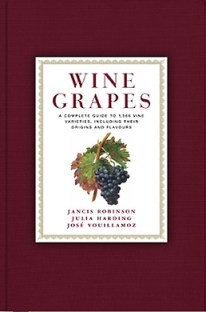
Best wine gift to receive? It’s gotta be Wine Grapes by Jancis Robinson, Julia Harding and Jose Vouillamoz — the brilliant 1242 page survey of 1368 wine grape varieties. So many grapes, so much information, such beautiful illustrations. This jeroboam-sized book will provide years of detailed research use (including very cool DNA analysis of wine grape origins!) and hours and hours of simple browsing pleasure for any curious wine geek.

Weight? Yes, quite a lot of it; 6.8 pounds shipping weight according to Amazon.com (although my copy feels light for its size). Deadweight loss? Forget about it!

>>><<<

Click here to view a pdf of Waldfogel’s original article, which appeared in the December (of course) 1993 issue of the American Economic Review. The illustration is of a certain Mr. Grinch, who may or may not have been an economist.  Happy holidays everyone!

Red Mountain: Think Global, Drink Local

Red Mountain is Washington’s smallest AVA and perhaps its most distinctive. This compact patch of dirt (see larger map below) has produced the grapes for some of the state’s most celebrated red wines. There’s a real sense of place in the wines according to critics, so the “drink local” part of this post’s title makes sense. But think global?

Well, yes. The wine world is very interconnected; international influences are surprisingly common and take many forms. A visit to Red Mountain (Sue and I were joined by research assistants Bonnie and Richard) revealed two of globalization’s many local faces.

The Italian Job: Col Solare

You might not expect to find one of the legendary names of Italian wine here on Red Mountain, but as you motor up Antinori Drive towards the beautiful winery at the top of the road the association becomes clearer. Col Solare (Italian for Shining Hill) is a joint venture of Tuscany’s Marchesi Antinori and Washington State’s Ste Michelle Wine Estates (SMWE). There has to be a story. Here it is.

It must have been about 20 years ago that Piero Antinori came to America, looking for a wine-producing partner. He wasn’t interested in making an American super-Tuscan. He wanted to do what he thought America did best: Cabernet. So, as the Ghost Busters used to say, “who ya gonna call?” if you want to make great Cabernet? The answer was obviously André Tchelistcheff, the legendary wine maker at Napa Valley’s Beaulieu Vineyards and consultant to many important wineries (including Chateau Ste Michelle).

P1040792

Where in America can I make distinctive Cabernet? Tchelistcheff knew what advice to give because in fact he had already given it to his nephew Alex Golitzin who founded Quilceda Creek winery, which makes some of Washington’s highest-rated Cabernets. Tchelistcheff’s advice to Antinori was much the same and resulted in the partnership with Ste Michelle Wine Estates and the Col Solare winery we see today.

The first wines, starting with the 1995 vintage, were made with grapes sourced from several Columbia Valley vineyard sites and produced at a nearby SMWE facility, but eventually the focus on Red Mountain grew stronger and the showcase winery was finished just in time for the 2006 crush. The estate vineyards radiate like the rays of the sun on the hillside below the winery.

The partnership has grown since that first step. SMWE is now the sole importer of Antinori wines into the U.S. market and in 2oo7 the two partnered again to purchase the Judgment of Paris champion Stag’s Leap Wine Cellars. Quite a successful partnership — you’ve got to believe that Tchelistcheff earned his consulting fee.

Col Solare is interesting to me because of the global-local connection. The wine is Cabernet-based, as Antinori wanted, but with a distinct Red Mountain twist, which means that it includes a little bit of Syrah in addition to the usual Bordeaux suspects since Syrah does so well here.

P1040817

Col Solare is an impressive achievement. Everyone we talked with on Red Mountain seemed glad to have them there. SMWE and Antinori are good neighbors, good customers for the local growers and good advocates of Red Mountain and its wines.

Red Mountain isn’t a first class wine tourist destination yet — the infrastructure needs further development and another couple of winery tasting rooms wouldn’t hurt either — but Col Solare is already a destination winery and worth the trip.

The Swedish Solution: Hedges Family Estates

Another destination Red Mountain winery, Hedges Family Estates, shows a different aspect of the local-global connection. Tom Hedges is a local boy, who grew up in the Tri-Cities area before the region became known for wine. He studied international business at the University of Puget Sound and then at the Thunderbird grad school in Arizona. I guess you could say that he got into the wine business through the side door — through the business side. Here’s how the Hedges website explains what happened next. 

In 1986 … Tom and Anne-Marie created an export company called American Wine Trade, Inc., based out of Kirkland, Washington State; they began selling wine to foreign importers. As the company grew, it began to source Washington wines for a larger clientele leading to the establishment of a negociant-inspired wine called Hedges Cellars. This 1987 blend of Cabernet Sauvignon and Merlot was sold to the Swedish Wine and Spirit Monopoly, Vin & Sprit Centralen, the company’s first major client.

So you could say that Hedges Cellars was created to satisfy a global demand. Soon Hedges was breaking ground on his Red Mountain estate. Today Hedges is the largest family winery in Washington and was instrumental in establishing the Red Mountain AVA.

It really is a family operations. Tom and his French-born wife Anne-Marie are proprietors, brother Pete Hedges makes the wines, Tom and Anne-Marie’s daughter Sarah is assistant winemaker and son Christophe is director of sales and marketing. The wine portfolio ranges from the Hedges Red Mountain estate wine (a Bordeaux blend, but with a bit a Syrah) to the popular CMS blends and the House of Independent Producers wines.

Taken together I think Col Solare and Hedges Family Estates show the local-global nexus at its best, bringing international attention and expertise  to local wines and taking those wines to global markets. We are often told that globalization suffocates local enterprise, but these wineries show that it can, in the right circumstances, breathe life into them.

P1040818

>>><<<

I can’t leave Red Mountain without mentioning two other stops we made that day. It was about time for lunch when we finished our visit to Col Solare and that can be a problem since I don’t think there are any restaurants on Red Mountain.  But we had planned ahead for a picnic and so we headed to Fidélitas, where we bought a bottle of Charlie Hoppes’ delicious Semillon and dined out on the patio overlooking the vineyards. Turns out we didn’t need to bring food — Charlie had arranged for a local barbeque food truck to be available for weekend visitors like us — nice touch!

Our next stop was the world’s best vineyard tour. Michael and Lauri Corliss (of Corliss Estates) had arranged for us to meet Mike McClaren and James Bukovinsky, who were working in one of  the Corliss Red Mountain vineyards just up the road from Fidélitas  supervising  the mid-October harvest. We spent the best part of two hours with Mike and James, visiting every nook and cranny of the complicated site, learning about the careful matching of grape variety and terroir and tasting the perfectly ripe fruit. A real taste of Red Mountain.

>>><<<

Thanks to Bonnie and Richard for their able assistance. Thanks to Wysteria Rush and Marcus Notaro at Col Solare and Tom Hedges and Deborah Culverhouse at Hedges Family Estates. Thanks to Michael and Lauri Corliss and Mike McClaren and James Bukovinsky for their hospitality.

Photos: (1) Col Solare winemaker Marcus Notaro (in his  classic Inter “Roberto Baggio” jersey), (2) the view down Red Mountain from Hedges, and (3) Mike, Tom and Richard in discussion at Hedges. You can see how tiny Red Mountain is on the map below.

Book Review: Italy in a Bottle (but maybe not what you think)

Grappa: Italy Bottled by Ove Boudin. (Originally published as Grappa: Italien på Flaska) Stockholm Text, 2012. Kindle download available here).

Any book that is subtitled “Italy Bottled” should be about Italian wine — right? The only question is which Italian wine? Italy has so many wines, so many wine regions and so many grape varieties that the question is maybe not so much which wine as it is which Italy?

So it comes as a bit of a shock to discover that this is a book about grappa, not wine, and since this is the Wine Economist blog, not the Grappa Economist or the Spirits Economist, I wondered if I would like it. Seduced as usual by all things Italian, I optimistically opened the e-book and began.

What a beautiful book — that was my first impression. The photos made me wish for a coffee-table sized physical book so that I could just drink them in. But I imagine that a physical book would be enormously expensive (Amazon lists the used 2008 edition of this book in hardback at prices that start at $320 and peak out over $500. Yikes! The e-Book is only $3.99.)  E-book it is, then, but this is definitely best viewed on a computer or tablet with a larger color screen.

Cool photos are nice, but it’s Italy after all, so you expect physical beauty. What about the book itself (and why would a wine enthusiast care)? 

Two Books in One

There are really two books here. The first can be thought of as a Practical Companion to Grappa because it really does tell you nearly everything you might want to know about this fiery liquid and in an interesting and informative way.

Grappa is closely related to wine because it is distilled from vinaccia, the grape solids that remain from the wine making process. The vinaccia residue from red wine is already alcoholic, since the skins and the juice were in contact during fermentation and can go straight to the distillery pot (fresher is better, the author advises). White wine vinaccia is alcohol free because the skins were whisked away before fermentation — these aromatic solids need to be fermented before distilling can begin.

The Wine Road to Grappa

So wine and grappa are related both in terms of raw materials (the grape varieties) and process, but there’s a lot more to the connection than this. Author Boudin assumes that you probably know very little about grappa, but that perhaps you know a bit more about wine and he exploits this fact. He defines the process of making grappa by  reference to wine-making, he talks about grappa terroir and he even outlines a grappa-tasting protocol that generally parallels wine tasting but is fundamentally different from it in some respects.

Grappa is tasted differently from wine because grappa is a different and much stronger drink with a different purpose. Wine tasting is performed on certain occasions or moments – for example when a new bottle is opened or when a glass of wine is served – and afterwards the wine is enjoyed. A grappa on the other hand should be tasted every time! At every intake of the bouquet, at each mouthful, at every swallow and at every taste sensation and association. Grappa is a complex sensory experience that simulates an inner-dialogue as well as a discussion around the table.

Good advice, I think if you want grappa tasting, not grappa drinking and grappa drunking. But good advice for wine drinkers, too. We shouldn’t take these precious liquids for granted. We should always taste (and enjoy)!

Unexpected Pleasures

The fact that Boudin’s insights about grappa often apply to wine is one of the unexpected pleasures of reading this part of the book. To pick an appropriate economic example, Boudin writes about the difference between artisan grappa and the bulk industrial product (a difference that exists in the wine world).

You might expect that he would praise the boutique product and condemn the manufactured commodity. But you would be wrong.

Some aficionados and purists (who only accept boutique grappa) are of the opinion that industrial distillers are a threat to the future of true grappa. However, both distillery schools have their different roles that in the big-picture presuppose each other’s existence.

The role of the industrial distilleries is to provide the world with grappa. Volume production and efficiency are key words here. Industrial-scale grappa is made from not only fresh grape skins, but also grape skins that have been stored for a period of time. Due to the production techniques, industrial grappa has a more neutral flavour. But industrial distilleries can still deliver a good, consistent-quality grappa. …

Customers have the right to know what they are buying. When, where, of what, by whom and by which method is the grappa made? Today, there are not enough labeling requirements to ensure that detailed information is consistently provided. The manufacturers themselves determine to a large extent what should appear on the bottle.

A declaration of goods of this kind would be beneficial for the smaller artisan distillers as they could lay claim to certain quality concepts as discontinuo (batchwise production). The industrial distilleries could offer this as they have the resources, the advantage and a global market. And a stronger focus on the quality of grappa would increases the interest in grappa and consequently the market.

This scenario would benefit all grappa producers.

Giro d’Italia / Grappa Edition

The second part of the book reports on a personal tour through Italy’s grappa heartland and it reads like what it is — a grappa enthusiast’s travelogue, complete with all the practical facts (I visited this town, stayed at this agritourismo, dined at this small restaurant, etc.) that you might expect. It is well written and useful if you want to follow in Boudin’s tracks, either for grappa or wine or simply for  pleasure.

I’ll admit that I didn’t read all of this part of the book. I only wanted to know one thing: Did he go to the hills outside of Asti and visit Azienda Rovero? Sue and I stayed with the Rovero family during our 2011 trip to Piemonte. We loved their wines and the local cuisine they served at the restaurant.  The grappa was great, too, but I ignored Boudin’s advice and didn’t taste it in all its fullness.

But I will the next time because of course he did go there and devotes ten pages to his experience. It sounds like it was one of the highlights of his journey.

Grappa: Italy Bottled is a beautiful book that will interest a wide audience that includes wine lovers. Highly recommended!

>>><<<

The photo above shows the chapel at the Rovero winery and distillery. Boudin had dinner there and so did we. Here are notes from our meal for your reading pleasure!

One highlight of our stay was a meal at the family restaurant, which is generally open only on weekends. Enrico’s mother prepared a menu of regional dishes that Enrico paired with Rovero family wines. It was the perfect way to learn about the wines — tasting them with the local Monferrato cuisine while talking with the winemaker about wine, wine markets and his plans for the future.  So you want to know what we ate, of course. OK, here’s the menu.

  • Two types of typical Piemontese salami crudo
  • Small puffed pastries stuffed with local cheese
  • Fried zucchini flowers
  • Soft herbed cheese
  • Salad of shredded chicken and radicchio in balsamic dressing
  • Zucchini and basil flan in an intensely rich Parmesan cream
  • Torta di fagiolini (green beans)
  • Tagliolini (thin, flat pasta) with peas and zucchini
  • Veal and roasted potatoes in a Barbera sauce
  • Panna cotta, bonet (chocolate panna cotta), and hazelnut cake

And the wines that complemented the meal:

  • Rovero Baptista (Riesling Italico)
  • Rovero Villa Drago (Sauvignon Blanc)
  • Rovero “La Casalina” (Grignolino D’Asti)
  • Rovero Spanase’ (Barbera D’Asti)
  • Rovero Nebbiaia (Nebbiolo Monferrato)
  • Rovero “Gustin” (Barbera D’Asti Superiore)
  • Rovero Rouve (Barbera D’Asti Superiore aged in French oak)
  • Rovero Brachetto (frizzante red dessert wine)
  • Rovero Calasaya (fortified Barbera D’Asti)
  • Rovero Ampolo Reserva 1998 (grappa made from Barbera)
  • Rovero Brandy (aged in barrel for 10 years)

Exaggerated Reports? Wine Writing and Wine Reading

“The reports of my death are greatly exaggerated.” – Mark Twain

This post is provoked by Andrew Jefford’s now-famous speech “The Wine Writer is Dead,” which he gave at a meeting of European wine bloggers in Izmir, Turkey last month. It’s a great speech, full of wisdom and insight — click here to read the written version on Jefford’s website.

Jefford’s title made me think of the famous scene in Mondovino (see video above) where Aimé Guibert declares that wine is dead (and cheese and fruit, too). It seems to me that Guibert’s obituary for wine was based on the fact that people try to make a living from wine in an increasingly global and competitive market environment and this changes things, although perhaps not as much as Guibert suggests since money and wine have always intermingled and it is foolish to pretend otherwise.

Jefford talks about the problem of making a living, too, and the changing writers’ market environment, but he doesn’t suggest that wine writing has lost its soul in the way that Guibert mourns the death of wine’s essence. Certainly it is difficult to earn a living writing about wine, especially with the decline in paid print-media jobs, he says. So wine writing has evolved into something broader — wine communications  — which seems to be about story telling in all its forms using all available media outlets.

“The world probably doesn’t need more writers … [but] the wine world will always …  need multi-tasking communicators …”.

I tend to agree with Jefford that telling stories about wine is much more than simply writing for print publications, but I wonder if wine writing has ever really been such a narrow and focused endeavor as he describes? He’s been at this longer than I have, so I suppose he is right, but my sense is that the his distinction between wine writing (RIP) and wine communicating is not so sharp as he suggests and that if wine writing has died it probably did so a long time ago.  In any case his point — that people who tell stories about wine should seize every opportunity to do so — is certainly well taken.http://www.twainquotes.com/exaggeration2.jpg

Is the Wine Reader Dead, Too?

I’m not really worried about whether wine writing is dead or alive. I’m more interested in wine reading, which I specifically do not define as reading about wine exclusively in paid (generally print) publications. Wine reading seems to be changing dramatically and that’s the more interesting  trend. Unsurprisingly, I tend to think about this in economic terms.

Economists who study the economics of food choice believe  that a key factor in  the growing consumption of high fat fast food is  cost — fast food is relatively cheap both in  terms of money and time, which are strong economic incentives. Even when healthier food is available and consumers understand something about nutrition the economic incentives push and pull them into the drive-through lane on the margin.

I think the economics of readership (and wine readership) works the same way. I’m not saying that writing on the internet is the intellectual equivalent of “empty calories, ” but the shift of readership from traditional print publications to electronic media is influenced by economic incentives (as well as other factors of course).

Electronic texts are obviously cheaper in terms of marginal dollar cost since most of them are available free on the web and even the electronic versions of books are often cheaper to buy than the print versions. And you can often access electronic documents in a fraction of a second rather than the minutes, hours, days or weeks that it might take to get a copy of a print publication. Fast beats slow in a time-constrained world just as cheap beats expensive when money is scarce. No wonder readership patterns are changing.

The shift is magnified by the technology associated with electronic publications — especially tablets and smartphones. I may have already told you about my university student who explained to me that he was going to do his senior year on his smart phone — all his reading and writing would be iPhone-based or not at all. He succeeded after a fact, which I found a bit shocking. Shifting from iPhone to iPad, I think he might succeed quite well today and there’s nothing shocking about it.

Follow the Money, Deep Throat Advised

Reading has always been as much affected by economics as writing. Imagine the chaos created by the introduction of paperback books in the 1930s (or read about it here).  Some observers predicted that paperbacks would be the death of the traditional book world, but in fact it seems that they ended up creating more readers and therefore more writers, too.

Follow the readers. This seems like good advice and I think it is Jefford’s’ point as well. The readers (and viewers and listeners) are shifting, responding to technological change and the altered economic incentives they confront. Writing has to do the same in order to stay relevant, and if a certain idea of wine writing (or writing in general) is a victim of the changing times I think we have to accept that and move on. Joseph Schumpeter called this sort of process creative destruction and we need to take account of what has been created as well as what is lost. Jefford understands this, although he doesn’t put it quite this way, which is why I recommend his talk to you.

It seems to me that there are probably more wine readers today than ever before in history, which is good news for wine writing, however you define it. As Mark Twain might have said, reports of its death are exaggerated.

>>><<<

Paperbacks then, Kindle today?

Can Chile Break Out of the “Value Wine” Trap?

First of all let me say that I have nothing against wines that are good values. We all struggle to find wines that pass the “is it worth it?” test and Chile has for a long time been a reliable source of wines that answer this question in the affirmative.

But it is in Chile’s interest to be seen as more than just a good value supplier. So I was very interested when Wines of Chile asked me to participate in a blogger tasting stressing Chile’s terroir. I think that an emphasis on distinctive terroir is just what Chile (and Argentina and South Africa) needs to attract wine enthusiast consumers and clearly differentiate themselves from the bulk wine pack.

The Terroir Two-Step

Establishing a reputation for terroir requires two things. First, you have to actually have terroir, which is to say wines that really are reflections of particular and distinctive winegrowing regions or sites. And, second, you need to be able to communicate this to consumers. Absent the first factor it’s just marketing. Absent the second it’s an exercise in futility from a wine economics standpoint.

Wines of Chile provided us with a dozen wines (see list below) — three each Sauvignon Blanc, Pinot Noir, Carmenere and Cabernet Sauvignon — and the opportunity to participate in an interactive video conference with Chilean winemakers hosted from Santiago by Fred Dexheimer (click here to view the video). I found the video conference to be very helpful and informative — the best yet! — both in terms of matching faces to wines and especially in unlocking details of the particular vineyard sites through Dexheimer’s probing questions.

Listening to the winemakers talk, it dawned on me that the rapid improvement in Chilean wines over the last decade derives from two sources. Improved winemaking is the first factor and the one that gets the most credit in discussions, but increased attention to matching particular varieties of wine grapes to particular sites is the under-rated other. This may be especially true for Carmenere, which was planted very widely back when it was mistaken for Merlot but that now is receiving more specific attention.

Taste the Terroir?

I organized two extended tastings to see if we could (1) detect the differences in terroir by tasting the wines and (2) find a terroir story in the wine marketing materials, especially the labels.

Sue and I were joined by Pierre, Cynthia, Patrick and Grant to taste the Sauvignon Blanc and Pinot Noir and by Ron and Mary for the Carmenere and Cabernet Sauvignon. I was especially interested in what university students Patrick (who wrote a paper on Chilean wine) and Grant (who studied abroad in Burgundy) would say about the wines. Here’s what we learned

The Sauvignon Blanc and Pinot Noir tasting was very interesting. The wines were well chosen both to highlight differences — differences between the Chilean wines and those from other countries and differences among the wines themselves. Our reference point for New World Sauvignon Blanc is Marlborough and these wines avoided the “me-too” trap, presenting styles somewhere between New Zealand and France. Our reference point for Pinot Noir here in the Pacific Northwest is Oregon and the Chilean wines were very much darker and riper — so much so that Patrick wondered if he would recognize them as Pinot in a blind tasting.

All six of the wines at the first tasting came from cool climate sites, where altitude or ocean influences (or both) affected growing conditions. We could easily detect differences between the wines, but I will honestly say that we struggled to connect them to the variations in terroir. Some of the wines helped us a bit by providing detailed information about the viticulture on the labels, but some focused more on the winemaking rather than the terroir.  This was a very successful tasting in terms of quality of the wines themselves, but it left some questions unanswered.

The Mythbuster Test

The story was much the same for the Carmenere and Cabernet tasting. We enjoyed the wines a great deal, especially with food (tasty pampeana  empanadas), and some  wines were even better on the next day.  Each flight presented real differences in aroma, flavor and style, showing the diversity of Chilean wines at these price points.

Once again, however, we had mixed results in searching for the terroir connection. Some of the wine labels made a point to provide specific information about vineyard site and growing conditions, so the link between terroir and what was in the glass was quite clear. Other wines didn’t highlight terroir as much as history or winemaking techniques. A couple of the labels were printed in type so small or light that it was nearly impossible to know the marketing message (this particularly annoyed Sue, who is an inveterate label-reader). My trusty magnifying glass got a good workout trying to read the details.

Confirmed. Plausible. Busted. These are the available options on the Discovery Channel’s hit show Mythbusters. I think our tasting panel was a bit divided in reaching a verdict about Chilean terroir. At least two tasters came to a “Busted” conclusion. They just couldn’t find the link they were looking for between the wines and their terroir and their advice to Chile is “don’t give up your ‘good value’ market position.” Most of the rest of us believed that it was “Plausible” that the distinct differences between the wines was due to different terroirs, but the connection was not strong enough or clearly enough explained to arrive at a “Confirmed” conclusion.

If the terroir story is important (and I think it is if Chile is going to upgrade its market position), then the wineries need to do a better job making the connection. I think Wines of Chile has provided a very good foundation, but the individual wine brands should take better advantage of the opportunity to promote the terroir factor. The labels of the San Pedro 1865 Sauvignon Blanc and the Carmen Gran Reserva Carmenere get high marks for their terroir message, although the Carmen’s tiny type was difficult to read.

The Los Vascos “Le Dix” didn’t even try to tell a terroir story — the focus was all about selecting the very best lots and blending them. But it was a terrific wine — Ron’s favorite, I think — which suggests that while terroir is important, it isn’t (and shouldn’t be) the only distinguishing characteristic.

Can “terroir wines” help elevate Chile’s international wine reputation? It’s a plausible proposition, but like most initiatives the key will be execution, especially coordination between Wines of Chile and key producers to provide wine enthusiasts with a clear and consistent message.

>>><<<

Vina Casablanca Nimbus Single Vineyard Sauvignon Blanc 2012 Casablanca Valley

100% Sauvignon Blanc / SRP: $12.99

 San Pedro 1865 Single Vineyard Sauvignon Blanc 2011 Leyda Valley

100% Sauvignon Blanc / SRP: $19.00

 Casa Silva Cool Coast Sauvignon Blanc 2011 Colchagua Valley

100% Sauvignon Blanc / SRP: $25.00

 Emiliana Novas Pinot Noir 2010 Casablanca Valley

100% Pinot Noir / SRP: $19.00

 Cono Sur 20 Barrels Pinot Noir 2009 Casablanca Valley

100% Pinot Noir / SRP: $32.00

 Morandé Gran Reserva Pinot Noir 2009 Casablanca Valley

100% Pinot Noir / SRP: $17.99

 Concha y Toro Marques de Casa Concha Carmenere 2010 Cachapoal Valley

100% Carmenere / SRP: $22

 Carmen Gran Reserva Carmenere 2010 Apalta- Colchagua Valley

95% Carmenere 5% Carignan / SRP: $14.99

 Koyle Royale Carmenere 2009 Colchagua Valley

85% Carmenere 8% Petit Verdot 7% Malbec / SRP: $25.99

 Ventisquero Grey Cabernet Sauvignon 2009 Maipo Valley

94% Cabernet Sauvignon 6% Petit Verdot / SRP: $29.00

 Maquis Cabernet Sauvignon 2010 Colchagua Valley

100% Cabernet Sauvignon / SRP: $19.00

Los Vascos Le Dix Cabernet Sauvignon 2009 Colchagua Valley

85% Cabernet Sauvignon 10% Carmenere 5% Syrah / SRP: $64.99

>>><<<

The photo shows (clockwise from top left) Grant and Patrick, Cynthia and Pierre, Mike’s magnifying glass and Mary and Ron. Thanks to Sue for the photos. Thanks to Wines of Chile for the wines and supporting material. Thanks to my research assistants for their feedback on the wines and marketing strategies.

Thanksgiving Leftovers: Black Friday Wine

It’s the time of year when wine writers give advice about what to serve with Thanksgiving dinner. The wine of choice here at The Wine Economist will probably be Pinot Noir that I received in friendly books (Wine Wars) for bottles exchanges with the winemakers themselves: a 2007 Boedecker Cellars “Athena” from the Willamette Valley in Oregon and/or a 2010 Paul Cluver Pinot Noir from Elgin in South Africa. I think they will be delicious with the traditional turkey and fixin’s.

What’s the best part of Thanksgiving? Leftovers are the best part for many of us. Hard to beat the turkey sandwich that you enjoy the next day when the cooking (and clean up) are done. And for some people the best part of Thanksgiving isn’t Thanksgiving at all — it’s the day after, which we ominously call “Black Friday” in the United States.

Here, in the flexible spirit of the holiday, is a leftover column about Beaujolais Nouveau and  Black Friday, reprinted from The Wine Economist November 23, 2009. Enjoy!

A Wine for Today’s Thanksgiving?

Although the United States is not the only country to set aside a day for giving thanks, we like to think of Thanksgiving as our distinctive holiday. It was conceived as a day for deep reflection, but Thanksgiving has evolved into a long weekend of over-consumption and discount shopping. Some of my friends really prefer to celebrate Black Friday, the day after Thanksgiving, when the holiday shopping season formally begins and retailers find out if they will be “in the black” for the year based upon early sales data.

If you plan an Old Time giving-thanks Thanksgiving, then [Beaujolais] Nouveau is not for you. It is not an especially thoughtful wine. It is a sorta soda pop wine; if wine were literature, my friend Patrick points out, Nouveau would be the  trashy paperback novel you read at the beach. Nothing wrong in that — everyone needs an escape once in a while.

The grapes for Nouveau are picked in late September or thereabouts and the only thing that prevents instant sale is the necessity of fermentation and the mechanics of distribution.  It’s still a bit sweet when it’s bottled and sometimes a bit fizzy, too, when it arrives with great fanfare on the third Thursday in November (a week before Turkey Day). Best served cold (like revenge!) it is the ultimate cash flow wine.

Black Friday Wine?

Nouveau is not very sophisticated, so why do the French, who otherwise are known to guard their terroirist image, bother with it? The Beaujolias producers make very nice ordinary (non-nouveau) wines; character complexity, you can have it all and for a surprisingly low price.

Ah, but that’s the problem. Sitting close to prestigious Burgundy, the Beaujolais cannot command high prices for their wines, good as they are, so they must try to make money through turnover more than markup. They churn out millions of bottles of Nouveau to pay the bills.

At the peak of the bubble in 1992 about half of all wines made in Beaujolais were Nouveau. The proportion remains high even today. Ironically, Nouveau often sells at prices as high as Beaujolais’ more serious wines because it is marketed so well. So it is hard to see why you’d want to buy it instead of the region’s other wines. It’s easy, on the other hand, to see why you’d want to sell it.

Beaujolais Nouveau, it seems, is France’s Black Friday wine! If the makers can sell their Nouveau, then maybe the bottom line for the year will be in the black. If the Nouveau market fails, well that red stain on the floor won’t be just spilled wine.

More than the Usual Urgency

Nouveau is therefore generally marketed around the world with more than the usual urgency (just as those Black Friday sales seem a little desperate at times) — and not just because young wines hit their “best by” date pretty quickly. This year things are even more stressful than usual, as you might imagine, with the economic crisis still on everyone’s minds and 10+ percent unemployment here in the United States. [Editor note: the unemployment rate is lower today than in 2009, but the weak economy is still an issue.]

Nouveau is usually distributed around the world via expensive air freight rather than more economic sea transport in part because the short time between harvest and final sale makes speed a factor. This year [2009] Nouveau was bottled in plastic for the Japanese market in part to lower shipping cost — a controversial move that may not be repeated because of its negative product image potential.

Intentionally choosing to adopt a more casual image, Boisset put all its US-bound Nouveau in screw-cap PET bottles, with a resulting 40% reduction in shipping cost. [Note: the PET bottles were not a great success with tradition-bound Thanksgiving consumers and Boisset switched to lightweight glass bottles for Nouveau in later years.]

Here’s a fun video from 2005

An American Wine?

Sweet, fizzy and packed in PET bottles — Beaujolais Nouveau sounds like the perfect wine for American consumers brought up on 2-liter jugs of fizzy-sweet Mountain Dew and Diet Coke. If you were kinda cynical, you would think Nouveau was an American wine … made in USA.

And it is, in a way. Although the wine obviously comes from France (and there is actually a long tradition of simple and fun early-release new wines in France and elsewhere), I think it is fair to say that the Nouveau phenomenon is an American invention.

W.J. Deutsch & Sons, the American distributors, really put Beaujolias in general and Nouveau in particular on the U.S. wine market map when they became exclusive distributors for Georges Duboeuf some years ago. They took this simple wine and made it a marketing event. To paraphrase an old Vulcan proverb, only Nixon could go to China and only the brilliant Deutsch family could sell Nouveau!

In fact they were so successful that they partnered with another family firm — the Casella family from Australia — and created a second wine phenomenon tailored to American tastes: Yellow Tail!

So although Nouveau is an American wine of sorts and might be perfectly crafted for this American holiday as we actually celebrate it on Friday, I’m going to pass this year (on Thursday, at least) and see if I can nurse some thoughtful reflection from my holiday glass [of Pinot Noir!] instead. Cheers, everyone! And thanks.

>>><<<

Thanks to Athena and Paul for the nice wine — hope you enjoy Wine Wars!