American Wine Laws: Time for a Change?

No food for sale in this NYC Trader Joes. No wine for sale at the Trader Joes next door.

Only in America? You can't buy food at this NYC Trader Joe's wine store. And you can't buy wine at the Trader Joe's next door.

A European visitor pulled me aside recently to complain about American wine laws, which considerably restrict the what, where and how of wine sales and consumption compared to more relaxed European practices.

“I thought there was separation of Church and State in America,” he said, showing that he hadn’t forgotten what he learned in Civics class years ago as a high school exchange student in Cleveland. He put the blame for America’s wine parochialism squarely on the influence of conservative religious groups.

Church and State vs. Special Interests

Religious groups are political powerful, I told him, and they no doubt have had some influence on the development of America’s wine laws. But that’s not the reason the laws don’t change, I said. It is the interests of those who gain from the current set up. He wasn’t convinced. He seemed to think that a moral explanation was inherently more persuasive (or more American?) than an economic one. But I still think I’m right.

My explanation — that economic forces organize around any set of regulations, become entrenched and use their political and economic clout to prevent change — has a good economic pedigree. It is the theory of structural rigidities developed by Mancur Olson in his two classic books, The Logic of Collective Action and The Rise and Decline of Nations.

Olson’s theory is elegantly simply. Restrictive economic arrangements benefit a small number of actors a great deal, so they have a strong incentive to organize and fight change. Eliminating the restrictions benefits a larger but widely diffused set of actors who have correspondingly smaller individual incentive to take action.

Even though the collective gain from liberalizing arrangements is likely to exceed the collective loss, the concentrated established interests have more of an incentive to influence legislators and regulators than the general public. This is why regulations, once enacted, are difficult to change. Public gain cannot seem to trump concentrated private interests.

Olson developed this theory in The Logic of Collective Action and used it in The Rise and Decline to explain why rich, stable economies sometimes experience slower growth rates. Stability allows interests to become entrenched and structural rigidities to solidify. Change becomes more and more difficult and potential collective gains from innovation are systematically sacrificed on the altar of vested interest.

Every once in a while, Olson argued, advanced nations need something that will shake things up and weaken the grip of special interests. Then all sorts of change becomes possible.

A Loaf of Bread But No Jug of Wine

An article by Graham Rayman in the August 11, 2009 Village Voice provides evidence to support this theory. New York is one of 15 US states where it is illegal to purchase wine or beer in a supermarket (and you can’t buy bread or cheese in a NY wine shop, either). It isn’t so much separation of Church and State as the division of  Wine and Cheese. Supermarkets can sell wine, beer and spirits as provided by the law, and some do this, but they must have separate stores with separate entrances, checkout stands and so forth.

Two doors, two lines, two sets of store staff. Greater legal control alcohol sales is possible, I suppose, but at a considerable sacrifice in convenience.  It is probably not a surprise that wineries and wine enthusiasts would want to change this, but it isn’t an easy thing to do.

The Village Voice article explains how liquor store interests organized and lobbied the NY legislature to kill a recent bill that would have permitted supermarket sales. The main force behind the proposal was the state government’s need for revenue — the state projected that increased sales though supermarkets would have added to state tax coffers. The story focuses on the anti-reform lobby — it would be interesting to know more about than the author reports here about how supermarket chain and corporate wine producer interests reacted to the bill. But the point about the blocking power of small but concentrated interests is well made.

Shake It Up, Baby

Supermarkets are just one distribution vector for wine, of course, and New Yorkers have many competitive specialist stores to keep prices down and service up, so we don’t need to feel too sorry for them. But it does seem that the increased convenience of grocery store sales would help expand the wine market and promote wine as a lifestyle choice. It’s too bad the reform effort failed.

The inconvenience of wine buyers in the 15 supermarket-ban states is important, but the grip of special interests on wine regulations extends to other areas.The cumbersome three-tier distribution system and restrictions on inter-state wine shipments are two other areas where entrenched interests have successfully fought off liberalization efforts.The result is the restrictive system my European friend finds so difficult to understand.

If Mancur Olson is right, restrictive regulations will be difficult to change unless something happens to shake things up. Maybe the economic crisis, which has put every link in the wine value chain under stress, will ultimately provide just such an opportunity. Consumers, wine producers and even state tax departments all have something to gain from changing the system now.

We Will Sell No Wine [Reform] Before Its Time

I told my European friend not to hold his breath waiting for wine reforms to trickle up from grassroots wine enthusiasts. The real hope is that the big players will push for liberal reforms.

Personally, I pin my hopes on Costco, the largest single wine retailer. And I wonder if Wal-Mart will get involved now that it is selling wine in many stores (it even has its own version of a Two Buck wine called Oak Leaf). OK, Wal-Mart is a long shot, given its Arkansas roots, but these are unusual times — almost anything is possible.

The New York defeat is a definite setback (and the California plan to increase wine taxes is a step in the wrong direction) but maybe European-style wine market regulations are an idea whose time has finally come.

8/27/2009 Update

Interesting article in the New York Times about Whole Foods’ failed attempt to open a wine shop in New York City.

Whole Foods learned the hard way that opening a wine store in New York is not easy. The wine shop at its market in the Time Warner Center was closed by the state liquor authority because the shop was deemed part of the supermarket; state law bans selling wine in food stores. Then Whole Foods’s license request for a wine shop near its store in the Bowery was denied because of community opposition. But the company succeeded in starting a wine store in the same building as its newest store on the Upper West Side: it opened on Aug. 24, and the supermarket will open on Aug. 27.

Read the whole story at

http://www.nytimes.com/2009/08/26/dining/26whole.html?_r=1

Will the EU Wine Reforms Work?

The September 2009 issue of Decanter arrived today and it features three articles about the European Union wine reform regime that went into force last week (on August 1).  I wonder if the reforms will work and dry up the EU’s wine lake by making this important economic sector more competitive?

The EU wine regime is part of the larger Common Agricultural Policy (CAP), which is not so much an agricultural policy as an incomes policy — a set of regulations and subsidies designed to support the incomes of European farmers. The CAP payments have provided income security and, in some areas, social stability, for regions where winegrowing is a marginal economic activity, but where there are few viable alternatives.

Bottle Shock

The subsidies have also served to delay what we now see as inevitable structural adjustment to a declining EU domestic wine market. The new reforms are meant to pull out the props and force adjustment. It’s not exactly shock therapy, but it will have some of the same effects.

You can see the problem if you just look at some of the vineyards in Spain and the South of France where the surplus wine originates. Many of the wines that are produced are poor products, without much market potential, which flow the into EU wine lake and end up in crisis distillation. These winegrowers need to get into a different business. Structural adjustment in this circumstance doesn’t mean changing from grapes to olives or some other crop, however, it probably means selling out, packing up and moving to other regions, a very expensive and disruptive process for both the individuals and their communities.

It’s like an economic Dust Bowl; if you have read  The Grapes of Wrath you know what I am talking about. No wonder there is so much opposition and foot-dragging.

The current economic crisis both compounds and confuses the problem. Solving the long term problem demands that crisis distillation disappear, for example, but the short term crisis makes a case for keeping the price supports just a little bit longer. With the Cash for Clunkers program so popular right now it is hard to rule out Cash for Carignan on principle alone. It is difficult to know how these political and economic forces will shake out in the future.

Label Laws

The first evidence of the new EU regime will show up on the labels of some European wines quite soon.  AOC (Appelation d’Origine Controlée) is being replace by AOP (Appelation d’Origine Protegée) on French wine labels, for example, and Vin de Pays wines will now be labeled Indication Geographique Protegée as EU standard terminology in introduced.These changes will confuse some buyers, I think, but the damage shouldn’t be too severe.

The Decanter story uses the English versions of these new classifications: PDO (protected designation of origin) and PGI (protected geographical indication). The PIG wine acronym is thankfully avoided.

More useful is the fact that wine producers will be able to list grape varietals on their labels, bringing them into line with New World market practice. Since Old World wine consumption continues to fall (and imports of New World wine now crowd European supermarket shelves) leveling the playing field this way makes good sense, even if it is not a perfect solution.

The new label and designation rules are just one part of the EU reform package (other elements including payments for grubbing up and support for export marketing programs), but you have to ask if they go far enough. While labels will be streamlined and made a bit more market friendly fears that hundreds of geographical designations would be eliminated have proved groundless. The confusing thicket of EU wine regions remains and will act as a barrier to supermarket sales, which is where this war will ultimately be fought.

Get Smart

An industry group in the UK that includes Tesco and Bibendum and 23 other retailers and importers want European winemakers to go beyond the EU reform template. They have produced Plan B, which calls for France’s regional wine authorities to set aside their seperate interests and differences and unite to collectively market their wines. The idea is that the French regions don’t compete against each other so much today as they compete with the rest of the world. A united front is needed and regional bickering only gets in the way.

The proponents of Plan B admit that it is unlikely that French producers will give up their local designations and controls and pull together, but they think it is the only way to reverse that country’s continuing decline in the British market. Plan B, whatever you might think of its merits, is about as likely to succeed as any of the “Plan B” schemes in the old Get Smart television series.

The EU is convinced that European winemakers can compete and will compete with New World makers under the new regime. I suspect that are right but, for now, it is too soon to tell.

The wine market has a way of surprising even the most hardened sceptic. Who would have thought 50 years ago that France would be considered a basket case in the wine business? Who would have thought 10 years ago that Australian wine would be considered passé?

I have great respect for innovators in the Languedoc and other threatened EU wine regions. But even with the recent reforms, things could still go either way.


Wines from Spain: Challenges and Opportunities

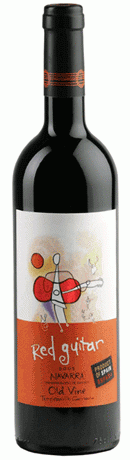
You know that a market niche is expanding when Constellation Brands decides to move into it, as it  has done with Red Guitar, an old vines Tempranillo-Granacha blend from Spain’s Navarra DO that sells for about ten bucks.

Red Guitar is marketed as “a rich, smooth and stylish celebration of the Spanish lifestyle” — a wine for the times, I guess, when consumers are looking for products that let them trade down in terms of price while trading up to a fun, more casual way of living.

Don’t Know Much

I didn’t know very much about the wines of Spain and the Spanish wine industry, so I went back to the classroom this week to try to catch up at a three day seminar on Spain’s wines organized by The Wine Academy of Spain and taught by Esteban Cabezas. My fellow students came mainly from within the wine industry — sommeliers, distributors and retailers. I learned a lot and sampled dozens of great wines. We didn’t taste Red Guitar, but we did survey the market from $5 bottles on up to the highest levels, including table wines, Sherry and sparkling Cavas. Yes, I know. Tough work …

Education is important to the future of the wines of Spain.  As I have written before, the number of unfamiliar regions and grape varieties is a challenge that must be addressed if wines from Spain are to achieve their obvious market potential. Constellation Brands’ decision to market Red Guitar as a “lifestyle” brand probably reflects the difficulty of selling wine from unfamiliar places made with unfamiliar grapes in a market where the international  varietals and styles are the lingua franca. Spanish winemakers need to get the word out — to educate consumers and sellers. Classes like the one I attended are a good step in this direction.

Uncorking the Potential of Wines from Spain

It’s useful to think about Spain’s wine industry using a basic SWOT (Strengths-Weaknesses-Opportunities-Threats) framework. Wines from Spain have many strengths that go beyond their obvious quality in the glass. Spanish food and culture are hot and Spain is a popular tourist destination, factors that can be leveraged in the marketplace. Intangible cultural factors have always helped sell Italian wines, so it is not unreasonable to think that Spain will benefit from them as well. Red Guitar’s marketing strategy is an obvious attempt to do just this.

There are weaknesses, too, of course. While the sparkling Cavas are very popular, offering Champagne quality at beer prices in some cases, other segments of the Spanish industry suffer from consumer ignorance or indifference. Sherry wines from Andalusia, for example, suffer the same challenge as Riesling wines. Consumers think they know what they are (simple, sweet stuff) but they are wrong. The diversity of styles and complexity of the best wines gets lost. For those who know them Sherry wines are the great bargains of the wine world. But most consumers never find out what they are missing. That needs to change.

The amazing diversity of Spain’s table wines is a strength in this market, where consumers are unusually willing to try new products if they perceive good value. But diversity is also a weakness to the extent that it confuses consumers (especially American consumers)  who are looking for a “brand” identity and can’t find it. Spain doesn’t have  a distinct regional identity that would draw in consumers initially and then encourage further experimentation as some other wine producing areas do.

In Search of “Brand Spain”

New Zealand has “brand” Marlborough Sauvignon Blanc, for example, which put that country on the wine map and gave millions of wine drinkers an excuse to try NZ wines. Oregon has its Pinot Noir, which has helped make it a wine region of international note despite its surprisingly small total production. Spain (like Washington State wine in this regard) produces so many different types and styles of wine that no one of them defines it. The regional identity is unclear. This is a barrier when trying to break into new markets, but a strength once a market beachhead has been established.

Although my terrioriste friends cringe when they hear me say this, I think it would be great if Spain had a Mondavi or Antinori who could define a “brand Spain”  in the global market. I think that a number of quality producers are trying to achieve this, but the industry is still pretty fragmented. Perhaps the consolidation that is sure to accompany the current economic downturn will move this process along.

The continuing economic crisis  is a great opportunity for Spain to expand export market share, especially in the United States where the market for wine is till growing in the mid-market segments. Spain, like Argentina, has a reputation for good value and distinctive wines and this is very useful right now.

Catch-22

It is important, however, to avoid being defined by low price alone. Spain’s first and fourth largest export markets (Germany and France) buy mainly low cost wines to stock the shelves of Aldi and similar discount sellers. Spain needs to focus on the UK and US (numbers two and three on their export table) where higher prices and margins are possible.

Another threat to Spain’s success in the international market is the temptation to conform too closely to the international market style (Pancho Campo, Spain’s leading wine authority, called this “the Australian style” in a Skype-dialogue with my class). Wines that are all alike become commodities at some point and it seems to me that Spain, with its already huge lake of surplus wines, wants to get out of that part of the market.

But there’s a Catch-22. It is easier, perhaps, to break into the market with a good value me-too wine. But it is hard to build upon that foundation (hence Australia’s current wine slump). Better to be yourself, distinctive, even quirky, it you can get consumers to give you a try.

As you can see, the prospects for Spain are as complex and multi-dimensional as the wines themselves.  I am optimistic that Spain’s wine industry will navigate this complicated passage successfully. Look for more on this topic in future posts.

Note: I would like to thank the Wine Academy of Spain and Catavino for allowing me to participate in the seminar on wines of Spain. Special thanks to my professor, Estaban Cabezas, and to Simone Spinner.

Tasting Note 8/11/2009: We tried the Red Guitar with dinner tonight and it was completely lacking in distinguishing qualities. It is hard to imagine that anyone who was introduced to the wines of Spain by Red Guitar would try another Spanish wine. Last night, however, we had the Borsao Tres Pichos, an Old Vines Granacha that sells for only a few dollars more, which was completely enchanting. You need to try Spain’s wines to know if you like them, but quality varies (and not just with price), so choose with care.

Wine Festivals Uncorked

jancis

Jancis Robinson and Wine Economist Mike Veseth at the IPNC. Wine Festivals draw celebrity wine critics, who taste, talk, sign books, pose for photos and lend credibility to the event.

Wine festivals have become big business. So big that the Wall Street Journal publishes a guide to upcoming festivals in each Friday’s edition. Click here to see their online August festival listing.There are lots of different wine events, but I’m not talking about charity wine walkabouts here, where you make a small donation, get a few drink tickets and visit tables where random bottles of donated wine are poured. The modern wine festival is a lot more focused and sophisticated and designed to engage wine enthusiasts on a different level.

International Pinot Noir Celebration

The International Pinot Noir Celebration (IPNC) in McMinnville, Oregon is a good example of the state of the art in wine festivals today. Sue and I attended the grand tasting last Sunday (a chance to sample dozens of Pinot Noir in a beautiful but hot outdoor setting), but the real deal for serious Pinot lovers is the full three day festival. For a fee of about $900 per person (not including lodging) you spend your days in tastings, seminars and vineyard tours and your nights under the stars at grand dinners.

The festival attracted winemakers from Oregon, California, Washington, Canada, France, Austria, Australia and New Zealand — quite an international lineup in a recession year.

I’m told that about 400 people attend the big festival — many of them come back year after year — and I would guess that another 300 or so came to the grand tasting on Sunday, so the festival’s total budget must approach a  half-million dollars. More than enough to pay the expenses of wine critics and celebrities (like Jancis Robinson above).

What’s In It For Me?

It is interesting to consider what brings all these people together? Yes, yes, I know that it must ultimately be about buying and selling wine, but that doesn’t fully explain it. No wine typically changes hands at events like this and there are probably more cost effective ways to market wine, from the supplier standpoint, and cheaper ways for consumers to fill their glasses, too. So what’s really going on?

One reason winemakers travel so far to attend these festivals is to communicate with other producers and to taste and compare their wines. Although I still don’t fully understand it, I have observed a subtle kind of dialogue when winemakers taste together. Information about taste, technique and status are all transmitted in the glass. Professors go to conferences and communicate by reading papers. Winemakers go to festivals and taste each others’ wines. It is easy to see who has the more sensible approach to intra-industry communication.

I suspect that there was a lot of producer dialogue at the Pinot festival because the wines that we tasted did not have much in common except the genetic pedigree of the grapes used to make them. Although the world wine market is moving to a lingua franca based upon grape varietal labeling (Chardonnay not Chablis, Pinot Noir not Burgundy) it is very clear that wines made from Pinot Noir grapes can have extraordinarily different textures, flavors and aromas. depending upon who makes them, how and where.

The Old World naming system (based on place not varietal) sure has its merits in the wineglass where terroir is actually experienced — too bad it works so poorly in the cluttered supermarket aisle when wines are bought and sold.

I met more than one winemaker who told me basically that she came to Oregon to prove something — to prove that good Pinot Noir could be made in X  where X = Oregon, Austria, California, Australia — fill in the place — only Burgundy has nothing to prove.

Hemispheric Exchange

A good deal of business gets done whenever producers come together, as you might expect. Partnerships, consulting services, distribution agreements and so forth are frequently arranged.  The McCrone vineyard wines made by Ken Wright Cellars and Ata Rangi are a good case study of the sort of  connections that probably could only happen in face-to-face meetings at a wine festival.

Don and Carole McCrone

Don and Carole McCrone

Don McCrone is a distinguished retired politics professor turned distinguished active winegrower. His vineyard outside of Carlton, Oregon  produces amazing fruit, which winemaker Ken Wright turns into a wonderful single-vineyard bottling. Don and Carole McCrone met the  winemakers from New Zealand’s famous Ata Rangi winery at IPNC a few years ago and were encouraged by them (while tasting each others’ wines, no doubt) to scout out vineyard properties in Martinborough.

Now the McCrones spend half of the year in each hemisphere supplying grapes to both Ken Wright and Ata Rangi for “McCrone Vineyard” wines. Are there any other winegrowers with vineyard designated wines in both hemispheres? It is an extreme example of the sort of cross-fertilization that can happen behind the scenes at major wine festivals.

Relationships not Transactions

I think that the most important function of wine festivals is to establish and build relationships. I always say that wine is good, but wine and a story is better. Wine and a relationship (even a superficial one with the grower, the winemaker, or other wine enthusiasts) is best of all. Doug Tunnell, winemaker at Oregon’s Brick House, explained to me that he brings his wines to IPNC every year to maintain contact with the people who attend. I got the impression that it isn’t so much about selling wine as honoring  relationships.  I think elite makers recognize that investing in relationships with customers (and with wine critics and journalists and all the others who attend these events) pays dividends down the road. Winemaking and relationship-building both require a long-term perspective.

The fact that many people come back to IPNC year after year suggests that they value the relationships, too, both with the producers and with each other. I have written that wine always tastes best when it is shared with others who enjoy and appreciate it. This may be especially true with festivals like IPNC, which tend to attract participants who are especially focused on a particular wine or region.

What I Think I Have Learned

So here is what I think I have learned from my fieldwork at wine festivals so far, both at IPNC and elsewhere, on both sides of the table, both pouring and receiving wine.

Wine festivals aren’t really about the wine, they are about the people, the conversations and the relationships. The role of the wine is to bring the people together and to give them something to share in a way that is impossible to recreate electronically.

Wine, or really the sharing of wine,  is a personal  relational experience in an otherwise increasingly impersonal transactional world.  That people seem to appreciate this sort of experience (and seek it out, even at high monetary cost and even in a deep recession) suggests something about its scarcity, don’t you think?

The End of France?

The rumors of my death are exaggerated — Mark Twain

Rumors are flying about the death of the French wine industry. One source reports that France has fallen to third place in the key UK wine market (behind Australia and the US) and is losing ground to surging South Africa. Other rumors whisper that France will seek authority for crisis distillation payments to deal with the growing lake of unsellable wine. And now a new book with more bad news!

Michael Steinberger writes about wine for Slate and other publications. We share many interests so when I heard about his new book, I just had to get a copy. It’s called Au Revoir to All That: Food, Wine and the End of France. The end of France? Gosh. Although just one chapter deals explicitly with French wine, it seems to me that the whole book comments in one way or another on the French wine dilemma.

We have met the enemy …

French cuisine, like French wine, once ruled the world, Steinberger argues, but not any more. Spain has taken the culinary lead, it is said, and many rivals compete on the wine shelf. Who is responsible for this sad situation, Steinberger asks? The answer is clear: the French themselves.

French economic regulations are one factor. They make it very difficult to operate restaurants profitably in France and so encourage the top chefs to look  abroad. Flying chefs are like flying winemakers, I guess, leveraging their skills (and celebrity) on a global scale.

Critics are part of the problem, too. Not Robert Parker this time — the Michelin Guide. The pressure to earn and keep precious Michelin stars is enormous, Steinberger argues, making nervous wrecks out of France’s culinary elite. Worse, Michelin has “a certain idea” of French cuisine and service and it is not clear that it encourages the best from French chefs.

The French invented critics like the Michelin Man and now Robert Parker, it seems, and today suffer from their “tyranny.” Exquisite irony!

… and he is us.

France suffers as well from its distinctive institutions, we learn in the chapter about French wine. The French invented the appelation system which now seems to be running amuck as winemaking regions large and small seek the status that geographical indicators allegedly provide. The French have made appelations so important, Steinberger argues, that they have backfired.

Appelations should be a guarantee of quality or typical style if they are to be very useful economically. But, according to Steinberger, the pressure is on to give the stamp of approval to all the wines in a given region because the economic consequences of losing AOC status is so great. Result, bad wines as well as good ones earn the designation, diluting the commercial value of the brand for all (pun intended).

Stressed out

So it seems as though the French have only themselves to blame for their problems, but I think they are not alone in this. We are all frequently our own worst emenies.

Steinberger’s book does a nice job of plotting his personal love affair with France and his ultimate disappointment reflects his great admiration for what French cuisine at its best can be. It is a good read; I recommend it, unless you are trying to diet!

I love France, too, and I am dismayed by the state of the French wine industry, but I think that rumors of its death are exaggerated. The combination of EU reforms and the current economic crisis will certainly stress French winemakers over the next few years. I am hopefully that this stress will produce less wine but better wine. That’s happens when vines are stressed, isn’t it?

Prime Time for Fine Wine?

The Wall Street Journal reports that USDA Prime beef is now available in your supermarket meat case. Bad news for your cholesterol count, perhaps, but maybe good news for supermarket wine sales. Do you think it will last?

Steak-Out at Ruth’s Chris

USDA Prime beef is usually almost impossible to get outside of restaurants. Prime is the grade reserved for the top 1-3% of all beef — it is sort of like beef with a 93+ rating from Robert Parker. Fine dining establishments, including steak houses like Ruth’s Chris (which advertises itself as “The Best Prime Steakhouse Restaurant”), pay a premium for the limited supplies of this top quality beef. It is unusual, therefore, to find much Prime beef in the regular retail food distribution chain (USDA Choice is usually the top grade you will find at your store). It is especially rare to discover choice cuts like Filet Mignon in a supermarket meat case.

So then why did some shoppers recently find USDA Prime ribeye steaks at Costco for $9.99 per pound? The answer, according to the WSJ article, is the slump in high end restaurant sales. (I don’t know how Ruth’s Chris in particular is doing, but the fine dining industry overall is taking a beating. due to the economic crisis.)

The recession is bad news for restaurants and for the businesses that supply them. I have already written about the effect on wine.  Some hard-to-get, winery-list and restaurant-only wines are now relatively easy to find — a few have even shown up at Costco — because distributors are diverting the wine that restaurants won’t buy to their other selling channels. The same thing, apparently, has happened to Prime beef.

Prime Time on the Wine Wall

Some of the folks who used to splurge on expensive restaurant meals are now sometimes treating themselves to  fancy home-cooked meals, which can be less expensive even when they use similar ingredients because high restaurant labor costs are supplied in house for free (or lower cost, anyway, if you have to pay your children to be waiters, prep-cooks or dishwashers).  Prime beef and excellent wines are now more readily available to these home chefs, as the WSJ article indicates and, while they may be expensive in an absolute sense (compared to Kraft Macaroni Dinner, for example) they are still cheap relative to the restaurant experience. Good food and wine at home can cushion the recession’s hard knocks.

My friend Patrick, wine manager at a local upscale supermarket, has a front row seat as these shoppers assemble ingredients for a special meal. His  Wine Wall is located strategically at the corner of Meat, Fish and Produce, so aspiring gourmet chefs inevitably pass through his territory once or twice and he is happy to help them select a nice wine to complement their home creations.

Patrick thinks that this fine-dining shift from restaurants to residences may not be a temporary phenomenon. People are educating themselves about food, ingredients, cooking methods — and wine of course — and they may find themselves drawn more deeply into the home dining experience. As they become more skilled and knowledgeable they may begin to identify themselves as “foodies” who enjoy planning menus, shopping for and preparing food, not just eating it, and change their fine dining behavior for good.

I’m sure this won’t happen to everyone everywhere, but I think I agree with Patrick that a noticeable structural shift could occur. If sustained, this trend could have important implications for several industries, including wine. A major shift in sales from restaurants to supermarkets, specialty stores and big box retailers would force some winemakers to reevaluate their business plans and perhaps shake up the whole wine market.

Now, where are my car keys? I feel an urge to go to Costco …

Decanter’s Wine Power List

Decanter, the self-proclaimed “World’s Best Wine Magazine,” takes its rankings very seriously. Wine rankings, of course,  and, in the July 2009 issue, Power rankings. Who are the most powerful people in the world of wine and what does the power list tell us? Let’s see if we can find the message in this bottle.

The Power List

The names on the power list are very interesting but the story that they tell about wine today is perhaps more important. Here are the first ten (top ten) people on the list.

  1. Richard Sands, USA, Chairman, Constellation Brands
  2. Robert Parker, USA, wine critic
  3. Mariann Fischer Boel, Denmark, EU Commissioner for Agriculture
  4. Mel Dick, USA, Southern Wine & Spirits (wine distributor)
  5. Annette Alvarez-Peters, USA, Costco wine director
  6. Dan Jago, UK, Tesco wine director
  7. Jean-Christophe Deslarzes, Canada, President of Alcan Packaging
  8. Jancis Robinson, UK, wine critic, author and journalist
  9. Nicolas Sarkozy, France, President of France
  10. Pierre Pringuet, France, Pernod Ricard

Since Decanter is a British magazine with very small US distribution you might be surprised that three of the top ten positions (and both of the top spots) are held my Americans, but don’t be. Constellation Brands is the largest wine company in the world and accounts for one out of eight bottles of wine sold in the UK. And Robert Parker is best known for his ratings of French wine, not Napa bottlings, which is important to British buyers and merchants. The presence of Sands and Parker at the top of the list does not reflect any sort of US-centrism, just the realities of the global marketplace. It really is a global list. Or at least, like those famous New Yorker cover illustrations, the globe as seen from London.

I won’t list the second ten names (out of 50 in total), but the I think they illustrate the global reach of the wine market today: America, China, Chile, Australia, Spain and so on. Even India, an emerging wine market, makes the top 50 ranking.

The list is complete and up-to-date (Gary Vaynerchuck, the US internet wine guru, shows up at number #40), but there are some interesting gaps. Fred Franzia, the godfather of Two Buck Chuck, is nowhere to be found, for example, despite his obvious influence on the US market, while Judy Leissner of Grace Vineyard in China, who perhaps represents the future of Chinese fine wine, makes the “Ones to Watch” list.

No wine economists make the list, alas. Greg Jones, the respected Southern Oregon University wine climatologist, is the only professor (#33). Maybe next year …

The Story

It is fun to see who makes the list and who doesn’t (why Jancis and not Oz?), but the ranking is more interesting if you strip out the personalities and consider what market forces they represent. Herewith my version of this  story.

The world of wine is very unsettled. Although wine is one of the most fragmented global industries (much less concentrated than beer or spirits, for example), size matters more and more as consolidation continues. [Hence the power of Constellation Brands, Pernod Ricard and Southern Wine & Spirits.] Reputation matters, of course [Parker and Robinson], but the world is changing and everything is up for grabs from how and where wine is sold [Costco and Tesco] to how the bottle is sealed [Alcan].

Although change is generally associated with New World wine, this is no longer the case. The biggest threats to “business as usual” for Old World wine come from inside the European Union itself. On one hand, the new EU wine regime [Mariann Fischer Boel] will pressure Old World wine to compete with the New World head-on and without continuing EU support. On the other hand we have an unexpected prohibitionist movement [symbolized by Sarkozy] that seeks to regulate wine like the Americans do (even as some parts of America are changing) — as a dangerous controlled substance. It is thus imperative for Old World wine to master the tricks of the New World industry — tricks that Constellation and Southern and Costco symbolize.

These changes take place, of course  within the context of the expanding global market, global climate change and a continuing global economic crisis (that’s where a wine economist would have been a useful inclusion).

I won’t pretend that the Decanter Power List is a scientific ranking (Decanter doesn’t claim this in any case), but it is an interesting peek into how wine insiders view their industry. I’ll be curious to see how the names and the story lines change when the next Power List appears.

Luxury Fever Cools Off

An article in today’s Wall Street Journal about the collapsing market for expensive wine provokes an essay on luxury goods. (Click here to read previous posts on wine and the economic crisis.)

Conspicuous Consumption

In his 1999 book Luxury Fever: Money and Happiness in an Era of Excess, Cornell economist Robert H. Frank analyzed the economic consequences of  the status-driven arms race that has raged for some years among the group that I call the affluenza. I guess affluenza is both the social class and the disease that afflicts them rolled into one.

The affluenza don’t simply consume goods and services, they use them to construct identities much as the singer in the video above (see note). Identity building is a complex process (ask the parent of a teenager) and sometimes an expensive one, too. You need to send status signals to others, of course, and you’ve also got to convince yourself. The acquisition and display of consumer goods (including but not limited to luxury products) is one aspect of identity building. Thorstein Veblen coined the term “conspicuous consumption” to describe it.

Private Choice, Social Consequence

Affluent consumers purchase increasingly expensive and scarce commodities as a way of telling others (and convincing themselves) of their status and taste. Robert Frank was concerned about the rise of luxury fever because of its boundless ability to soak up resources that might be better used somewhere else.

If you are just buying a car for transportation, for example, you can get pretty much what you might need for less than $30,000 (much less, in fact). But if you are building a self-image or staking out a place in the social pecking order, then the sky is the limit, both in terms of the car itself and the gadgets, accessories and so forth. Pretty soon you’ve got enough automotive wealth parked in your garage to feed and clothe a small Africa village for several years.

Luxury fever isn’t a new phenomenon. Affluent citizens of renaissance Venice engaged in competitive conspicuous consumption that threatened to bankrupt the city and its great families. In desperation, sumptuary laws were enacted to protect the citizens from their own excessive zeal. Such conspicuous displays as the number of rings that women could wear in public were strictly regulated.

To this day the gondolas that ply the waters of Venetian canals must by law be painted plain black — a regulation that dates back to the era when elaborate and expensive decorations threatened to sink both the boats and their owners “under water.” I think about sumptuary laws whenever a Hummer fills my rearview mirror.

Positional Goods

Robert Frank isn’t the first economist to express concern about luxury fever. John Maynard Keynes wrote his famous essay “The Economic Possibilities of our Grandchildren” in 1930, in the depths of the Great Depression. Keynes’s main point in the essay was that the temporary problem of the Depression would eventually disappear leaving a bigger problem, which Keynes called the Permanent Problem: how to live a rewarding, fulfilling life.

Keynes meant the essay to both calm panicked citizens and to inspire them to think beyond their wallets and purses to bigger issues that matter more in the long run. I have been thinking a lot about this essay recently, since 2009 bears a family resemblance to 1930.

Keynes thought that we would be getting to that point where the economic problem was fading and the permanent problem being solved right about now. He thought we would be rich enough, most of us in the developed world, to have enough stuff to satisfy our needs and be ready to think about more important matters than material goods. He put a number of conditions on this forecast, however, and one of them was that we would get over our interest in positional or status goods — that we would get over luxury fever. But I guess he was wrong.

Luxury Fever Cools

Or maybe I am being too hasty. “Luxury Wine Market Reels from Downturn” is the story in today’s Wall Street Journal. It reports a collapsing market for high end wines in the United States with lower sales, discounted prices and the prospect of industry consolidation as the wine market shakes out. Some of these wines are the sort of rare, expensive luxury products that have an irresistible appeal to the affluenza. Their value goes beyond what’s in the bottle to the people who long to own them.

The collapsing luxury wine market is bad news for the wineries, distributors, retailers and restaurants that earn a living on luxury wines. Good news for bargain hunters and collectors, I guess.

And possibly good news for our grandchildren. The decline in luxury wine sales is probably simply an exaggerated reaction to the economic crisis and this market will likely bounce right back when the economy starts looking up. But maybe, just maybe what we are seeing here is a reassessment of the economic and social role of fine wines, designer clothes, and other luxury goods.

I’m not saying that luxury goods will disappear, but if they become a mere end in themselves, not a means to a more complicated  psychological goal, then they will lose a little of their toxic social effect. Perhaps the economic crisis will change public perception of conspicuous consumption and encourage individuals to define identities in the ways that Keynes imagined. It’s a long shot, I know. Or maybe it is just a beginning.

Video note: Elton John and Tim Rice wrote this song for their Disney musical Aida. The cartoon characters are from the Disney series Kim Possible. Enjoy!

Stimulus Package: Refreshing but Restrained

cavatappiPeople are always asking me what I think about the stimulus package and they never seem to be satisfied with my answers.

What Stimulus Package?

For a while I was telling people, “Stimulus package? What stimulus package?” My reasoning was that the tax cuts were more political than economics — no one seriously thought they would stimulate much consumer spending — and the big government spending programs will take several quarters to kick in. Only a small percentage of the money has been spent so far. The promise of economic stimulus in six or nine months is a useful thing, but there hasn’t been much in the way of a direct effect yet.

Here in Washington State, cutbacks at the state level seem to be more than offsetting whatever Federal stimulus there has been. Although the Washington situation is very serious (see the recent Economist article on the recession in this state), things could be worse — think California.

Too Soon to Tell

Recently I’ve changed my tune a bit. Stimulus package? Too soon to tell, I say, or impossible to know. These are both good answers even if my friends don’t like them. Too soon to tell because it will take more time before the full effects, positive and negative, are felt. Too soon to tell because we haven’t figured out yet  how to deal with the inevitable consequences of the recent spectacular money creation and public debt increases. Some people fear that the cure to these problems will be more deadly than the recession’s disease.

Impossible to tell? Yes, because economics isn’t a hard science and we don’t have the luxury of running controlled experiments. We know that unemployment has increased to 9.5% with the stimulus package in place — that’s pretty shocking — but how high would it have been without the federal emergency programs? We will never know for sure, so these policies are sure to be debated back and forth for years.

No one seems to appreciate my analysis of the economic stimulus package so I’m going to change gears again. Now when people ask me my opinion I’m going to give them a wine review. That’s because I recently discovered an interesting white wine called Cavatappi Stimulus Package 2008.

In Vino Stimulus

Cavatappi (it means corkscrew in Italian) is a winery founded some years ago by former restaurateur and Italian wine lover Peter Dow. Cavatappi produces mainly Washington-grown Italian varietal wines (23 vintages of Washington Nebbiolo and Sangiovese). I’ve seen a Cavatappi white blend before, but this is the first one with an economic crisis hook. I couldn’t find anything about the wine on the web so I wrote to Peter Dow. He reports that

It is a blend of SB and Viognier. I tasted a similar wine in the Rhone last winter that was a Marsanne Roussane and SB blend and I really liked it.  It is designed to be a simple summer quaffer and at 10.00 retail it is being well received.

I was speculating about what message Cavatappi is trying to send by naming this white blend in honor of the economic stimulus program. Is it to show support for the Obama plan? To send a message to consumers: spend your tax savings on wine? Or maybe it’s a cash flow thing — white wines can be turned over relatively quickly, providing an economic stimulus to the winemaker. Buy this wine and stimulate the Cavatappi economy!

Unfortunately the correct answer is much less complicated. “I used the name because I thought there was some humor in it, but mainly wanted to see if I could get it by the TTB,” according to Peter. Apparently he did!

So here’s the bottom line: what do I think of the stimulus package? Refreshing, but restrained. (I’m not a skilled wine taster but it seems to me that the Viognier tames the Sauvignon Blanc and shapes it a bit.) It made a nice match with a hearty salad at dinner last night.

Refreshing but restrained. Not a perfect description of the economic stimulus package, but not completely off the mark either.

And I can honestly recommend this stimulus to all my friends. (Or almost all of them: ten dollars is more than my senior cheap wine researcher  Michael Morrell likes to spend — I guess you can’t please everyone.)

Book Review: The Business of Wine

The Business of Wine (edited by Geralyn G. Brostrom and John C. Brostrom) is organized as an encyclopedia with entries from A (Airlines comes first) to Z (for Zinfandel, of course). I opened the book with two questions on my mind: Why an encyclopedia? And why another encyclopedia?

Why an encyclopedia?

This question comes up because there are a lot of different ways to tell the story of the business of wine and to organize that story. An encyclopedia, with alphabetically arranged entries of various lengths, is a peculiar choice when you think about it.

On one hand, it gives a lot of freedom to the reader to cut and paste her own story by darting back and forth among items, possibly but not necessarily hitting all the key points along the way. On the other hand it also gives the editors quite a bit of control, since they get to choose what gets in (and in which author’s account) and what and who are left out.

Does the encyclopedia format work, or would a series of essays by various experts  (the format chosen for another recent book also titled The Business of Wine) have been more useful?

Why another encyclopedia?

This question arises because we already have a really excellent encyclopedia of the business of wine — it is embedded in The Oxford Companion to Wine 3/e edited by Jancis Robinson. Although the Oxford Companion is an encyclopedia of wine in general, there is a lot of great wine economics to be found here.

This is understandable. It is difficult to think about wine without straying, intentionally or not, into wine economics. Winemaking is an art, a science and a business and you really can’t leave the business part out if you want to understand the whole process. That’s why about a third of the Masters of Wine exam deals with questions about the business of wine.

The Oxford Companion does a good job dealing with many wine economics topics. Does the new encyclopedia add something to a bookshelf that already contains the Oxford Companion?

Managing the Trade-Offs

How does the encyclopedia format work? Well, having spent some time with this book I have to say that it is an OK compromise. It is a lot more hit-and-miss than the ideal book of essays that I imagine, but apparently that book is very difficult to write because no one seems to have written it. The business of wine is very complicated and the parts of the business and the factors that affect it are both numerous and highly interconnected.

The encyclopedia format is problematic, but all the other wine business books I have read have had their problems, too. (One in particular — I won’t name it, but you probably know the one I’m talking about  —  promised a first-person account of the wine trade  but descended into something closer to a personal vendetta against professional colleagues.)

Do we need another encyclopedia – this specialized one – when the Oxford Companion already does a pretty good job covering wine economic topics? Yes, I think so, but as a supplement to the Oxford Companion not a replacement for it. I find it useful to have a book that drills down into the wine business in many cases, rather than treating it as part of a more general survey.

And some of the choices the editors have made are interesting. The Argentina entry, for example, is written by Laura Catena, VP of Bodega Catena Zappa and owner of Luca winery. And Joel Butler MW, the head of wine education at Ste. Michelle Wine Estates, wrote the Washington State essay. Interesting to get these industry insider views.

Possible Improvements

My initial doubts about this new book have been overcome to a considerable extent. There are a number of ways the book could be improved, however. It seems to me that the editors might want to tinker with ratio and proportion a bit. Most encyclopedias like this divide entries into short, longer and longest (the longest being a couple of thousand works at most) and it is probably difficult to match topics and lengths. Maybe the entry on Airline wine sales could have been shorter and the discussion of Biodynamic wine a bit longer – you know what I mean. It’s a tricky business.

Most of the entries include suggestions for further reading and these are often  inadequate (as is the brief attempt at a bibliography). An encyclopedia like this is usually the introduction to a topic for readers, not the last word, so readers need to know where to go next. A little more guidance would be useful, especially for students.

And although this is an encyclopedia, I would have appreciated a longer introductory essay that tried to say something interesting about the state of the wine industry today and its challenges for the future.

Got data?

Finally, I am an economist, so I’d naturally like to see more data. Many of the entries include a good deal of data, as you would expect, and there is an appendix on “international wine data,” providing basic consumption and production information on many but not all the countries discussed in the main text. I think this could be usefully expanded to include more country-level data as well as data about international flows and time series data on prices and quantities.

Let me end on a positive note. This book exceeded my expectations and I think it is a useful reference, especially good for anyone just getting started in the study of the business of wine. And especially useful when read alongside other standard references like the Oxford Companion and Tom Stevenson’s excellent Wine Report annual series.