Wine Recession: Winners & Losers

Some people think that the long hard winter of the economic crisis is coming to an end and “green shoots” are emerging. It is too soon to tell if this view is correct, but not too early to begin to assess which parts of the wine economy have been hardest hit by the recession and which have actually benefited. Herewith a brief analysis of winners and losers.

Wine Market Breakdown

There are several ways to break down the winners and losers in the wine market. The first and most obvious is by price segment. Distributors are finding wines in the $25 and up category difficult to move through normal retail or “off premises”  sales channels. This doesn’t mean that everyone is buying Two Buck Chuck, however. The “super-premium” $10-$15 segment continues to grow, for example, although the trading down effect is still significant. The woman who was willing to pay $20 two years ago now aims to spend $15 or less, with similar changes further down the line.

Some wine brands have been particularly well positioned to attract value-seeking buyers. Gallo’s Barefoot wines, for example, have gained market share among the “fighting varietals” and the CMS by Hedges red and white blends have done well in the $10-$12 category, as have many others.

Since most Wine Walls are arranged with the most expensive wines on the top shelf and the cheapest at the bottom, it is almost as if the top shelf has been eliminated and all the other wines moved up one rank. Whether this is a temporary or a permanent shift remains an open question. I explicitly do not assume that everything will reset back to “normal” once the recession’s game of musical chairs has come to an end.

On-premise sales have declined, too, as restaurants have felt the recession’s sting. It has been especially interesting to watch as restaurants adjust by switching to lower cost wines from beyond the “usual suspect” regions. Reds from Spain and whites from Oregon, for example, can be sold profitably at lower price points than the better known French and Californian alternatives. Because buyers may not be as familiar with these wines they can enjoy the adventurous experience of “switching over” rather than simply “trading down.” Restaurants can maintain their margins at lower prices.

Wine Geography

Inevitable the recession has had uneven effects on different regions and countries. The news from Northern California is not good, for example, with many reports of surplus grapes, some that will not find a buyer this year. Cost is a big factor. Napa and Sonoma are high cost growing regions. The rule of thumb is that $2000/ton grapes produce $20/bottle wine — that’s how it pencils out when all the costs and mark-ups are accounted for. It is difficult to know who will buy wine made with $3000/ton grapes in the present market if, as we are told, the $25+ segment is a “dead zone.”

There is better news here in Washington state, on the other hand. Sales of Washington wine are rising at a 9% rate according to recent data. This makes sense because so much of Washington’s wine is positioned in the $15 and under category. About three quarters of all Washington wine is produced by Ste Michelle Wine Estates’s brands such as Chateau Ste Michelle and Columbia Crest that provide good quality and good value.

Argentina is another winner. Much like Washington State, Argentina produces good value wines at every price point and has increased sales across the board, although I suspect that Malbec at $10-$12 leads the way. While the overall US wine market has grown by 4.8% over the last year according to the most recent Nielsen Scantrack numbers, sales of Argentinian wines have risen by 46.8% — a tremendous if unsustainable rate of growth. By comparison Chilean wines sales have risen by 12.7%.

New Zealand’s wine industry is heading toward a crisis, as I have written before, but this seems less about the recession than a simply matter of demand and supply. You cannot double and redouble vineyard acreage forever and expect the export market to absorb every drop.

Australia is suffering, too, but like New Zealand I think the recession is a secondary “tipping point” factor. Wine imports from Australia are down 2.5 % for the last 52 weeks and Syrah/Shiraz sales are off 5.2% for the same period. Australia is facing all sorts of problems — drought, fire, recession and so forth — but the biggest problem maybe that “brand Australia” has gone out of sytle, taking the whole Syrah/Shiraz category with it. Even unfashionable Merlot has done better, with 0.8% growth.

The French Connection

I think France is the big loser from the recession, especially the segments that previously earned a “prestige premium,” particularly Bordeaux and Champagne. There is enough Champagne squirreled away in producer cellars to supply the market for several years. I think the big houses would pass on making any new wine this year if they could.

Even the famous chateaux are cutting price in Bordeaux this year, so I can only imagine what things are like for the producers of ordinary bottlings and bulk wine. French wine is a drag on the market even in Britain, where South African wines are surging ahead. Brand France, like Brand Australia, is in steep decline, although for different reasons.

There is a lot to be learned from a close study of the wine recession. The most important, at this point, is that it is more than a decline in demand. There are hints of more profound structural changes taking place. The more things change, the French say, the more they stay the same. I wonder if that will be true this time as the recession’s grip slowly weakens?

8/31/2009 update: An article in today’s Times of London suggests how severe the crisis is in Champagne. (Click on the link to read the rest of the story.)

Hopes of a glut of cheap champagne are set to be dashed when vineyards meet next week to agree on a big cut in production to prop up prices.

With sales falling, producers may be ordered to leave up to half their grapes to wither on the vine in an attempt to squeeze the market.

Merchants are pushing for an historic reduction in yield as they seek to ensure that champagne remains an expensive luxury. “Everyone agrees that production has to be cut because no one here wants to see prices fall,” an industry insider said. “The only disagreement is on the scale of the cut.”

The backdrop to the debate is a slump in sales for champagne makers, from 338 million bottles in 2007 to 322 million last year and a predicted 270 million this year. The fall stems in part from a slide in demand, estimated at about 10 per cent, and in part from destocking by distributors, notably in Britain and the United States.

9/3/2009 update:  A great article in today’s Wall Street Journal on the crisis in Champagne. Check it out!

Book Review: Doubts about Bordeaux

Benjamin Lewin MW, What Price Bordeaux? Vendage Press (an imprint of the Wine Appreciation Guild), 2009.

Wine is bottled poetry, I have read, and bottled geography, too. It is also liquid doubt.

Uncertainty is a key obstacle to the purchase of wine because it is so difficult to know what’s really in the bottle at time of purchase (and, of course,  if you will like it) . There are thousands of different wines from different places made in a myriad of styles. The uncertainty is magnified by the fact that wine changes with each vintage, each vintage changes as it ages, and we all have different tastes. Add to this the fact that some wines are frauds – not what they seem to be  — and others are “lemons” with bad corks or random flows. It’s surprising, when you think about it, that anyone buys wine at all.

Diluting the Brand

Doubt is one of the biggest obstacles to the successful intersection of demand and supply for wine and much effort is expended in making consumers more confident in their purchases. Brands are one solution. A brand that has established a reputation for quality and consistency is a valuable thing in the wine market. This applies to both private brands like Robert Mondavi  and to communal brands, like Champagne.

Champagne was the first wine appellation – a geographic designation meant to deter fraud and encourage confident consumption. It is probably the most valuable “brand” in all wine.

If Champagne is the top wine brand then Bordeaux must come a close second. Bordeaux wines are possibly the best, arguable the most famous and certainly the most expensive in the world. Or at least some of them are, because Bordeaux’s production includes much that is common, foul or unsellable at any price.

The paradoxes of Bordeaux and its famous brand are the subject of Benjamin Lewin’s new book, What Price Bordeaux? Although Dr. Lewin might disagree, I would say that one theme of his book is that the Bordeaux brand is a bit of a fraud. Bordeaux’s reputation is rooted in history, for example, as is the case of much Old World wine, but we learn that the Bordeaux wines of today bear little resemblance to wines of the past.

This is a good thing, in some respects. The Bordeaux wines of history were thin products, “corrected” to meet market demand by the addition of darker wines from Spain and the South of France. Bordeaux wines today are more like their arch rivals from the Napa Valley, both by choice and as a  consequence of global warming, which has nearly eliminated the climate differences between the two regions.

Wine Mythbusters

The top brands in Bordeaux were established by the Classification of 1855, which grouped the chateaux into a rigid quality hierarchy based upon market prices at that time. This, Dr. Lewin’s analysis suggests, was a bit of a fraud as well, and not a very reliable guide to wine choices today.

My favorite chapter examines the “second wine” phenomenon. Many Bordeaux producers (and almost all of the top chateaux) produce a second wine (selling at a lower price) in addition to the flagship bottling. The second wine is marketed to people like me, who probably can’t afford to buy the top wine but want an idea of what it might taste like. We buy the cheaper product and imagine the taste of the grand vin.

The problem, Dr. Lewin tells us, is that there is no fixed idea of what a second wine should be and no certain relationship between the greater and lesser products. Indeed, he says, many second wines are poor values – over-priced because they benefit from the borrowed reputation of the top wine. Better off with a better wine at lower cost from a lower-tier producer, he suggests. Good advice for people who taste what’s in the bottle, not what they imagine to be there based upon the label.

Dr. Lewin’s book is unusually full of data for a wine publication – wine writers are better with stories than bar graphs – but it fits perfectly his myth-buster approach. The maps and figures are colorful and engaging – or at least they engaged the wine geek in me. Each chapter examines some particular aspect of the Bordeaux brand and reveals the reality behind the curtain. I admire both the book and Dr. Lewin’s research and expertise, although I would have appreciated a stronger central argument.

It is pretty clear that this exposé is a labor of love not malice – Dr. Lewin is convinced that the wines and the Bordeaux brand could both be much better. The first step is to acknowledge the facts and that’s where this book comes in. Dr. Lewin has done a service to the Bordeaux producers in this regard. Now it is up to them.

Stein’s Law and New Zealand Wine

Stein’s Law, named for presidential economic advisor Herb Stein who coined it, holds that if something cannot go on forever it will eventually end.

If that sounds like an obvious conclusion remember that, Freakonomics aside, most of what economists do is point out the obvious to people who somehow fail to see it.

Think about everyone who was surprised that the housing bubble imploded and that credit crashed. Everyone knew that rising housing prices and expanding mortgage debt couldn’t go on forever, but many acted like it would never end. If only they had remembered Stein’s Law!

I wonder if this is a Stein’s Law moment for the New Zealand wine industry?

Objectively the New Zealand wine industry has all of the classic characteristics of a bubble (and I’m not talking about sparkling wine here). The industry has expanded at a break-neck pace in recent years, fueled by foreign investment. The home market is quite small, so increasing output has been pushed into export markets, especially Australia, the U.S. and Great Britain. New Zealand wines are best sellers in each of these markets.

Incredibly, New Zealand has been able to continually expand export sales while maintaining its historically high export price. (No country has received a higher average price for its table wine exports in recent years.) The high prices, of course, draw in more investment, so production continues to grow and the cycle repeats.

Chateau Ponzi

If I told you a story like this about a financial investment of some sort you’d probably tell me that it sounds like a Ponzi scheme — no way this can go on forever. Pretty soon the market will be saturated and prices will have to fall. This is what worried the New Zealand winemakers I talked with when I visited there a few years ago: the moment when exports at a premium price would become unsustainable. They worried that their fine wines would become commodities, sold in bulk at permanently lower price points.

Any luxury good retailer will tell you that it is hard to push prices back up once buyers come to expect discounts.

Yesterday’s Marlborough Express suggests that the tipping point may have been reached. The article reports that

New Zealand Winegrowers’ annual report released yesterday shows exports surged 24 per cent to $992 million and the industry is on track to reach the $1 billion mark this year, a year ahead of expectations.

This was largely driven by bulk exports, which Mr Smith said were a concern to the industry. Historically, bulk wine exports have accounted for less than 5 per cent of total export volume; in the past year this quadrupled to nearly 20 per cent as producers looked to shift excess inventories.

Bulk exports might relieve pressure on wineries in the short term, but in the long term they could damage the market positioning and the reputation of New Zealand wine, Mr Smith warned.

The fact of falling prices due to bulk sales is hard to dispute.  I have not seen big discounts on New Zealand wine here in the U.S., but the Marlborough Express reports that

A surplus of Marlborough sauvignon blanc is driving down wine prices, says a Nelson wine producer. Brightwater Vineyards’ owner, Gary Neale, says his company is up against an oversupply of discounted Marlborough sauvignon blanc exports.

Mr Neale sells his wine for 10.50 (NZ$25.80) in Britain, but British consumers are being offered three bottles of Marlborough sauvignon blanc for 10 , or 3.99 for one bottle. An email from his Sydney agent tells of New Zealand wine being sold at A$4 a bottle, and Marlborough sauvignon blanc is selling there for as little as A$2.75 when buying six bottles.

“In the past, Australia has been a very easy and a profitable market, but Australia is absolutely flooded with cheap Marlborough sauvignon blanc,” says Mr Neale.

Two Buck Kiwi Wine

With the Australian dollar trading at about 83 U.S. cents this morning, that makes makes the Marlborough six-pack price a little over $2.25 US per bottle — Two Buck Chuck (TBC) range.

An article posted today on Decanter.com reports low prices in the U.K. market, too, although not so low as in Australia, and sounds an optimistic note.

The sale of £3.99 Marlborough Sauvignon Blanc is a short-term ‘blip’, according to the European head of New Zealand Winegrowers.

Following the record 2008 and 2009 vintages, increased production created an oversupply problem, giving rise to the first-ever £3.99 New Zealand wines as producers tried to clear tank space.

But David Cox, European director for New Zealand Winegrowers told decanter.com: ‘We are going to see the odd £3.99 New Zealand wine but not very often. I don’t think the consumer will ever get to the stage where they think they can get New Zealand wines for under £4.’

£3.99 translates to about $6.50 US — well clear of the TBC price, but frighteningly low for New Zealand wines in the UK market. Let’s put this price in context.

New Zealand producers received an average price of $6.00 for their exports in 2001-2005. Retail prices in the export markets were necessarily much higher to reflect transportation and distribution costs, tariffs and retail mark-ups. No wonder so many Marlborough Sauvignon Blancs have been priced in the $15-$20 range in the past.

If NZ wines are retailing for the equivalent of $6.50 in London then, working backwards, this suggests that net producer prices have plunged to less than $3, at least for the bulk wine product. That’s a huge drop and it is hard to see how production is sustainable at this price point.

All Black?

So is this it? Has the bubble burst? Is the future of New Zealand wine all black? No. The reputation of New Zealand wine is very strong and it may well be that consumers will be able to differentiate the bulk product at bulk price from the premium product higher up on the shelf as they do for products from France and California. The danger is that the whole national brand is devalued. That would be a devastating blow.

It would be a mistake to over-react to this news, but it would also be a mistake not to react at all.

Stein’s Law holds here as it does in so many cases and the surpluses will go away one way or another — either because the growers act to control them or else because the market collapses and they get sold off at bulk wine prices.

Chateau Cash Flow: The Rise of House Brand Wine

Decanter.com reports that house brand wine sales are rising in Great Britain even as the overall market slumps.

Retailers are reporting impressive growth of own-label wines as cash-strapped customers look to rein in their spending.

A Datamonitor survey reports 41% of all grocery sales in the UK are now own-label, up from 38.2% in 2008, and wine sales are following the upward trend.

Supermarket retailer Sainsbury’s told decanter.com its own-label wines had grown at double the rate of its wine range this year. A spokeswoman said: ‘Last year we revamped our own-label packaging and we have put a lot of effort behind the range in store and in the media.’

House brands aren’t so important in the U.S. wine market [yet] but they may well be in the future. The best known U.S. house brand wines are Charles Shaw (a.k.a. Two Buck Chuck) at Trader Joe’s and Kirkland Signature at Costco. Big Box retailers Target and Wal-Mart have launched their own house brands in recent months and other retailer’s have commissioned discount brands (not yet closely associated with their names) in an attempt to get a grip on the trading-down market. Look for this trend to continue, especially if the economic downturn persists.

Chateau Cash Flow

House brands are a solution to several problems, which is why they are likely to increase in importance. On the consumer side, they provide buyers with reputational assurances. You might wonder if a $3 wine can be any good, but you are more likely to try it if Trader Joe’s or Wal-Mart stands behind it. As I have written before, a $3 unknown wine at Safeway makes you think “how can it be any good?” while a $3 wine with the Trader Joe’s imprimatur makes you think “how bad can it be?” You might buy the latter but not the former.

The British have years of experience with house brands — it is why they are [for now] the world’s most important wine market and why Britain’s supermarkets are arguably the most sophisticated wine distribution machines on earth. The U.S. is catching up, but Britain still leads.

Reputation is especially important when consumers are trading down, moving into unfamiliar territory on the lower shelves. Decanter reports that while some British consumers are trading down to house brands, building that market, existing customers are trading up within the house brand portfolio! If this trend continues it will be hard to resist the house brand strategy.

Supply Side Wine

House brands have big advantages on the supply-side, too. Producers with surplus wine are often happy to sell it off through house brand bopttlings because it generates cash flow without directly undercutting their own brands and market. In my international economics class we call this “dumping.” You sell off unintended surpluses (of which there are plenty just now) through retailers in a different market segment, allowing you to maintain reputation and price points in the home market. If you start discounting wine to sell it, we have learned, it is sometimes difficult to regain the ground you have lost.

Some British retailers have moved aggressively into the supply chain, buying up grapes and surplus wines and acting as full-fledged negociants, but it isn’t really necessary to make such a large commitment to get into the house brand wine business. There are plenty of regional and national firms who can quickly respond to demand. No large investment is required, cost is low.

House brands can also have a somewhat fluid identity (not tied tightly to a particular region or style), which allows them to benefit from global opportunities, sourcing Sauvignon Blanc from Chile, for example, and Pinot Noir from Northern Italy or the South of France.

The main problem is to be sure that quality is good enough. Otherwise you have put your own brand in jeopardy.

Three Way Battle

The world’s wine markets are a battleground for three models of wine sales. The German model is based upon low cost (one euro per liter) and hard discount sellers like Aldi. The American model is all about corporate brands like Gallo and Constellation Brands. The British model is built upon upscale supermarkets and the house brands they sell.

Recent news suggests that the British model is gaining ground, both in the UK and here in America, where it is the model that drives Costco sales (Trader Joe, on the other hand, uses a version of the German system). It will be interesting to see if this trend persists once the recession eases up.

American Wine Laws: Time for a Change?

No food for sale in this NYC Trader Joes. No wine for sale at the Trader Joes next door.

Only in America? You can't buy food at this NYC Trader Joe's wine store. And you can't buy wine at the Trader Joe's next door.

A European visitor pulled me aside recently to complain about American wine laws, which considerably restrict the what, where and how of wine sales and consumption compared to more relaxed European practices.

“I thought there was separation of Church and State in America,” he said, showing that he hadn’t forgotten what he learned in Civics class years ago as a high school exchange student in Cleveland. He put the blame for America’s wine parochialism squarely on the influence of conservative religious groups.

Church and State vs. Special Interests

Religious groups are political powerful, I told him, and they no doubt have had some influence on the development of America’s wine laws. But that’s not the reason the laws don’t change, I said. It is the interests of those who gain from the current set up. He wasn’t convinced. He seemed to think that a moral explanation was inherently more persuasive (or more American?) than an economic one. But I still think I’m right.

My explanation — that economic forces organize around any set of regulations, become entrenched and use their political and economic clout to prevent change — has a good economic pedigree. It is the theory of structural rigidities developed by Mancur Olson in his two classic books, The Logic of Collective Action and The Rise and Decline of Nations.

Olson’s theory is elegantly simply. Restrictive economic arrangements benefit a small number of actors a great deal, so they have a strong incentive to organize and fight change. Eliminating the restrictions benefits a larger but widely diffused set of actors who have correspondingly smaller individual incentive to take action.

Even though the collective gain from liberalizing arrangements is likely to exceed the collective loss, the concentrated established interests have more of an incentive to influence legislators and regulators than the general public. This is why regulations, once enacted, are difficult to change. Public gain cannot seem to trump concentrated private interests.

Olson developed this theory in The Logic of Collective Action and used it in The Rise and Decline to explain why rich, stable economies sometimes experience slower growth rates. Stability allows interests to become entrenched and structural rigidities to solidify. Change becomes more and more difficult and potential collective gains from innovation are systematically sacrificed on the altar of vested interest.

Every once in a while, Olson argued, advanced nations need something that will shake things up and weaken the grip of special interests. Then all sorts of change becomes possible.

A Loaf of Bread But No Jug of Wine

An article by Graham Rayman in the August 11, 2009 Village Voice provides evidence to support this theory. New York is one of 15 US states where it is illegal to purchase wine or beer in a supermarket (and you can’t buy bread or cheese in a NY wine shop, either). It isn’t so much separation of Church and State as the division of  Wine and Cheese. Supermarkets can sell wine, beer and spirits as provided by the law, and some do this, but they must have separate stores with separate entrances, checkout stands and so forth.

Two doors, two lines, two sets of store staff. Greater legal control alcohol sales is possible, I suppose, but at a considerable sacrifice in convenience.  It is probably not a surprise that wineries and wine enthusiasts would want to change this, but it isn’t an easy thing to do.

The Village Voice article explains how liquor store interests organized and lobbied the NY legislature to kill a recent bill that would have permitted supermarket sales. The main force behind the proposal was the state government’s need for revenue — the state projected that increased sales though supermarkets would have added to state tax coffers. The story focuses on the anti-reform lobby — it would be interesting to know more about than the author reports here about how supermarket chain and corporate wine producer interests reacted to the bill. But the point about the blocking power of small but concentrated interests is well made.

Shake It Up, Baby

Supermarkets are just one distribution vector for wine, of course, and New Yorkers have many competitive specialist stores to keep prices down and service up, so we don’t need to feel too sorry for them. But it does seem that the increased convenience of grocery store sales would help expand the wine market and promote wine as a lifestyle choice. It’s too bad the reform effort failed.

The inconvenience of wine buyers in the 15 supermarket-ban states is important, but the grip of special interests on wine regulations extends to other areas.The cumbersome three-tier distribution system and restrictions on inter-state wine shipments are two other areas where entrenched interests have successfully fought off liberalization efforts.The result is the restrictive system my European friend finds so difficult to understand.

If Mancur Olson is right, restrictive regulations will be difficult to change unless something happens to shake things up. Maybe the economic crisis, which has put every link in the wine value chain under stress, will ultimately provide just such an opportunity. Consumers, wine producers and even state tax departments all have something to gain from changing the system now.

We Will Sell No Wine [Reform] Before Its Time

I told my European friend not to hold his breath waiting for wine reforms to trickle up from grassroots wine enthusiasts. The real hope is that the big players will push for liberal reforms.

Personally, I pin my hopes on Costco, the largest single wine retailer. And I wonder if Wal-Mart will get involved now that it is selling wine in many stores (it even has its own version of a Two Buck wine called Oak Leaf). OK, Wal-Mart is a long shot, given its Arkansas roots, but these are unusual times — almost anything is possible.

The New York defeat is a definite setback (and the California plan to increase wine taxes is a step in the wrong direction) but maybe European-style wine market regulations are an idea whose time has finally come.

8/27/2009 Update

Interesting article in the New York Times about Whole Foods’ failed attempt to open a wine shop in New York City.

Whole Foods learned the hard way that opening a wine store in New York is not easy. The wine shop at its market in the Time Warner Center was closed by the state liquor authority because the shop was deemed part of the supermarket; state law bans selling wine in food stores. Then Whole Foods’s license request for a wine shop near its store in the Bowery was denied because of community opposition. But the company succeeded in starting a wine store in the same building as its newest store on the Upper West Side: it opened on Aug. 24, and the supermarket will open on Aug. 27.

Read the whole story at

http://www.nytimes.com/2009/08/26/dining/26whole.html?_r=1

Will the EU Wine Reforms Work?

The September 2009 issue of Decanter arrived today and it features three articles about the European Union wine reform regime that went into force last week (on August 1).  I wonder if the reforms will work and dry up the EU’s wine lake by making this important economic sector more competitive?

The EU wine regime is part of the larger Common Agricultural Policy (CAP), which is not so much an agricultural policy as an incomes policy — a set of regulations and subsidies designed to support the incomes of European farmers. The CAP payments have provided income security and, in some areas, social stability, for regions where winegrowing is a marginal economic activity, but where there are few viable alternatives.

Bottle Shock

The subsidies have also served to delay what we now see as inevitable structural adjustment to a declining EU domestic wine market. The new reforms are meant to pull out the props and force adjustment. It’s not exactly shock therapy, but it will have some of the same effects.

You can see the problem if you just look at some of the vineyards in Spain and the South of France where the surplus wine originates. Many of the wines that are produced are poor products, without much market potential, which flow the into EU wine lake and end up in crisis distillation. These winegrowers need to get into a different business. Structural adjustment in this circumstance doesn’t mean changing from grapes to olives or some other crop, however, it probably means selling out, packing up and moving to other regions, a very expensive and disruptive process for both the individuals and their communities.

It’s like an economic Dust Bowl; if you have read  The Grapes of Wrath you know what I am talking about. No wonder there is so much opposition and foot-dragging.

The current economic crisis both compounds and confuses the problem. Solving the long term problem demands that crisis distillation disappear, for example, but the short term crisis makes a case for keeping the price supports just a little bit longer. With the Cash for Clunkers program so popular right now it is hard to rule out Cash for Carignan on principle alone. It is difficult to know how these political and economic forces will shake out in the future.

Label Laws

The first evidence of the new EU regime will show up on the labels of some European wines quite soon.  AOC (Appelation d’Origine Controlée) is being replace by AOP (Appelation d’Origine Protegée) on French wine labels, for example, and Vin de Pays wines will now be labeled Indication Geographique Protegée as EU standard terminology in introduced.These changes will confuse some buyers, I think, but the damage shouldn’t be too severe.

The Decanter story uses the English versions of these new classifications: PDO (protected designation of origin) and PGI (protected geographical indication). The PIG wine acronym is thankfully avoided.

More useful is the fact that wine producers will be able to list grape varietals on their labels, bringing them into line with New World market practice. Since Old World wine consumption continues to fall (and imports of New World wine now crowd European supermarket shelves) leveling the playing field this way makes good sense, even if it is not a perfect solution.

The new label and designation rules are just one part of the EU reform package (other elements including payments for grubbing up and support for export marketing programs), but you have to ask if they go far enough. While labels will be streamlined and made a bit more market friendly fears that hundreds of geographical designations would be eliminated have proved groundless. The confusing thicket of EU wine regions remains and will act as a barrier to supermarket sales, which is where this war will ultimately be fought.

Get Smart

An industry group in the UK that includes Tesco and Bibendum and 23 other retailers and importers want European winemakers to go beyond the EU reform template. They have produced Plan B, which calls for France’s regional wine authorities to set aside their seperate interests and differences and unite to collectively market their wines. The idea is that the French regions don’t compete against each other so much today as they compete with the rest of the world. A united front is needed and regional bickering only gets in the way.

The proponents of Plan B admit that it is unlikely that French producers will give up their local designations and controls and pull together, but they think it is the only way to reverse that country’s continuing decline in the British market. Plan B, whatever you might think of its merits, is about as likely to succeed as any of the “Plan B” schemes in the old Get Smart television series.

The EU is convinced that European winemakers can compete and will compete with New World makers under the new regime. I suspect that are right but, for now, it is too soon to tell.

The wine market has a way of surprising even the most hardened sceptic. Who would have thought 50 years ago that France would be considered a basket case in the wine business? Who would have thought 10 years ago that Australian wine would be considered passé?

I have great respect for innovators in the Languedoc and other threatened EU wine regions. But even with the recent reforms, things could still go either way.


Wines from Spain: Challenges and Opportunities

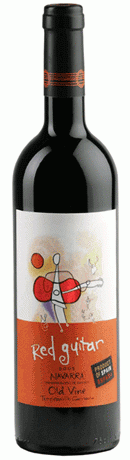
You know that a market niche is expanding when Constellation Brands decides to move into it, as it  has done with Red Guitar, an old vines Tempranillo-Granacha blend from Spain’s Navarra DO that sells for about ten bucks.

Red Guitar is marketed as “a rich, smooth and stylish celebration of the Spanish lifestyle” — a wine for the times, I guess, when consumers are looking for products that let them trade down in terms of price while trading up to a fun, more casual way of living.

Don’t Know Much

I didn’t know very much about the wines of Spain and the Spanish wine industry, so I went back to the classroom this week to try to catch up at a three day seminar on Spain’s wines organized by The Wine Academy of Spain and taught by Esteban Cabezas. My fellow students came mainly from within the wine industry — sommeliers, distributors and retailers. I learned a lot and sampled dozens of great wines. We didn’t taste Red Guitar, but we did survey the market from $5 bottles on up to the highest levels, including table wines, Sherry and sparkling Cavas. Yes, I know. Tough work …

Education is important to the future of the wines of Spain.  As I have written before, the number of unfamiliar regions and grape varieties is a challenge that must be addressed if wines from Spain are to achieve their obvious market potential. Constellation Brands’ decision to market Red Guitar as a “lifestyle” brand probably reflects the difficulty of selling wine from unfamiliar places made with unfamiliar grapes in a market where the international  varietals and styles are the lingua franca. Spanish winemakers need to get the word out — to educate consumers and sellers. Classes like the one I attended are a good step in this direction.

Uncorking the Potential of Wines from Spain

It’s useful to think about Spain’s wine industry using a basic SWOT (Strengths-Weaknesses-Opportunities-Threats) framework. Wines from Spain have many strengths that go beyond their obvious quality in the glass. Spanish food and culture are hot and Spain is a popular tourist destination, factors that can be leveraged in the marketplace. Intangible cultural factors have always helped sell Italian wines, so it is not unreasonable to think that Spain will benefit from them as well. Red Guitar’s marketing strategy is an obvious attempt to do just this.

There are weaknesses, too, of course. While the sparkling Cavas are very popular, offering Champagne quality at beer prices in some cases, other segments of the Spanish industry suffer from consumer ignorance or indifference. Sherry wines from Andalusia, for example, suffer the same challenge as Riesling wines. Consumers think they know what they are (simple, sweet stuff) but they are wrong. The diversity of styles and complexity of the best wines gets lost. For those who know them Sherry wines are the great bargains of the wine world. But most consumers never find out what they are missing. That needs to change.

The amazing diversity of Spain’s table wines is a strength in this market, where consumers are unusually willing to try new products if they perceive good value. But diversity is also a weakness to the extent that it confuses consumers (especially American consumers)  who are looking for a “brand” identity and can’t find it. Spain doesn’t have  a distinct regional identity that would draw in consumers initially and then encourage further experimentation as some other wine producing areas do.

In Search of “Brand Spain”

New Zealand has “brand” Marlborough Sauvignon Blanc, for example, which put that country on the wine map and gave millions of wine drinkers an excuse to try NZ wines. Oregon has its Pinot Noir, which has helped make it a wine region of international note despite its surprisingly small total production. Spain (like Washington State wine in this regard) produces so many different types and styles of wine that no one of them defines it. The regional identity is unclear. This is a barrier when trying to break into new markets, but a strength once a market beachhead has been established.

Although my terrioriste friends cringe when they hear me say this, I think it would be great if Spain had a Mondavi or Antinori who could define a “brand Spain”  in the global market. I think that a number of quality producers are trying to achieve this, but the industry is still pretty fragmented. Perhaps the consolidation that is sure to accompany the current economic downturn will move this process along.

The continuing economic crisis  is a great opportunity for Spain to expand export market share, especially in the United States where the market for wine is till growing in the mid-market segments. Spain, like Argentina, has a reputation for good value and distinctive wines and this is very useful right now.

Catch-22

It is important, however, to avoid being defined by low price alone. Spain’s first and fourth largest export markets (Germany and France) buy mainly low cost wines to stock the shelves of Aldi and similar discount sellers. Spain needs to focus on the UK and US (numbers two and three on their export table) where higher prices and margins are possible.

Another threat to Spain’s success in the international market is the temptation to conform too closely to the international market style (Pancho Campo, Spain’s leading wine authority, called this “the Australian style” in a Skype-dialogue with my class). Wines that are all alike become commodities at some point and it seems to me that Spain, with its already huge lake of surplus wines, wants to get out of that part of the market.

But there’s a Catch-22. It is easier, perhaps, to break into the market with a good value me-too wine. But it is hard to build upon that foundation (hence Australia’s current wine slump). Better to be yourself, distinctive, even quirky, it you can get consumers to give you a try.

As you can see, the prospects for Spain are as complex and multi-dimensional as the wines themselves.  I am optimistic that Spain’s wine industry will navigate this complicated passage successfully. Look for more on this topic in future posts.

Note: I would like to thank the Wine Academy of Spain and Catavino for allowing me to participate in the seminar on wines of Spain. Special thanks to my professor, Estaban Cabezas, and to Simone Spinner.

Tasting Note 8/11/2009: We tried the Red Guitar with dinner tonight and it was completely lacking in distinguishing qualities. It is hard to imagine that anyone who was introduced to the wines of Spain by Red Guitar would try another Spanish wine. Last night, however, we had the Borsao Tres Pichos, an Old Vines Granacha that sells for only a few dollars more, which was completely enchanting. You need to try Spain’s wines to know if you like them, but quality varies (and not just with price), so choose with care.

Wine Festivals Uncorked

jancis

Jancis Robinson and Wine Economist Mike Veseth at the IPNC. Wine Festivals draw celebrity wine critics, who taste, talk, sign books, pose for photos and lend credibility to the event.

Wine festivals have become big business. So big that the Wall Street Journal publishes a guide to upcoming festivals in each Friday’s edition. Click here to see their online August festival listing.There are lots of different wine events, but I’m not talking about charity wine walkabouts here, where you make a small donation, get a few drink tickets and visit tables where random bottles of donated wine are poured. The modern wine festival is a lot more focused and sophisticated and designed to engage wine enthusiasts on a different level.

International Pinot Noir Celebration

The International Pinot Noir Celebration (IPNC) in McMinnville, Oregon is a good example of the state of the art in wine festivals today. Sue and I attended the grand tasting last Sunday (a chance to sample dozens of Pinot Noir in a beautiful but hot outdoor setting), but the real deal for serious Pinot lovers is the full three day festival. For a fee of about $900 per person (not including lodging) you spend your days in tastings, seminars and vineyard tours and your nights under the stars at grand dinners.

The festival attracted winemakers from Oregon, California, Washington, Canada, France, Austria, Australia and New Zealand — quite an international lineup in a recession year.

I’m told that about 400 people attend the big festival — many of them come back year after year — and I would guess that another 300 or so came to the grand tasting on Sunday, so the festival’s total budget must approach a  half-million dollars. More than enough to pay the expenses of wine critics and celebrities (like Jancis Robinson above).

What’s In It For Me?

It is interesting to consider what brings all these people together? Yes, yes, I know that it must ultimately be about buying and selling wine, but that doesn’t fully explain it. No wine typically changes hands at events like this and there are probably more cost effective ways to market wine, from the supplier standpoint, and cheaper ways for consumers to fill their glasses, too. So what’s really going on?

One reason winemakers travel so far to attend these festivals is to communicate with other producers and to taste and compare their wines. Although I still don’t fully understand it, I have observed a subtle kind of dialogue when winemakers taste together. Information about taste, technique and status are all transmitted in the glass. Professors go to conferences and communicate by reading papers. Winemakers go to festivals and taste each others’ wines. It is easy to see who has the more sensible approach to intra-industry communication.

I suspect that there was a lot of producer dialogue at the Pinot festival because the wines that we tasted did not have much in common except the genetic pedigree of the grapes used to make them. Although the world wine market is moving to a lingua franca based upon grape varietal labeling (Chardonnay not Chablis, Pinot Noir not Burgundy) it is very clear that wines made from Pinot Noir grapes can have extraordinarily different textures, flavors and aromas. depending upon who makes them, how and where.

The Old World naming system (based on place not varietal) sure has its merits in the wineglass where terroir is actually experienced — too bad it works so poorly in the cluttered supermarket aisle when wines are bought and sold.

I met more than one winemaker who told me basically that she came to Oregon to prove something — to prove that good Pinot Noir could be made in X  where X = Oregon, Austria, California, Australia — fill in the place — only Burgundy has nothing to prove.

Hemispheric Exchange

A good deal of business gets done whenever producers come together, as you might expect. Partnerships, consulting services, distribution agreements and so forth are frequently arranged.  The McCrone vineyard wines made by Ken Wright Cellars and Ata Rangi are a good case study of the sort of  connections that probably could only happen in face-to-face meetings at a wine festival.

Don and Carole McCrone

Don and Carole McCrone

Don McCrone is a distinguished retired politics professor turned distinguished active winegrower. His vineyard outside of Carlton, Oregon  produces amazing fruit, which winemaker Ken Wright turns into a wonderful single-vineyard bottling. Don and Carole McCrone met the  winemakers from New Zealand’s famous Ata Rangi winery at IPNC a few years ago and were encouraged by them (while tasting each others’ wines, no doubt) to scout out vineyard properties in Martinborough.

Now the McCrones spend half of the year in each hemisphere supplying grapes to both Ken Wright and Ata Rangi for “McCrone Vineyard” wines. Are there any other winegrowers with vineyard designated wines in both hemispheres? It is an extreme example of the sort of cross-fertilization that can happen behind the scenes at major wine festivals.

Relationships not Transactions

I think that the most important function of wine festivals is to establish and build relationships. I always say that wine is good, but wine and a story is better. Wine and a relationship (even a superficial one with the grower, the winemaker, or other wine enthusiasts) is best of all. Doug Tunnell, winemaker at Oregon’s Brick House, explained to me that he brings his wines to IPNC every year to maintain contact with the people who attend. I got the impression that it isn’t so much about selling wine as honoring  relationships.  I think elite makers recognize that investing in relationships with customers (and with wine critics and journalists and all the others who attend these events) pays dividends down the road. Winemaking and relationship-building both require a long-term perspective.

The fact that many people come back to IPNC year after year suggests that they value the relationships, too, both with the producers and with each other. I have written that wine always tastes best when it is shared with others who enjoy and appreciate it. This may be especially true with festivals like IPNC, which tend to attract participants who are especially focused on a particular wine or region.

What I Think I Have Learned

So here is what I think I have learned from my fieldwork at wine festivals so far, both at IPNC and elsewhere, on both sides of the table, both pouring and receiving wine.

Wine festivals aren’t really about the wine, they are about the people, the conversations and the relationships. The role of the wine is to bring the people together and to give them something to share in a way that is impossible to recreate electronically.

Wine, or really the sharing of wine,  is a personal  relational experience in an otherwise increasingly impersonal transactional world.  That people seem to appreciate this sort of experience (and seek it out, even at high monetary cost and even in a deep recession) suggests something about its scarcity, don’t you think?