Chateau Cash Flow: The Rise of House Brand Wine

Decanter.com reports that house brand wine sales are rising in Great Britain even as the overall market slumps.

Retailers are reporting impressive growth of own-label wines as cash-strapped customers look to rein in their spending.

A Datamonitor survey reports 41% of all grocery sales in the UK are now own-label, up from 38.2% in 2008, and wine sales are following the upward trend.

Supermarket retailer Sainsbury’s told decanter.com its own-label wines had grown at double the rate of its wine range this year. A spokeswoman said: ‘Last year we revamped our own-label packaging and we have put a lot of effort behind the range in store and in the media.’

House brands aren’t so important in the U.S. wine market [yet] but they may well be in the future. The best known U.S. house brand wines are Charles Shaw (a.k.a. Two Buck Chuck) at Trader Joe’s and Kirkland Signature at Costco. Big Box retailers Target and Wal-Mart have launched their own house brands in recent months and other retailer’s have commissioned discount brands (not yet closely associated with their names) in an attempt to get a grip on the trading-down market. Look for this trend to continue, especially if the economic downturn persists.

Chateau Cash Flow

House brands are a solution to several problems, which is why they are likely to increase in importance. On the consumer side, they provide buyers with reputational assurances. You might wonder if a $3 wine can be any good, but you are more likely to try it if Trader Joe’s or Wal-Mart stands behind it. As I have written before, a $3 unknown wine at Safeway makes you think “how can it be any good?” while a $3 wine with the Trader Joe’s imprimatur makes you think “how bad can it be?” You might buy the latter but not the former.

The British have years of experience with house brands — it is why they are [for now] the world’s most important wine market and why Britain’s supermarkets are arguably the most sophisticated wine distribution machines on earth. The U.S. is catching up, but Britain still leads.

Reputation is especially important when consumers are trading down, moving into unfamiliar territory on the lower shelves. Decanter reports that while some British consumers are trading down to house brands, building that market, existing customers are trading up within the house brand portfolio! If this trend continues it will be hard to resist the house brand strategy.

Supply Side Wine

House brands have big advantages on the supply-side, too. Producers with surplus wine are often happy to sell it off through house brand bopttlings because it generates cash flow without directly undercutting their own brands and market. In my international economics class we call this “dumping.” You sell off unintended surpluses (of which there are plenty just now) through retailers in a different market segment, allowing you to maintain reputation and price points in the home market. If you start discounting wine to sell it, we have learned, it is sometimes difficult to regain the ground you have lost.

Some British retailers have moved aggressively into the supply chain, buying up grapes and surplus wines and acting as full-fledged negociants, but it isn’t really necessary to make such a large commitment to get into the house brand wine business. There are plenty of regional and national firms who can quickly respond to demand. No large investment is required, cost is low.

House brands can also have a somewhat fluid identity (not tied tightly to a particular region or style), which allows them to benefit from global opportunities, sourcing Sauvignon Blanc from Chile, for example, and Pinot Noir from Northern Italy or the South of France.

The main problem is to be sure that quality is good enough. Otherwise you have put your own brand in jeopardy.

Three Way Battle

The world’s wine markets are a battleground for three models of wine sales. The German model is based upon low cost (one euro per liter) and hard discount sellers like Aldi. The American model is all about corporate brands like Gallo and Constellation Brands. The British model is built upon upscale supermarkets and the house brands they sell.

Recent news suggests that the British model is gaining ground, both in the UK and here in America, where it is the model that drives Costco sales (Trader Joe, on the other hand, uses a version of the German system). It will be interesting to see if this trend persists once the recession eases up.
Wines from Spain: Challenges and Opportunities

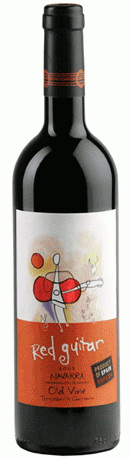
You know that a market niche is expanding when Constellation Brands decides to move into it, as it  has done with Red Guitar, an old vines Tempranillo-Granacha blend from Spain’s Navarra DO that sells for about ten bucks.

Red Guitar is marketed as “a rich, smooth and stylish celebration of the Spanish lifestyle” — a wine for the times, I guess, when consumers are looking for products that let them trade down in terms of price while trading up to a fun, more casual way of living.

Don’t Know Much

I didn’t know very much about the wines of Spain and the Spanish wine industry, so I went back to the classroom this week to try to catch up at a three day seminar on Spain’s wines organized by The Wine Academy of Spain and taught by Esteban Cabezas. My fellow students came mainly from within the wine industry — sommeliers, distributors and retailers. I learned a lot and sampled dozens of great wines. We didn’t taste Red Guitar, but we did survey the market from $5 bottles on up to the highest levels, including table wines, Sherry and sparkling Cavas. Yes, I know. Tough work …

Education is important to the future of the wines of Spain.  As I have written before, the number of unfamiliar regions and grape varieties is a challenge that must be addressed if wines from Spain are to achieve their obvious market potential. Constellation Brands’ decision to market Red Guitar as a “lifestyle” brand probably reflects the difficulty of selling wine from unfamiliar places made with unfamiliar grapes in a market where the international  varietals and styles are the lingua franca. Spanish winemakers need to get the word out — to educate consumers and sellers. Classes like the one I attended are a good step in this direction.

Uncorking the Potential of Wines from Spain

It’s useful to think about Spain’s wine industry using a basic SWOT (Strengths-Weaknesses-Opportunities-Threats) framework. Wines from Spain have many strengths that go beyond their obvious quality in the glass. Spanish food and culture are hot and Spain is a popular tourist destination, factors that can be leveraged in the marketplace. Intangible cultural factors have always helped sell Italian wines, so it is not unreasonable to think that Spain will benefit from them as well. Red Guitar’s marketing strategy is an obvious attempt to do just this.

There are weaknesses, too, of course. While the sparkling Cavas are very popular, offering Champagne quality at beer prices in some cases, other segments of the Spanish industry suffer from consumer ignorance or indifference. Sherry wines from Andalusia, for example, suffer the same challenge as Riesling wines. Consumers think they know what they are (simple, sweet stuff) but they are wrong. The diversity of styles and complexity of the best wines gets lost. For those who know them Sherry wines are the great bargains of the wine world. But most consumers never find out what they are missing. That needs to change.

The amazing diversity of Spain’s table wines is a strength in this market, where consumers are unusually willing to try new products if they perceive good value. But diversity is also a weakness to the extent that it confuses consumers (especially American consumers)  who are looking for a “brand” identity and can’t find it. Spain doesn’t have  a distinct regional identity that would draw in consumers initially and then encourage further experimentation as some other wine producing areas do.

In Search of “Brand Spain”

New Zealand has “brand” Marlborough Sauvignon Blanc, for example, which put that country on the wine map and gave millions of wine drinkers an excuse to try NZ wines. Oregon has its Pinot Noir, which has helped make it a wine region of international note despite its surprisingly small total production. Spain (like Washington State wine in this regard) produces so many different types and styles of wine that no one of them defines it. The regional identity is unclear. This is a barrier when trying to break into new markets, but a strength once a market beachhead has been established.

Although my terrioriste friends cringe when they hear me say this, I think it would be great if Spain had a Mondavi or Antinori who could define a “brand Spain”  in the global market. I think that a number of quality producers are trying to achieve this, but the industry is still pretty fragmented. Perhaps the consolidation that is sure to accompany the current economic downturn will move this process along.

The continuing economic crisis  is a great opportunity for Spain to expand export market share, especially in the United States where the market for wine is till growing in the mid-market segments. Spain, like Argentina, has a reputation for good value and distinctive wines and this is very useful right now.

Catch-22

It is important, however, to avoid being defined by low price alone. Spain’s first and fourth largest export markets (Germany and France) buy mainly low cost wines to stock the shelves of Aldi and similar discount sellers. Spain needs to focus on the UK and US (numbers two and three on their export table) where higher prices and margins are possible.

Another threat to Spain’s success in the international market is the temptation to conform too closely to the international market style (Pancho Campo, Spain’s leading wine authority, called this “the Australian style” in a Skype-dialogue with my class). Wines that are all alike become commodities at some point and it seems to me that Spain, with its already huge lake of surplus wines, wants to get out of that part of the market.

But there’s a Catch-22. It is easier, perhaps, to break into the market with a good value me-too wine. But it is hard to build upon that foundation (hence Australia’s current wine slump). Better to be yourself, distinctive, even quirky, it you can get consumers to give you a try.

As you can see, the prospects for Spain are as complex and multi-dimensional as the wines themselves.  I am optimistic that Spain’s wine industry will navigate this complicated passage successfully. Look for more on this topic in future posts.

Note: I would like to thank the Wine Academy of Spain and Catavino for allowing me to participate in the seminar on wines of Spain. Special thanks to my professor, Estaban Cabezas, and to Simone Spinner.

Tasting Note 8/11/2009: We tried the Red Guitar with dinner tonight and it was completely lacking in distinguishing qualities. It is hard to imagine that anyone who was introduced to the wines of Spain by Red Guitar would try another Spanish wine. Last night, however, we had the Borsao Tres Pichos, an Old Vines Granacha that sells for only a few dollars more, which was completely enchanting. You need to try Spain’s wines to know if you like them, but quality varies (and not just with price), so choose with care.

The #1 Sauvignon Blanc

Decanter.com reports that Nobilo Marlborough Sauvignon Blanc has overtaken Kendall Jackson as the best selling Sauvignon Blanc in the United States. The ranking is based upon sales volume, but the wines retail for about the same $10 to $12 price,  so Nobilo probably ranks first by value as well. An amazing achievement, given the many obvious challenges the New Zealand wine industry faces in terms of size, production cost, shipping distances, access to US distribution and so on.

A Matter of Style

It is interesting to consider how Nobilo and the New Zealand industry have  managed to achieve this success. The first reason is the distinctive quality of Marlborough Sauvignon Blanc itself. Even wine critics who don’t think very highly of Sauvignon Blanc in general (I’m talking about you, Jancis Robinson) acknowledge that the Marlborough wines are distinctive and that the best of them are truly exceptional. In my house they set the standard for Sauvignon Blanc.

Why are these wines so good (and so popular)? Winemakers always start with the vineyard and it is certainly true that Marlborough seems ideally suited to produce Sauvignon Blanc grapes. (Ironically, no grapes at all were grown there before the mid-1970s). The skills of the winemakers are also important. The distinctive style of the wines is another factor. The June 2009 Wine Business Monthly includes a fine article by Curtis Phillips on Sauvignon Blanc yeasts that nicely explains the NZ style. NZ SB, he writes, emphasizes a varietal style, letting the fruit speak forcefully. The French SB style is “anti-varietal,” he says, emphasizing texture and minerality over fruit aromas and flavors.

Finally there is the oak-influenced style, which originated in France but was made famous by Mondavi as Fumé Blanc. This barrel-fermented SB style remains very popular in the U.S., but has obviously been eclipsed in the marketplace by the fruit-forward Marlborough product.

The New Zealand varietal style is a hot commodity. New Zealand producers should hope that it stays hot and doesn’t fade as some popular regional styles have done (I’m thinking about how quickly Australian Shiraz has fallen from favor).

The International Influence

Nobilo’s rise to #1 in the US market is not an accident, according to the Decanter.com article. Nobilo is a Constellation Brands product — one of five New Zealand export brands of ConstellationNZ (see logos above).  Joe Stanton, the ConstellationNZ CEO, explains that his company’s strategy was to make Nobilo the top US SB by focusing on “traditional” wine buyers and giving them what they expect in the way of packaging for premium wine: cork instead of screw-cap, for example, and flint-colored glass bottles instead of traditional French green. Plus, of course, the intense Marlborough aromas and flavors. New wine in old bottles (and closures), I guess, and it worked.

ConstellationNZ accounts for 40% of all NZ wine sold in the US — an astonishing figure, but understandable given the strong brands that it has acquired (Nobilo, Kim Crawford, Drylands, Selaks) or built (Monkey Bay)and the efficient distribution system that has evolved to get these wines and all the other Constellation products on store shelves and restaurant wine lists.

In fact, the New Zealand industry is dominated by foreign-owned wineries, as wine writer Michael Cooper points out in the new edition of his fine Wine Atlas of New Zealand. Of the top wine producers only two (Delegat’s and Villa Maria) are Kiwi-owned. The largest producer is Pernod Ricard NZ (formerly Montana wines), part of the big French drinks group. Pernod manages 25 NZ brands according to their website, including of course Montana (sold as Brancott Estate in the US), Corbans, Church Road and others.

The most famous NZ wine — Cloudy Bay — is owned by LVMH Möet Hennesy-Louis Vuitton, the French luxury goods conglomerate.  Matua Valley, another leading NZ producer, is part of the Australian Foster’s Group. The list goes on.

It is tempting to consider the pluses and minuses of international ownership as Michael Cooper does briefly in the article linked above. This is a topic that I plan to analyze in more detail my next book. In the meantime, however, it is perhaps best to consider how the combination of the local (New Zealand’s wonderful terroir) and the global (big multinationals like Constellation and Pernod Ricard) have combined to both produce New Zealand’s tasty wines and to deliver them to our doorsteps.

New Zealand has done specutacularly well in the global wine market so far. What lies ahead? Watch this space!

AVAs: Good, Bad or Ugly?

The birth of a new AVA (American Viticultural Area) is generally greeted like the birth of a baby – a good thing, a cause for celebration.  So a recent Wine Spectator article was somewhat bittersweet – it announced two successful births (Snipes Mountain AVA and Lake Chelan AVA – both in Washington State) and one failure.  But I’m not sure that that “two cheers” is necessarily the right toast (and I found myself quoted to this effect in the Wine Spectator).  My problem, I guess, is that I can’t stop thinking like an economist, even when it comes to good news like new AVAs.

It isn’t that AVAs are bad, it is just that they are complicated and new AVAs produce both benefits, which are celebrated, and costs, which economists like me can’t seem to ignore.

Good or Bad?

As I have said in a pervious post, the American Viticultural Area is an ill-defined concept.  It is a geographic indicator, of course, telling the buyer that a high percentage of the grapes used to make a particular wine come from a specific geographic area, but its significance beyond that is unclear.

An AVA doesn’t necessarily indicate a particular style of wine, for example, the way some European AOC rules do.  AOC protocols often specify region, grape varieties, levels of ripeness and even the nature of particular blends that are permitted or sometimes required.  Chianti is a region in Tuscany, for example, but it is also a recipe (albeit a flexible recipe) for the wines that carry that label.  There can be great variation among wines from a given AOC, but the idea is that they represent variations on a theme rather than completely different wines.

AVAs don’t necessarily define terroir either.  Many AVAs are quite large and contain many different soil types and microclimates.  The Napa Valley AVA, for example, encompasses rather different condition in the North than the South and on the hillsides and valley floor.  The Columbia Valley AVA in Washington State takes this to the next level in terms of terroir diversity.

Even the relatively small Snipes Mountain AVA (a sub-AVA of the Columbia Valley) includes rather dramatic differences in growing conditions.  As Kevin Pogue of VinTerra Consulting said in a comment on a previous Wine Economist post:

It’s impossible to equate US AVAs with terroir. They’re just too big and there’s too much variability in all the physical parameters (soil, bedrock, climate, geomorphology). I had temperature monitors on Snipes Mountain (one of the smallest AVAs) during the growing season last year, and they showed huge variations in several important climate parameters. The top part of Snipes Mountain rises above the cold air pool that regularly forms in the Yakima Valley and so it’s much warmer and has a much longer growing season. The Walla Walla AVA has at least 4 distinct soil terroirs and the average annual rainfall varies from 7 to 24 inches within its boundaries!

In Economics Veritas

While the viticultural idea of AVAs is ill-defined the economic idea of AVAs is relatively clear.  AVAs are brands, but not the type of brands you are used to thinking of.  Brands have a bad reputation among wine consumers because they are associated with insipid wines sold as package goods – Franzia, Yellow Tail, Two Buck Chuck.  While these wines clearly serve a purpose in the marketplace and are obviously a satisfactory choice to the people who buy them, they are seen by wine enthusiasts as an insult to the concept of fine wine.  They are industrial wine, not terroir wine, if you see what I mean.

Economists don’t react so strongly to the idea of a brand, however.  To us brands are just devices that producers use to send signals to buyers in markets with costly information. You may or may not like to eat at McDonalds, for example, but you know what to expect when you go there.  Brands do the same thing for Budweiser, Coca Cola and Starbucks.

Private brands do the same thing for wines if you think about Robert Mondavi, Clos du Val or Screaming Eagle. You have a good idea of what you are getting in terms of style and quality because producers invest in the brands to establish reputations.  Having a well known and reliable brand is a great advantage in the marketplace.

The main difference between private brands like these and AVAs is this: AVAs are communal brands.  They don’t belong to any single producer but rather to anyone who sources grapes from the region.  Hence the great difference in style that appears as different makers first seek the AVA designation to differentiate themselves from wineries in other areas and then further to differentiate themselves from other makers within the AVA.  The result is not necessarily harmonious and so the AVA concept loses value to consumers.

Essentially the problem is that the incentive to invest in the communal brand is ultimately weaker than the incentive to invest in the private brand once the AVA has been established.  This makes sense since benefits from an improved communal brand must be shared while benefits from improving your own private brand are yours alone. The market significance of the AVA can quickly disappear.

The problem gets worse as AVAs increase in number, making it more and more difficult for consumers to understand what qualities are associated with each.  As I say in the Wine Spectator article, each new AVA benefits a small set of producers by giving them a new brand, but the collective result (the number of AVAs is now approaching 200) is in fact to reduce the significance of AVAs generally.  I think it is possible that private brands gain market power as collective AVAs proliferate.  And that’s exactly the opposite of what AVAs are supposed to do.

The Ugly Side

I felt bad in raising my doubts about AVAs because I know and admire some of the winemakers in the new Lake Chelan AVA (especially Tsillan Cellars and Nefarious Cellars) and I didn’t want to rain on their parade. But I stopped feeling guilty when I discovered an article by A to Z Wineworks CEO Bill Hatcher on the Oregon Wine Press website. The continued proliferation of AVAs and sub-AVAs in Oregon, Bill says, isn’t good or even bad.  It’s downright ugly!

Oregon’s wine industry is tiny compared to California and small relative to Washington State.  But it is big in AVAs, as the map above indicates, with sixteen AVAs overall and six sub AVAs within the Willamette Valley region itself.  Wow!  Bill writes that …

Our fixation on sub-appellations at the expense of raising the profile of Oregon over the past years is coming back to haunt us. As the economy tailspins, consumers, restaurateurs and retailers are returning to familiar roots. The results are pruned wine lists, repetitive shelf facings of monolithic national brands and small wineries being culled from wholesaler books. Gone are the halcyon days when someone picked up a $50 bottle of Oregon Pinot Noir in Memphis and said, “Cool, I didn’t know they were making wine in Oregon; let’s give it a try.”

If the majority of Americans cannot point to Iraq on a world map, do we really expect them to pinpoint the Eola Hills or Chehalem Mountains, let alone deconstruct the subtleties between the two? Further underscoring that presumptiveness, a recent study commissioned by the Oregon Wine Board revealed that over half the respondents in our target market were largely unfamiliar with Oregon as a wine-producing region. The sub-appellation movement reached absurdity with the Snake River AVA, containing one Oregon vineyard and no wineries, meaning that we had, in fact, finally parsed an appellation to someone’s backyard.

Bill Hatcher is smart and bold.  His A to Z Wineworks is now the largest single producer in Oregon and he thus has an unusually strong interest in seeing the Oregon brand strengthened since this would strengthen his own brand as well.  He argues that a complex web of sub-AVAs provides few benefits and potentially large costs. An ugly situation, but an understandable one.  It is what Mancur Olson characterized as the tension between narrow and encompassing interests. Bill Hatcher concludes

The industry has come to be driven more by politics and narrow self-interest rather than collective marketing economics or common sense, a polemic we can no longer afford (if we ever could) in these precarious times. More than a few wineries will fail in the coming months and more than a few vineyards will not be harvested. This is not the time for intellectually bankrupt parlor debates as to whose soil is redder and whose vineyard practices are greener, but rather a time to unite and underwrite the commonwealth of Oregon.

The economic crisis is likely to intensify the tension between narrow and encompassing interests and between private and communal brands.  The strong are likely to get stronger in this environment, I think, and as Bill Hatcher suggests, some of the weak will fade away.

Wine, Recession and Argentina

The global economic crisis has been bad news for Argentina, but good news so far for Argentinian wine. Will the wine part of the story have a happy ending or, like so many Argentinian economic booms, turn eventually to bust?

Bad News and Good

The Economist Intelligence Unit reports that Argentina’s economy has been hard hit by the economic crisis. The economic forecast is gloomy (see below) with the only good news being that inflation, while still high, is falling.

Given rapidly declining business and consumer confidence, the government’s fiscal stimulus measures will have a limited effect, and we expect the economy to contract by 3% in 2009, before only a mild recovery in 2010.

Unofficially measured inflation will ease to 10-15% in 2009, as private demand falls. The official rate will end 2009 at 6.8%, with a similar rate in 2010.

The peso will continue to depreciate in 2009 owing to weaker foreign-exchange inflows, before the pace of depreciation slows in 2010. The current-account position will weaken in 2009-10.

The Argentinian wine economy situation is sunnier.  The May 2009 issue of Wine Business Monthly includes two reports that paint a bright picture of Argentinian wine trends.

The first story is a competitive analysis of Argentina wine in the United States market.  It reports that U.S. imports of Argentinian wine have risen dramatically in recent years, from 2.6 million cases in 2006 to 4.3 million in 2008.  The total value of Argentinian wine in the U.S. rose from $75 million to $146 million in this period.

It is important to put this increase in perspective, however. Total Argentinian imports are roughly equal to the annual output of a single US winemaker, Washington State’s Chateau Ste. Michelle. So the Argentinian presence is rising, but from a modest base.

Molto Malbec

Unsurprisingly, Malbec is Argentina’s calling card in the U.S. market. Malbec’s share of Argentinian wine imports increased from 35% to 48% over 2006-2008 measured by volume and from 44% to 55% measured by dollar value. I was interested to learn that Argentina wine sales are rising at all price points, not just in the value brand segment as you might imagine.  But value is still important.  Argentinian wine prices are rising, but still relatively low.  The article reports that the average FOB price has increased from $29 to $33 per standard 9-liter case.

In the same issue the results of the Nielsen company wine market survey for the period ending 2/7/2009 are reported.  Argentinian table wine imports were up 40% by dollar value for most recent year.  This compares to a 10 percent increase for Chile, one percent for Italy and a one percent decline for Australia.  Overall growth in imported wines was 2.4 percent by dollar value for the most recent year.

The 40 % annual rise is spectacular, but  Argentinian wines account for just 1.4 percent of U.S. domestic wine volume compared with two percent for Chile, nine percent for Australia, almost 10 percent for Italy. This shows that Argentina either has a lot of room to grow in the U.S. market, as optimists will perceive, or a lot of work to do to escape niche player status.

American Exceptionalism

I think the Argentina producers were wise to focus on the U.S. wine market for their export surge.  Although the European Union is more important to Argentina in other major export sectors, the U.S. is the target wine market, and that’s a good thing in this economic environment.  EU wine consumption has long been in decline because of demographic and market shifts, for example, while wine sales have been rising in the U.S.

The recession is likely to depress wine sales growth in both the U.S. and the EU, but the impact will be less in the U.S., I believe, if only because I think the recession will be shorter here. My current thinking is that the U.S. economy will benefit from greater short term fiscal and monetary stimulus, compared with the EU, and more effective medium term structural adjustment.  That said, the recession is and will be very severe.

Early U.S. evidence suggests that wine sales have actually continued to rise during in the first year of the recession, when measured by case volume, although the dollar value of those sales has declined as consumers trade down.

Opportunities and Threats

Reading the latest articles on WineSur, a noteworthy Argentinian industry website,  it pretty clear that Argentina producers appreciate both the opportunities and threats inherent in the current situation.  The opportunities — to establish a market presence built around good value and the rising popularity of Malbec — are significant. But I think it must be hard for Argentinians to see silver linings without looking around for associated dark clouds — their country has suffered repeatedly from the global market booms and busts.

Some of the threats are strictly economic. Argentinian producers are currently benefiting from a falling peso value relative to the US dollar, for example, which helps their wine hit market-friendly price points in the US.  But the falling currency is in part a reflection of high domestic inflation rates, which ultimately lead to higher production costs. A lot will depend upon how the inflation (cost) and exchange rate (export price) factors balance out in the future.

Some of the threats relate more to the fickle nature of the wine market itself.  Malbec and Argentina are nearly synonymous today, but this could change as other wine regions adopt their signature varietal. A recent visit to the Walla Walla AVA, for example, found many producers experimenting (successfully, I think) with Malbec.  Argentina has the first mover advantage in Malbec and must capitalize on this because it will face more competition in the future.  This happened to New Zealand (Sauvignon Blanc) and Australia (Shiraz) and I do not think Argentina will be different.

In exploiting its Malbec lead Argentina will need to strike another difficult balance, between establishing a useful “house style” that will build market identity and letting this deteriorate into a stylistic “monoculture” that soon bores consumers.  It seems to me that Australian Shiraz is currently suffering from the “monoculture” curse, perhaps unfairly, while New Zealand still benefits from a popular “house style,” although I’m not sure how much longer it can ride the gooseberry wave, especially given the vast quantities of Sauvignon Blanc that need to be sold.

Argentina is at a crossroads at a critical moment and moving in the right direction.  Count me cautiously optimistic regarding the future of Argentinian wine.

Update: Just hours after I posted this piece about Argentina the following item appeared on the Decanter.com website.

Argentine wine harvest down 25%

May 1, 2009  / Jimmy Langman

Due to climatic conditions, this year’s wine harvest in Argentina will be down 25% as compared to last year.

According to Argentina’s National Wine Institute, hail in some provinces, and overall higher temperatures in February and March, are factors in the lower production output this year.

The lower production this year has occurred despite Argentina having a 12% increase in land under cultivation for wine grapes.

Guillermo Garcia, president of the National Wine Institute, said: ‘If there had not been an international crisis, we would not have been able to provide wine to countries with developed markets.’

Garcia added that Argentine wine companies need to begin keeping more than three months of stock on hand to make up for such production shortfalls.

Exequiel Barros of the Mendoza-based Caucasia Wine Thinking consultancy told decanter.com that many Argentine wineries are worried about their ability to supply medium-priced wines but added: ‘We need to see how the international outlook develops this year before we can dare to make any projections.’

In Chile, wine growing areas that are not irrigated, such as Cauquenes in the Maule Valley, are predicting a similarly low harvest, with an estimated drop in production from 30 to 40% because of higher temperatures and low rainfall.

Most wineries in Chile, however, are reporting a good harvest. ‘The lack of rain has been good for this year’s harvest. But wineries in the far south, such as in the Bio Bio, may experience changes to quality because of the higher temperatures,’ said Edmundo Bordeu, professor of oenology at Chile’s Catholic University.

Cooperatives and Fair Trade Wine: Unraveling the Paradox

My previous blog entry (see below) presented a paradox. Fair Trade wine might be an effective “ethical consumption” good, I speculated, because wine is one of the few products where consumers routinely know something about production conditions (the who, what, where, when, how and why) and so might be motivated by ethical considerations, such as the equity of grower payments or environmental impacts.

But Fair Trade programs are typically organized through grower cooperatives and coops have a famously bad reputation for quality (see previous blog entry for details). So the paradox is that  while wine might be an ideal Fair Trade product from the consumer standpoint, the cooperative production model dooms it to failure because of low production quality.

Sad, if true.  But is it?

Re-Thinking Wine Cooperatives

It is time that we reconsidered wine cooperatives because the old stereotypes do not always hold. From a statistical standpoint, cooperatives are far more important than most of us suspect.  My guess is that more of the world’s wine is made by cooperatives than by the all the huge multinational wine corporations put together.

The Oxford Companion to Wine reports that over half of all French wine production is by cooperatives (caves coopératives).  About two-thirds of German growers are coop (winzeverein) members.  Italian cooperatives (cantina sociale — see the vintage wine poster above) are responsible for as much as 60% of total national output.  Similar high proportions are reported for Spain and Portugal.  That’s a lot of wine!

Since France, Italy and Spain are the largest wine producers by various measures, it follows that a huge proportion ( perhaps 25% to 30%) of the world’s wine  comes from cooperative cellars.  Gallo, by comparison, accounts for about three percent of world production, if the calculations I made a few years ago are correct.

Within this huge puddle of coop wine there is great diversity.  Certainly there is a lot of bad or mediocre wine. Reunite, the Italian cooperative famous for its sweet Lambrusco, is an easy target if only because it is so large and ubiquitous. Some people say that Reunite destroyed the reputation of  Italian wine in the United States in the 1970s with its low quality offerings.

But there are a lot of well-made cooperative products, too. A recent supplement to Decanter magazine, for example, highlighted a number of very successful Italian cooperatives, including San Michele Appiano and Cantina Terlano in Alto Adige and Produttori del Barbaresco in Piedmont. These cooperative make some of the finest wines in Italy, consistently receiving top marks (three glasses) from Gambero Rosso.

Ugly, Bad and Good

So why do some cooperatives produce fine wine and others make plonk — and which kind of wine will Fair Trade coops make?  There is no simple answer to this question because there are several different motives that drive cooperatives with correspondingly different results.

Sad to say, some European cooperatives find themselves organized around national and EU regulations that have until recently given special benefits to cooperatives.  These are subsidy cooperatives and they have had little incentive to quality produce wine because they have been insulated from market forces. Changes in EU wine rules should put these cooperatives on the endangered species list.

Then there the political cooperatives.  Many of the coops organized in the 1920s and 1930s were motivated more or less by socialist or communist political ideologies. Their desire to earn short run revenue, and to share it equitably, often conflicts with the long run need to protect quality and develop markets.  If solidarity requires that no member’s grapes be turned away, no matter how poor their condition, how can good wine result?

Market forces are forcing the political cooperatives to upgrade their standards, however.  Payments are generally no longer based on tonnage alone.  Now ripeness (potential alcohol) and other factors are also considered in many cases. It is a necessary step in the right direction.

Finally, there is a group that you might call the efficiency cooperatives. They are motivated by fundamental market factors rather than subsidies or grower solidarity.  This is a diverse group of winegrowers who share resources in order to be able to afford costly up-to-date technology, the services of skilled winemakers (including the controversial flying winemakers) and even marketing expertise.

The best of these wineries, like Produttori del Barbaresco, have created valuable brands that must be protected at all costs.  Quality wine is the objective, cooperation is mainly the means that allows small individual growers to reap some of the advantages of a large scale operation.

Back to Fair Trade Wine

So what kind of wine will Fair Trade cooperatives produce?  The answer is that some of it will likely be very good,  as I have reported earlier.  But just as there is no reason to believe that all cooperative wine will be bad, there is nothing to say that all Fair Trade cooperative wine will be good.  It will depend upon the motives and actions of the individual producers.  Fair Trade wine, in other words, will be like other wine. Or at least that is my guess.

And that’s too bad, because the advocates of Fair Trade products would love it if “Fair Trade” became a brand that consumers associated with quality (and perhaps it will be).  But being Fair Trade won’t be enough. This wine, like others, will have to earn a place on the table.

Note: Thanks to Martin Cubertafond at Sciences-Po in Paris for insightful correspondence on this topic.

Asking the Right Questions about Wine

It’s finals week at the University of Puget Sound, so I’m thinking about the question, what wine goes best with final exams and term papers?  A sweet wine, to capture the sweet taste of success?  Some bubbles to celebrate finishing one set of tasks and moving on?  Or maybe a bitter sweet wine, because moving on inevitably means leaving some people and relationships behind?  Hard to figure how best to match a wine with all these emotions. It’s a difficult question.

Dump Bucket Drills

But I know one wine that doesn’t match up very well.  My class on “The Idea of Wine” organized an informal tasting on Monday to celebrate finishing their term papers.  The main project was a blind tasting of inexpensive (some were very inexpensive) Merlots.  I was impressed with the students’ serious efforts to evaluate and score the wine and their recently acquired (and, for college students, somewhat unnatural) propensity to use the dump bucket.

We tasted other wines including a Chinese wine that Brian West personally hauled back from Beijing a few years ago.  It was a 1999 Changyu Cabernet Sauvignon.  Changyu is China’s oldest winery and a good example of a mid-market Chinese wine (I wrote about Changyu and the Chinese wine industry in The China Wine Syndrome).

I found a video review of this wine on the web (click here to view it, but be forewarned that there is some harsh language used by the reviewer) that described the wine as being all about ashtray and coffee ground flavors with aromas of urinal crust.  Hard to imagine.  Until you taste it, that is.  The description is right on the money.

I’ve read many optimistic reports on the Chinese wine industry, mostly based on high potential production volumes and not so much on quality.  The quality wasn’t there in 1999, based on this wine, but there is reason to believe that things are changing.  I sure hope they are! The dump bucket got good use on this one.

Hard Heads, Soft Hearts

I’m reading my students’ final papers now – they are quite good, by the way – and I thought you might be interested in their topics.  I gave them great freedom to choose topics that interested them or related to their academic majors.  You can find a list of the paper titles at the end of this post.

Most people think education is about learning the right answers, and this is certainly important, but I think the more valuable skill is learning to ask the right questions, and this is true about wine.  I was impressed by the creativity of the questions my students asked.

One student, a Finance major, asked why Treasury bill auctions and wine auctions have different structures and what the impacts might be? A very interesting theoretical treatment. Another student did fieldwork in three wine retailers to try to understand the actions and interactions of wine buyers and wine sellers. The result was a revealing first person account of wine consumer behavior.  An economics student who grew up in Napa Valley examined issues relating to migrant labor there, combining economic theory, empirical data and personal observation very effectively.

All the papers were very interesting. My favorite title: “How corks are being screwed over” (an analysis of the cork versus screw cap debate).  Imagine, I get paid to read this!

Looking at the list of paper titles, I’m struck by how many students were drawn to issues of sustainable or ethical production and consumption:  organic wine, climate change, biodynamic wine, fair trade wine and so forth.  In general their analysis was thorough, pointed and objective.  They have “soft hearts” and “hard heads,” as Princeton Economist Alan Blinder would say.  They care about social issues, but think about them critically.  Blinder says (and I agree) that’s better than the other possible combinations: soft head/hard heart, soft heart/soft head or hard head and heart.

  • Comparative analysis of changes in Treasury auctions versus global wine auctions
  • An ethnographic study of wine consumer trends
  • Hispanic workers in California’s wine industry
  • Climate Change: what it means for Spanish vineyards.
  • Climate change and the wine industry
  • TetraPaks and cans: the alternative packaging of wine
  • Movement from niche markets to mainstream: prospects and challenges for ethical consumption in the wine market
  • The terroir of equality: fair trade wine
  • Organic wine: the beginning of redefining fine wine
  • Oak in Wine: an exploration into differences.
  • Green wine: ideas and details of sustainable wine
  • Wine’s historical and modern role in religion
  • Of vines and witchcraft: biodynamic wine
  • India’s wine prospects
  • Old world crash: wine’s changing face in the globalized market
  • What makes that bottle so expensive?
  • How corks are being screwed over
  • Aging wines: from barrels to bottles
  • Drowning in the wine lake
  • Wine brands: friend or foe?
  • Wine tourism and economic development
  • Bordeaux versus Burgundy: why the rivalry matters
  • Transitioning wine industries: assessing development strategies in the wine industry

The Rise (and Fall?) of Celebrity Wine

We live in the age of Celebrity.  People are celebrated for their achievements in sports, politics and the arts.  Some people are even celebrated for their lack of achievement — famous for being famous, as the saying goes.  I won’t name names, but you know what I mean. Celebrities are everyone — in the news, on TV and all around us through ads and product endorsements.

People Magazine’s Wine

Lil Jon

Lil Jon, Celebrity Winemaker

So we shouldn’t be surprised that there are celebrity wines, too.  Some wines simply use a celebrity name as a marketing tool.  I think the Martha Stewart label falls into this category (the wine is made by Gallo). Other celebrity wines are more than just marketing projects (although having a famous name doesn’t hurt).  The Fess Parker and Francis Ford Coppola wines come to mind here.

Celebrity wines are hot, or at least that’s what the indicators say.  People magazine features an article on celebrity wines in their November 10, 2008 issue.  People asked Gary Vaynerchuck, a celebrity wine critic, to rate the wines of four celebrity wine makers.  Hip-hop artist Lil Jon’s Little Jonathan Winery Chardonnay ($15.99) scored a solid 89 points.  Sopranos star Lorraine Bracco’s Italian-made Pinot Grigio ($11.99) earned an 86+ rating.  Mötley Crüe rocker Vince Neil’s $9 Petite Sirah is an 88-point good buy, Gary says.  And the $20 Victory Rosé from Olympic figure skater Peggy Fleming’s winery, Fleming-Jenkins, received 87 points. (Fleming donates $2 to breast cancer research for each bottle of this pink wine she sells — a use of celebrity clout that is difficult to criticize.)

The Nielsen Report

Maybe you aren’t entirely comfortable taking wine recommendations (or wine market analysis) from the pages of People magazine. If so, then a study released by The Nielsen Company (market research experts) might interest you.

The Nielsen data, which do not reflect the impact of the current economic crisis, indicate that grocery store sales of celebrity wine grew by nearly 19 percent in 2007, albeit from a low base (the celebrity wine category is still a small market segment — less than one percent).

The average price of the celebrity wines, $8.50, is higher than the supermarket average of $5.75, according to Nielsen. Unsurprisingly, the Nielsen report focuses on marketing and distribution (not the quality of the wines themselves) as the key factors driving sales growth.

“Several factors are fueling the growth of celebrity wines,” said Hurst.  “First, existing brands are expanding and gaining new distribution through new line extensions.  Second, more celebrities have launched their own brands in the past year or have had suppliers launch products under their names.   As these brands have proven themselves, they’ve gained distribution in other retail outlets, which has further stimulated growth.   And third, savvy marketers leverage the ‘celebrity’ benefit into expanded marketing programs via in-store vehicles, outdoor events and traditional and online media.”

Celebrity Wine Myths

Like the “critter wines” that they superficially resemble, celebrity wines are associated with a number of myths that should be briefly considered.

Myth #1: Celebrity wines are an American phenomenon. Alas, no.  One of the most famous celebrity winemakers is the French actor Gerard Depardieu, who now owns vineyards in Bordeaux, Languedoc, Spain, Morocco and Argentina in partnership with wine tycoon Bernard Magrez. Ernie Els, the South African golfer, has a line of wines from his home country, following the example set by Australian Greg Norman. New Zealand actor Sam Neil has an estate in Central Otago.

Myth #2: Celebrity wines are bad wines. No again, although I admit I haven’t tried very many of them.  The studies I have found suggest that celebrity wines are just like wines generally, you can find examples that are good, bad and maybe even a few that are ugly (hey — good, bad, ugly — that would make a great name for a line of Clint Eastwood wines!).  Because celebrities have an incentive to protect their personal “brands,” I suspect they try to avoid associating their names with really foul products. At least some of the celebrity winemakers take a real personal interest in their products, which is likely to make a difference in quality.

Some celebrity wines are excellent, which is easy to understand. Celebrity is a powerful force in today’s world and celebrity winemakers can often leverage their fame through connections and associations that contribute to wine quality.  You know what I mean — privileged access to quality grapes, personal advice from talented professionals, and so forth.  Football hero Drew Bledsoe is opening a winery called Doubleback in Wallla Walla, his hometown. I think he is bound to make good wine because so many wine professionals have taken an interest in it.  Wine people, even prominent ones, are only human and like to be associated with heroes and to participate in their projects. The wine can’t help but benefit form this attention.

Myth #3: Celebrity wines are bad for the wine business. Celebrity brands draw attention away from “real wine,” this argument goes, and only cheapen and commodify the idea of wine.  There is obviously some truth to this, especially if we consider multi-product lifestyle brands that have expanded to include a wine component in their portfolios– Martha Stewart, for example, and Sir Richard Branson’s Virgin empire. It seems to me that these associations diminish wine as a distinct product by reducing it to “just another” Martha S or Virgin label.

But most celebrity wines that I’ve seen don’t fit this mold and create a different kind of celebrity association.  These products may benefit the wine market by attracting new customers and encouraging wine drinkers to try new types of wine.  They also probably distort the market a bit, making it marginally more difficult for non-celebrity wines to get distribution in some market segments.  On balance, the influence of celebrities is probably positive since they draw public attention to wine.  Even the readers of People now know a little more about wine thanks to the Lil Jon piece.

The Future of Celebrity Wine

Prediction is difficult, economists like to say, especially about the future.  But I’ll hazard a guess about the future of celebrity wine.  As a category of wines I think celebrity wine will remain a small but vital niche.  Wine is part of society, so why should wine be excluded from the celebrity effect?

Some celebrity wines will thrive, but I don’t think it will be because of a famous name.  In the long run I believe that the quality of the wine is what matters.  I cite Fess Parker as evidence in this regard.  The wines are very good and speak for themselves.  The Fess Parker name and Davey Crockett association hardly matters after you’ve pulled the cork.

But most celebrity wines will rise and fall in sync with the notorious name on the label. Celebrity itself tends to be fleeting and I suspect that most celebrity wines will be here today and gone tomorrow, replaced by someone and something new. Fame’s famous quarter hour passes quickly these days as the media moves on to tomorrow’s headline and a new People profile appears.

[Note: Special thanks to Emily Gordon for bringing the People article to my attention.]

Australian Winequake

Market tremors seem to be felt everywhere — food, fuel, money, natural resources. And now in the wine world.

Wine Tremors

It has been hard to ignore the feeling of instability in the wine world for the last few months. There has been a lot of shifting around of brands and alliances, as if the big wine producers are feeling off balance and need to get recentered. In January, for example, Constellation Brands, the world’s largest wine company, sold off their high volume Almeden and Inglenook brands along with the Paul Masson winery to The Wine Group. The reported logic was that Constellation wanted to focus more on premium and superpremium wines. The Wine Group is a privately held San Francisco-based company that has its roots in Coca Cola’s old wine division. (See Note below.)  It makes and markets a variety of high volume brands, including Franzia, Concannon, Corbett Canyon, Glen Ellen, Mogen David and several international brands.. It is the third largest wine company in the United States, behind on Gallo and Constellation, with 44 million case sales in 2007.

I felt another tremor on Tuesday, when a Decanter.com story reported that Constellation had sold more of its wine brands, this time to a new Healdsburg, California-based group called Ascentia Wine Estates. The wineries are Geyser Peak Winery in Alexander Valley, Atlas Peak in Napa, Sonoma Valley’s Buena Vista Carneros, Gary Farrell Winery, Washington’s Columbia Winery and Covey Run, and Idaho’s Ste Chapelle. They produce about a million cases of wine a year between them. Vineyards in Napa and Sonoma county were included in the $209 million deal. The logic, the article said, was to allow Constellation to continue to sharpen its focus on key upmarket brands.

There are several interesting things about this sale. From the Constellation standpoint brands like Geyser Peak, Buena Vista Carneros and Columbia are a good deal more upscale than high-volume Almaden and Inglenook brands that were sold in January. Constellation sold 59 million cases of wine in the U.S. alone in 2007, so the loss of a million case capacity is less important, I think, than the sign that the company is very serious about reshaping itself to adapt to changing market conditions. Constellation says that they are going to focus on fewer brands at the top of the pyramid and I guess they really mean it.

Ascentia is clearly making a different bet. Ascentia is a private group that includes major investors GESD Capital Partners, a San Francisco-based private equity fund, wine distributor WJ Deutsch & Sons and Jim DeBonis, former chief operating officer of Beam Wine Estates (several of the brands included in this deal were part of the Beam Wine Estates portfolio when Constellation acquired that operation last year).

The involvement of the Deutsch family is significant. Deutsch is the masters of marketing and distribution of value-priced wines. They partnered with Australia’s Casella family to create [Yellow Tail], the best selling import wine in the U.S. (I have written about this in my [Yellow Tail] Tales article. They also import and distribute George DeBoeuf, J. Vidal Fluery and other important wine brands. They clearly see opportunity where Constellation does not. It will be interesting to see how this group adapts to the shifting wine landscape. I cannot believe that they are through assembling their new portfolio because I think there may be more wine brands on the market soon (see below).

Winequake

The news from California on Tuesday regarding the Constellation-Ascentia deal was interesting. But the news from Australia in yesterday’s Financial Times as stunning and represents the first of what might prove to be a series of significant winequakes.

Foster’s, the big Australian drinks group, announced major write-downs of its wine assets and the resignation of its CEO, Trevor O’Hoy. The FT’s Lex column summarized the situation like this:

We all know the feeling: a night of bacchanalian excess followed by regrets and a light wallet the next morning. Foster’s, after a 12-year bender in which it spent A$8bn in the wineries of Australia and the US, has a severe hangover. Australia’s biggest beer and winemaker on Tuesday announced A$1.2bn of write-offs, lowered profit forecasts and parted company with its chief executive.

Foster’s last big splurge, the A$3.7bn purchase of Southcorp, is partly responsible. Foster’s bought the Australian winemaker in 2005 for a generous 14 times enterprise value to forward earnings before interest, tax, depreciation and amortisation, among the highest multiples for deals in the wine sector at the time. It even mocked Southcorp, as it attempted to defend itself against the hostile takeover, for being unduly conservative with respect to its own earnings forecasts.

Fast-forward three years and the hubris has been punished. Integration was botched, partly due to the ill-judged decision to blend sales forces into a single unit in Australia. In the US, distribution was poorly managed. External factors packed the final punch. Australia’s vineyards produced a glut of wine and prices plummeted. The Aussie dollar surged, from about 76 US cents at the time of the acquisition to 95 cents today. Foster’s reckons that every cent move lops A$3.2m off the wine business’ earnings before interest and tax – forecast to total A$1.2bn this year.

Fosters owns 22 wineries in five countries and 60 wine brands, including Beringer, Lindemans, Wolf Blass, Penfolds, Rosemont and Matua Valley. Among other things it is writing off A$ 70 million of bulk wine inventory. It will try to trim its US inventory by 1.4 million cases. (Fosters was the fifth largest wine seller in the U.S. in 2007 with 20 million cases, about the same as Bronco wines and its Two Buck Chuck brand). This is more than a tremor. What does it mean? It is a Foster’s problem, or does it have larger significance?

The assumption for the last few years has been that bigger is better in the global wine market and that big global firms like Constellation and Foster’s had an unbeatable advantage. Is this just a shakeout, or are these recent events a signal that the world of wine is experiencing a fundamental change? Watch this space for updates.

Note: Coke purchased Franzia some years ago and built its wine division from that foundation. The Franzia family now owns Bronco Wines, the Two Buck Chuck company.

The Sub-Prime Wine Crisis

What does the sub-prime mortgage crisis have to in common with the market for wine today? More than you might think! Read on …

Liquidity Problems

Here’s a simplified version of the sub-prime mortgage crisis narrative. A housing bubble masked the inherent risk of the mortgaged-backed securities that financed the bubble itself. Investors were unable to fully assess risk because the complicated financial vehicles were not very “transparent” and the rating agencies did not prove to be trustworthy guides.

When the crisis came, liquidity dried up and the market deflated (crashing in some cases). The solution to the problem, many think, is to increase transparency — to make it easier to figure what is in a mortgage-backed security and how to assess its risk and return.

Some wine buyers will find it easy to relate to elements of this story, according to the Project Genome study recently released by Constellation Brands (I have written about Project Genome in my post “What are wine enthusiasts looking for?”).

According to this study, the largest single group of wine consumers are”overwhelmed” by the choices confronting them and cannot adequately assess the risk they face when staring down a crowded supermarket wine aisle or endless restaurant wine list. Their “liquidity crisis” is a real one — they are afraid to invest in complicated wine products due to a lack of confidence in their knowledge and lack of transparency regarding what’s really in the bottle. Intimidated, they buy a lot less wine than other groups. They lose and winemakers lose, too.

Project Genome estimates that overwhelmed consumers represent 23% of wine buyers, but make just 13% of all wine purchases. They are the “bottom of the pyramid” of wine and many industry people figure that a fortune awaits anyone who taps this market.

Making Wine More Transparent

So what’s the best way to make the wine buying process more transparent and end the overwhelmed consumer’s liquidity crisis? Better information is one approach. Wine critics are the bond rating agencies of the wine market. Their scores give many wine buyers the confidence they need to make what really is a risky purchase. At their best, wine critics serve a useful function of reducing uncertainty about what’s in that bottle and whether it is worth the price.

But there are dozens of wine critics and their ratings, using different scales and ranking protocols, do not always agree and are not always a clear guide. How many disappointing wines have you bought because of the “89-point” rating on the shelf tag? It only takes a few highly-rated losers to discourage an overwhelmed buyer from taking a chance.

Wine critics are part of the answer, but they are also part of the problem. What other options are available? The May 15, 2008 Wall Street Journal included an interesting article by Charles Passy (the “Cranky Consumer” columnist) that examined how some wine retailers are trying to demystify wine. “For Novice Shoppers, a Little Wine 101” describes four retailers, WineStyles, Total Wine & More, The Grape and Costco, and their different marketing strategies (I wrote about Costco’s system in an earlier post, “Costco and Global Wine“).

I’ve been to a WineStyles store so I can give a personal report. The store is arranged according to wine style profiles (crisp, silky, rich, etc.) rather than varietal type, production region or retail price. So if you know you like a crisp wine, you go to that wine rack and you find wines such as Washington Riesling, Chilean Sauvignon Blanc and South African Chenin Blanc. You are directed to the style you like and hopefully encouraged to try unfamiliar types of wine. If consumers can actually figure out what they like about wine and if they develop confidence in the style categories, this system helps them make better and more self-assured choices.

Food and wine writer Cynthia Nims reports on another strategy on her blog, Mon Appétit. Cynthia discovered a line of branded wines called “Wine that Loves” that are intended to simplify the wine-food pairing choice. Are you looking for something to serve with roast chicken? Pick up “Wine that Loves Roast Chicken.” Fish tonight? Look for “Wine that Loves Grilled Salmon.”

The chicken wine is “Predominantly Garnacha” according to the label — not a wine that an overwhelmed consumer would probably risk as a varietal choice, but might try and like in this format. The salmon wine is a Pinot Grigio/Garganega/Chardonnay blend. I like this concept because it links wine to food, which is very important, and encourages experimentation. It will be interesting to see if buyers embrace it or if it is just a novelty that soon fades.

The British System of House Brands

Great Britian is the most important wine market in the world in part because British retailers have developed a number of successful strategies to increase wine buyer confidence. Supermarkets are the big players in the U.K, and house brands are key to their wine strategies. Tesco, Waitrose, Sainsbury’s and Marks & Spencer all have their own brands of wine (sourced from around the world). Buyers are willing to try an unfamiliar wine because their confidence in the supermarket chain transfers over the the wine.

(It doesn’t hurt that at least some of the house brand wines are very good, of course. A M&S house brand wine is one of the highest-rated New World Sauvignon Blancs in the current Decanter ratings, for example.)

Trader Joe’s uses this strategy here in the U.S. (I have written about this in 300 Million Bottles of Two Buck Chuck). Trader Joe’s sells vast quantities of Charles Shaw (a.k.a. Two Buck Chuck) wine each year and the key is reputation. Not the wine’s reputation — the store’s. Trader Joe’s has a reputation for value and quality, which lends credibility to their house brand wine. As I have said before, the miracle of Two Buck Chuck isn’t that you can sell a wine for $1.99, it is that you can get anyone to buy it. The $1.99 price point just screams “rotgut.” But people happily buy wine at Trader Joe’s  at price points they would never think of considering at Safeway or Kroger because they have confidence in the TJ brand.

My local upscale grocer, Metropolitan Market, is trying the house brand route, apparently with success. For the last year or so they have occasionally stocked limited-release house brand wine specials such as the 2007 Columbia Valley “White Selection #1” shown here. The wines go for $8 per bottle or $88 per case and they are stacked in big displays that remind me of, well, Trader Joe’s.

These house brand wines are kind of interesting. The first release of the year was a Rosé — hardly an easy sale given upmarket consumer resistance to pink wines (too close to White Zin!) and the chilly spring we have had — and now a white that turns out on close inspection to be an oak-free Semillon blend. I like Semillon quite a bit, but I don’t think you could sell it by the case at a neighborhood grocery store with a traditional brand name and varietal label. But “Met Market White #1” and the Rosé are products that buyers seem to embrace as safe bets and good values because of the store’s reputation for quality.

They fly out the door, according to the satisfied customers in line with me last week. You might have trouble selling them as ordinary branded varietals, but they go down easy as trusted house brand wines. The British know the wine game really well. We are smart to learn from them.

Confidence Game

Everyone is trying to solve the overwhelmed consumers’ liquidity problem. Here in the Pacific Northwest we have consumer friendly labels like House Wine (produced by the Magnificent Wine Company) and Wine By Joe, an Oregon brand. Like the Met Market generics, these are good quality upmarket answers to the question, what should I buy to drink tonight? The reputations these brands have developed for value and quality makes buying their wines a comfortable experience for many consumers. (My Costco sells the House Wines brands by the case.)

Take a close look at your supermarket wine aisle and I think you will see a lot of products designed to make wine easier to understand and buy. With so much creative energy at work here, I am confident that the needs of overwhelmed wine buyer market are being well served. Maybe they’ll stop being overwhelmed and their liquidity crisis will end. I wish I had the same confidence about the financial markets!