Groot Expectations: Is South Africa #1 for Wine Tourism?

P1070944Sue and I returned from our visit to South Africa with many strong impressions and great memories.  Maybe the single thing that struck us the most is this: the Cape Winelands are a wonderful wine tourism destination. The best we have ever visited? Perhaps!

And this is important because wine tourism is now widely seen as playing a critical role in the industry. It is not just a way to sell wine at the cellar door (with direct sales margins), although that can be important to the bottom line. And it is not just a way to fill hotel beds and restaurant tables, although that is clearly important from an economic development standpoint.

A Sophisticated Industry

Wine tourists are also wine ambassadors, who carry a positive message back home with them. They sell the place, the people, the food, and of course the wine. That’s why Australia is betting so heavily on wine and food tourism to turn around its image on international markets. My friend Dave Jefferson of Silkbush Mountain Vineyards has recently called for more attention to promoting wine tourism in South Africa and I think he’s on the right track.

The South African wine tourism industry is very sophisticated as you might expect with people like Ken Forrester and Kevin Arnold involved. Forrester has made his restaurant 96 Winery Road a key element in his winery’s business plan and Arnold says that he sees filling hotel beds as a primary objective.  If the hotels are full of wine tourists, he is justifiably confident that his Waterford Winery will get its share of the business. They are two of a growing list of South African wine producers who have invested in the wine tourism strategy.

The variety of wine tourism experiences is striking ranging from vineyard safaris at Waterford to a stately home visit at Antonij Rupert to luxurious spa facilities at Spier. We loved the lush gardens at Van Loveren in Robertson and the warm Klein Karoo feeling at Joubert-Tradauw in Barrydale.  The opportunity to sip Riesling during a children’s theater performance in the forest at the Paul Cluver Estate in Elgin was memorable.  There is always something new around the corner.

Our photo collection from this trip seems to have an equal number of images of beautiful scenery and mouth-watering plates of food. I think wine tourists will be struck both by the physical beauty of the Cape Winelands and by the high quality restaurants that a great many of the wineries feature.Jordan lunch

A  Sticky Experience

The splendid winery restaurant opportunities in South Africa may come as a shock to many Americans who are used to touring at home since in the U.S. the rule seems to be that food and wine should not mix – at least not at wineries. That’s wrong, of course, but the result of America’s archaic alcohol regulations.

I think the restaurant at Domaine Chandon may be the only one of its kind in Napa Valley, for example. And of course in some states including New York wine sales in supermarket settings are forbidden. Wine and food — a dangerous combination!

One key element of the wine tourist business is to create an experience that makes visitors slow down, stop and take a a little time to let the impressions sink in – a “sticky” experience if you know what I mean. Vineyard and winery tours can do this and various sorts of specialized tasting and pairings experiences work, too, but maybe nothing is quite as effective as the opportunity have a great meal  in a fabulous setting along with the wine you have just sampled.

The list of great winery restaurants in South Africa is very long – some of the highlights from our brief visit are Jordan (where Sue enjoyed the beet salad above), Diemersdal,  Stark-Condé, Lanzerac, Glen Carlou, La Motte, Kleine Zalze, Fairview and Durbanville Hills (the view shown in the photo at the top of the page  is of Cape Town and Table Mountain at sunset as seen from the Durbanville Hills restaurant).

So what are the keys to being a wine tourist in South Africa? Well, first you have to get there, of course, and I think many people wish that there were more direct flights to Cape Town. Our SEA-LHR-CPT route on British Airways was long and tedious as you might imagine, but pleasant and efficient by contemporary air travel standards.

Wine Tourist Checklist

Once you are on the ground, will  need a couple of essentials. Here is my short list.

First, a rental car with a GPS unit. You can do a little wine touring without a car, of course, booking one of the many day tours out of Cape Town. The historic Groot Constantia winery is actually on one of the routes of the hop-on hop-off tourist bus that shuttles visitors to all the main scenic location. But renting a car opens many more doors. The roads in the Cape wine region are mainly quite good and and the region itself is fairly compact, so driving is certainly an attractive option.

South Africa drives on the same side of the road as Britain and Australia but the adjustment if you have to make it is relatively easy. You will need the GPS because many of the wineries are a bit off the beaten path and while GPS units all have their quirks, they are extremely useful here.

Second, buy a Platter’s Guide as soon as you hit the ground in Cape Town. You can get a physical copy or a digital subscription, but be sure to get a Platter’s Guide.  Most people will buy this guide for its ratings and recommendations of the current release wines of just about every South African producer, which we found very helpful even if subjective ratings need to be used with care. But the wine ratings are not the whole story.

I especially like Platter’s  for its detailed factual information about each winery, which I see as a necessary prelude to a successful visit — plus the practical contact and visit details, including GPS coordinates. Many wineries are on unnamed roads, so it is necessary to have the latitude and longitude coordinates and Platter’s data is very up to date.

These resources, plus a sense of adventure and a curious nature, are the essential equipment for a successful South African wine tourist trip (common sense helps too — as the sign at Groot Constantia says, don’t feed the baboons!).

If you would like to go beyond the basics, I heartily recommend Tim James’s excellent 2013 book Wines of the New South Africa, which provides more depth and detail concerning the history of South Africa wines, the grape varieties, the regions and many of the wineries. I studied this book before our trip and the effort paid off.

I love maps, but I could not find a wine atlas of South Africa here in the U.S. As we were leaving the Cape area Cobus Joubert gave us a lovely Cape Winelands wall map that he has produced and I wish I knew about it before we came. It is an impressive and beautiful document with a map of the wine regions on one side and basic information about the wineries (including those critical GPS coordinates) on the other. Not essential, I suppose, but very useful and very desirable and it is a great addition to my collection.

What if you can’t travel to South Africa? Then I guess they have to get their wines to you. I’ll talk about the new wave of export plans that will make South African wines more widely available in the U.S. market next week.

>>><<<

P1070630I am known to love the braai, South Africa’s national feast. Meat grilled over wood coals, salads and veggies, wine and friends. Can’t beat it. Nothing brings South Africans together like a braai.

Special thanks to Albert and Martin at Durbanville Hills, Meyer at Joubert-Tradauw and Johann at Kanonkop for inviting us to join their braais!

Groot Expectations: South Africa Wine Report

P1070420South African wine is not as well known as it should be (and soon will be) here in the United States, which is both surprising and not. You might think that South Africa would have a higher profile given its long history and large wine production, for example.

Cape winemakers produced about 10 percent less wine than Chile in recent years, about 10 percent more than Germany and about four times (!) the total wine production of New Zealand (according to OIV statistics).

That, my friends, is a lot of wine. Given those figures and how ubiquitous Kiwi, German and Chilean wines are, you might expect to see a South African wine on every shelf or nearly so.

South Africa Surprises

But numbers aren’t everything in this case. South Africa produces a lot of wine and much of it is consumed at home or shipped off to Europe, the traditional export market for more than three hundred years.

The lack of a strong presence in the U.S. market is due to this and to other factors. The South Africans like to say that Americans don’t seem to know very much about geography and I think this is true although not exclusively a Yankee trait.

Some Americans are surprised to learn that South Africa is a country and not a region, for example, but even my friends who follow soccer and therefore know that South Africa is the country that hosted the 2010 World Cup are often surprised to learn about South African wine.

The Invisible Wine

Ignorance is therefore one reason why South African wines are not better known but there are others. South Africa reentered the global wine market in the 1990s, which in retrospect was a critical moment for the world of wine. Australia, New Zealand, Chile and Argentina all had “coming out” parties within the span of a few years. It wasn’t always easy to get noticed with so much new wine on offer.

Easy to get lost or forgotten — ask Bulgaria, which had previously had an important presence in UK supermarkets! South African wines were among the replacements in the UK, but had less success in the US market, which is structurally difficult to penetrate and hotly contested by both domestic and international firms. Add to that logistics issues and some early problems with consistent quality and you can begin to see why South Africa got off to a slow start.

But times have changed and Sue and I wanted to see how South Africa was changing, so we flew to Cape Town where I gave the keynote speed at the NedBank VinPro Information Day program, a meeting of more than 500 wine industry leaders, and tried to learn as much as we could in a short (three week) period of time.

Intense and Extreme

It was quite an intense (and extreme) experience as we visited 30 wineries, talking with owners, winemakers and export and marketing executives. I will paste the list of wineries at the end of this post to give you some idea of who we met and where we went. This was Sue’s first visit; I was here in 2012 to open the Nederburg Auction (click here to read about that visit and to see all the columns about South Africa).

A lot has changed in just a short period of time and I will be writing about what I learned in the next few Wine Economist columns. Perhaps the biggest change I found was in a clearer sense of direction.

When I visited two years ago many winemakers knew that they needed to explore new paths (entering or reentering the US market was the most common topic of conversation but perhaps that’s because of my American roots), but when and how were usually questions without answers. They had some idea of what had not worked in the past, but no clear sense of what to do differently this time.

Great Expectations

Fast forward to our many conversations this year and the change is dramatic. Many perhaps most know what they want to achieve and they have developed clear strategies to get them there. The plans are not all the same (nor should they be) and they probably won’t all succeed (that’s the wine business for you), but there is a certain confidence as they put their best feet forward. We were impressed!

Next week I will tell you more about our reasons for optimism about South African wine. And then, since I am an economist, some necessarily dismal science perspectives since wine is such a difficult game and dark clouds and silver linings are difficult to separate.

Finally, we want to tell you about a few of the extreme wine people we met on this trip. Wine is a people business as most of you already know and it is the people of South African wine who are the greatest reason to be optimistic about its future.

>>><<<

The image at the top of the page is a painting of four seasons of wine at Klein Constantia Estate.

Here is a list of most (but not quite all) of the wineries and winemakers we visited on this trip. Special thanks and deep appreciation to everyone who took time to meet with us!

Groot Constantia

Klein Constantia Estate

Cape Point Vineyards

Lanzerac Wine Estate

Glen Carlou

Paul Cluver Estate

Spioenokop Wines

Iona Vineyards

Joubert-Tradauw

 De Wetshof Estate

Excelsior Estate

Springfield Estate

Van Loveren

Durbanville Hills

DeGrendel Wines

Diemersdal Estate

Fairview Winery

De Toren Private Cellar

Jordan Winery (Jardin in the U.S.)

De Trafford Wines

Warwick Estate and Vilafonte

Waterford Estate

Backsberg Wine Esate

Stark-Condé Wines & MAN Vintners

Rupert & Rothschild Vignerons

Anthonij Rupert Wines

La Motte

Kanonkop Wine Estate

World Tour Update: VinPro and the Unified Sympoisium

The “Wine Economist World Tour” (my calendar of talks and book signings) is starting to fill up and the end of January 2014 looks like a particularly interesting couple of weeks. Lots of frequent flier miles — and maybe a bit of jet lag, too!

On January 23 I will be in Somerset West, South Africa to give the keynote at the Nedbank VinPro Information Day program. VinPro is a key service organization for 3,600 South African wine producer members. It strives to both represent the wine sector and to further its development. I’m pleased to be invited to speak to South African growers and producers at this important event.

Fast forward a few days and I will be in Sacramento, California at the Unified Wine and Grape Symposium, the western hemisphere’s largest wine industry gathering speaking in two of the sessions.

On Tuesday, January 28 I will be moderating an afternoon panel on “Using Data for Better Decision-Making.” The premise is that you can’t manage what you don’t measure and many in the wine industry would benefit from a more systematic approach. Here is the official description of session.

This session will explore how to use data to better understand and run your business. Presentations will include operating and financial benchmarking data and how these data can be applied to your business for improved decision making. Attendees will hear how benchmarking data are gathered and analyzed, and what it means. A winery and a grower representative will provide examples on how they started measuring various forms of data, what tools they acquired or developed, and lessons learned. They will also share best practices and identify the biggest problem areas for good data measurement and use. The session will end with key takeaways to consider in implementing better data tools for your business.

Then on Wednesday I will be one of three speakers, along with Jon Fredrikson of Gomberg, Fredrikson & Associates and Nat DiBuduo of Allied Grapegrowers of California, at the “State of the Industry” session (Extreme Wine readers will recall that I wrote about this event in Chapter 6).

The State of the Industry session will provide a comprehensive look at every aspect of the wine industry, from what’s being planted to what’s selling. This 2½ hour session features highly regarded speakers and delivers incredible value for attendees who need to understand the market dynamics of the past year and are seeking insight into the market trends that will define the year ahead.

My job will be to bring a global perspective to the discussion. It’s an honor to share the stage with Jon and Nat, who have both earned the respect of those of us in the industry. Looking forward to hearing their remarks!

Hope to see you in Cape Town or Sacramento or any of the other stops on the world tour!

Elephants Optional: Two New Reports on South Africa’s Wines

President Obama’s recent trip to Africa (including his much publicized pilgrimage to South Africa) presents us with a good opportunity to reassess our views. Africa has its problems and challenges (don’t we all!), but also successes and opportunities. This is true generally and, thinking specifically of South Africa, about wine.

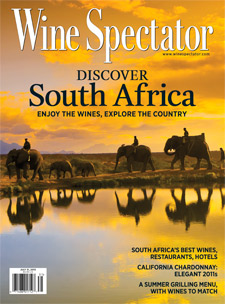
Two new publications ask us to remember what’s old about South African wine even as we embrace the new. I’m talking about James Molesworth’s cover feature in the current issue of Wine Spectator and Tim James’s just-published book Wines of the New South Africa: Tradition and Revolution (University of California Press, 2013).

Wine Spectator Showcase

The Wine Spectator report gives South Africa the full glossy wine magazine treatment (over 30 pages of text and photos), starting with James Molesworth’s “At a Crossroads” essay then continuing with a tasting report including ratings for more than 500 wines, a short list of wine recommendations, selected producer profiles, and brief travel recommendations for Cape Town, Stellenbosch, and Franschhoek, Paarl and Swartland.

Molesworth does a great job capturing a sense of South Africa’s dynamism — this s a country that is moving quickly into the future. It was interesting to compare his ratings with my own experience when I was in Cape Town last year. I am not an expert taster and I always defer to those who are, but I was pleased to see some similarities in our reactions, particularly regarding the many fine Syrah and Rhone blend wines as well as the Bordeaux-style reds. And we seem to agree that many of the white wines are both extremely delicious and present extremely good value.

If there is one place where we differ just a bit it is Pinotage. I went to South Africa a Pinotage skeptic based on my early experiences with the grape variety back in the 1990s, but I have become a convert. Molesworth correctly notes that many of South Africa’s early post-Apartheid exports were not up to snuff and that’s when U.S. consumers like me got their first tastes of South African wine and their first (and sometimes last) experience of Pinotage.

Pinotage has certainly changed along with the wines more generally as the industry has caught up with international standards  and I found many favorites among wines made from old bush Pinotage vines and with careful use of oak, so I might put Pinotage a bit higher on the scale than Molesworth, but I wouldn’t want to press too hard to make it a “signature varietal.” South African wine is diverse and can’t be captured in any single wine, region or style.

I guess Molesworth just didn’t find the quality he was seeking in Pinotage. Or maybe the South Africa story is easier to tell Americans (at least for now) with Pinotage in the background. Either way, this useful survey of the territory is recommended Wine 101 reading for anyone who wants to discover (or re-discover) South Africa’s wines.

Wines of the New South Africa

But of course Wine Spectator only scratches the surface — it is impossible to do more than that in a few dozen pages. So if Molesworth’s fine feature makes you want to learn more, head straight for Tim James’s new book, Wines of the New South Africa: Tradition and Revolution.

James digs down a good deal deeper into South Africa’s wine story in his 300+ pages of text and simple maps. The heart of the book is a collection of chapters on ten key wine producing areas with both general regional information and detailed profiles of the major wine producers. The profiles are very much up-to-date and capture effectively the dynamic nature of South African wine today.

The regional discussions are preceded by exceptionally informative overview chapters on history, grape varieties and wine styles and South Africa’s Wines of Origin system. The chapter on grape varieties and styles surprised me — I didn’t think an analysis of the grapes and so forth would be so interesting and teach me so much about South Africa and its wine industry.

This is a fine book  — well-written, detailed and interesting — that deserves your attention. What could make it  better? Perhaps James (or another author) will publish a colorful wine atlas of South Africa to supplement this volume. South Africa’s terroir is so complex and interesting — it would be great to see it explored (and illustrated) in equal depth.

Follow the Wine to South Africa

South Africa is one of the world’s top ten wine producing countries, so it more than fills the 300 pages available here. Want do learn even more? I guess the next step is to take a trip, which is what Sue and I are doing early next year.

I was hoping that the Wine Spectator’s travel section would be useful in making plans, but perhaps I was expecting to much. The collection of brief restaurant and hotel profiles whets the appetite, that’s for sure, but the luxury lodging choices are pretty  much outside my budget range.

Wine Spectator publisher Marvin Shanken says that Johann Rupert nagged him for years to visit South Africa and now that he finally has done it he urges us all to follow his lead. Molesworth and James give us a road map. Start packing you bags. And don’t forget your corkscrew.

>>><<<

About that Wine Spectator cover photo. Elephants? Really? With all the beautiful Cape winelands vineyard and winery scenery, I wonder why they fell back on a cliché like African elephants? Oh well, if elephants are good enough for Wine Spectator 

Extreme Wine South Africa: VinPro Information Day 2014

I’m pleased to announce that I’ll be returning to South Africa early next year to speak at VinPro Information Day on January 23, 2014. (You can read the agenda for the 2013 Information Day program here.)

VinPro, the service organization for 3600 South African wine producer members, announced yesterday that it will merge with Wine Cellars South Africa, creating a unified wine industry organization.  I’m honored to be invited to speak at the first Information Day program for the combined group and I look forward to meeting everyone and sharing what I know about global market developments while learning more about the dynamic Cape wine sector.

My previous visit to South Africa (to attend Cape Wine 2012 and give the keynote at the Nederburg Auction) was eye-opening — my only regrets were that I didn’t have more time to visit and study the different regions and that Sue wasn’t able to join me. Both of these concerns will be addressed this time as we will spend a couple of weeks touring before Information Day. Still not enough time to do justice to the Cape Winelands, but a big improvement!

We are just beginning to plan our visit. Use the comments section below or write to Mike@WineEconomist.com if you have suggestions of where we should go and what we should do.

Thanks again to VinPro for this opportunity. Looking forward to seeing old friends and making new ones at VinPro Information Day 2014.

Busting the Big Tank Myth: Durbanville Hills

dhwThere are easier ways to get to Durbanville Hills Winery than aboard a snorkel-equipped Land Rover, but I don’t think there’s a better way to go.

They brought out the 4×4 vehicles (snorkel-equipped — who knew? — so the engines can breathe even in deep water crossings) so that we could experience and appreciate the hills, the vineyards and the rugged terrain even before we came to the winery itself and the braai lunch that was planned for us there.

My visit to Durbanville Hills Winery started as adventure and became a learning experience about the diverse nature of wine in South Africa. Now it is also Exhibit A in the case against the One Big Tank myth that I wrote about last week.

The Big Tank theory is that giant wine and drinks companies with dozens of brands in their portfolios offer consumers the illusion of choice, not real choice. It’s as if all the different wines came out of one big tank.  Although there is a grain of truth in this idea, I think it is fundamentally bogus and Durbanville Hills is a case in point.

From Oom Tas to Nederberg Noble

Durbanville Hills Winery is part of the Distell drinks empire. As I wrote last week, Distell is South Africa’s largest wine and spirits producer and is a global power in several beverage categories. They superficially fit the Big Tank stereotype, but within their range of brands you will find choices over a wide range starting with very basic wines such as Oom Tas (described as “an inexpensive, dry, golden, unsophisticated wine of constantly good quality and taste”) and Kellerprinz (” an unpretentious, fun wine, its quality is nevertheless good and consistent, offering value for money”) and moving on up the ladder to the rather special Nederberg Noble Late Harvest wine I wrote about last year.

Durbanville Hills Winery is a relatively new addition to the Distell group.  The winery is beautiful in a modern way that does not seem out of place for its setting. The public spaces are welcoming, the restaurant gets good marks and you can’t beat the views looking out over the vineyards or on to the city. It looks like Distell has put a lot of time and money into the operation and the result is impressive.

Even Lettie Likes It

The wines are impressive, too. I especially liked the Sauvignon Blanc, which seems to do especially well in these hills. And the Pinotage is good enough to get a nod from self-confessed Pinotage-hater Lettie Teague, wine critic for the Wall Street Journal.

Durbanville Hills’ wines are distinctive (which runs counter to the Big Tank myth), but in fact the whole operation is unusual and not what you would expect from a “drinks company” winery at all.

Durbanville Hills was founded in 1999 as a partnership between Distell and seven wine farms in this region and the first wines were released in 2001. This area has a long history of wine growing — the youngest of the farms was founded in 1714 according to the winery website.

Triple Bottom Line

Distell’s representatives sit on the winery board, as I understand it, along with the farmer partners plus a workers’ representative. The wine farm workers have a 5% equity stake in the business that is administered through a trust that provides a number of social and economic benefits to workers and their families. Durbanville Hills was one of the first wineries to be accredited by the Wine Industry Ethical Trade Association. 

Cellar master Martin Moore is an enthusiastic promoter of a particular brand of sustainability that is sometimes called the “triple bottom line” approach (although he never used this term when talking with me). Businesses need profits to sustain themselves in the long run, of course, but economic sustainability doesn’t mean much if the environment is sacrificed (true for all business, but especially for wine), so you have to add that factor into the equation. And what are planet and profit without people? Communities must be sustained along with business and the environment. So true sustainability is the intersection of the three spheres of life taken together.

To quite intentionally organize a wine company around these values is a long term commitment and not the sort of thing that you associate with a corporation nervous about quarterly earnings reports. But it seems to me that everyone at Durbanville Hills is in this for the long run and the structure of the business is meant to keep it that way. It’s an impressive achievement and it makes a glass of Durbanville Hills wine a particularly satisfying drink.

Not Free Range

Clearly there are values and principles beyond a simple short-term profit motive behind the Durbanville Hills project, but they are usefully balanced with a sense of realism — you have to be pragmatic to make the triple bottom line work because this idea of business  isn’t about avoiding trade-offs, it’s about confronting them and making effective choices.

I saw this in a sort of sustainability manifesto that Martin Moore gave me at the end of my visit. Moore writes that, “We farm responsibly … not organic, not biodynamic … but sustainably.”  I think his point is that it is difficult to balance all three bottom lines if you swear off potentially important tools. “I would not even claim that we have free range vines,” he jokes, “as most of it is stuck in a trellis system.”

But I do believe that if we continue improving strengthening our 3 pillars of sustainable farming Durbanville Hills, our producers, our farm workers and community will hand over a successful business to the future generation without having to apologize.P1040576

Myth and Reality

Clearly Durbanville Hills Winery doesn’t fit the Big Tank theory and I think it is an indication that Distell and other giant wine and drinks companies are capable of offering wine consumers real choice — choice in both the wines themselves (which is the point after all) and in the entire wine experience.

It would be easy to make the case that Distell and Durbanville Hills are special cases. South Africa has a unique wine history that stretches back for hundreds of years and a unique social history, too, which motivates many there to address directly issues of race and inequality.

And then there is the Rupert family’s influence on Distell. If anyone understands the the benefits of product differentiation and avoiding a Big Tank syndrome, it is probably the Ruperts, whose broad holdings control many luxury brands including Cartier. They would certainly appreciate the business value of distinctive products compared with Big Tank uniformity.

Distell is a unique wine company in many ways, but I don’t see it as unique in terms of the Big Tank myth.  While I don’t deny that there are a few Big Tanks out there, in general I believe that even giant wine companies have strong business incentives to provide consumers with diverse choices (and even in some cases to take seriously the triple bottom line).

It is a sad fact that some of the great potential diversity of wine production does get filtered out by the logic of distribution and retail economics, and the vast scale and scope of the wine giants indirectly contributes to that problem. But, as I said in my last post, it takes a village to raise a child and it takes an entire supply chain to deliver diverse wine choices … or not. But it’s not just a Big Tank problem.

>>><<<

I realize that one example, even a really good one like Durbanville Hills, isn’t enough to bust a myth (n=1 is a pretty small sample size). But there are lots of examples if you only take off the “Big Tank” glasses and look around.

Thanks to Cellar master Martin Moore and Managing Director Albert Gerber for taking the time to answer all my questions at Durbanville Hills and Cape Wine 2012. The images up top are from the winery’s website.

The “One Big Tank” Myth

My recent post about How Much Choice Do Wine Drinkers Really Have? made the point that true diversity in wine choice is complicated. Although there are constellations of wine brands that are theoretically available, from a practical standpoint the choice available to you depends on your price point “comfort zone,” how you shop (on-line or wine club versus bricks and mortar stores), where you shop (local shop versus national chain store), where you live (state regulations vary enormously) and many other factors.

It takes a village to raise a child, they say, and it takes an entire product chain to raise up a diverse selection of wine … or not!

The Illusion of Choice?

A persistent concern is the influence of giant wine companies with dozens of wine brands in their portfolios. The conventional wisdom seems to be that these big firms merely create the illusion of choice, not choice itself. I guess the idea is that all of these different wine brands actually pour out of the spigot of one giant wine tank. If they all come from Gallo (or Constellation Brands or Treasury Wine Estates, etc.) then they must all be the same — or so similar as to make choice irrelevant.  I call this the “One Big Tank” theory and I think it’s a myth, although like all myths it contains a grain of truth.

The reality is that giant wine companies can and often do produce distinctive wines. And smaller operations sometimes pump out quantities of relatively terroir-free negociant wine to pay the bills. Size matters in wine, but it’s not the only thing. My motto is still “think global, drink local,” so I am not arguing against small terroir-driven producers, but I think at least some of the big wine companies have an undeserved poor reputation from the wine choice standpoint.

Giant wine companies have many advantages: access to capital, technology and vineyards, for example, and economies of scale in purchasing, distribution  and some aspects of production. What matters from the consumer choice standpoint is how these advantages are employed. You can aim to fill that one big tank as cheaply as possible or you can leverage the large scale advantages to create real quality and diversity.

Big Tank Stereotypes

A good example of how the myth unravels at least some of the time comes from my visit to South Africa. I was a guest of Distell for part of my visit (Distell owns Nederberg and I gave the keynote at the Nederberg Auction) and this gave me an opportunity to learn about the company, which is South Africa’s largest wine and spirits producer.

If you go strictly on stereotypes, Distell has got to be one of those “big tank” operations because it has most of the defining characteristics. It is, first of all, a “drinks company” and not a “wine company,” to use a distinction I first heard from a New Zealand winemaker (who worked for a “wine company,” of course). Here’s how the wine vs drinks dichotomy works.

Wine companies make wine (and only wine) and are often family owned. Drinks companies, on the other hand, manufacture all sorts of alcoholic beverages and are usually public corporations.  Whereas wine companies think tradition and  terroir, the story goes, drinks companies think marketing and product positioning.  Wine companies sometimes stay in the founding family’s control for generations. Drinks companies often get acquired, merged and traded back and forth like properties on a Monopoly board.

Distell fits the drinks company profile pretty well. It dominates the market for brandy in South Africa and is the leading wine producer, too. It is the world’s #2 producer of cider, another “drinks” category. Distell has strong international interests and owns  both a French Cognac house (Bisquit) and an Asian distributor. It has over 30 spirits brands in its portfolio and an even larger number of wines, wine apertifs, ciders and “ready to drink” beverages.

Distell is probaby best known in the U.S. for its Two Oceans and Fleur du Cap wine brands, but its hottest product is a cream liqueur called Amarula, “the Spirit of Africa.” It is the #2 best-selling cream liqueur in the world according to the company’s 2012 annual report.

Circumstantial Evidence

Distell also has a complicated business history.¹ The current firm was created in 2000 with the merger of Stellenbosch Farmers’ Winery and Distillers Corporation, but the history stretches back a ways. Key players include the South African billionaire Rupert family, which controls a diversified multinational business portfolio (they own the  Richemont  group of luxury goods companies, for example), the South African wine giant KWV and the big beer player SAB (think SABMiller — SAB stands for South African Breweries).

So, Distell fits the big tank  stereotype pretty well and some of its products have the classic “drinks company” profile, too. But the evidence that wine choice at Distell is an illusion is what Perry Mason would call “circumstantial.”  Can a “drinks company” like Distell offer consumers wines that give then a real choice and not just an illusion of choice?

Inside the big drinks company I found a good deal of counter evidence to the big tank theory. Join me in my next post as I climb into a snorkel-equipped Land Rover 4×4 and visit Distell’s Durbanville Hills Winery.

>>><<<

The top image is an historic example of a great big tank: the famous Heidelberg Tun, made in 1751, with a reported capacity of 220,000 liters. Here’s what Mark Twain had to say about it in A Tramp Abroad (1880). 

Everybody has heard of the great Heidelberg Tun, and most people have seen it, no doubt. It is a wine-cask as big as a cottage, and some traditions say it holds eighteen hundred thousand bottles, and other traditions say it holds eighteen hundred million barrels. I think it likely that one of these statements is a mistake, and the other is a lie. However, the mere matter of capacity is a thing of no sort of consequence, since the cask is empty, and indeed has always been empty, history says. An empty cask the size of a cathedral could excite but little emotion in me. I do not see any wisdom in building a monster cask to hoard up emptiness in, when you can get a better quality, outside, any day, free of expense.

¹ Most of what I think I know about Distell’s business history I learned from the company’s investor website and from Nick Vink, Gavin Williams and Johann Kirsten, “South Africa” in Kym Anderson (editor), The World’s Wine Markets: Globalization at Work (Edward Elgar, 2004).

Extreme Wine South Africa: The International Connection

One of the issues I wanted to explore during my visit to South Africa was the nature of international investment, partnerships and strategic alliances in that country.  There is so much about South African wine that is very old and traditional that I wondered how it was  dealing with the new and global. Here’s some of what I found out.

[This is part of a series of posts reflecting on my recent visit to South Africa.  Click here to see all the posts in this series.]

The International Connection

I am interested in international economic connections in particular because they have proved to be so important elsewhere in the Southern Hemisphere wine world. The modern wine boom in New Zealand really took off when the international wine trade was opened up, for example, along with opportunities for inward investment. Now the export-focused NZ wine business is largely foreign owned,  part of the Faustian bargain that generated New Zealand’s great success.

International investment, partnerships and strategic alliances have been important in Argentina, too, with European, American and Chilean relationships exerting strong influence.  Chile and Australia also have important stories to tell in this regard, too, but as they say on Facebook “it’s complicated” for these two countries — too complicated to be included here.

The Screaming Eagle Connection

What’s the story in South Africa, I wondered as I walked into CapeWine 2012? I didn’t have to wait long to find out. The opening general session featured remarks by Charles Banks, former managing partner of California cult winery Screaming Eagle,  and Troy Christensen, CEO of Accolade Wines, which is the phoenix that has risen from the ashes left behind when Constellation Brands offloaded their wine assets in Australia and Europe. Banks and Christensen were seen as leading indicators of international interest in the South African wine industry.

Banks received special attention, which probably isn’t surprising given his Screaming Eagle background. He is CEO of Terroir Capital, an investment group whose international holdings now include Mulderbosch Vineyard and Fable Wines in South Africa. He is very positive about South Africa’s wine future and obviously purchased assets there with an eye towards taking them to the next level.

Mulderbosch was already a global brand, he told the international audience, and he saw potential to increase quality and expand scale. With Fable Wines Banks intends to take a highly-regarded existing South African winery (Tulbagh Mountain Vineyard) and rename (to make it more pronounceable, Banks said), rebrand and re-position it in international markets. The focus is on old bush vine Chenin Blanc and red Rhone varietal wines.

So clearly South Africa is on the wine investment radar, I concluded, despite what American investor Bill Foley told Lettie Teague in a recent Wall Street Journal article. But how deep does the interest go?

A Half Dozen Answers

I got my answer and more at a seminar the next day that was organized and led by Mike Ratcliffe, the managing director of Warwick Wine Estate. Mike wanted to showcase international investment in the South African industry and he decided to do it through a tasting of the six wines shown in the photo at the top of this post and listed below. Each wine had a different international story to tell and together I think they give an idea of the variety of actors, interests and motivation.

 # Wine & Vintage
1 Waterkloof Circle of Life White 2011
2 Delaire Graff Botmaskop 2009
3 Glenelley Lady May 2009
4 Anwilka 2008
5 Fable Bobbejaan 2010
6 Vilafonte Series M 2009

Waterkloof  Wines is the creation of UK wine executive Paul Boutinot, whose title is listed as “Custodian” on the website, which suggests that he is in this for the long run.  Boutinot, his UK business, is an ambitious and successful enterprise that produces, imports and sells wine; it was named Sommelier Wine Awards “Wine Merchant of the Year” four years in a row. The South African winery is a personal investment that reflects Boutinot’s passion for wine and sincere interest in terroir. I expect it will also benefit from his business background and distribution experience.

Delaire Graff Estate is the project of Englishman Laurence Graff, Chairman of Graff Diamonds International and I think you can see the luxury lifestyle influence in the video and on the website. The intention was to create more than a winery — Delaire is a destination resort that includes the winery of course, but also luxury lodges, a “destination Spa,” and two restaurants in an atmosphere filled with art and natural beauty.


Madame May de Lencqauesaing is the proprietor of Glenelley Estate and you are correct if you guess that she is French. She was born in Bordeaux and managed her family estate Chateau Pichon Longueville Comtesse de Lalande until its sale to the Roederer Champagne house in 2007.  Since then she’s focused on her South African estate, which makes “South African wine with a French Touch” according to the website.

Anwilka is a multinational partnership between South Africa’s Lowell Jooste of Klein Constantia, Hubert de Bouard, co-owner of Chateau Angelus in Bordeaux and Bruno Prats, former owner of another Bordeaux property, Chateau Clos d’Estournel. The bulk of Anwilka’s production of its Syrah-Cab-Merlot blend is exported, according to a Wine Advocate note, and sold through the Bordeaux marketplace.

The fifth wine was the Bobbejaan from Fable Wines , which I’ve already discussed. It added an American name to the mix and was the perfect prelude to the final glass.

Mike Ratcliffe saved his own project for the last act, but it was worth waiting for. Vilafonté  is an ambitious collaboration between South Africa, represented by Ratcliffe, and America in the form of head winemaker Zelma Long and head winegrower Dr. Phillip Freese. Long is legendary in California for her work at Robert Mondavi, Simi and her own family winery, Long Vineyards. Freese was head of winegrowing for Mondavi for 13 years and designed the first Opus One vineyards.  He has consulted with several South African wineries including Warwick. Like the other wines in the tasting, Vilafonté was a South African wine made to international standards and positioned for export.

These wines will be good ambassadors for South Africa, I believe, and represent intelligent (and generally delicious) international initiatives and collaborations. Each international investment brings something useful to the South African wine table while highlighting the best of what’s already here.

I know that there are other international investments in South Africa (Donald Hess’s investment in Glen Carlou springs to mind)  and I know that all of them have not worked out as well as the ones showcased here (I won’t name names). It’s too soon to tell how the story will turn out in the end, but on balance it seems to be a healthy collaboration so far.

>>><<<

This is the last post in my series on South African wine, but look for the topic to come up again in other contexts. Thanks to Mike Ratcliffe for organizing the seminar and encouraging me to attend.

I hope you don’t mind the videos that I’ve inserted in the post. I found them on YouTube and I think they add something to the story.

Extreme Wine South Africa: Nederburg Edelkeur

Since I’m writing about South Africa’s Extreme Wines (see previous post) I cannot neglect a wine so extreme that it it took an act of Congress (figuratively) to get it produced, and act of Will (literally) to initiate a tradition that can be sustained only when acts of Nature permit, and that  provoked the creation of a very special stage for extreme acts and actors.

I’m talking about the wine in the photo, Nederburg Edelkeur, one of South Africa’s (and the world’s) treasured extreme wines.

[This is part of a series of posts reflecting on my recent visit to South Africa. Click here to see all the posts in this series.]

Wine Gets Personal

This is a personal story for me because my small cellar now holds two half-bottles of Edelkeur from the 1977 and 1979 vintages. They were given to me by Carina Gous, Distell Business Director of Wines, as a token of thanks for giving the keynote address this year at the Nederburg Auction. I’m looking forward to sharing these wines with Sue (and perhaps one or two special friends) on an appropriately special occasion several years in the future.

Edelkeur was the personal vision of an extreme wine person, Günter Brözel, one of South Africa’s most honored winemakers who was Nederburg‘s cellar master for 33 years until his retirement in 1989. (You can see and hear  Brözel in the video below. You can read details of Edelkeur’s history here and  another story here).

Brözel’s extreme idea was to create a Noble (made with Botrytis infected “noble rot” grapes) Late Harvest wine that would express the elegance and power of South African terroir in much the way that German Trockenbeerenauslese, French Sauternes and Hungarian Tokaji represent their respective wine producing regions. The only things that stood in his way were Mother Nature and the South African wine law.

Mother Nature is easy enough to understand. Late harvest wines are tricky to produce because the grapes need to stay on the vines long after the usual harvest and they are subject to damage from birds, mold and other problems. Making a Noble wine is even harder and requires both luck (in the vineyard) and lots of harvest labor. You can’t count on making a noble late harvest wine every year and indeed the first Edelkeur vintage in 1969 was not followed by a second until 1972.

Extreme Wine Law

So Edelkeur required an act of nature to make, but an act of Congress? Well, not literally Congress, but it’s a fact that South African wine laws prior to the 1969 vintage did specifically forbid this kind of wine. The rules permitted (and protected) sweet fortified wines but outlawed the production of natural (unfortified) wines with more than 30 percent residual sugar. Tokaji Eszencia often has as much as 50 percent to 70 percent residual sugar (90 percent in the 2000 vintage!). Brözel was going for an extreme and the law got in his way, so the law had to be changed. And it was.

But not all the laws yielded to Nederburg’s cellar master. The most reliable way to get late harvest grapes (because Mother Nature’s part is reduced) is to harvest them earlier and dry them on racks, concentrating the flavor that way. (Just as the most reliable way to make Ice Wine is to pick unfrozen grapes and then … freeze them!) But Nature’s Law prevailed here and so the grapes for Edelkeur are left to hang exposed to and expressing wild nature before being finally picked and vinified.

A Special Stage 

And so finally Brözel was able to make Nederburg Edelkeur but that created another problem: how to distribute the tiny amount of this precious wine that law and nature permit. After some early trial and error, it was decided that a special stage was needed and this became the now-famous Nederburg Auction, where a juried selection of rare South African wines are offered up once a year to the international wine trade. Some of the 1972 vintage was sold at the first Nederburg Auction in 1975 and the link between the auction, Edelkeur and the best of South African wine has been going ever since.

The “first five” founding wineries — Nederburg, Delheim, Groot Constantia, Overgaauw and Simonsig — are now joined by many others, the Auction Selection wines determined through rigorous blind tasting panels. It’s an honor just to be selected for the auction and to have your bottles wear the “Nederburg Auction Selection” ribbon.

The auction today does much more than just allocate one extreme wine. It honors an extreme wine person’s vision and draws international attention to South Africa’s best wines.

Back to the Wine

So what does the wine taste like? Well, I’m not going to open my bottles for several years, but I was able to taste through several vintages of Edelkeur on the first day of the auction and they were memorable and gave a hint of how this wine can age. I don’t rate wines or write reviews, but I found this CellarTracker tasting note for the 1976 vintage that sums up my opinion.

Brown with a bright yellow rim. Fabulous nose – intense citrus, caramel and leather with a very slight flor touch. Amazing attack. Citrussy sweetness. Amazing life. Huge depths of flavour. Great length. Excellent

One of the people I was tasting with that day had this reaction: “They shouldn’t sell these wines; they should hold them back.” She didn’t care about the money, she just knew that the wines would get better and better and that it was a sin to drink wines like the 1979 and the 1977 so young.

She’s right, I suppose, because certainly the wines will continue to develop for many years, but I think she’s wrong, too. Yes, the wines will get better with age, which is why I’m not rushing to pull these corks, but putting some of them up for auction isn’t really about the money or maybe even [just] about the wines themselves. There’s something bigger going on here — defining the identity of South Africa and its wine and honoring the passion of the wine makers — and that’s what makes it really extreme.

>>><<<

Update November 1, 2012. Here’s a new video from the Nederburg Auction website. Cheers!


Extreme Wine South Africa: Oldest Living Wine?

I received many invitations to sniff, swirl and chat while I was in South Africa and I had to decline most of them because of my tight schedule. But I’m glad I made time for lunch with Cobus Joubert of Maison Joubert and his winemaking (and photo-taking) brothers. It was a most memorable Extreme Wine experience.

[This is part of a series of posts reflecting on my recent visit to South Africa to attend Cape Wine 2012 and give the keynote address at the Nederburg Auction.  Click here to see all the posts in this series.]

Brothers in Wine

The agenda for the tapas lunch was mainly to talk about wine and South Africa (and for me to autograph a copy of Wine Wars that Cobus brought along for that purpose). Cobus and his wine-maker brother Meyer opened several bottles of wine from the family wine farm, Joubert-Tradauw, which were excellent and paired well with the tasty food.

But the simple tasting turned a bit competitive when another brother, Schalk-Willem Joubert, Cellarmaster at Rupert & Rothschild Vignerons, pulled out some of his wines for comparison. Joubert-Tradauw and Rupert & Rothschild represent two faces of South African wine that, like the brothers, compete in a friendly way.

The Joubert family history in South Africa goes back ten generations to 1688 when French Huguenot Pierre Joubert arrived in Cape Town. The current  Joubert-Tradauw wines date from 1982, when vines were planted in Klein Karoo, and 1997, when the cellar was established.

Rupert & Rothschild, on the other hand, is a partnership between the Rupert family of South Africa and the late Baron Edmond de Rothschild. The Rupert family, whose wealth is measured in the billions, controls the Swiss luxury goods multinational Richemont (brands include Cartier, Alfred Dunhill, Van Cleef & Arpels, Piaget, Sulka, Montblanc, and Baume & Mercier) as well as South African wine and spirits producers such as La Motte Wine Estates.

Baron Benjamin de Rothschild, who continues his father’s work in this project, is descended from the non-winemaking branch of the Rothschild family tree, but certainly the Rothschild name unlocks doors, for wine as other things, especially in the growing China market. The R&R wines have South African roots to be sure, but with high international aspirations.

It was interesting to taste the brothers’ wines at lunch. Sometimes Meyer’s wine would shine a bit brighter, other times it was Schalk-Willem’s wine that stood out. The wines were deliciously different, but not without a certain family resemblance, just like the brothers themselves.

The Oldest Living Wine?

But the brightest star of all came at the end of the meal, when Cobus brought out a small bottle of Jaubert Muscat d’Alexandrie vintage 1800! Wow, what an experience it was to taste this wine. Here is Neal Martin’s Wine Advocate tasting note:

Just twelve 250-ml bottles of this incredibly rare and ancient Muscat d’Alexandrie are released from a 100-litre French oak barrel in Klein Karoo that is topped up each year. It has an iridescent clear amber hue with green tints on the rim. The nose is simply stellar: candied orange peel, toffee, apricot and almond soar from the glass and fix you to the spot. The palate is perfectly balanced and fresher than some South African wines two centuries younger! It has a Sauternes-like viscosity but is not cloying like a Tokaji Essenzia. There is a touch of sherbet at the tip of the tongue and then it fans out towards a kaleidoscope of spice, clove, candied fruits and a touch of honey. One can discern an oxidative tang towards the finish that has a touch of volatility. Very long and intense and yet somehow refined and elegant, this is an ethereal experience. Drink now-2100+. Tasted June 2011.

I missed the touch of sherbert, but the rest was there in my glass. Drink now or until 2100+. Now that’s a wine that can age.

The brothers date the wine in their barrel from 1800 because that is the date that is given for the few similar lots of wine that are still around, but they think it could be older. The barrel has been in the family for several generations and in fact the house they grew up in was built around the barrel, so there is no way to get it out. They worried a bit (as brothers would about an ageing uncle) that the oak barrel was getting old and might some day simply collapse. But they had no plans to try to fix it up — too risky.

They maintain the wine — and share it! — through a sort of solera practice where, as the tasting note above explains, three liters of the wine are drawn off each year, replaced with new wine and a little bit of spirits. Is it the “oldest living wine” in the world as some have said? That probably depends upon your point of view, but it is certainly the oldest wine that I have ever sampled. And one of the youngest and freshest, too, if you go by taste.

One of my goals in visiting South Africa was to taste a wine as close as possible to the famous Vin de Constance that European heads of state treasured and Napoleon requested on his death bed. I did in fact get to taste a 2007 Klein Constantia Vin de Constance (made by Adam Mason, who was at the Joubert lunch) at a dinner party hosted by Mike Ratcliffe and it was great — hats off to Napoleon and special thanks to Mike and Adam. But the glass that Cobus put in my hand brought me as close as any human being can come to that 200 year old taste.

>>><<<

The lunch group shown in the photo includes (left to right)  John Mitchell, Chris Waters, Igor Ryjenkov MW, Schalk-Willem Joubert, Adam Mason (winemaker at Mulderbosch, ex of Klein Constantia), Cobus Joubert, Mike Veseth and Meyer Joubert. Photo by Andries Joubert. Thanks to Cobus and family for sharing this great experience with me.