Cru Cerrati and Ruchè: Piemonte Wine’s Past, Present, & Future

What do you remember about the hit 1985 film “Back to the Future”? Doc? Marty? The “Chuck Berry” scene? How could you forget that time-traveling DeLorean sports car?

I don’t know if anyone thinks much about the film’s deeper messages anymore, but the idea that the future is somehow buried in the past is a theme that has long been of interest. It shows up in wine in various guises. Here are two “Back to the Future” stories from the Piemonte region of Northern Italy.

The Return of Cerrati in the Land of Barolo

The Rossi Cairo family has been making wine, especially Gavi DOCG,  at their biodynamic farm, La Raia, since 2002. They began a “Back to the Future” journey in 2015 when they expanded their vision to Tenuta Cucco in the prime Serralunga region where the Nebbiolo grape and Barolo wine are firmly rooted.

Tenuta Cucco presented the Rossi Cairo family an opportunity and a challenge in the form of the Cerrati vineyard. Cru Cerrati was well known and respected in the past, receiving special note in Renato Ratti’s Map of Barolo in 1971, for example, and even in the 1990 Slow Food wine atlas of the Langhe, but its glory faded over the years until Piero Rossi Cairo, working with La Raia winemaker Clara Milani, determined to convert the project to organic viticulture and to revive the vineyard and the reputation of the Cerrati zone.

Sue and I enjoyed the opportunity to taste the wines and participate in a Zoom call with Piero Rossi Cairo and Clara Milani. About 80 percent of Tenuta Cucco’s production is exported; the United States is the biggest single market.

The two estate vineyards total about 20 hectares and total production is about 70,000 bottles (6000 cases) each year including  white wines (Chardonnay), a traditional method sparkling Pinot Nero, Rosé, and, of course, the reds. The Barolo DOCG Serralunga d’Alba, a blend of grapes from the two vineyards, is the main focus with production of 25,000 to 40,000  bottles depending on the year. Only about 2400 bottles of single-vineyard Barolo wines from Cerrati and Bricco Voghera are produced each  year. And 5000 to 8000 bottles of a fresh and fruity Langhe DOCG Nebbiolo are made.

The “no wood” Langhe Nebbiolo was simply delicious, with beautiful color, light body, soft tannins, intense aroma, and complex fruit flavors. If you are looking for a “Baby Barolo,” this isn’t it. But who wouldn’t enjoy a wine like this with cheese and salami or a light pasta? And the Serralunga d’Alba was delicious, too, a great culinary wine because of its medium body and nice acidity. The single-vineyard products are philosopher wines, to be appreciated at a relaxed pace. We haven’t decided which one we like best, but are very much enjoying the opportunity to study them.

Ruchè Renaissance

Wines made from the Ruchè grape variety are full of contradictions. Wine Grapes tells us that “Varietal wines tend to be headily scented, often with aromas of roses. They can be spicy and the tannins so marked that the wines can sometimes leave a bitter aftertaste.”  Roses, spicy, bitter — not something you find every day.

Sue and I first stumbled on Ruchè back in 2011 when we attended a food and wine festival in Moncalvo, near Asti. As I wrote then, “I had never heard of Ruchè and honestly didn’t know what it might be until I happened upon the stand of the Castagnole Monferrato group. They were cooking with Ruchè, marinating fruit in Ruchè and selling it by the glass — they were obviously very proud of their local wine. I had to try it and it was great. Suddenly I saw Ruchè everywhere (a common experience with a new discovery) and enjoyed a bottle at dinner in Asti that  night.”

Ruchè very nearly disappeared at one point as attention focused on market-friendly grapes such as Barbera and Nebbiolo. As Ian D’Agata explains in the chapter on Ruchè  Italy’s Native Wine Grape Terroirs, Don Giacomo Cauda, Castagnole Monferato’s town priest, was obsessed with Ruchè, studied it, collected specimens from scattered small plots,  and promoted Ruchè as the region’s signature wine. Ruchè di Castagnole Monferrato received DOC recognition in 1987 and was elevated to DOCG in 2010, putting it up among the elite of the Italian wine world. A long climb from near-extinction to the summit in just 50 years.

But DOCG recognition does not automatically translate into sales. Almost everyone around Castagnole Monferrato probably drinks Ruché, but almost no one does anywhere else. Selling an unfamiliar wine like Ruché requires creativity and determination. So we were intrigued to learn that a local importer, Mallard Libations in Woodinville, Washington) has taken up the challenge so that those who know Ruché  will have an opportunity to enjoy it and hopefully help spread the word.

We’ve started our new Ruchè research with the Ferraris Agricola Ruchè di Castagnoble Monferrato Riserva DOCG, which featured medium body, a memorable nose, and more depth than I remember from the wines we enjoyed in Italy. This single-vineyard wine deserves its “Riserva” designation. It is one of five different Ruchè wines that Ferraris produces. We are especially looking forward to trying the flagship Opera Prima Riserva.

Ferraris Agricola takes Ruchè and its history very seriously. Luca Ferraris, a.k.a. “Mr. Ruchè,” has created a Ruchè Museum that chronicles Ruchè’s history and celebrates its rebirth. We have added it to our “must-see” list for our next trip to Piemonte.

Discovering new wines or wine regions is always interesting. Re-discovering (and perhaps even rescuing) over-looked wines and regions is even more satisfying. Innovation, we are told, is especially important in today’s wine market environment. Back to the future can be part of that process.

Non-Alcoholic Wine: Three Questions

Sue and I continue exploring the world of non-alcoholic (or alcohol-removed) wines. NA wine is one of the few growing categories of wine (if it is wine — see below), so it makes sense to see what’s going on. That’s especially true since NA beer and spirits are booming, too. Here is our report, which examines NA wine from three perspectives.

On Trade: What Does an NA Wine Bar Look Like?

It has become easy to order non-alcoholic beer at a bar or restaurant — there is almost always at least one NA beer option available — and NA cocktails (a.k.a. mocktails) are ubiquitous. But NA wine remains hard to find (at least for us) in on-trade settings. I wonder what an NA wine bar would look like and who would go there?

I stumbled on the answer to this question a few weeks ago when I was researching French Bloom, the upscale line of NA wines that caught the eye of  LVMH, the French luxury conglomerate. French Bloom is in limited distribution at this stage and the website features a map of the world to guide you to on- and off-trade points of sale. I was surprised to discover that one of the relatively few U.S. sellers was just a few miles from The Wine Economist world headquarters in Tacoma, Washington.

Soulberry Coffee House and Dry Speakeasy is located about mid-way between the University of Washington/Tacoma campus and the Tacoma Dome district. It is a warm, inviting space that sort of reminds me of a cross between the family pubs that we knew when we lived in England and the original Starbucks concept of the “third space” that’s neither home nor workplace.  Soulberry bills itself as an “all-ages after-hours safe space” and that seems pretty accurate.

Soulberry’s owner, Terri Quintana-Jessen, says that she’s a coffee roaster, but Sue and I quickly noticed how much she talked about community and relationships. Coffee brings people together, which must be one of the reasons she is so interested in it. Wine brings people together, too, but alcohol can keep people apart.

Because NA wine is NA, selling and serving it doesn’t come with the burdens and regulations that must be considered for alcoholic beverages. Terri studied up on NA wine, spirits, and beer, and soon her coffee shop was also a bottle shop and “dry speakeasy” featuring a rotating selection of almost 40 NA cocktails. The French Bloom is popular as the base for Sunday mimosas and NA French 75s.

Soulberry is not alone. Dry wine and spirits bars and popping up much as natural wine bars did a few years ago. Is there a NA wine bar in your town? Maybe there is and, like me, you just didn’t know it.

Is NA Wine Really Wine?

Is non-alcoholic wine really wine? I know from previous columns that many readers believe that wine isn’t wine without alcohol. Studies have even shown that some consumers base their buying decisions on the amount of alcohol they can get for their money (more is better!). It is certainly the case that fermentation (which produces alcohol) is necessary for the transformation of juice into wine. But, once alcohol is removed, is the resulting product still wine?

Although opinions may vary, the use of the term “wine” is defined by regulations and therefore differs in different jurisdictions. Some producers are keen to call their NA products wine because they see a market opportunity. With sales of full-strength stagnant or falling, it makes sense to go after a share of the growing NA beverage market. But other producers think it important to defend the term “wine” from being debased or diluted, which might be a slippery slope.

It is interesting to observe the evolution of this debate in Italy, where it has been illegal to affix the name “wine” to anything with less than 8 percent abv. As Wein.plus reported a few weeks ago, The Italian Ministry of Agriculture has recently revised its regulations to allow de-alcoholized wines to use the term “wine,” but not for wines with protected designations. So you can have NA red wine from Tuscany, but not NA Chianti because Chianti is a protected appellation. This explains why the NA Mionetto wine that we found at Total Wine was labeled “sparkling non-alcoholic wine” and not “NA Prosecco.” Of course, the Mionetto brand is so closely connected to Prosecco that a mental association is almost impossible to avoid.

Before the new ruling, Italian winemakers could only call their NA products wine for export purposes. The use of “wine” was reserved for alcoholic wine at home. NA wine regulations are evolving with different interests pushing to liberalize the rules and others pushing back. But the question — is it really wine? — is ultimately up to you to decide.

That said, the OIV recently highlighted its work on dealcoholization of wine, which dates back to a 2012 resolution. The January 8, 2025, press release explains that,

Adopted in 2012 at the 35th World Congress of Vine and Wine in Izmir, Türkiye, OIV-OENO 394A-2012 “Dealcoholisation of wines” includes prescriptions to obtain vitivinicultural products with a reduced or low alcohol content through partial vacuum evaporation, membrane techniques, and distillation. It also specifies that this process must not be used on wines with any organoleptic defects and must be overseen by an oenologist or specialized technician.

The OIV’s framework for wine dealcoholisation provides producers with tools to innovate while navigating technical and market complexities. This progression supports the industry’s goal of quality and authenticity in a changing consumer landscape.

Can NA Wine Pass the “Second Glass Test”?

Sue and I have been trying NA wines and putting them to the “Second Glass Test.” We ask that NA wines (1) remind us of the wines that they represent and (2) be tasty enough that we would welcome a second glass. Our early research was full of failures. Either the wines didn’t remind us of the alcoholic version or they just weren’t to our taste. Often they were flat, lacking the fruit or aroma that were lost in the de-alcoholization process.

That Mionetto sparkler mentioned above did pretty well in the “Second Glass Test,” for example. It reminded us of Prosecco in a general way (could have done with a little more fruit and acidity), but was very nice to drink and was priced in the general range of Mionetto’s regular sparkling wines. We finished the bottle over dinner. The bubbles in NA sparkling wine come from carbonation, not the fermentation process, and in general we’ve found them to be more successful than still NA wines.

Recently Sue and I have been testing NA wines from Chavin Zéro, a French winery that has been in this business since 2010. The wines are being introduced in the U.S. market now by importer Kobrand. These NA wines were created to solve the same problem as French Bloom: what’s a wine lover to drink when she’s pregnant?

Pierre Chavin makes wines in France including a line of NA wines called Chavin Zèro. We focused on two still wines from Chavin Zéro, a Rosé and a Sauvignon Blanc. The Sauvignon Blanc came first and Sue declared it to be probably the best NA still wine we’ve tried so far even though it didn’t line up with our idea of Sauvignon Blanc. (To be fair, there is no universal definition of how a Sauvignon Blanc should taste and smell.) But it was very nice to drink and had better than average fruit and mouthfeel, probably because it contains 12 percent grape juice (concentrated grape must). We’ll add it to our list.

We were intrigued by the very pale pink Chavin Zèro Rosé, which features both an attractive bottle and an interesting blend of Cinsault, Syrah, and Grenache grapes. It was probably the most interesting and confusing wine we have tried so far. It was tasty for sure — no problem with the second glass. And it had the aromas, fruit, and mouthfeel that we have been looking for but seldom finding. But it didn’t taste like any Rosé we’ve ever had. The winery’s tasting note said to expect aromas of yellow fruit and white flowers. You don’t see “yellow fruit” very often in wine descriptions. Maybe the flavor was yellow plum? We couldn’t decide. Sue said it was more like wine, and likely was the best in terms of providing the complete package, but it didn’t remind us of Rosé or any other particular wine.

20 Years Behind Beer?

We finally opened the bottle of French Bloom sparkling wine that we bought at the Soulberry bottle shop. As we reported a few weeks ago, this wine has received a lot of press because of a connection to the Taittinger Champagne family and a highly-publicized recent investment by the LVMH wine, spirits, and luxury brands group. Terri at Soulberry said that her customers gave it high marks.

We shared our bottle of the sparkling blend of Chardonnay and a bit of Pinot Noir with two winemaker friends. Sue and I found the French Bloom to be dry and drinkable, but lacking some of the body, fruit, and aroma that we look for but often fail to find in NA wines. It would be a good base for the kinds of NA wine cocktails that Soulberrry serves.

I think we would have been more impressed by French Bloom when we started our research, but now we expect more, especially for the premium $40-plus price.

The NA wine, beer, and spirits category is growing (see graph), albeit from a low base, and there is a lot of research going on. A recent Economist article charts the market changes and suggests that, while NA wine might be 20 years behind the much more successful NA beer category, it might not take 20 years for it to catch up. Fingers crossed that NA wine drinkers (and producers) will find their respective sweet spots soon.

2025: Wine & the Age of Uncertainty

The Unified Wine & Grape Symposium, North America’s largest wine industry meeting and trade show, is only a few weeks away. I will be in Sacramento to moderate the State of the Industry session, which features an impressive lineup of wine industry experts:

  • Jeff Bitter, Allied Grape Growers
  • Glenn Proctor, The Ciatti Company
  • Stephen Rannekleiv, Rabobank
  • Danny Brager, Brager Beverage Alcohol Consulting

The panelists have decades of experience in the wine industry, which informs their analysis of current problems and future prospects. It is a tremendous opportunity to hear what the experts are thinking now and to talk about it with the other attendees.

There are many other sessions at the Unified covering all sorts of topics in winegrowing, winemaking, marketing, and business operations. I am particularly interested in the Thursday general session on Crafting a Positive Narrative: Promoting Wine in the Face of Challenges, which will be moderated by New York Times wine critic Eric Asimov. One of the biggest challenges, of course, is the rising anti-alcohol movement. Telling wine’s positive story is as difficult as it is important in the current environment.

There is something for everyone at the Unified (click here to view the complete program and click here to read the speaker bios). Sue especially appreciates the big trade show where more than 900 exhibitors will highlight what’s new in the wine industry from the biggest machines, smartest technology, and best products and services from vineyard to cellar to bottling line all the way to market.

Always the Age of Uncertainty?

I always start the State of the Industry session with a few remarks to set the stage and this year I have chosen a theme, the Age of Uncertainty. This is a time of great change in the wine industry and change makes people nervous.

Age of Uncertainty? I know what you are thinking. It is always the Age of Uncertainty in the wine business. Growing grapes is risky, making wine is risky, and selling wine is risky. There is no part of the wine business that does not have an uncertain component. Wine is a global business, too, and while global markets create opportunities they also introduce additional layers of risk.

I specialize in international and global wine markets, so I am especially concerned with how international economic policies add more layers of uncertainty to wine business today. We have been told to expect high tariffs (on wine and just about everything else) in 2025. Depending upon how they are structured, and how our trading partners react to them, tariffs can have a number of direct and indirect effects.  There’s a lot at stake and the final outcome is difficult to predict.

Indeed, the International Monetary Fund recently identified the threat of tariffs as a major global economic concern. The possibility of tariffs has driven up long-term borrowing costs around the world, according to the IMF, which will release its new report on the global economy later this week.

And this week’s Economist newspaper highlights uncertainty about tariffs and other policies as a main cause of global instability.

It is easy to see why uncertainty has spread. Will Donald Trump deport millions of people? Nobody knows. But if he succeeds inflation could jump as employers lose workers. The story is similar for tariffs, which would also increase prices. At the same time, potential Chinese counter-measures in a trade war, such as a devaluation of the yuan, could prompt a global deflationary shock.

The rising perceived risk, according to the Economist, helps explain falling bond prices, rising mortgage interest rates, and many other current trends. They say that what you don’t know won’t hurt you, but uncertainty clearly has a cost.

Not by Wine Alone

I know many people who think a tariff on imported wine would benefit American growers and producers and others who strongly oppose the idea. But it is important to remember that we aren’t talking about tariffs just on wine. Although it is hard to know right now (that uncertainty thing), it looks like the new administration will impose tariffs on most imported products from many or most of our trading partners, with the highest tax rates on China, Mexico, and Canada, the countries with whom we trade the most.

Border taxes on such a long list of imports have different effects than a tax on a specific product category like wine. That’s part of the uncertainty problem. U.S. producers may gain from protection from imports but lose from higher costs for imported supplies, equipment, and technology. Labor costs, interest costs, and insurance costs would all likely be pushed higher by rising inflation.

And U.S. tariffs aren’t the end of the story. How will other countries react? Will European nations retaliate with tariffs on U.S. wine? Probably not. I think they’d focus on spirits, not wine. Would Canada target U.S. wine? Yes, I think they might and that’s a problem because Canada is a good market for U.S. wine exports.

The  Dollar Also Rises

President Trump favors a falling dollar value on foreign exchange markets because that would reinforce his trade policy by discouraging imports and promoting exports. But tariffs tend to push the dollar higher as we have seen since the election results were announced. The dollar’s value rises when it sounds like tariffs will be used as a blunt weapon to keep out imports. The dollar falls, however, when the rhetoric suggests tariffs as targeted strategic tools to gain specific concessions. Which way will tariff policy lean in 2025? I don’t know, do you?

How are tariffs and the dollar related? Here’s one way. Tariffs tend to increase inflation, which forces the Federal Reserve to keep interest rates higher than they otherwise would be. This attracts foreign capital that boosts the dollar’s value, making imports cheaper in dollar terms and U.S. exports less competitive abroad.

Immigrant policies are the third element of the Age of Uncertainty for wine in my analysis. It is too soon to know how border controls and deportations might affect labor both generally and in industries such as agriculture and construction that are most exposed. So wine’s Age of Uncertainty is a complicated matter.What’s the bottom line? I’m saving that for the State of the Industry session.

Galbraith’s Uncertainty Principle

Why did I choose this theme for my remarks? The idea was inspired by an old book that strikes me as still relevant today. The Age of Uncertainty is the title of a 1977 BBC/KCTS television series and an accompanying book by the distinguished Harvard economist John Kenneth Galbraith. The book and videos, which survey two hundred years of economic history and the history of economics, were timed to coincide with the 200th anniversary of Adam Smith’s Wealth of Nations.

People tend to remember Galbraith as the sophisticated author, public intellectual, and Harvard professor that he became, but his personal story is more complicated. He grew up on his family’s small Ontario farm and seemed set for a farming career, graduating from Ontario Agricultural College in 1931. But the 1930s were not the best of times for farming and Galbraith soon found himself doing PhD studies in agricultural economics at the University of California and then working for the U.S. federal government’s Agricultural Adjustment Agency (AAA) trying to prop up farm prices.

I don’t think that wine is mentioned even once in Galbraith’s book, but his agricultural background and experiences are easy to trace. The world has changed a lot in the almost 50 years since The Age of Uncertainty first appeared (and nearly 250 years since Wealth of Nations), but American winegrowers and agriculture generally can certainly relate to Galbraith’s story and the concerns he expressed in this book.

Understudy to Center Stage: The Unexpected Rise of Cabernet Franc

Wine made from Cabernet Franc is generally paler, lighter, crisper, softer, and more obviously aromatic than that of its progeny, Cabernet Sauvignon.

This is how the authors of Wine Grapes, my standard reference, describe Cabernet Franc. Sounds great, doesn’t it? So it is a bit of a surprise that Cabernet Franc’s place in French wine is relatively limited.

France: Two Faces of Cab Franc

Cabernet Franc is the headline red wine grape in the Loire Valley, but in Bordeaux (and most other places) it is best known as a blending grape (or an insurance grape, I am told, because it buds and blossoms earlier than Cabernet Sauvignon and so helps winegrowers hedge their bets against unfavorable weather). Apart from Chateau Cheval Blanc and a few other BDX wines, Cab Franc is a backup singer behind Cabernet Sauvignon.

I think I first began to pay attention to Cabernet Franc about 15 years ago when I found myself helping Mike and Karen Wade on the bottling line at their Fielding Hills Winery (my report on the experience was the very first Wine Economist newsletter post). All the wines, made with grapes sourced from their Riverbend Vineyard on the Wahluke Slope, were great. But the Cab Franc really blew me away. It was then and remains now my favorite FHW wine.

Cab Franc was suddenly a thing to us and Sue and I started to wonder if maybe it was a Washington state wine thing. We got this idea from Chris Carmada, winemaker and proprietor at the Andrew Will Winery on nearby Vashon Island. Carmada said that Cab Franc might be Washington’s best red wine grape variety and Andrew Will makes the most of its exceptional quality in both their varietal wines and in the vineyard-specific blends.

This video tells the story of Andrew Will Winery and its particular affinity with Cabernet Franc. We also admire the elegant Cab Franc that Robin Pollard makes from her vineyard in the Rattlesnake Hills (a.k.a. “The Hills”) area.

Once we started looking for northwest Cabernet Franc we began to find it in unexpected places. The Rocks of Milton-Freewater is a famous AVA on the Washington-Oregon border. It is best known for the Syrah and Grenache wines that wineries such as Cayuse and Reynvaan make from the vines there. So we were surprised to find that Watermill Winery makes a terrific “Hallowed Stones” Cabernet Franc from their rocky estate vineyard, very different from Andrew Will, Pollard, or Fielding Hills. Distinctive.

Many Faces of Cabernet Franc

Looking further afield we stumbled across our first Napa Valley Cab Franc, the Ehlers Estate Cabernet Franc St. Helena, Napa Valley. Cab is King in Napa Valley, but Cabernet Franc is an unexpected discovery. This wine had the power and depth that you expect from Napa (15% abv, 18 months in oak) with the slight green edge that said Cab Franc not Cab Sauvignon. Sue liked it but said that the Napa style almost dominated the Cab Franc character.

Recently we’ve been learning more about the wine industries in Virginia and the Niagara Peninsula in Canada and discovered that Cab Franc plays important roles in both places. Barboursville Vineyards is probably our favorite Virginia winery (it was featured in my book Around the World in Eighty Wines) and its Barboursville Cabernet Franc Reserve is both great quality and great value.

Cabernet Franc is one of the most important red grape varieties for Niagara producers. We visited the region earlier this year and enjoyed tasting wines at Leaning Post Wines and Westcott Vineyards. Both focus on Pinot Noir and Chardonnay, which do very well in that region, but both wineries also make exceptional Cab Franc wines inspired by the grape’s ability to express the character of particular sites.

The idea that Cabernet Franc is or could be a terroir wine — a wine that reflects its particular vineyard characteristics — comes as a surprise if you are used to thinking about it as a useful but secondary blending grape. Further study is required to explore this idea.

So we are starting to look for Cabernet Franc wines from Argentina. We know from our visits there that the differences in terroir, especially elevation, can be important. Malbec from Lujan de Cuyo can be very different from Malbec from the higher-elevation Uco Valley. So we are excited to taste the Durigutti Proyecto Las Compuertas Cabernet France (from Lujan de Cuyo) alongside the Bodega Andeluna Pasionado Cabernet Franc from Uco Valley vineyards situated at an even higher elevation 1300 meters above sea level.

Cab Franc World

It seems to me that Cabernet Franc has quietly exploded on the wine scene. Maybe it was always there and I just overlooked it. But maybe those qualities I found in Wine Grapes have become more important to wine drinkers. According to Wine Grapes, Cab Franc can be found almost everywhere: Northeast Italy, Spain, Romania, Hungary, Argentina, and Chile have significant plantings of the grape variety and there are patches of Cab Franc vines almost everywhere else. Even on Malta!

There is clearly a lot of work to be done to chart the Cab Franc universe. Once upon a time, Cabernet Franc was Cabernet Sauvignon’s shy understudy that has now taken center stage, at least some of the time. Either way, let’s celebrate Cabernet Franc.

From Sharecroppers to Superstars: Family Wineries in Italy

The arc of the Italian wine industry bends towards quality in the 21st century, something that has become increasingly clear to Sue and me as we have visited many of Italy’s important wine regions in recent years.

Quality has not always been Italian wine’s guiding star, however. Piero Antinori’s 2014 book The Hills of Chianti traces the 20th-century transformation of Italian wine from quantity to quality that continues today. The role of forward-thinking family wineries and their intense focus on quality from the vineyard to the cellar and beyond comes through on every page.

We recently sampled wines from two of our favorite regions — Romagna and Piemonte — that illustrate Antinori’s hypothesis about the link between quality and family-owned wineries.

>>><<<

Rediscovering Romagna

I was reminded of Antinori’s book recently when we were invited to taste wines from Romagna, a region that extends from the Adriatic coast inward toward Bologna. We enjoyed these wines, mainly Sangiovese di Romagna and Albana di Romagna, when we lived in Bologna years ago (I was a visiting professor at the Johns Hopkins center there).

The wines were perfect with the city’s rich cuisine. We look for them here in America, but they are hard to find. I once asked one of the Colli Bolognesi winemakers about the problem and he just pointed over the hill. Tuscany, he said. Tuscany (and Antinori, I guess) get all the attention. We mostly sell our wines at home.

But the bending arc can have many effects and it seems to me that the rising quality of Italian wine offers wine drinkers around the world new opportunities, both within Tuscany (as Antinori’s book suggests) and in other parts of Italy, too.

All in the Family

So we were excited to taste the Romagna wines of Poggio della Dogana and Ronchi di Castelluccio, wineries owned by the brothers Aldo and Paolo Rametta. The Rametta family does not have centuries of history in the wine business like the Antinori family, but they are firmly rooted in the Romagna region. After working in other industries (finance and renewable energy), Aldo and Paolo Rametta found it impossible to resist scratching the itch to return home to work with the land. Wine, of course, but not just wine. They are interested in agriculture and bring family business values to their work.

Poggio della Dogana was their first investment in 2016; then an unexpected opportunity appeared in 2020 to purchase Ronchi di Castelluccio, the very well-known maker of Sangiovese di Romagna. We know the latter winery because their Le More Sangiovese di Romagna is a wine we can sometimes find here at home to pair with Sue’s authentic Bolognese ragu.

Everybody and Nobody

We couldn’t resist sampling the Ronchi di Castelluccio Buco del Prete Romagna DOC Sangiovese Modigliana, made with grapes from a vineyard carved into a forest clearing in 1989. We paired the wine with roast chicken (which we often have with Pinot Noir) and I think the combination made us appreciate the elegance of the medium-bodied wine and the complexity that lingered on the finish. An excellent wine. We can’t wait to try the Ronco della Simia, made with grapes from an even older vineyard.

We loved the Sangiovese, but I admit that the Poggio della Dogana Belladamaa Romagna DOCG Albana Secco stole our hearts. Why? Quality was part of the answer, of course. Albana is a white wine that thinks it is red, with good body and memorable herby notes on the finish in the case of the Belladama.

We often enjoyed Albana wines when we lived in Bologna, but we always thought of it as a simple, easy wine, not something that can be serious. So tasting a next-level Albana got our attention.

But, if I am honest, it is also something that Aldo Rametta said on a Zoom call. Everyone drinks Albana in Romagna, he said, but no one drinks it anywhere else. And it is true. But maybe a wine like this at a time like this can change things. In fact, quality white wines from up and down Italy are now finally getting attention and developing followings in export markets.

>>><<<

Tenuta Carretta was founded in 1467 when sharecropping arrangements were formalized for the estate north of the city of Alba. As Antinori’s book explains, sharecropping remained the dominant organization for Italian agriculture into the mid-20th century and in wine the turn towards quality only gained strength when the difficult transition from sharecropping was complete. In all its long history the Carretta estate has changed hands only a few times. The winery’s website explains that

In 1811, after 350 years, the property passed from the Marquis Damiano to the Count of Roero, who cultivated it for 120 years. In 1932, he gave the estate to the Veglia family of Turin. In 1985, the property finally passed to the Miroglio family from Alba, founders and owners of the textile group with the same name.

The Miroglio family’s commitment to the winery strikes me as very much fitting into Antinori’s ethos and the Rametta brothers’ work in Romagna. The Miroglio family have roots in the Langhe. Their apparel empire began there before expanding around the world. Their purchase of Tenuta Carretta almost 40 years ago seems to have been about family and tradition and they have invested considerable time and effort to develop distinctive wines that reflect the particular terroirs of Roero and the Alta Langa. Each wine is meant to be unique to its time and place, to bend the arc even more toward the quality pole.

Tenuta Carretta makes the great red wine varieties of  Piedmont, so it is noteworthy that the samples they sent us were white wines: the Roero Arneis DOCG Riserva “Alteno della Fontana” and the Langhe DOC Riesling “Campofranco.”  Interest is rising in white wines these days and many consumers are searching for distinctive wines, so we welcomed the opportunity to taste these wines.

The Roero Arneis DOCG Riserva was a wonderful wine, refined and elegant. It is a proper reserve wine having spent 24 months aging on lees and a further year resting in bottle. The Riesling was a completely different experience, however.

You might be surprised to see a Riesling from Piemonte, but we know a few other Piemonte winemakers who produce Riesling because they just love this noble grape variety and cannot resist the temptation to see what it will produce here. It seems that a great deal of effort was necessary to make this Riesling a reality. A special terroir was discovered in a long-abandoned vineyard area (“franco” in the name “Campofranco” means “unused”). It is kind of extreme terroir and the cellar treatment is distinctive, too. The result is a wine that Sue said she wouldn’t have guessed to be a Riesling. Lots of minerality, a whiff of petrol that quickly disappeared. Fascinating and delicious. Kinda wild, too. Worth seeking out as are all the Tenuta Carretta wines we have tried.

>>><<<

At the end of Piero Antinori’s book, he peers into the future and sees the outlines of what is recognizably the wine world of today, where consumption quantities are falling, wine quality is rising, the family wine firms are stronger than ever. He was right about quality and about the challenges he saw ahead for the wine market generally. Time will tell how family wineries fare in the global and local market adjustments that lie ahead. These seem like just the sort of challenges that family wineries are built for.

NA Wine & the Second Glass Test: Bolle Bubbles, LVMH’s Bet, South African Spritz

LVMH Bets on Booze-Free Bubbles at $100-Plus a Bottle” was the Wall Street Journal headline. The story, which you may have read when it came out last month, is that luxury goods conglomerate LVMH was buying a 30 percent stake in a (luxury) non-alcoholic wine start-up called French Bloom. The new NA wine boasts both good DNA (one of the founders and the winemaker are members of the Taittinger Champagne clan) and a bold business plan. The WSJ reports that

The brand sells bottles of sparkling white for $39 and sparkling rosé for $44, mostly in high-end bars and restaurants, or through luxury retailers. Its latest nonalcoholic fizz, La Cuvée Vintage 2022, which accounts for a small percentage of its production, sets consumers back $119 a bottle.

While the brand initially expected customers would mostly be pregnant women and nondrinkers, it estimates that about 80% of its clients drink alcohol.

NA Wine Challenges and Opportunities

I think the logic of the investment was pretty simple for LVMH. Someone is going to develop a non-alcoholic luxury sparkling wine brand, so they might as well do it themselves and capture the high end of the market. The acquisition is driven, at least in part, by the same logic that led Moet Hennessy to create an international network of wineries to satisfy the local thirst for sparkling wine. Argentina, California, Australia, China, and India. And now in NA-land, too.

What I found particularly interesting about the French Bloom article was the discussion of winemaking challenges. Making quality NA wine or beer is not as easy as just taking the alcohol out. Millions of dollars are being invested in innovative processes to make the NA products as appealing as their alcoholic shelf-mates. The WSJ reports that,

When a wine is dealcoholized, it loses about 60% of the aromas. “We have to start with something that has, we like to say, wider shoulders, versus if you dealcoholized a Chardonnay from Burgundy, you’re not left with a lot,” …

French Bloom sources its grapes from the Languedoc region of southern France, where the sunny climate results in grapes with naturally high alcohol content and sugar levels. They also harvest the grapes two to three weeks early, depending on the year, to have maximum acidity. They then age the wines in new oak barrels from Burgundy. … The wine is “undrinkable before the dealcoholization process,” said Frerejean-Taittinger. “It’s so overpowering.”

The goal, as we here at The Wine Economist have proposed, is for NA wine to pass the “Second Glass Test.” An NA wine should remind us of the type of wine it represents (an NA Sauvignon Blanc should remind us of a Sauvignon Blanc) and it should be good enough that you ask for a second glass. It is a simple test but, as we reported last year, one that many wines seem to fail. Either they don’t really taste like the wines they mimic or they just aren’t that fun to drink. Sad!

Bolle Sparkling Wine Passes the Test

LVMH’s investment in French Bloom provides evidence, if any is needed, that NA wine is a thing. We haven’t had an opportunity to put French Bloom to the Second Glass Test yet, but we could not resist an invitation from the makers of Bolle Non-Alcoholic Sparkling Wines to give their wines a test drive.

I was intrigued by the innovative production process. There are several ways to remove alcohol (French Bloom uses a process called vacuum distillation). The Bolle method first ferments the grape juice in the usual way, removes the alcohol, then adds a little grape juice, and allows a second fermentation to replace some of the characteristics that were lost earlier in the previous process. It is a clever idea, don’t you think?

The resulting wine has less than 0.5 percent ABV, which is within the “non-alcoholic” range. Does the second fermentation put the magic back in the bottle?  Does Bolle pass the Second Glass test? There was only one way to find out.

We tried the Bolle sparkling Rosé and were quickly convinced: this is probably the best NA wine we have tasted so far. Did it remind us of Blanc de Noir sparkling wine? Yes. Would we accept a second glass? Absolutely. The wine was nicely balanced, dry, but with some of the fruit that we have found missing in earlier “second glass” trials. Whatever they are doing at Bolle the results are excellent.

The Bolle sparkling Rosé is made with a combination of Chardonnay and Pinot Noir wines. We are looking forward to trying the Bolle sparkling Blanc de Blanc, which is Chardonnay blended with Sylvaner. The grapes are from Spain and the NA wine process happens in Germany. Production is still quite limited, so the best way to purchase Bolle is probably directly from the winery website.

Abstinence NA Spirits

As long as Sue and I were testing NA wines we could not resist an invitation to expand our experiments to include a NA spritz product. One of the best things about a trip to Italy is the excuse it provides to enjoy an Aperol or Campari spritz. We make them at home, too, and they bring back that warm Italian feeling.

Abstinence Spirits sells a range of non-alcoholic spirits products that are made in South Africa using the distilled essence of botanicals of the Cape Floral Kingdom. There are a variety of interesting NA spirits both bottled straight and used in NA RTD spritz beverages. We were tempted by the lemon spirits (I was thinking lemoncello), but could not pass up the Abstinence Blood Orange Aperitif, which is flavored with African wormwood, cinchona bark, allspice, clove, blood orange, and spice distillate.

We tried the spritz as directed with both tonic water and soda and the result was a split decision. I liked the tonic spritz because it reminded me of an Aperol spritz, and I’d definitely take a second glass if offered. Sue admitted the resemblance to Aperol but found the drink just too sweet (both the NA spirits and the tonic are sweetened).  The soda spritz was less sweet but lacked a bit of the bitter punch we were expecting.

Two cheers, not three, for the Abstinence Blood Orange aperitif, but we will keep experimenting. Lots of innovation in the NA beverage category. Watch for our next report in a few weeks.

Strength in Numbers: VITÆVINO and Wine’s Global Battle for Hearts & Minds

There is a lot of work to do to restore wine to the place (in the market, in society) that many of us believe it deserves. Here in America, for example, we have recently concluded the successful launch of Come Over October, a program that seeks to replace the image of wine as dangerous alcohol with the idea of wine as an integral part of healthy and satisfying lifestyles.

What I liked best about Come Over October 2024 was that it provided a broad umbrella that wineries and wine regions big and small used to reach out to their customers. By seizing the opportunity, wineries and others generated a grassroots buzz. It is a very good beginning. The question now is, what next?

The headwinds that wine faces are global, not just local, and come from several points of the compass. So it is a good sign that Come Over October is not an isolated response. I want to draw your attention to two international movements that seek to advance wine’s agenda on different levels and in different ways.

VITÆVINO Declaration

Wine is threatened both from below (diminished consumer appreciation) and above (neo-prohibitionist government policies). Come Over October is meant to address the former problem. In Europe, a movement called VITÆVINO has been mobilized in part to take on the latter. The program is supported from above by powerful European industry groups (Comité Européen des Entreprises Vins, Confédération Européenne des Vignerons Indépendants. Copa-Cogeca and European Federation of Origin Wines), but also seeks to draw support from grassroots advocates.

Wine’s essential identity is under attack, according to VITÆVINO, and it is important to take action.

Wine is facing a significant existential threat as a growing anti-alcohol movement increasingly seeks to demonize alcoholic beverages. The responsible and moderate consumption of wine — which is the way the overwhelming majority of wine consumers enjoy it — is being stigmatised by the removal of the distinction between alcohol abuse and the moderate wine consumption within a healthy and balanced lifestyle.

Policy-makers, wine industry professionals, and wine-loving citizens are invited to sign the VITÆVINO Declaration in order to protect and preserve wine’s cultural role, value its socio-economic impact, and to give voice to moderation.

VITÆVINO went live on October 1 (what is it about October?). About 10,000 individuals (some of whom can be seen in this collection of video presentations) have signed the declaration so far, mainly in Europe but around the world, too, including a few in America. Significantly, some of the first to sign were elected members of the European Parliament, where alcohol regulation is an important issue.

The discussions that produced VITÆVINO began several years ago when European wine industry leaders realized that the wine industry was being increasingly attacked by anti-alcohol forces. Ignacio Sánchez Recarte, general secretary of the Comité Européen des Entreprises Vins, determined that an organized two-prong approach was needed, both political action at the national and EU level and also the development of broad-based grassroots support for wine culture and the wine industry.

This campaign invites everyone — from wine producers and exporters to sommeliers, bartenders, policymakers, and wine lovers alike — to unite in support of wine. It encourages participants to defend a product that embodies agricultural heritage, cultural legacy, and a symbol of conviviality. Together, we assert the right to enjoy wine in moderation, preserving its legacy and securing its future.

The next step is to broaden and deepen the movement by encouraging more stakeholders around the world to sign the VITÆVINO declaration, making it a true global movement, and to forge alliances with other groups such as Fondo Vitivinícola Mendoza in Argentina and Come Over October in the United States.

Looking ahead, our plan is to gather as many signatures as possible to amplify the voices of those advocating for wine worldwide and to create a united platform for wine supporters globally.

Beyond our ambition to expand both numerically and geographically, we aim to build a network grounded in shared goals and values. To start, the campaign’s results will be presented at the European Parliament in mid-January 2025, hosted by MEPs. We also encourage everyone in our field to feature VITÆVINO at wine and agricultural events with a dedicated stand or corner. Additionally, we are developing an art-based project to further support our mission, with details to be shared soon through our dedicated channels.

Wine in Moderation

Come Over October and VITÆVINO are both relatively recent initiatives, but Wine in Moderation traces its history back to 2007-2008. Originally focused on Europe to provide a countervailing voice to neo-prohibitionist policies and rhetoric. It is now a global movement, although it has not caught fire here in America yet.

When I mention Wine in Moderation to my friends in California, they seem to roll their eyes (maybe it is just my imagination). I think what they hear is Wine in MODERATION and wonder why in the world they would want to tell people to drink less wine. But the intended message, as I understand it, is WINE in Moderation, promoting wine as a natural element of a healthy lifestyle.

A 2019 Wine Economist column asked, “What Can We Learn from the Wine in Moderation Movement?” The answer, in part, was this.

Wine in Moderation movement members are given the tools they need to spread the word, which is a model that could work here in the U.S. Leadership is needed, of course, but it seems to me that our many regional wine associations and wine companies, too, would benefit from bringing a coordinated message into their diverse communications programs.

I can imagine a program with a general message agreed at a high level, but implemented with creative local twists and turns by the dozens of regional wine associations around the U.S. Such a plan would share the creative energy (and cost) while leveraging wine’s broad and diverse base.

Work together? Is that realistic? Well, what’s the alternative? In Europe, as George Sandeman said, the alternative was being regulated like tobacco. The alternative here in the U.S. might be a  gradual (and then sudden) wine market bust.

Obviously I was skeptical when I wrote those words back in 2019 that the industry could come together to address market challenges, but recent events in the U.S. and across the global wine patch make me more optimistic.

Will Come Over October, the VITÆVINO Declaration, Wine in Moderation, and other initiatives solve the wine world’s problems? Silver bullets are hard to find and hope is not a strategy. Much hard work is required and strength in numbers is welcome, too. It is a good thing that many individuals and groups are tackling the problem on different levels and in different ways.

>>><<<

Thanks to George Sandeman for alerting me to the VITÆVINO Delaration project and to Susana Garcia Dolla for introducing me to Wine in Moderation a few years ago when we were both speakers at a meeting in Porto.  Special thanks to Gaya Ducceschi, Head of Wine & Society and Communication for CEEV for answering my questions about VITÆVINO (some of which are quoted in the text above).

Wine & Value: Push, Pull, Squeeze

A cynic, according to Oscar Wilde, knows the price of everything and the value of nothing. For some reason, this characterization is often associated with “dismal science” economists like me. Today’s Wine Economist column hopes to make an exception to Wilde’s rule by focusing on wine’s value problem and how understanding it can help explain recent market trends.

Price versus Value

Inflation is on everyone’s mind these days (both as an election issue and in more general terms), so it is not surprising that there is concern about the high cost of wine. But when I look at other consumer categories (as I did on The Wine Economist several weeks ago), I find that price isn’t as important to consumers today as value.

Consumers seem to recognize that sometimes when you pay less you get less. They are willing to pay more when they believe they get better value. A focus on value and not just price is not new, of course. Although it is easy to imagine that the Two Buck Chuck boom of a few years ago was driven by low price, it was true that there were even cheaper options. Many of the wine drinkers who embraced TBC cited value as the appeal. TBC is a two dollar wine, they’d say, that tastes like a five dollar wine.

Push versus Pull

Many wine consumers have shifted up a shelf or two on the wine wall in recent years in a process called Premiumization. Why have they done this? Did they wake up one morning and think that they just weren’t spending enough on wine? Probably not. Maybe they were pulled up by the higher quality of more expensive wines. I am sure that is the case for many.

But it is also possible that they were pushed up by falling quality and poorer value of the wines they had been drinking before. Did the value proposition of those mainstream wines deteriorate?

The Big Squeeze

Both wine producers and winegrape growers have been squeezed in recent years as costs have risen faster than price. One way that winegrowers have reacted is by increasing vineyard yields. This can be often be done without affecting grape quality, but only up to a point, as I understand it. When growers are squeezed so hard, quality can suffer and this can affect the perceived value of the resulting wine.

I know some growers who believe the value problem comes from a different source. They see wineries, caught in a cost squeeze themselves, substituting cheaper imported bulk wine (there is a lot of it on the market these days) for higher-cost domestic wine. California growers might argue that this dilutes quality.

Whatever the reason, the demand for wines below $10 (and now above $10, too) has been falling for many years. There are certainly many reasons for this phenomenon, but I think the value hypothesis is part of the problem. Value-seeking consumers have reacted to changing circumstances by shifting their wine-buying behavior, pushed by lower value here, pulled by high perceived value there, and squeezed by general economic conditions.

Some Implications

If budget-constrained consumers find themselves forced to move to higher price points in order to find the value that you used to get at lower cost, then it is not surprising that they have reduced the volume of wine they purchase.

If consumers believe that white wines give them the value they seek at lower cost than red wines, this might explain some of the red-to-white wine shift that we are seeing.

If correct, my speculations about value explain some but surely not all of the changes we have seen in the wine industry and raise an interesting question. Are the wine industry’s reactions to the current crisis addressing the cause of the problem or only the symptoms?

Global Market Trends: Is White Wine the New Red?

The global wine market is in flux these days and much of the attention is focused on falling consumption in the post-pandemic era. Global wine consumption actually peaked a few years ago, as the graph above shows, but the trend was disguised for a while by Covid pantry-stocking and other factors.

The falling sales volume is a stark fact that concentrates the mind, but it isn’t the only wine market change to consider. The strong trend of premiumization seems to have lost momentum, too, which may be related to a growing affordability crisis affecting many products including wine. (It is noteworthy that both Burberry’s luxury stores and Dollar Tree budget stores are experiencing sales declines associated with strained consumer budgets.) Do consumers think wine is good value for money?

Bottle of White? Bottle of Red?

Another trend that bears watching is the shift (in both production and consumption) from red to white wine (increased rosé sales are also part of this pattern). The change is so dramatic that last year the  OIV produced a special report on the topic. The OIV data for wine production shows a dramatic shift from red to white (see below). Like the decline in global wine consumption, this trend started a few years ago but has picked up steam (and attracted attention) recently.

The figure below provides a demand-side picture of the situation. Global white wine sales (by volume) held up better in the current climate than did red wine sales, so white’s share of the pie has grown. Changing production is a response to shifts in demand. Good news for white wine producers like New Zealand. Not-so-good for red wine producers like Argentina and Spain.

The changing color of wine shows up in both the data and on the store shelves. We have encountered more examples of white wines made from red grapes, for example, as producers look to align production with demand within the constraints of existing vineyard varieties. White Malbec from Argentina? It was the surprise hit of one of our tastings. White Pinot Noir from Oregon? Yes, that’s a thing now, too, and it can be very nice.

The China Syndrome

Part of the global decline in red wine production and consumption is no doubt due to the collapse of the Chinese wine market in the last ten years (wine production and sales in China are disproportionately red) as shown in the graph below.

French Paradox?

The pattern of changing red-white consumption differs considerably among the largest consuming countries. In France, for example, the volume of red wine sales has trended down for many years, with white and pink wines holding their own.

Do you remember the “French Paradox”? That was the title of the 60 Minutes program segment about how the French stay healthy in part by drinking red wine. It helped power a red wine boom in the U.S. Well, it looks like we have another paradox on our hands now as French red wine consumption slip slides away at the same time, we are told, that consumer interest in health has increased.

American Exceptionalism?

In the United States, on the other hand, red wine sales by volume have been stagnant (premiumization has pushed value up, however). White wine sales (and pink too, to a lesser extent) have risen modestly as measured by volume (see below) The red shift in U.S. wine consumption is less pronounced than in China or France … so far.

(Note that the OIV data shown here end in 2021, before U.S. wine consumption began to sharply decline.)

The NIQ sales data for the U.S. (found in the most recent issue of Wine Business Monthly) suggest that this red-to-white trend may be accelerating.  Total sales value for the most recent 52 weeks, for example, was $9,172 million for red wine and $7,857 for white wine (red still leads by dollar value). But this pattern changes when you look at the most recent four survey weeks, where white wine’s $619 million outpaces red wine’s $583 million. Seasonal factors surely account for some of white wine’s lead, of course, but it still comes as a surprise.

The shift is more dramatic when measured by volume of sales. For the most recent 52 weeks the numbers are 72.9 million cases of red wine versus 79.9 million cases of white wine. White’s lead lengthens for the most recent four weeks. Measured white wine sales were 6.2 million cases compared with 4.7 million cases of red wine.

The patterns of red-to-white sales shift differ by country, but the fact of the global trend seems pretty clear. What’s behind this surprising change in consumption patterns? Every time I come up with a simple answer to this question I quickly find a reason to dismiss it, so I won’t bore you with my theories. I note that the OIV report is long on factors but shorter on analysis, too.

The Curse of Corporate Wine-Think Déjà Vu?

The global wine industry continues to adjust to the “new normal” market environment, with recent news stories focusing on strategies to support demand (Come Over October), grubbing-up programs to reduce grape supply, and restructuring wine winemaking businesses (Vintage Wine Estates bankruptcy, Duckhorn Vineyards acquisition, etc.) after a surge of consolidation fueled by cheap money came to a sudden end.

The restructuring has sometimes returned wineries to the people and families that founded them. In other cases (here I am thinking specifically about Stags Leap Wine Cellars and Col Solare in Washington State) a family-winery partner (the Antinori family) has acquired control from its unintended private-equity co-owner. I hesitate to generalize, but the situation suggests that the advantages of family ownership and control in the wine business are becoming clear again.

I wrote a series of columns about family versus corporate wine regimes back in 2015 and I thought it might be useful to re-publish excerpts from two of them now because the issues they addressed seem relevant again today. Hope you find them interesting.

The Curious Dominance of Family-Owned Wine Businesses in the U.S.

May 5, 2015

Last week’s column about the rise and fall of the Taylor Wine Company of New York raises a number of interesting issues and one of them is the singular importance of family-owned and privately-held businesses in the U.S. wine industry and the very mixed record of publicly-listed wine corporations. In retrospect, a case can be made that Taylor’s downfall began when they made the initial move from family ownership to public corporation.big10

The conventional wisdom holds that family-owned and privately held firms can be very successful, but their scale and scope are necessarily limited. Corporations, it is said, can have better access to capital and may be able to negotiate risk more successfully because of limited liability structure. You might expect the largest firms in any given industry to be corporations and this is true in some industries, but not in others.

Wine Exceptionalism

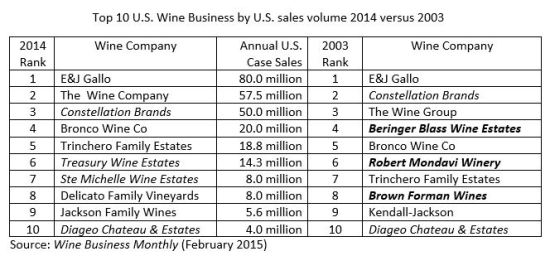
Wine is one exception to the dominant corporation rule. Here (above) is a table of the ten largest wine businesses in the U.S. market (measured by estimated or reported volume not value of sales) for 2014 and 2003. The data are from Wine Business Monthly, which publishes an analysis of the 30 biggest U.S. wine firms each February.  I’m looking at just the top ten to keep the analysis simple, although I should note that these ten firms collectively account for about three-quarters of all wine sold in the U.S.

Looking at the 2014 data, you will note that only four of the top ten firms (those in italics) are public corporations or subsidiaries of public corporations. The other six are family-owned or, like The Wine Group, privately-held and together they produce more than half of all the wine sold in America. [editors note: There was a typo in te graph, which should list The Wine Group not The Wine Company.] The bias towards private- and family-ownership is even stronger if we look at the next 20 wineries where only a few corporate names like Pernod Ricard make the list.

Looking closely at the 2014 numbers it is hard not to be impressed by the growth of family firms Delicato and Jackson Family Estates and also the success of Ste Michelle Wine Estates, which seems to behave like a privately-held firm even though it is a subsidiary of a public one, albeit in a different line of business (Altria specializes in tobacco products, not drinks).

All in the Family

Family- and private-owned wine companies are if anything more important today than they were before the Great Recession. Why are family-owned wineries so vibrant despite their structural economic limitations?

The conventional answer to this question — and there is in fact a substantial academic literature dealing with family businesses and even family wine businesses — stresses the ways that family businesses take a multi-generational approach and are able to negotiate the trade-off between short run returns and long run value. Corporations, it is said, are sometimes driven too much by quarterly returns and end up sacrificing the long term to achieve immediate financial goals.

When business requires a long run vision, it is said, families gain an advantage. Wine is certainly a business where it is necessary to look into the future if only because vines are perennials not annuals like corn or soybeans and successful brands are perennials, too.

Another school of thought examines issues of trust and transactions costs within the firm and the ways that family ties can reduce internal barriers and make interactions more effective.  It is commonplace to say that wine is a relationship business and family firms may have advantages in this regard. I have knows some family wine businesses that even go out of their way to work with family-owned distributors and so forth.  I think one author saw family-to-family links (the Casella family and the Deutsch family) as keys to the success of Yellow Tail brand wine.

Maybe the Real Question Is …

There are good explanations for the success of family-owned wine businesses, but sometimes they feel a bit ad hoc, tailored to explain a particular case and less capable of generalization.  And they often fail to fully account for the fact that many family businesses (and family-owned wine businesses) either fail or, like the Taylor family, end going over to the dark corporate side. Family relationships can be good, bad or ugly — you cannot think of the Mondavi family story without channeling an episode of Family Feud) and not every new generation wants to stay in the business. So there must be something more here than simple families think long-term. But maybe we are actually asking the wrong question.

Maybe the question isn’t why family-owned wine businesses are so strong and instead why corporate owned wine businesses are sometimes so ineffective. Is there something about wine that turns smart corporate brains to mush (not all of them, of course, but maybe some of them)? Come back next week for some thoughts on this provocative question.

The Curse of Corporate Wine-Think?

 May 12, 2015

Protecting Assets versus Leveraging Them

One difference that I have noticed about family wine businesses versus some of the corporations regards the role of key assets such as brand and reputation.  Many family wineries that come to mind seems to see their role as protecting brand and reputation so that they will continue to provide benefits well into the future. Some corporations that come to mind, on the other hand, seem to focus on leveraging brand and reputation in order to increase short run returns.

What’s the problem with leveraging a brand? Leverage has the potential to increase returns in any business, but it also increases risk. And one risk is that the integrity of key assets can be undermined by the leverage process itself.

An example? Well, I hate to pick on Treasury Wine Estates because they have seen enough bad news in the last few years, but one of my readers emailed me in dismay when a news story appeared about Treasury’s latest market strategy. I’ll use this as an example, but Treasury isn’t the only wine corporation that I could pick on and maybe not even the best example

One element of Treasury’s plan is to develop brands for the “masstige” market segment, which means taking a prestige brand and levergaing it by introducing a cheaper mass market product that rides on the iconic brand’s reputation. 

Masstige? Sounds like something from a Dilbert cartoon, which means of course that it is a totally authentic contemporary business term. Prestige fashion house Versace, for example, seems to have developed a masstige product line for mass market retailer H&M. The line was launched in 2011 and I’m not sure where it stands today. Maybe it was a big success? If  masstige  worked for shoes and dresses, how could it be a bad idea for wine?

I’m sure a prestige association helps sell the cheaper mass market products, but I can think of some examples in the wine business (Paul Masson? Beringer?  Mondavi?) where it might have undermined the iconic brand itself a little or a lot, which seems self-defeating. I know that has happened in the fashion field (think about how the Pierre Cardin brand was diluted by cheap logo products) so I imagine it could be a factor in wine, too.

Think Global, Source Global

Here’s another example. Regional identity is more important in wine than in some other industries and Treasury owns some famous “wine of origin” brands — wines associated with particular regions, which are valuable assets.  But my worried reader was concerned about Treasury’s plan to source globally to expand the scale of some of these regional brands.

“Building scale via sourcing breadth is one of the most critical platforms necessary for the globalization of wine brands,” according to the report. Gosh, that even sounds like corp-speak, doesn’t it? Logical, I suppose, but maybe locally-defined brands need to be locally sourced to maintain authenticity? Maybe consumers would be suspicious of a Stags Leap wine, to make up an example, that is sourced from Australia or some other distant place as a way of leveraging its brand power? I wonder just how flexible these terroir-based brand concepts are in the real world where consumers are the ones who decide what is authentic and what is bogus.

Global Market Moral Hazard

Some big wine corporations that have had troubles in recent years seem to have made the mistake of thinking that big global markets will soak up all that they (and the other big firms) can produce. It’s a matter of global-think. The global markets are huge. There’s always a market for another dozen containers somewhere in the big world of wine, or so it might seem, and so the risk of failure is misunderestimated, to use a GW Bushism.

In finance we would say that the false sense that the global market is always there to bail you out leads to moral hazard and this is probably true in wine, too.  Moral hazard encourages excessive investment and promotes booms and the busts that often follow. What seems to be true for an individual company is not necessarily true for an industry and misunderstanding this sort of risk is downright dangerous in an industry like wine, which is by its nature subject to cycles and booms and busts.

If private- and family-firms avoid the tendency to think global when their markets are local and thus avoid misunderestimating risk and if they really do work to preserve rather than leverage key assets it might help explain their lasting power and influence. Lots of “ifs” there, but its a theory. What do you think?