 Aimé Guibert and Robert Skalli — these were the key protagonists in my analysis of globalization and wine in the Languedoc in my 2011 book Wine Wars. Both Guilbert and Skalli revolutionized Languedoc wine, but in different ways. And they had different opinions of globalization, too.
If I were writing a second edition of Wine Wars today (readers: do you think I should?) I would add a third name — a champion of Languedoc wine who is revolutionizing it in another way today. That name is Gérard Bertrand. Here’s the story.
Mondovino meets Mondavi-no
Aimé Guibert starred as one of the heros of the 2004 anti-globalization wine documentary Mondovino (flying winemaker Michel Rolland was one of the villians!). Guibert helped revolutionize Languedoc wine at his estate Mas de Daumas Gassac Working with Emile Peynaud and others, Guibert produced exceptional wines that changed the way that many viewed the Languedoc and its potential for fine wine. An impressive achievement and a great story.
That’s not the story that Mondovino told, however. The film was more interested in his opposition to Robert Mondavi’s plans to invest in the Languedoc and produce large quantities of branded varietal wine to be sold around the world. The local uproar eventually discouraged Mondavi, who turned his attention elsewhere. Did Guibert and his activist colleagues win? Mondavi was gone, but not the market strategy he represented.
That’s because, as I argued in Wine Wars, Robert Skalli was already at work to revolutionize Languedoc wines in a Mondavi-esque way. Skalli met Mondavi in California and was inspired by both his modern wine-making and by his marketing strategy, which focused on easy-to-understand varietal labels rather than sometimes-obscure appellations. Skalli was so impressed that he opened his own Napa winery (St. Supery, sold a few years ago to French icon Chanel) and invested in clean, modern, market friendly varietal wines at home including especially the popular brand Fortant de France.
Skalli embraced globalization just as Guibert shunned it, but they both drove change in a region that surely needed it and helped set the stage for the emergence of the new Languedoc wine world that Sue and I discovered during our recent visit. They also helped pave the way for the Languedoc’s current global market champion, Gérard Bertrand.
Celebrity Wine?

It didn’t take long for Gérard Bertrand’s name to come up. We landed in Toulouse and on the road to our hotel in Carcassone our well-informed driver pointed to a vineyard on the right and said that he’d been there the day when the crowds gathered and a helicopter descended carrying Bertrand and his special guests, rocker Jon Bon Jovi and his son. Bon Jovi is famous for his music. Bertrand is possibly more famous (at least in this part of France) for his exploits for club and country on the rugby field.
Sport, music, and wine — a potent mix! Bertrand’s father was in both businesses– wine and rugby. Besides running the family estate he was a professional referee; his son learned both disciplines from the earliest age.
The helicopter gathering was the launch of a joint Bon Jovi-Bertrand project — a Rosè wine called Diving into Hampton Water. A limited edition celebrity wine, for sure, its first vintage sold out on allocation in short order. The wine lists for $20-$25 here in the U.S. when you can find it.
I don’t know much about Diving into Hampton Water, which has received mixed reviews, but I’m pretty familiar with another Gérard Bertrand Rosé, the Cotes des Roses pictured above. It’s a lovely wine in a distinctively graceful bottle that is easily found on the shelves of upscale supermarkets and even in Costco bins in my region. There is a red and a white wine in the Cotes des Roses portfolio, according to the website, but I see only the pink one in my market.

You can think of the Cotes des Roses as an upscale evolution of the Robert Skalli idea of Languedoc wine. It is a wine made for the market, that represents the Languedoc very well, but does so by reaching out to consumers with a clear image and strong brand. That’s kind of how I thought of Gérard Bertrand wine at the start of my visit — and the Bon Jovi connection reinforced that perspective. But I soon learned that there is a good deal more.
The first formal masterclass in Carcassone was devoted to tasting a cross section of Cru du Languedoc wines and one of the favorites was the Gérard Bertrand 2011 La Forge. This was very different from Cotes des Roses — it was a serious wine of origin and it made me rethink the whole Bertrand project. Bertrand is Cotes des Roses and Hampton Water, but it is also a collection of very well made wines that celebrate and explore the multiple regions and terriors of Languedoc and Roussillon, Gérard Bertrand’s home (he first played rugby for Narbonne).
 Ambassador Bertrand
Bertrand’s wines appeared twice more in our program, reinforcing this more complex view. Tasting through a lineup of Crèmant de Limoux sparkling wines, I stumbled across Gérard Bertrand Cuvée Thomas Jefferson. Jefferson fell in love with Crèmant de Limoux when he was U.S. ambassador to France and championed the wine, shipping quantities back home to Virginia.
Bertrand’s bottling honors the appellation and its historic connection to Jefferson. I was beginning to think of Gérard Bertrand as more of an ambassador (like Jefferson) of the Langeudoc than a simple celebrity. His project includes many of these terroir wines that together paint a picture of the region.
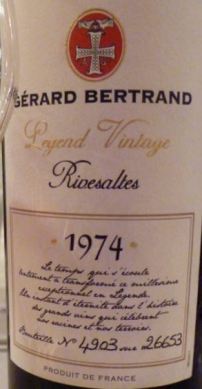
Then, at a gala dinner at Château de Pennautier, we were served a lovely mature sweet wine, the 1974 Gérard Bertrand Legend Vintage Rivesaltes. What a wine! And a wonderful tribute to this appellation. The Legend Wine series includes select Rivesaltes vintages going back to 1875! Bottled history.
I’ve Got a Little List
And so I think you can see why I have added Gérard Bertrand to my Languedoc icons list. He seems determined to push Languedoc forward, but not just in one direction and always with an eye on his roots. A fine ambassador indeed.
Every emerging wine region needs a brand ambassador to help break into the market and get attention. Napa had Mondavi, for example. Strong brands, if linked to time and place, can open doors a bit wider. As Languedoc and Roussillon re-emerge in their contemporary form, effective ambassadors like Bertrand are especially important.
Languedoc has many faces and these three tell a story of the ways that the region has changed to adapt to new market conditions. Bertrand’s complex inks to and respect for the past make him a particularly interesting addition to my little list. But there are many more faces to consider — you should pull some corks and see for yourself.
>><<<
The Wine Economist will pause for a couple of weeks while Sue and I are in Italy. We’ll visit old friends in Bologna (I taught at the Johns Hopkins/SAIS Center there years ago) and tour Eataly World before heading to Forte dei Marmi, where I’m speaking about Money and Wine at VinoVIP on June 18.
 Wine tourism is an increasingly important element of wine marketing and sales as both authenticity and identity grow as ways to differentiate products in today’s incredibly crowded and competitive global market. Nothing like the personal experience that wine visitors often receive to turn customers into ambassadors.
 Chinese visitors are especially important for Australia. Proximity is one factor, of course, but wine market strategy is another. China is now Australia’s #1 wine export market, surpassing both the U.S. and the U.K.
 Sue and I recently returned from a press tour to three French wine regions — Languedoc, Roussillon, and the Loire Valley — that are benefiting from the current surge in demand for French wines in the U.S. market. As I
 Now I am not going to say that cheap wine production has disappeared, but the momentum has decidedly shifted to better wines made with more marketable grape varieties such as Grenache, Syrah, and Mourverde along with standbys like Carignan.
 When we arrived at
 What do you think of when you think of French wine? If you are like most people, your thoughts probably stray to the iconic regions of Burgundy, Bordeaux, and Champagne. These regions and their wines are fundamental to the way we understand U.S. French wine and wine generally.

 There is a big world of American wine out there, full of surprises. Wine is made in all 50 states, so “Support your local wine industry” is practical advice. Sometimes this requires you to head off the the vineyards, but sometimes they can come to you. Case in point … the booming Boise, Idaho wine scene.


 I was busy this winter speaking at national and regional wine industry gatherings here in the United States: the